
 English
 Arabic
 Chinese (Simplified)
 Dutch
Dutch French
 German
 Italian
 Portuguese
 Russian
 Spanish
How adults learn best is not the same as how children learn in school.
That is where many courses get it wrong.
Adults do not arrive as blank pages.
They arrive with years of experience, old knowledge, work habits, confidence issues, responsibilities, and opinions about what learning should feel like.
Some adults have studied before.
Some stopped years ago.
Some remember more than they think.
Some have gaps they cannot see.
Some are motivated, but tired.
Some want to improve, but do not know where to start.
So when adult education uses the same fixed approach for everyone, progress becomes harder than it needs to be.
Adults do not always need more lessons.
They need learning that respects where they are now.
The Question Is Not “Can Adults Learn?”
Of course adults can learn.
The better question is:
What makes learning actually work for adults?
That question matters because many adults return to learning with pressure already attached.
They may need new skills for work.
They may want better opportunities.
They may feel embarrassed about starting again.
They may believe they are slower than they used to be.
But adult learning is not about being young or fast.
It is about using the right method.
A good adult learning system should not ask adults to fit into a school-style structure that no longer matches their lives.
It should build around the way adults actually learn.
Adults Learn Best When the Learning Has a Clear Reason
Adults usually want to know why they are learning something.
Not in a disrespectful way.
In a practical way.
They are asking:
Will this help me at work?
Will I use this soon?
Is this solving a real problem?
Is this worth my time?
That question is important.
If the reason is clear, adults pay attention differently.
If the reason is weak, motivation drops quickly.
This is why adults often respond better to learning that connects to real situations.
A lesson that feels useful today is easier to remember tomorrow.
A lesson that feels disconnected becomes harder to care about.
Adult Learning Australia describes adult learners as self-directed and independent, with a preference for choice and learning goals they can manage themselves. That supports the idea that adults need learning to feel purposeful, not random.
The Best Adult Learning Starts With What the Student Already Knows
A child may be learning something for the first time.
An adult often is not.
Adults bring prior experience into the lesson.
That experience can help them learn faster.
It can also hide old mistakes.
For example, an adult may have studied a subject years ago and remember the basics.
They may not need to start from zero.
But they may also have weak areas that were never corrected properly.
This is why starting point matters so much.
If an adult is placed too low, they feel bored.
If they are placed too high, they feel discouraged.
If their prior learning is ignored, they waste time.
If their gaps are ignored, they keep struggling.
A better approach is to ask:
What does this learner already know?
What do they only recognize?
What can they actually use?
What needs to be refreshed?
What needs to be corrected?
That is where adult learning becomes more accurate.
What Adults Think They Need vs What They Often Need
| What Adults Often Ask For | What They May Actually Need |
|---|---|
| More lessons | A clearer starting point |
| More information | Better feedback |
| More time | A more flexible learning path |
| More motivation | More visible progress |
| More practice | More targeted practice |
| A harder course | The right level, not just more difficulty |
This is one reason adults can work hard and still feel stuck.
The effort may be real.
But if the learning is not precise, effort gets wasted.
Adults Learn Best When They Can Use the Skill Quickly
Theory has a place.
But adults usually learn better when theory connects to action.
They need to try the skill.
Test it.
Make mistakes.
Get feedback.
Use it again.
That cycle is where learning becomes stronger.
A lesson that only explains can feel clear in the moment, but fade later.
A lesson that makes the student use the skill gives the brain something stronger to hold onto.
This is why practical learning matters.
Adults often remember better when they can connect new knowledge to a real task, decision, problem, or workplace situation.
They do not need learning to be entertaining.
They need it to be usable.
Feedback Is Not Extra Support. It Is Part of Learning.
Adults need feedback because they cannot always see their own gaps.
They may know something is wrong, but not know exactly what.
They may repeat the same mistake without realizing it.
They may feel slow, when the real problem is one missing step.
Good feedback does more than correct.
It explains.
It shows the learner:
- what happened
- why it happened
- what to practise next
- whether the mistake is repeated
- how to apply the correction
The Education Endowment Foundation describes feedback as information given to learners about performance in relation to learning goals, with the aim of improving outcomes.
That matters because adult learners often have limited time.
They cannot afford to practise the wrong thing for months.
Feedback helps them focus.
How Adults Learn Best When Life Is Already Busy
Adult learning has to compete with real life.
Work does not pause.
Family does not pause.
Stress does not pause.
Responsibilities do not pause.
That is why adult learning needs to be flexible without becoming loose or directionless.
Flexible learning does not mean easy learning.
It means learning can continue when life is imperfect.
An adult may miss a few days and return.
They may need shorter learning sessions.
They may need to move faster through material they already understand.
They may need extra support in one weak area.
OECD notes that more than two in five adults who do not participate in training say they lack time because of work or family commitments.
That point is important.
If learning is designed only for people with perfect schedules, it is not really designed for adults.
Adults Need to See Progress Before the End
Many courses make progress feel too far away.
Finish the module.
Finish the level.
Finish the course.
Then see the result.
But adults need signs of progress earlier than that.
They need to see that something is changing.
A mistake happens less often.
A task feels easier.
A sentence becomes clearer.
A response comes faster.
A concept finally makes sense.
Small progress matters because it keeps the learner moving.
Without visible progress, adults start to question the value of the learning.
They may still be improving, but if they cannot see it, motivation drops.
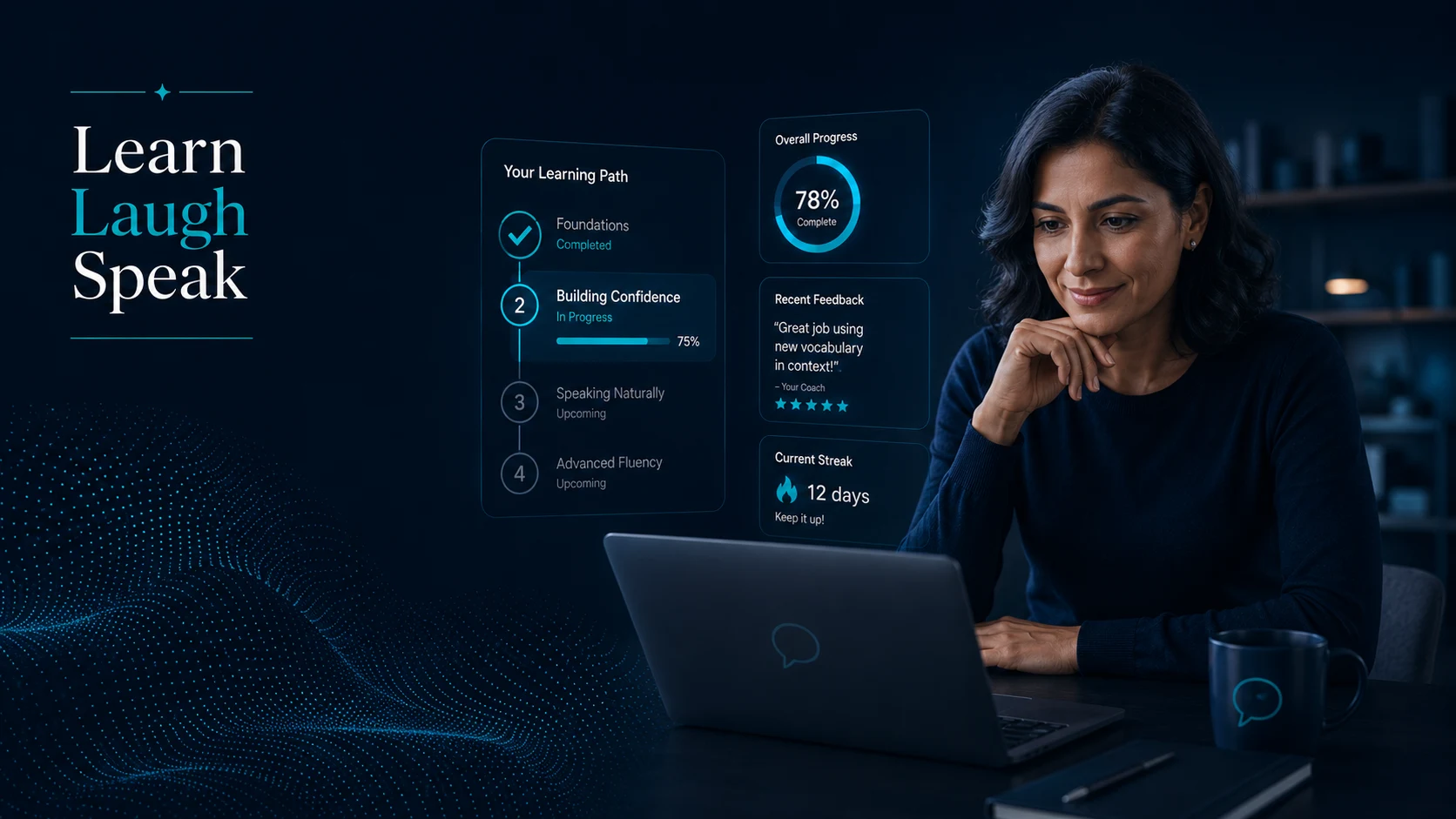
This is why progress tracking, feedback, and clear goals are so useful for adult learners.
They make improvement easier to notice.
The Role of Self-Direction in Adult Learning
Adults usually do not want to be treated like passive students.
They want some control.
That does not mean they want to design the whole course themselves.
Most still need structure.
But they want learning to respect their goals, time, experience, and decisions.
Self-direction can look like:
knowing why the lesson matters
choosing when to study
understanding what skill comes next
seeing progress clearly
receiving feedback that explains the path forward
OECD’s work on adult learner profiles shows that adults participate in learning for different reasons and face different barriers, including personal goals, practical barriers, and how they view the value of learning.
That is why one adult learning path cannot serve everyone equally.
The reason for learning changes the way adults engage.
The Simple Formula for How Adults Learn Best
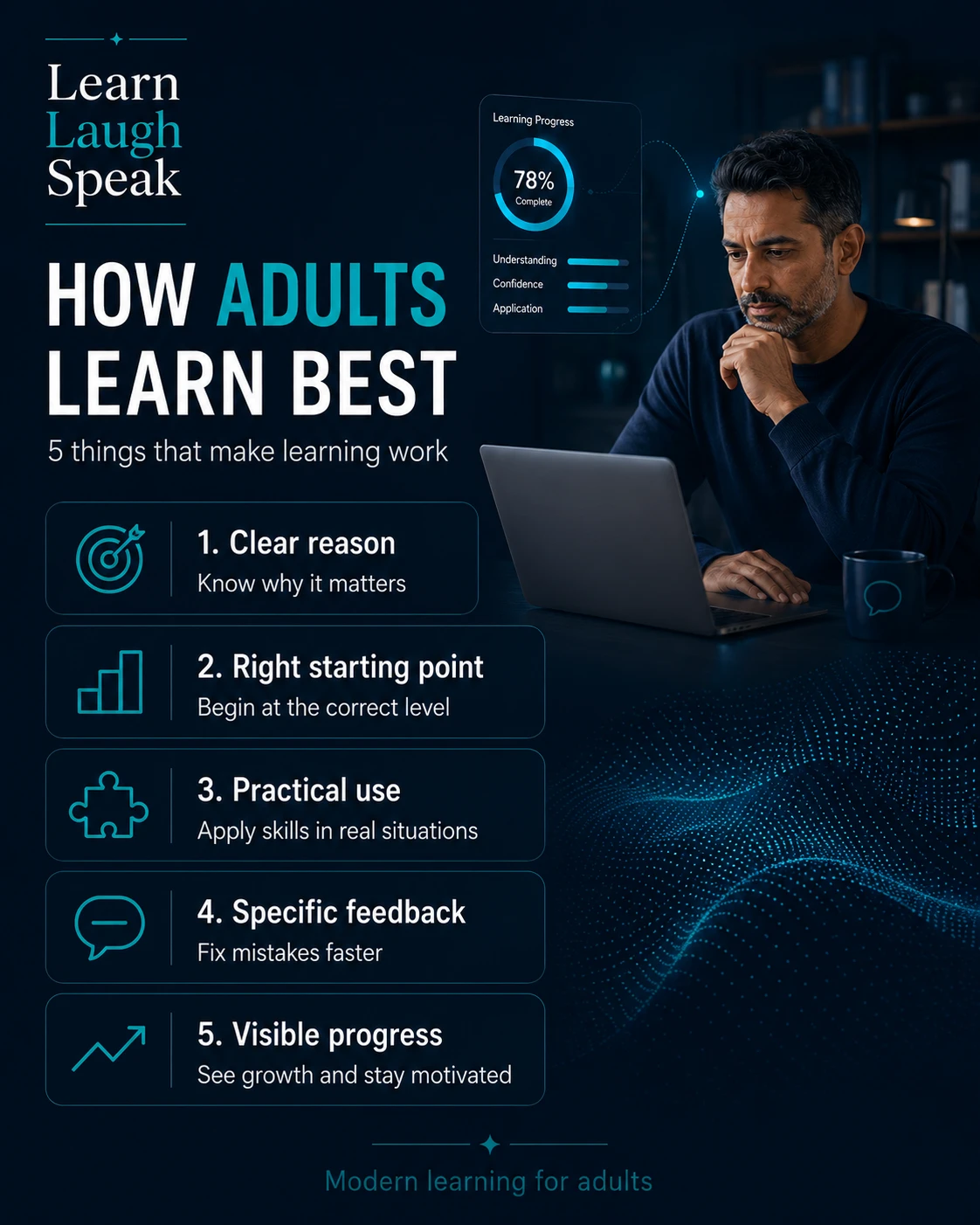
A strong adult learning experience usually includes five things:
1. A clear reason
The learner understands why the skill matters.
2. The right starting point
The learner is not placed too low or too high.
3. Practical use
The learner applies the skill, not only studies it.
4. Specific feedback
Mistakes become useful information.
5. Visible progress
The learner can see improvement before motivation fades.
When these five things are missing, adults often struggle.
When they are present, learning feels more realistic.
Not always easy.
But realistic.
Why Modern Education Needs a Different Approach
Modern education cannot only be about delivering content.
Content is everywhere.
Adults can find videos, articles, apps, courses, AI tools, and explanations in seconds.
The problem is no longer access to information.
The problem is knowing what information matters, where to start, what to practise, and how to keep improving.
That is why modern education needs to become more precise.
Adults need learning that can identify their level, respect prior knowledge, find gaps, support practice, and adjust based on progress.
OECD’s 2025 adult learning report focuses on participation, barriers, delivery, and ways to improve accessibility and effectiveness in adult learning systems.
That direction fits what many adult learners already feel.
They do not want endless content.
They want learning that helps them move forward.
How Learn Laugh Speak Connects to How Adults Learn Best
At Learn Laugh Speak, adult students do not begin from a random lesson.
They start with a level assessment so the platform can understand where they are now.
That matters because adults arrive with different learning histories.
Some have prior experience.
Some have hidden gaps.
Some can move faster through areas they already understand.
Some need more support because repeated mistakes are slowing them down.
From there, each student follows a personalized learning path based on their level, progress, mistakes, and needs.
This connects directly to how adults learn best.
Adults learn better when the path is clear.
They learn better when the starting point is correct.
They learn better when feedback shows what to fix.
They learn better when progress feels personal and visible.
For adult English learners, this means they are not simply completing lessons.
They are building skills they can use in real situations.
What Adult Learners Should Remember
Adults do not need to learn like children.
They do not need to start from zero unless zero is really their starting point.
They do not need more content if the problem is unclear feedback.
They do not need harder lessons if the real issue is a hidden gap.
They do not need to feel embarrassed about returning to learning.
Adult learning works best when it respects the learner’s real life.
That means experience matters.
Time matters.
Motivation matters.
Feedback matters.
Relevance matters.
And the starting point matters more than many people realize.
Final Thought on How Adults Learn Best
How adults learn best depends on more than motivation.
Adults learn best when learning is relevant, practical, flexible, personal, and supported by clear feedback.
They need to know why the lesson matters.
They need to start from the right place.
They need to use what they learn.
They need to see progress.
And they need a learning path that respects the life and experience they already bring with them.
That is why modern education needs a different approach.
Not more content for everyone.
Better learning for each adult.
Still unsure on how adults learn best after reading this? Send us a message as we help thousands of adults, teams and professionals learn English quickly and correctly.
2 thoughts on “How Adults Learn Best: Why Education Needs a Different Approach”
Pingback: Mastering Technical English for Worm Gear Design: 3 Key Terms That Prevent Errors - Learn Laugh Speak
Pingback: Why Adults Forget Learning Even When They Study Hard - Learn Laugh Speak