
 English
 Arabic
 Chinese (Simplified)
 Dutch
Dutch French
 German
 Italian
 Portuguese
 Russian
 Spanish
Adult learning support matters because adults do not always need more content.
They often need better direction.
That is the part many courses get wrong.
When an adult student struggles, the usual answer is often:
Do another lesson.
Watch another video.
Practise more.
Spend more time.
Sometimes that helps.
But not always.
If the student is in the wrong level, more lessons will not fix the problem.
If they keep repeating the same mistake, more content may only hide the gap.
If they are learning around work and family, a longer course may make progress feel even harder.
Adults do not need endless lessons.
They need support that helps them understand where they are, what is missing, and what to do next.
That is the difference between studying more and improving better.
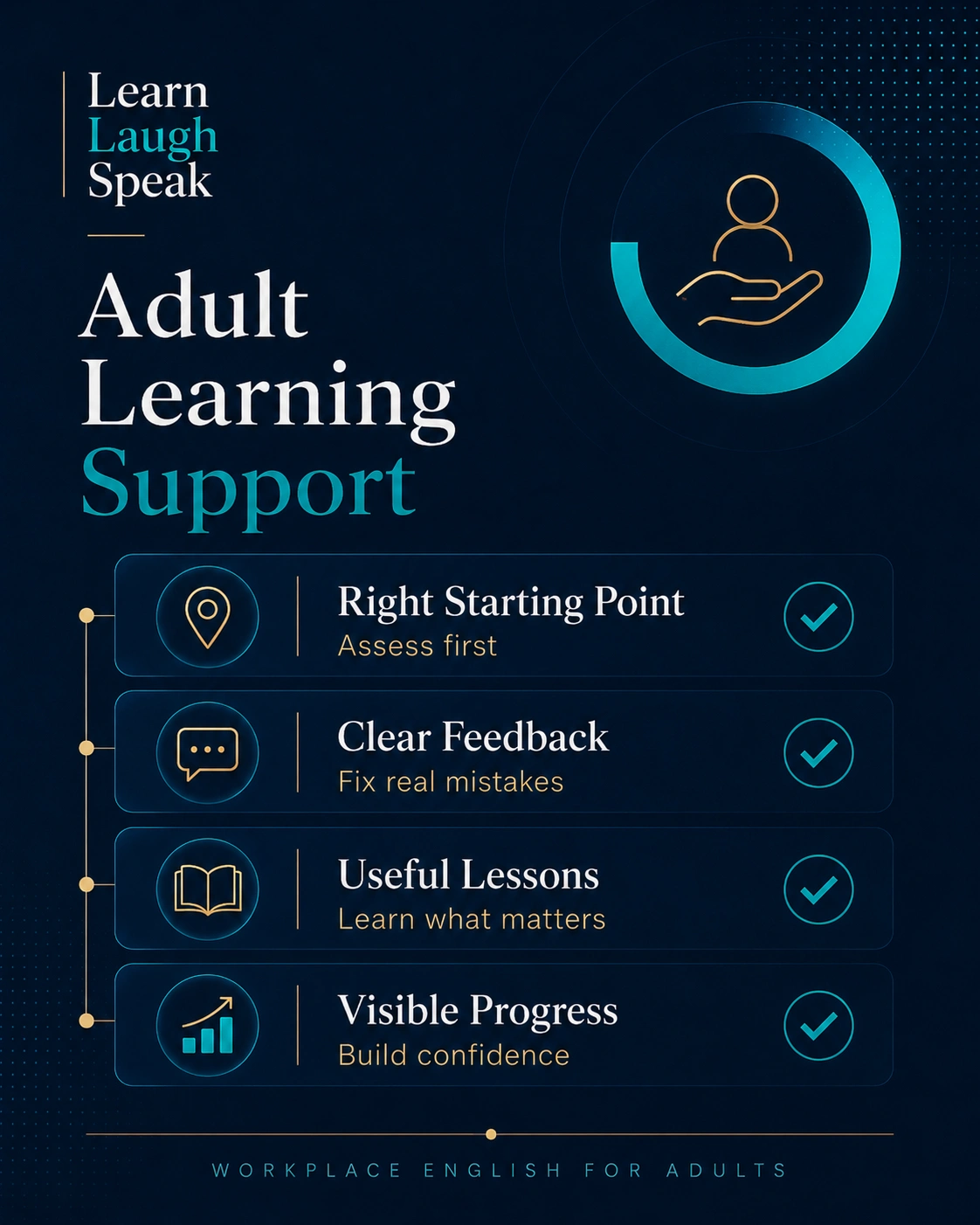
More Lessons Can Feel Productive Without Solving the Problem
A lot of adult students are hard workers.
They are not lazy.
They are not careless.
They want to improve.
So when progress slows, they often blame themselves and try to do more.
More grammar.
More vocabulary.
More videos.
More apps.
More practice.
But if the learning problem is specific, general study can become frustrating.
A learner may spend hours reviewing vocabulary when the real issue is sentence structure.
They may watch speaking videos when the real issue is confidence under pressure.
They may repeat a grammar topic they already understand, while missing the small mistake that keeps appearing in real use.
This is where adult learning support becomes important.
Support helps the learner stop guessing.
It helps them focus.
The Support Gap Adults Often Feel
Adult students usually know when something is not working.
They can feel it.
They understand the lesson, but still make mistakes.
They study regularly, but still feel slow.
They complete exercises, but still struggle in real situations.
They start strong, then lose consistency.
The problem is that they do not always know why.
That is the support gap.
It is the space between:
“I know I need to improve.”
And:
“I know exactly what to practise next.”
Many adults are stuck in that space for a long time.
They are trying.
But they are trying without enough guidance.
Adult Learning Support Starts With the Right Starting Point
The first form of support is accurate placement.
If the starting point is wrong, the whole learning journey becomes harder.
Too easy, and the learner gets bored.
Too hard, and the learner loses confidence.
Too general, and the learner feels unseen.
Adult learners often have uneven skills, especially in English.
One person may read well but struggle to speak.
Another may speak confidently but write with repeated mistakes.
Another may have studied years ago and still remember parts of the language, but not enough to use it naturally.
A simple level label does not always show the full picture.
Support starts by asking a better question:
Where is this learner actually starting from?
Not where a course assumes they should start.
Where they are now.

Why Adults Need Feedback That Explains the Problem
Feedback is one of the most useful forms of support.
But it has to be clear.
A mark, score, or red correction is not always enough.
Adults need feedback that explains:
what happened
why it happened
whether it keeps happening
what to practise next
how to use the correction in real life
The Education Endowment Foundation describes feedback as information given to learners about their performance in relation to learning goals, with the aim of improving learning outcomes. It also identifies feedback as a high-impact approach when used well.
That matters for adults because time is limited.
They cannot afford to practise the wrong thing for months.
Good feedback saves time because it turns a mistake into a direction.
A Real Example: The Student Who Keeps Making the Same Mistake
Imagine an adult English learner who keeps writing:
“I am agree.”
They may already know the word agree.
They may understand the sentence when corrected.
They may even remember being taught this before.
But the mistake keeps returning.
More lessons may not solve it unless the feedback is specific.
The learner needs to understand:
“Agree” is already a verb.
You do not need “am” before it.
The correct sentence is: “I agree.”
Now practise it in real workplace sentences.
That is support.
Not just correction.
The difference matters.
Correction says what is wrong.
Support helps the student stop repeating it.
Adult learning motivation usually starts with a good reason, find your reason with us!
What Adult Learning Support Should Actually Include
Adult learners need support that is practical, not complicated.
| Adult Learner Problem | Useful Support |
|---|---|
| “I do not know where to start.” | Accurate level assessment |
| “I keep making the same mistake.” | Specific feedback and targeted practice |
| “I understand but cannot use it.” | Real-world application |
| “I lose motivation quickly.” | Visible progress and small wins |
| “I studied before.” | Recognition of prior learning |
| “I do not have much time.” | Flexible learning structure |
| “I need this for work.” | Practical, relevant lessons |
This is why support is not only emotional encouragement.
It is learning design.
The right support helps adults use their time better.
Adults Need Support Because Their Learning Lives Are Not Simple
Adult learners do not all arrive with the same situation.
Some are returning after years away from study.
Some need English for work.
Some are learning because their role has changed.
Some want confidence in meetings.
Some need stronger writing.
Some feel embarrassed about mistakes.
Some have strong prior learning but weak active use.
The OECD’s work on adult learner profiles explains that adults take part in learning for different reasons and face different barriers, including personal goals, practical barriers, and how they view the value of learning.
That is why support needs to be more personal.
A generic course may explain the same lesson to everyone.
But adults do not always need the same explanation.
They need the right next step.
Support Helps Adults Stay Consistent
Consistency is one of the hardest parts of adult learning.
Not because adults lack discipline.
Because life interrupts.
Work gets busy.
Family responsibilities change.
Energy drops.
A week gets missed.
Then the learner comes back and feels behind.
Good support helps adults return without starting again from zero.
The OECD notes that more than two in five adults who do not participate in training say they lack time because of work or family commitments, and highlights the need for flexible adult learning options that reduce participation barriers.
This is important because adult learning needs to survive real life.
A learning system that only works when life is perfect is not really built for adults.

Why Motivation Is Easier When Support Is Clear
Adults often lose motivation when learning feels vague.
They do not know if they are improving.
They do not know why they keep making mistakes.
They do not know if they are at the right level.
They do not know what to focus on next.
That uncertainty drains motivation.
Support gives the learner something more useful than inspiration.
It gives clarity.
A student who knows what to fix is more likely to continue.
A student who sees progress is more likely to continue.
A student who feels the lesson is relevant is more likely to continue.
This is why adult learning support is closely connected to motivation.
People keep going when the path makes sense.
Adult learning barriers are not always obvious, but the motivation is easier when your support is one click away.
Support Is Not the Same as Making Learning Easy
There is a common misunderstanding.
Some people think support means making learning easier.
It does not.
Good support can actually make learning more challenging in the right way.
It directs effort toward the weak area.
It shows the learner what they are avoiding.
It makes repeated mistakes visible.
It pushes the student forward when they are ready.
Support is not about lowering standards.
It is about helping adults reach the standard more efficiently.
That is very different.
Why Adult Learning Support Matters in Workplace English
Workplace English makes support especially important.
At work, English is not just a subject.
It is something adults need to use.
Emails need to be clear.
Meetings need to be understood.
Questions need to be answered.
Mistakes can affect confidence.
Misunderstandings can slow work down.
This is why adult English learners need more than general English lessons.
They need support that connects language to real situations.
For example:
How do I say this professionally?
Why does this sentence sound unnatural?
What mistake do I keep making in emails?
How can I speak more clearly in meetings?
What should I practise next?
These are practical questions.
They need practical support.
Digital Learning Only Works When Support Is Built In
Digital learning is useful, but it is not automatically supportive.
A video library is not support.
A long list of exercises is not support.
A course that gives every adult the same path is not truly personal.
Digital learning becomes powerful when it can respond to the learner.
That means tracking mistakes.
Showing progress.
Adjusting the path.
Helping students focus on the exact areas they need.
UNESCO’s Institute for Lifelong Learning describes learning for and at work as an important part of adult education and lifelong learning, with learning taking place across formal, non-formal, and informal settings.
That fits the reality of modern adult learning.
Adults learn in many places.
At work.
Online.
At home.
Through mistakes.
Through practice.
Through feedback.
Support helps connect all of that into a clearer journey.

How Learn Laugh Speak Provides Adult Learning Support
At Learn Laugh Speak, adult students do not begin from a random lesson.
They start with a level assessment so the platform can understand where they are now.
That matters because adult students arrive with different histories.
Some have prior learning experience.
Some have hidden gaps.
Some need workplace English.
Some need stronger writing.
Some need more speaking confidence.
Some can move faster because they already know parts of the level.
From there, each student follows a personalized learning path based on their level, progress, mistakes, and needs.
This helps provide adult learning support in a practical way.
Students learn what they need, when they need it.
They do not waste time repeating everything they already know.
They also do not skip the areas where mistakes are still appearing.
For adults, that matters because progress needs to feel useful.
The goal is not just to complete lessons.
The goal is to build English they can use in real situations.
A Better Way to Think About Support
Adult students should not see support as something they need because they are weak.
Support is not weakness.
Support is structure.
A strong learning system helps adults:
start in the right place
see their progress
understand their mistakes
practise the right skills
return after interruptions
connect learning to real goals
That is what keeps learning moving.
Not pressure.
Not endless content.
Not motivation alone.
Support.
Final Thought
Adult learning support matters because adults do not need more lessons for the sake of more lessons.
They need clearer direction.
They need feedback that explains mistakes.
They need a starting point that matches their real ability.
They need learning that respects their time, prior experience, and goals.
When support is missing, even motivated adults can feel stuck.
But when support is built into the learning journey, progress becomes easier to understand and easier to maintain.
That is why adult learning support should be treated as a core part of modern education, not an extra feature.
3 thoughts on “Adult Learning Support: Why Adults Need Guidance, Not Just Lessons”
Pingback: How Where You Live Impacts Your English Learning Progress - Learn Laugh Speak
Pingback: Future Skills for Adults: What Work Will Expect From You Next
Pingback: Fun Ways to Pass Time When You Can’t Sleep - Learn Laugh Speak