
 English
 Arabic
 Chinese (Simplified)
 Dutch
Dutch French
 German
 Italian
 Portuguese
 Russian
 Spanish
Adult learning barriers are not always obvious.
That is why they are so frustrating.
An adult student can be motivated.
They can want to improve.
They can understand why learning matters.
And still struggle to keep going.
That is the part many learning systems miss.
They treat adult learners as if motivation is the main problem.
But for many adults, motivation is already there.
The real problem is usually something else.
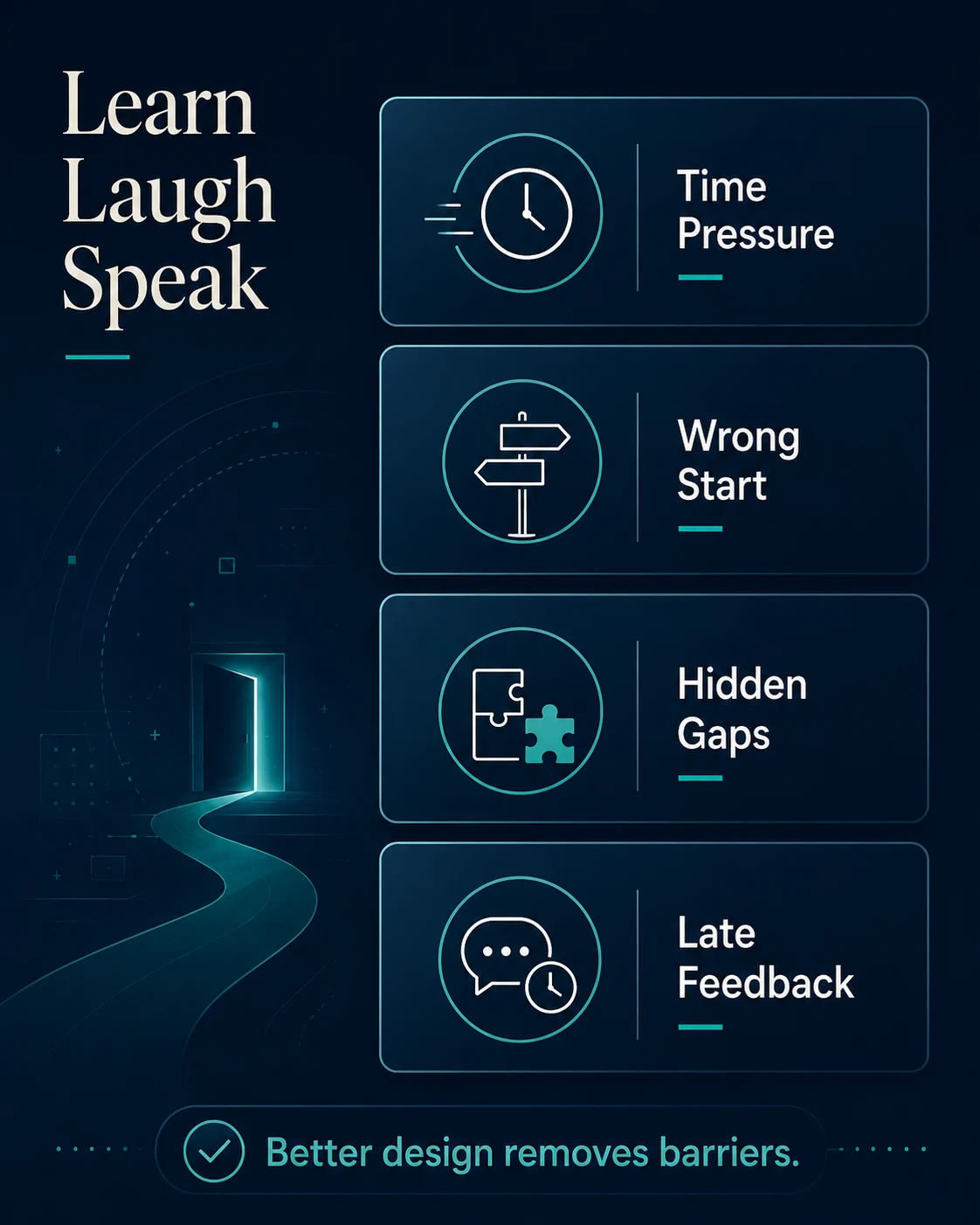
- Time.
- Confidence.
- Wrong starting level.
- Old learning gaps.
- Lessons that feel too general.
- Feedback that comes too late.
- A learning path that does not match real life.
When those barriers are ignored, adult students often blame themselves.
They think:
“I’m not disciplined enough.”
“I’m too slow.”
“Maybe I’m just not good at learning anymore.”
But often, that is not true.
The student is not the problem.
The learning design is.
Pro Tip: Check out this 12 step guide by indeed to improve adult learning in the workplace.

The First Barrier: Learning Has to Compete With Real Life
Adult students are not learning inside a perfect schedule.
They are learning around work, family, stress, travel, business, health, and responsibilities.
That changes everything.
A teenager may study because school is the main structure of their day.
An adult often studies after everything else has already taken energy from them.
That means learning has to be realistic.
If a course expects the same time, same energy, and same focus every week, it may work on paper — but fail in real life.
This is one of the biggest adult learning barriers because it has nothing to do with ability.
It has to do with availability.
OECD research on adult learning shows that lack of time due to work and family responsibilities is one of the most common reasons adults do not participate in training they want to do.
That matters.
Because adults may want to learn.
They may know the value.
But if learning does not fit their life, they stop.
Not because they do not care.
Because the system gives them no easy way to continue.
The Second Barrier: Starting in the Wrong Place
This one is quiet.
But it causes a lot of damage.
Many adult students return to learning after years away and are placed too low or too high.
Too low feels boring.
Too high feels stressful.
Both create the same result:
The student loses trust in the learning path.
This is especially common in English learning.
An adult may understand a lot when reading but struggle when speaking.
They may know grammar but make mistakes in emails.
They may have studied years ago but forgotten parts of what they learned.
So one simple label — beginner, intermediate, advanced — is not always enough.
A good starting point should not only ask:
“What level are you?”
It should ask:
“What can you actually use?”
That is a much better question.
The Third Barrier: Adults Bring Old Learning With Them
Adults are not empty pages.
They bring previous lessons, forgotten grammar, work experience, travel experience, habits, confidence issues, and mistakes that may have stayed with them for years.
Some of that helps.
Some of it gets in the way.
A student may have learned something incorrectly years ago and repeated it ever since.
Another may have strong listening skills but weak writing.
Another may be confident in casual conversation but nervous in professional situations.
This is why adult education needs better diagnosis.
If a learning system ignores what the student already knows, it wastes time.
If it ignores what the student never fully learned, the same mistakes keep appearing.
That is one reason adult learners can feel stuck even when they are working hard.
They are not missing effort.
They are missing precision.
A More Honest View of Adult Learning Barriers
| What It Looks Like | What May Be Happening |
|---|---|
| “I don’t have time.” | The learning path is too rigid |
| “I keep forgetting.” | The skill is not being reused enough |
| “I know this, but I still make mistakes.” | The knowledge is not automatic yet |
| “The course feels too easy.” | The starting point is too low |
| “The course feels too hard.” | Hidden gaps were not found first |
| “I’m losing motivation.” | The learning does not feel relevant enough |
This is why adults need more than content.
They need the right content.
At the right level.
At the right time.
The Fourth Barrier: Lessons Feel Too General
General learning can help at the beginning.
But adults usually need learning to become specific quickly.
They are not always learning for a test.
They are learning because they need something practical.
A better email.
A clearer meeting response.
More confidence speaking.
Better workplace communication.
Fewer repeated mistakes.
If the lesson does not connect to those needs, the adult learner starts asking:
“Why am I doing this?”
That question matters.
Because relevance drives persistence.
When learning feels connected to real life, adults are more likely to continue.
When it feels disconnected, even motivated learners start to fade.
This is one reason one-size-fits-all learning does not work well for adults.
OECD’s work on adult learner profiles shows that adults participate in, or avoid, learning for different reasons, including personal goals, practical barriers, and how they view the value of learning.
That means adult students need learning that understands their situation.
Not just their subject.
The Fifth Barrier: Feedback Comes Too Late
Adults do not have time to practise the wrong thing for months.
This is where feedback becomes essential.
A student may keep making the same mistake and not understand why.
They may feel they are practising, but the mistake becomes stronger because no one corrects it clearly.
Good feedback should show:
what happened
why it happened
whether it keeps happening
what to practise next
That is very different from simply marking something wrong.
The Education Endowment Foundation describes feedback as information given to learners about their performance in relation to learning goals, with the aim of improving learning outcomes. It also identifies feedback as a high-impact approach when used well.
For adult students, feedback is not just helpful.
It is time-saving.
It turns confusion into direction.

The Sixth Barrier: Confidence Drops Before Skill Improves
Confidence is one of the most misunderstood adult learning barriers.
People often treat confidence as something separate from learning.
But confidence is usually connected to repeated experiences.
If an adult keeps making the same mistake, confidence drops.
If they feel placed in the wrong level, confidence drops.
If they study but cannot use what they learn, confidence drops.
And once confidence drops, participation becomes harder.
The learner may avoid speaking.
Avoid writing.
Avoid practising.
Avoid situations where mistakes might appear.
That creates a cycle.
Less practice creates slower progress.
Slower progress creates more doubt.
More doubt creates more avoidance.
This is why adult learning needs safe, accurate progression.
Not pressure.
Not random lessons.
A clear path.
Avoiding learning gaps with a clear plan or path is essential.
The Seventh Barrier: Learning Is Measured by Completion, Not Ability
A lot of adult learning still focuses on finishing.
Finish the lesson.
Finish the module.
Finish the course.
That is easy to track.
But it does not always prove progress.
A student can complete lessons and still struggle to use the skill.
They can pass exercises and still make mistakes in real situations.
They can move through a course and still feel unsure.
Adult learning should ask better questions:
Can the student use this without help?
Can they remember it later?
Can they apply it at work?
Can they correct the mistake next time?
Can they move forward with confidence?
Those questions matter more than completion.
Because adults do not need certificates of effort.
They need usable progress.
Usable progress, easily to see and flexible learning options.
The Eighth Barrier: Learning Does Not Adjust When Life Changes
Adult learning is rarely smooth.
A student may start strong, miss a week, return tired, then feel behind.
This happens all the time.
A rigid course makes that feel like failure.
A better learning system helps the student return without shame.
That means the path should be flexible enough to continue after interruption.
Not restart everything.
Not push forward blindly.
Continue from where the student actually is.
This is where digital learning can help — but only if it is designed well.
A video library is not enough.
A fixed online course is not enough.
The system needs to respond to progress, mistakes, and readiness.
That is what makes learning more useful for adults.
What Better Adult Learning Should Do
A strong adult learning system should reduce barriers instead of adding more.
It should help students:
- start at the correct level
- recognize prior learning
- find hidden gaps
- get feedback quickly
- learn around real-life schedules
- focus on practical needs
- move faster where they are ready
- slow down where support is needed
That does not make learning easy.
It makes learning more accurate.
And accuracy matters because adults usually do not have time to waste.
They need learning that respects what they already know and helps them improve what is actually holding them back.
Also adult learning must adhere to previous prior learning experience, slow progress by relearning and wasting time is going to build a new barrier.
How Learn Laugh Speak Helps Reduce Adult Learning Barriers
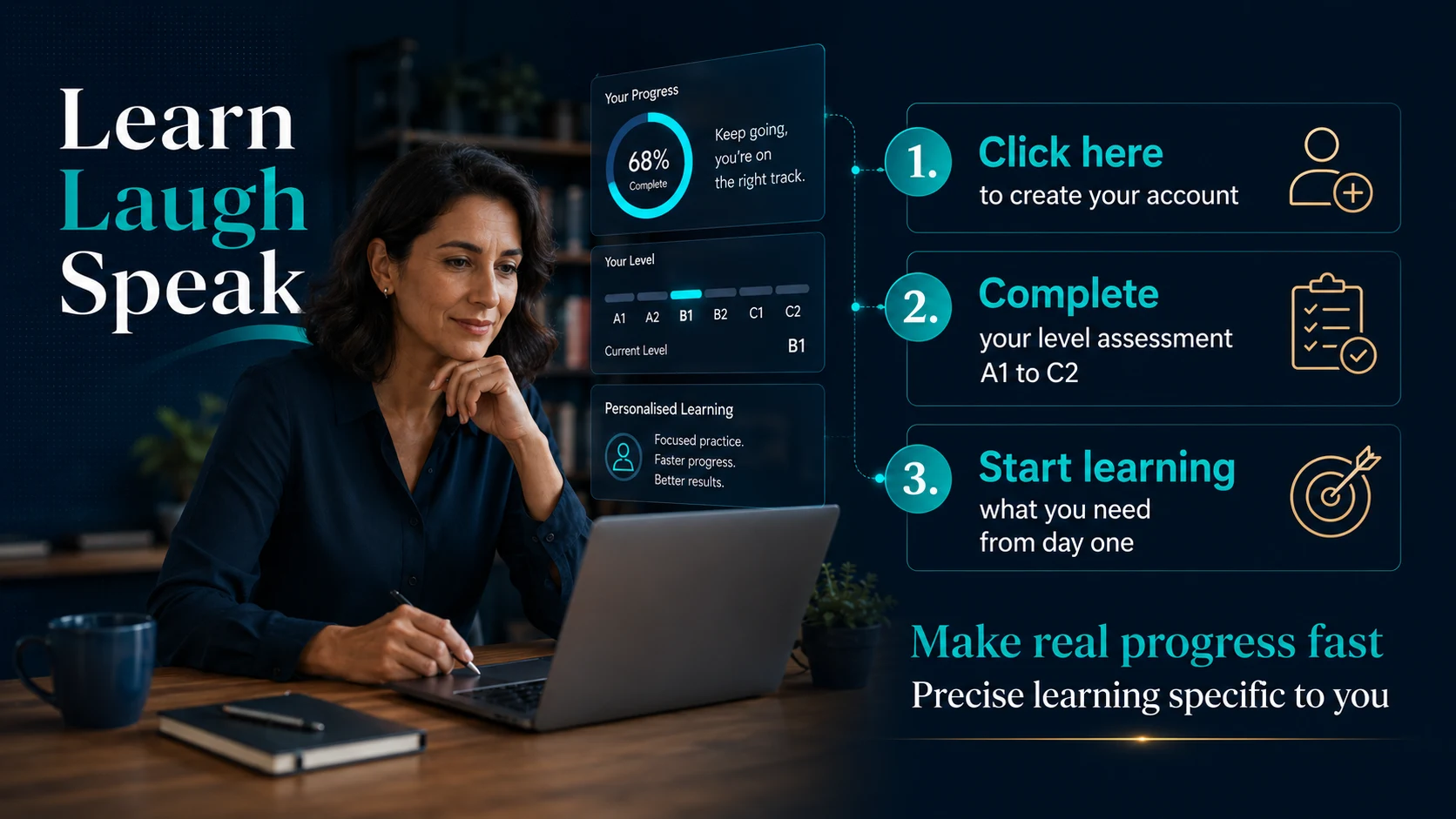
At Learn Laugh Speak, adult students do not begin from a random starting point.
They begin with a level assessment so the platform can understand where they are now.
That matters because adults arrive with different histories.
Some have prior learning experience.
Some have forgotten parts of what they learned years ago.
Some understand English but struggle to use it confidently at work.
Some make repeated mistakes that need targeted correction.
From there, each student follows a personalized learning path based on their level, mistakes, progress, and needs.
This helps reduce common adult learning barriers because students are not forced through the same generic journey.
They learn what they need, when they need it.
They do not waste time repeating everything they already know.
They also do not skip the areas where support is still needed.
That is especially important for workplace English.
Because adults do not just want to “study English.”
They want to use English better in real situations.
Meetings.
Emails.
Conversations.
Professional communication.
Daily work.
The goal is not only to complete lessons.
The goal is to make real progress.
A Better Way to Think About Adult Learning Barriers
Adult students should not see barriers as proof they are failing.
A barrier is not a personal weakness.
It is something in the way.
And once it is visible, it can be dealt with.
No time?
The learning needs to be more flexible.
Wrong level?
The starting point needs to be corrected.
Repeated mistakes?
The feedback needs to be clearer.
Low confidence?
The path needs to build progress in smaller, visible steps.
Old learning gaps?
The system needs to find them before they slow everything down.
This is what better adult education should do.
Not blame the learner.
Remove the barriers.
Final Thought on Adult Learning Barriers
Adult learning barriers are real.
But they are not always the barriers people expect.
Many adults are already motivated.
They already know why learning matters.
They are not failing because they do not care.
They struggle because learning often does not match their real life, their prior experience, their confidence, or the exact gaps holding them back.
When adult education becomes more precise, more flexible, and more connected to real use, progress becomes easier to maintain.
That is why the best learning systems do not just deliver lessons.
They remove the barriers that stop adults from moving forward.
One thought on “Adult Learning Barriers: Why Motivated Students Struggle to Progress”
Pingback: Adult Learning Support: Why Adults Need Guidance, Not Just Lessons