
 English
 Arabic
 Chinese (Simplified)
 Dutch
Dutch French
 German
 Italian
 Portuguese
 Russian
 Spanish
Why adults forget learning is a question many people ask quietly.
Usually after it happens.
You sit through a lesson.
You understand it.
You feel good about it.
Maybe you even think:
“Okay, I’ve got this now.”
Then a few days pass.
The same information feels weaker.
A week later, you need it — and it is not there quickly enough.
That moment can feel personal.
It can make an adult learner think they are too slow, too old, too busy, or just not good at learning anymore.
But most of the time, that is not what is happening.
Adults are not forgetting because they are bad learners.
They are forgetting because the lesson did not have enough chances to become useful.
That is a very different problem.
And it is much easier to fix.
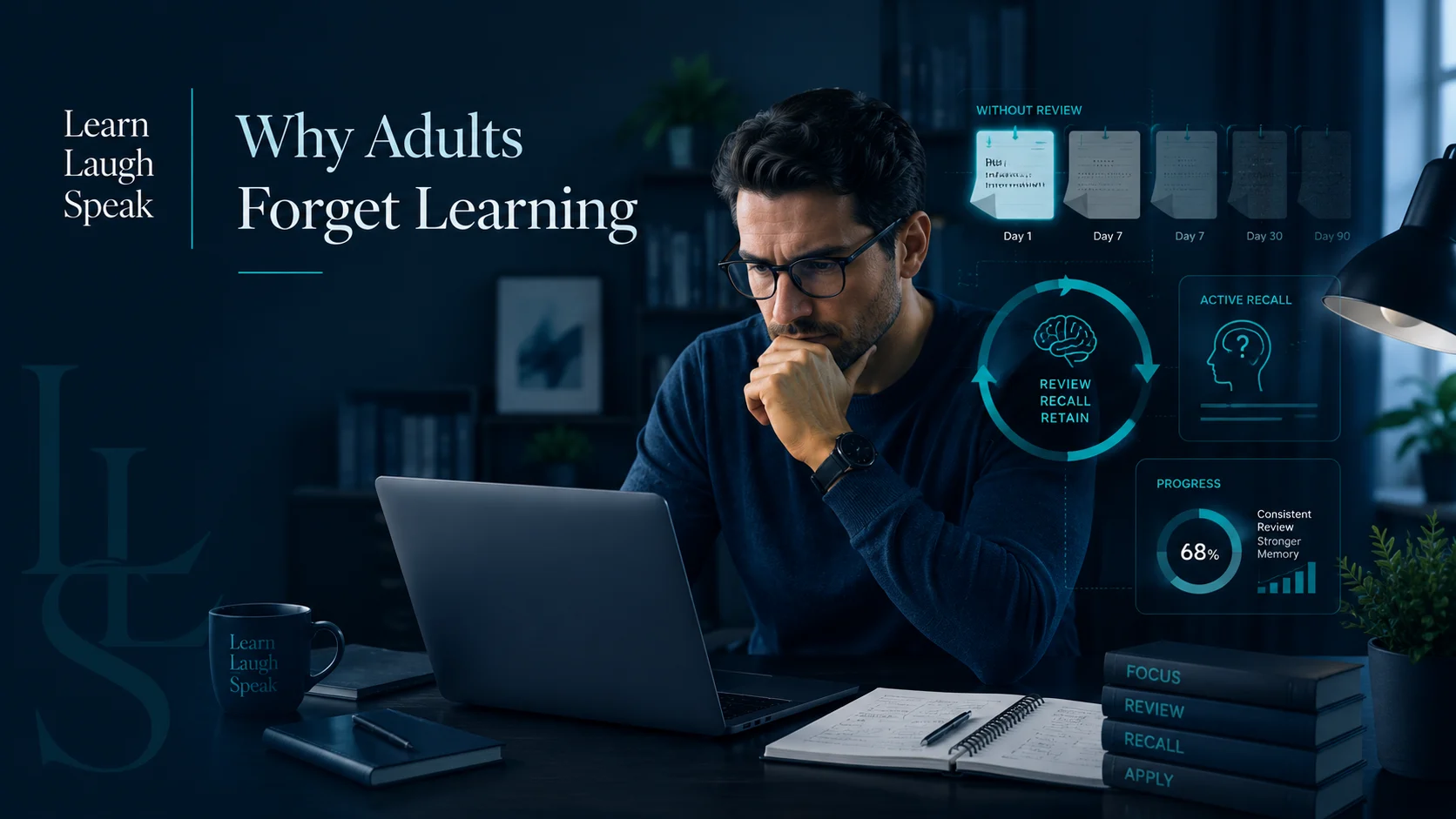
Understanding Feels Like Learning, But It Is Not Always Memory
This is the trap.
A lesson feels clear while someone is explaining it.
The examples are in front of you.
The structure is already built.
The answer is visible.
The teacher, video, or platform is guiding the thinking.
So the learner follows along and feels confident.
That confidence is real.
But it may only be temporary.
Later, when the learner has to remember the idea without help, the brain has to do more work.
It has to retrieve the idea.
Rebuild the structure.
Choose what matters.
Apply it without the lesson sitting there as support.
That is where forgetting appears.
Not because the learner never understood.
Because understanding something once is not the same as being able to bring it back later.
The Forgetting Loop Adults Fall Into
For many adults, forgetting creates a loop.
First, they learn something.
Then they forget part of it.
Then they feel frustrated.
Then they avoid using it because it feels uncomfortable.
Then the memory gets even weaker.
That loop can make progress feel slower than it really is.
The adult student may still be capable.
They may still be motivated.
They may still have the right goal.
But the learning cycle is incomplete.
It stopped too early.
It stopped at:
“I understand.”
When it needed to continue into:
“Can I recall it?”
“Can I use it?”
“Can I correct it?”
“Can I return to it later?”
That is one of the real answers to why adults forget learning.
The lesson ends before the memory becomes strong enough to survive real use.
Passive Review Can Make Learning Feel Stronger Than It Is
Passive review is comfortable.
Reading notes again.
Watching the same video.
Highlighting a page.
Listening to an explanation.
These actions can help, but they can also create false confidence.
The learner sees the information and thinks:
“I know this.”
But recognition is not the same as recall.
Recognition means:
“I know it when I see it.”
Recall means:
“I can bring it back when I need it.”
That difference matters.
Washington University’s Center for Teaching and Learning explains that retrieval practice means recalling facts, concepts, or events from memory to improve learning, and that retrieving information strengthens the memory connections that make future recall more likely.
For adults, this is important because real life rarely gives you the answer first.
You have to access it yourself.
Adult learning can be difficult without the support system needed for adults.
Why Adults Forget Learning After Good Lessons
A good lesson can still fade.
That is the part many learners do not expect.
The lesson may be clear.
The teacher may be excellent.
The examples may be useful.
But if the student does not use the knowledge again, the memory weakens.
A lesson is not the finish line.
It is the first contact.
The learner still needs to meet the idea again.
In a different way.
At a different time.
With less help.
Through real use.
That is how learning becomes stronger.
A Quick Forgetting Diagnosis
| What Happens After the Lesson | What It Usually Means |
|---|---|
| “I knew it during the lesson, but forgot later.” | Understanding happened, but recall was not practised enough |
| “I remember it when I see it.” | Recognition is stronger than active memory |
| “I keep forgetting the same thing.” | The weak area needs repeated practice and feedback |
| “I studied for a long time, but it faded.” | The learning may have been too passive |
| “I know it, but cannot use it quickly.” | The skill has not become automatic yet |
This is not meant to make learners feel worse.
It should do the opposite.
It shows that forgetting is not random.
There is usually a reason.
And once the reason is visible, the next step becomes clearer.
Spacing and Reuse Matter More Than One Long Study Session
Adults are busy, so they often study in big blocks.
One long session when they finally have time.
That feels productive.
Sometimes it is.
But memory often needs something different.
It needs return.
A shorter session today.
A small recall tomorrow.
A quick review in three days.
A real use later in the week.
Spacing gives the brain a chance to rebuild the memory instead of only seeing it once.
Research on effective learning describes spacing and retrieval as strategies that help make learning more durable, especially when learners return to material and practise recalling it over time.
For adults, the lesson is simple:
Do not only study until something feels familiar.
Come back to it later.
That second or third return is often where the learning becomes stronger.
Real-Life Use Gives Learning Somewhere to Live
Adults remember better when the learning has a real place to go.
A workplace task.
A conversation.
A message.
A problem.
A decision.
A real reason.
When learning stays abstract, it floats.
The student may understand it, but not know where to use it.
When learning connects to life, the brain has more hooks.
For example:
A phrase used in a real email is easier to remember than a phrase copied once in a notebook.
A correction used in a conversation is stronger than a correction only read silently.
A rule applied in a real sentence is more useful than a rule memorized for a test.
This is why adult learning needs application.
Not because adults cannot learn theory.
Because theory becomes stronger when it is used.

The Emotional Side of Why Adults Forget Learning
Forgetting can feel embarrassing.
Especially for adults.
Adults often expect more from themselves.
They think:
“I should know this already.”
“I learned this before.”
“Why am I still making the same mistake?”
That frustration can quickly turn into avoidance.
The learner stops practising the difficult thing.
They choose the easier lesson.
They avoid the conversation.
They tell themselves they will return later.
But later often becomes much later.
This is how forgetting becomes more than a memory issue.
It becomes a confidence issue.
The best learning systems do not make adults feel ashamed for forgetting.
They help them return to the weak area without feeling like they have failed.
More Content Is Not Always the Answer
When adults forget, they often look for more.
More lessons.
More videos.
More vocabulary.
More explanations.
But forgetting is not always caused by lack of information.
Sometimes the information is already there.
It is just not strong enough yet.
The adult does not need a completely new lesson.
They may need:
- a better review
- a chance to recall it
- a practical task
- clearer feedback
- a real example
- more repetition in the weak area
This is why adult education needs to be precise.
More content can make a learner feel busy.
Better practice makes the learner improve.
Adult Learning Needs Better Design
Adults have limited time.
That is not an excuse.
It is reality.
Work, family, energy, stress, and responsibilities all compete with learning.
OECD’s recent adult learning work focuses on participation, delivery, and barriers in adult learning systems, especially as adults need to keep building skills in changing labour markets.
That matters because adult learners need education that helps them remember what matters most.
Not endless content.
Not random review.
Not lessons that disappear after one session.
Better adult learning should include:
- a clear starting point
- active recall
- spaced review
- real-life use
- specific feedback
- visible progress
- practice in the areas where mistakes repeat
That is how learning becomes stronger.
How Learn Laugh Speak Helps Adults Remember What They Learn
At Learn Laugh Speak, adult students do not begin from a random lesson.
They start with a level assessment so the platform can understand where they are now.
That matters because forgetting is often connected to the wrong starting point or hidden gaps.
Some adults have prior learning experience.
Some remember parts of English but cannot use them confidently.
Some have repeated mistakes that need correction.
Some need more practice before a skill becomes automatic.
From there, each student follows a personalized learning path based on level, progress, mistakes, and needs.
This helps answer why adults forget learning in a practical way.
Students do not only move through lessons.
They practise, receive correction, and continue through a path designed around what they need next.
They learn what they need, when they need it.
They do not waste time repeating everything they already know.
They also do not skip the areas where mistakes are still appearing.
That is how learning becomes easier to remember.
Not because it is simpler.
Because it is more precise.

What Adults Can Do to Forget Less
A better learning cycle does not need to be complicated.
It can look like this:
Learn the idea once.
Use it in a small task.
Close the notes and recall it.
Review it the next day.
Use it again in a real situation.
Get feedback.
Return to it later.
That is much stronger than studying once and hoping it stays.
Adults should also stop treating forgetting as proof they are failing.
Forgetting is part of learning.
The goal is not to never forget.
The goal is to build a system that brings the skill back often enough until it becomes usable.
Final Thought on Why Adults Forget Learning
Why adults forget learning is not only about memory.
It is about the way learning is built.
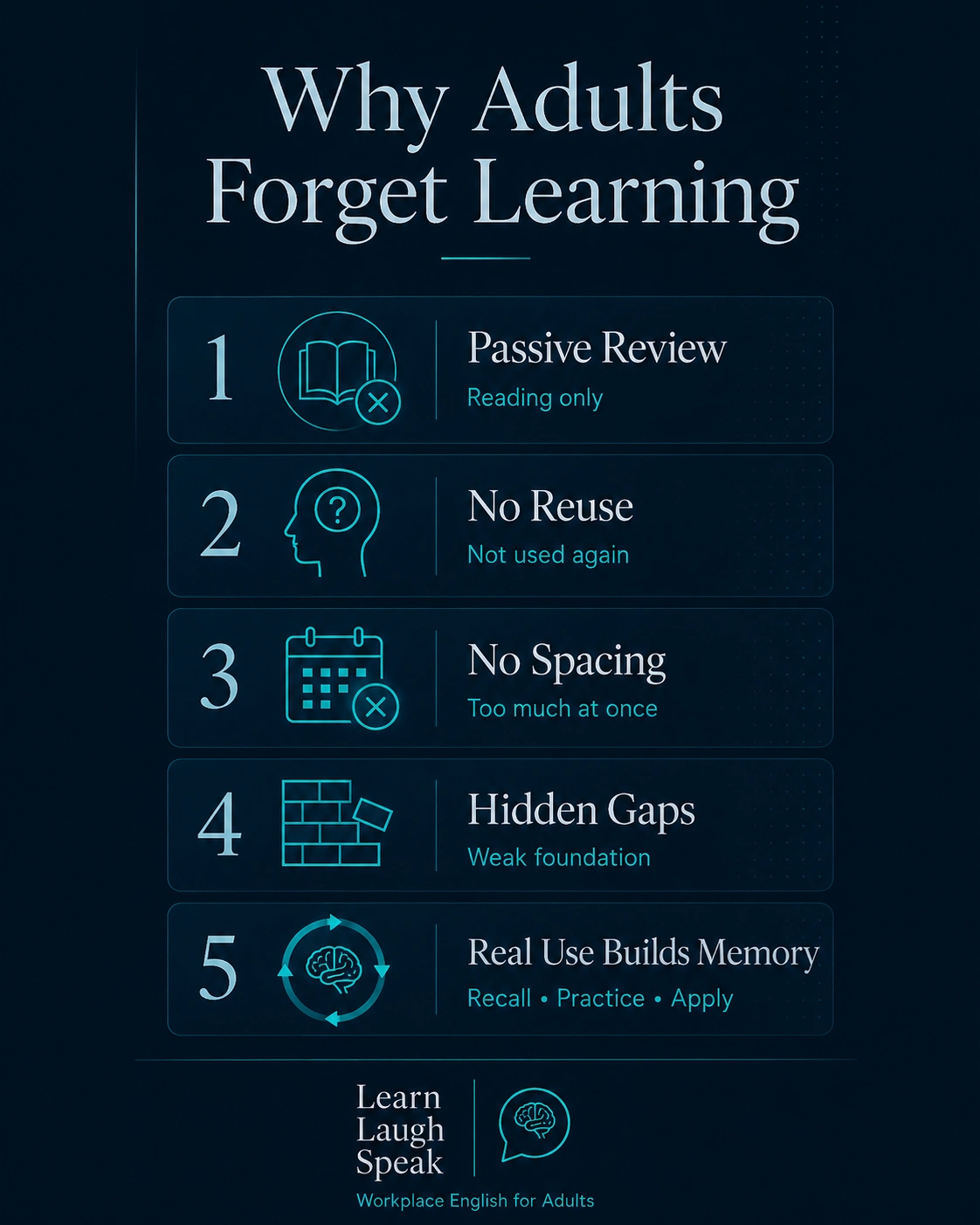
Adults forget when learning is passive, disconnected, rushed, unsupported, or never used again.
They remember better when learning has a clear reason, active recall, spaced practice, feedback, and real-life use.
That is why adult education needs more than content.
It needs structure that helps knowledge stay.
Adults do not need to feel ashamed when they forget.
They need a better learning cycle.
Because when learning is used, recalled, corrected, and repeated in the right way, it becomes much easier to keep.
Adults forget learning is not just a simple answer, we often all forget about learning especially when life gets busy.

One thought on “Why Adults Forget Learning Even When They Study Hard”
Pingback: What I Learned Testing AI Image Tools That Do Not Waste Your Attention - Learn Laugh Speak