
 English
 Arabic
 Chinese (Simplified)
 Dutch
Dutch French
 German
 Italian
 Portuguese
 Russian
 Spanish
Let’s be honest: nailing English at work isn’t just about vocabulary lists or perfect grammar. It’s about sounding credible in a meeting, writing emails that get replies, and building trust with global colleagues. That’s where Professional English for Work truly matters. If you’re wondering how to practice professional English without drowning in textbooks, I’ve got you covered.
Here’s what actually works, straight from my years of teaching busy professionals like you.
35 Questions for an English Interview (With Sample Answers)
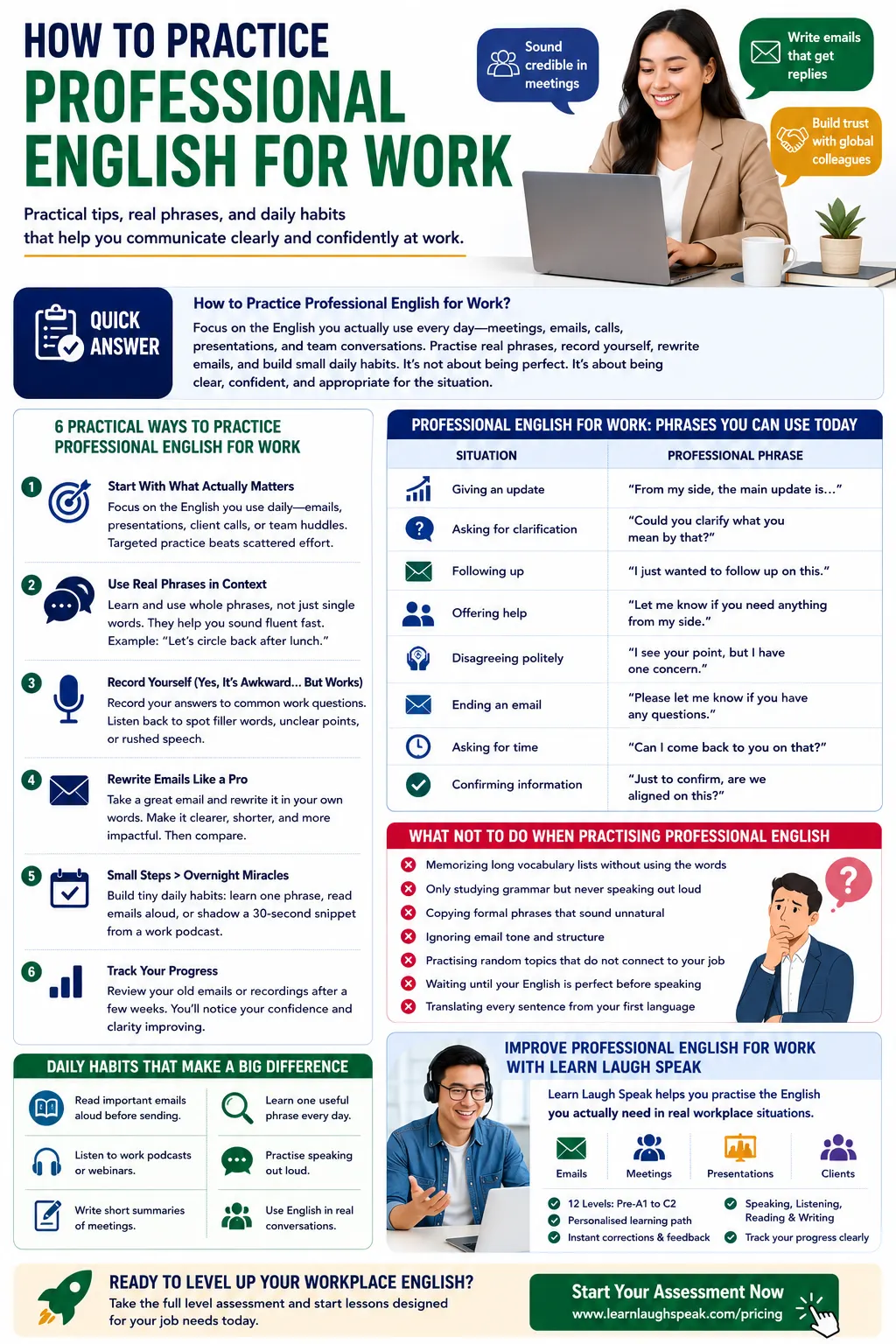
Quick Answer: How to Practice Professional English for Work
To improve Professional English for Work, focus on the English you actually use every day. Practise meeting phrases, email responses, client communication, presentations, and workplace conversations instead of studying random vocabulary or grammar rules.
The fastest progress usually comes from small daily habits: recording yourself, rewriting emails, learning full phrases, reading messages out loud, and practising the situations you face at work most often. Professional English is not about sounding perfect. It is about sounding clear, confident, and appropriate for the situation.

Start With What Actually Matters: Professional English for Work
Before you dive into random exercises, pause. Ask: “What English do I use daily?”
- Emails? Presentations? Client calls? Team huddles?
Focus your energy there first. If you spend hours crafting emails, master that. Save negotiation phrases for later. Trust me – targeted practice beats scattered effort every time.
Professional English for Work: Phrases You Can Use Today
Use full phrases instead of single words. This helps you sound more natural in meetings, emails, and workplace conversations.
| Situation | Professional phrase |
|---|---|
| Giving an update | “From my side, the main update is…” |
| Asking for clarification | “Could you clarify what you mean by that?” |
| Following up | “I just wanted to follow up on this.” |
| Offering help | “Let me know if you need anything from my side.” |
| Disagreeing politely | “I see your point, but I have one concern.” |
| Ending an email | “Please let me know if you have any questions.” |
| Asking for time | “Can I come back to you on that?” |
| Confirming information | “Just to confirm, are we aligned on this?” |
These phrases are useful because they are short, natural, and easy to adapt to different workplace situations.
Professional English for Work with Real Phrases
Forget memorizing single words. Professional English for Work thrives on whole phrases used in context. Keep a running list of gems you hear:
“Let’s circle back after lunch.”
“Could you unpack that idea a bit?”
“I’ll follow up with details by EOD.”
Slip these into your next chat. They’ll make you sound fluent fast – even if your grammar’s still warming up.
12 Useful Tips To Improve Your Essay Writing Skills
Record Yourself (Yes, It’s Awkward… But Works)
I know, hearing your own voice can be cringe-worthy. But try this: Grab your phone. Record yourself answering a common work question like “What’s your update on Project X?”
Listen back:
- Did you mumble?
- Rush through key points?
- Sound unsure?
This isn’t about perfection. It’s about spotting habits before your boss does.
Rewrite Emails Like a Pro
Here’s a game-changer: Find a great professional email (internal announcements work well). Now rewrite it in your words.
Ask yourself:
“Is this clearer?”
“Could I trim 20%?”
“Does the tone build rapport?”
Then compare. You’ll sharpen real skills faster than any grammar drill.
What Not to Do When Practising Professional English
Many learners work hard but practise the wrong way. Professional English improves faster when your practice matches your real work situations.
Avoid:
- memorizing long vocabulary lists without using the words
- only studying grammar but never speaking out loud
- copying formal phrases that sound unnatural
- ignoring email tone and structure
- practising random topics that do not connect to your job
- waiting until your English is perfect before speaking
- translating every sentence from your first language
Instead, focus on useful phrases, real examples, and daily communication habits.
Small Steps > Overnight Miracles
How to practice professional English sustainably? Tiny, daily habits beat marathon sessions.
- Jot one new phrase daily in your notes app.
- Re-read important emails aloud before sending.
- Shadow a 30-second snippet from a work podcast.
- Progress feels slow until you look back at last month’s emails. Suddenly, you’re crisper, calmer, more convincing.
Patient Responding for Professional English is Key
Improve Professional English for Work with Learn Laugh Speak
If you want to improve Professional English for Work, Learn Laugh Speak helps you practise the English you actually need in real workplace situations.
That includes:
- business emails
- meetings
- presentations
- client communication
- professional phrases
- workplace speaking confidence
- reading, writing, speaking, and listening
Every student starts with a full level assessment from Pre-A1 to C2. From there, learners follow lessons matched to their exact level, goals, mistakes, and progress.
Instead of guessing what to study next, Learn Laugh Speak gives adults a structured path to improve professional English clearly and correctly.

5 thoughts on “Master Professional English for Work: Practical Tips from a Teacher”
Pingback: How to choose dropshipping providers for a thriving ecommerce business ? - Learn Laugh Speak
Pingback: The Word While Explained Simply & Easily For Students - Learn Laugh Speak
Pingback: Level C1 Of The English Language Explained - Learn Laugh Speak
Pingback: Slot Gacor English: Casino and Gaming Vocabulary Explained Simply - Learn Laugh Speak
Pingback: Easily Learn How to Describe a Person's Personality in English - Learn Laugh Speak