
 English
 Arabic
 Chinese (Simplified)
 Dutch
Dutch French
 German
 Italian
 Portuguese
 Russian
 Spanish
The word while is useful in English because it can show time, contrast, or a short period of time.
This is why many English learners find it confusing.
Sometimes while means two actions are happening at the same time.
For example:
“I answered emails while my manager prepared the report.”
Here, while means the two actions happened during the same time.
But while can also show contrast.
For example:
“While the project was difficult, the team completed it on time.”
Here, while means something similar to although.
Learning how to use the word while correctly helps you write clearer emails, explain timelines, and describe situations more naturally in English.
According to Cambridge Dictionary, “while” can be used to talk about time, contrast, or a period of time. That is why the word while can feel confusing at first, but it becomes easier when you learn each use separately.
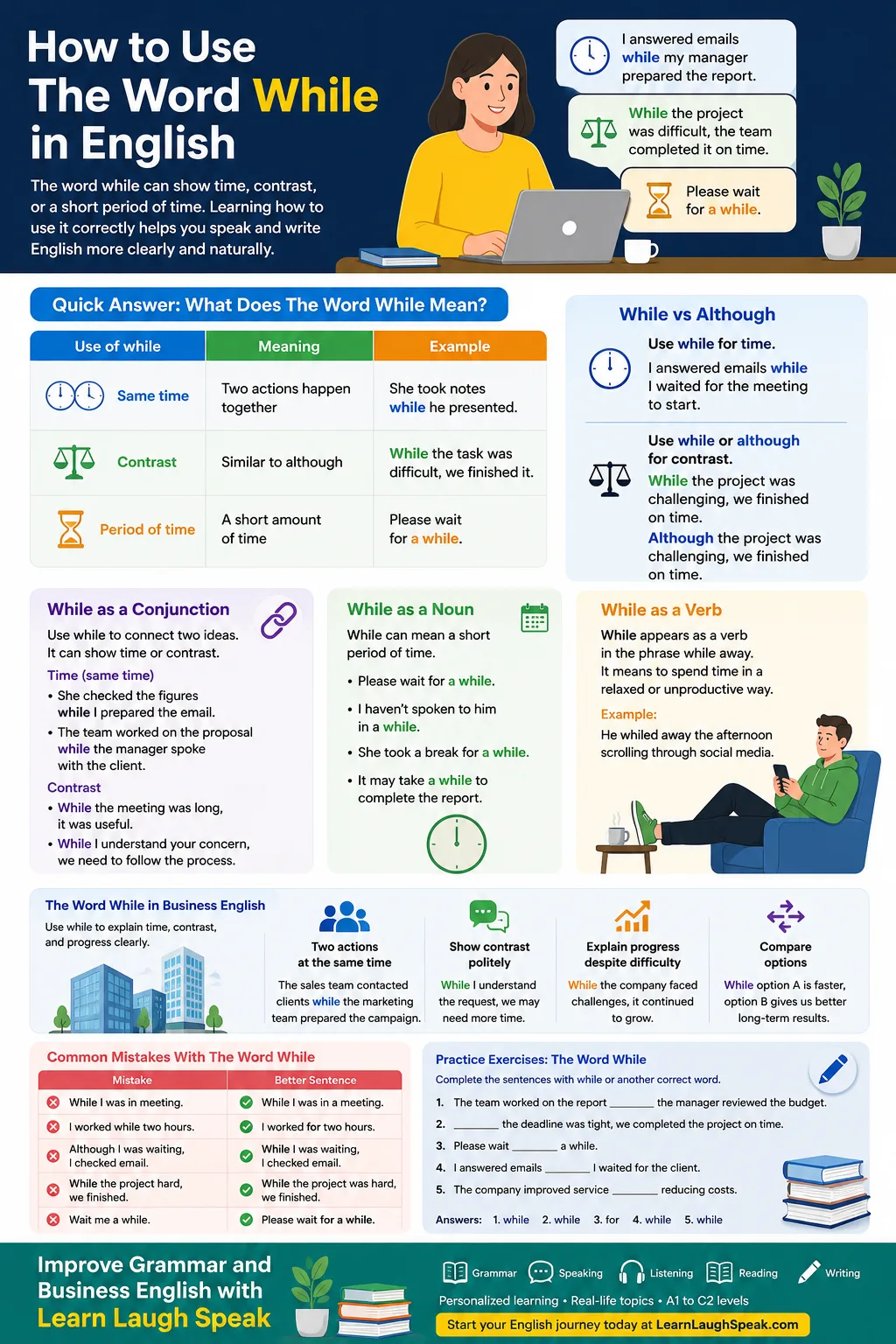
Quick Answer: What Does The Word While Mean?
The word while usually has three common uses in English.
| Use of while | Meaning | Example |
|---|---|---|
| Same time | Two actions happen together | “She took notes while he presented.” |
| Contrast | Similar to although | “While the task was difficult, we finished it.” |
| Period of time | A short amount of time | “Please wait for a while.” |
In business English, while is often used to explain timing, compare two ideas, or show contrast politely.
Business English can be tricky and learning some simple tips for speaking professionally can be such a game changer.
Understanding The Meaning of While
The word while is commonly used as a conjunction.
A conjunction connects two parts of a sentence.
For example:
“The team reviewed the data while the manager prepared the presentation.”
In this sentence, two actions are happening at the same time.
The team reviewed the data.
The manager prepared the presentation.
The word while connects both ideas.
But while can also introduce contrast.
For example:
“While the results were not perfect, they showed clear progress.”
This means the results were not perfect, but they were still positive in some way.
In simple English, while can mean:
- during the time that
- at the same time as
- although
- even though
- for a short period of time
The meaning depends on the sentence.
The Word While as a Conjunction
The most common use of while is as a conjunction.
Use while when two actions happen at the same time.
Examples:
- “I listened carefully while the client explained the issue.”
- “She checked the figures while I prepared the email.”
- “The team worked on the proposal while the manager spoke with the client.”
- “He took notes while the trainer explained the process.”
You can also use while to show contrast.
Examples:
- “While the meeting was long, it was useful.”
- “While the deadline was tight, the team completed the project.”
- “While I understand your concern, we need to follow the process.”
- “While the first option is cheaper, the second option is more reliable.”
This use is helpful in professional English because it makes your sentence sound balanced and respectful.

While vs Although: What Is the Difference?
The word while can sometimes mean the same as although, but not always.
Use while for time:
“I answered emails while I waited for the meeting to start.”
Use while or although for contrast:
“While the project was challenging, we finished on time.”
“Although the project was challenging, we finished on time.”
Both are correct in this example.
However, if you are talking about two actions happening at the same time, do not use although.
Correct:
“She took notes while he presented.”
Incorrect:
“She took notes although he presented.”
This is one of the most important differences for English learners to remember.
The Word While as a Noun
The word while can also be used as a noun.
When used as a noun, while means a short period of time.
Examples:
- “Please wait for a while.”
- “I haven’t spoken to him in a while.”
- “She took a break for a while.”
- “It may take a while to complete the report.”
This use is common in everyday English and professional conversations.
For example:
“The update may take a while, but I’ll let you know when it’s ready.”
This sounds natural and polite in workplace English.
While vs When vs During
The words while, when, and during are all connected to time, but they are used differently.
| Word | Use | Example |
|---|---|---|
| While | Two actions happen at the same time | “I answered emails while I waited.” |
| When | One action happens at a specific time | “Call me when you arrive.” |
| During | Something happens inside a period of time | “I took notes during the meeting.” |
Use while before a full action.
Use during before a noun.
Correct:
“I took notes while the manager spoke.”
“I took notes during the meeting.”
Incorrect:
“I took notes during the manager spoke.”
This section can help you rank for more related searches without changing the core article.
The Word While as a Verb
The word while can also appear as a verb in the phrase “while away.”
This means to spend time in a relaxed or unproductive way.
Example:
“He whiled away the afternoon scrolling through social media.”
This use is less common in business English, but it is useful to recognize when reading or listening.
Most English learners will use while more often as a conjunction or noun.
The Word While in Business English
In business English, while is useful because it helps you explain time, contrast, and progress clearly.
Use it to describe two actions happening together:
“The sales team contacted clients while the marketing team prepared the campaign.”
Use it to show contrast politely:
“While I understand the request, we may need more time to complete it properly.”
Use it to explain progress despite difficulty:
“While the company faced budget challenges, it continued to improve customer service.”
Use it to compare options:
“While option A is faster, option B gives us better long-term results.”
These examples sound professional because they are clear, balanced, and easy to understand.
Common Mistakes With The Word While
English learners often make small mistakes when using while.
| Mistake | Better Sentence |
|---|---|
| “While I was in meeting.” | “While I was in a meeting.” |
| “I worked while two hours.” | “I worked for two hours.” |
| “Although I was waiting, I checked email.” | “While I was waiting, I checked email.” |
| “While the project hard, we finished.” | “While the project was hard, we finished.” |
| “Wait me a while.” | “Please wait for a while.” |
Remember:
Use while with an action or situation.
Use for with a length of time.
Correct:
“I worked for two hours.”
Incorrect:
“I worked while two hours.”
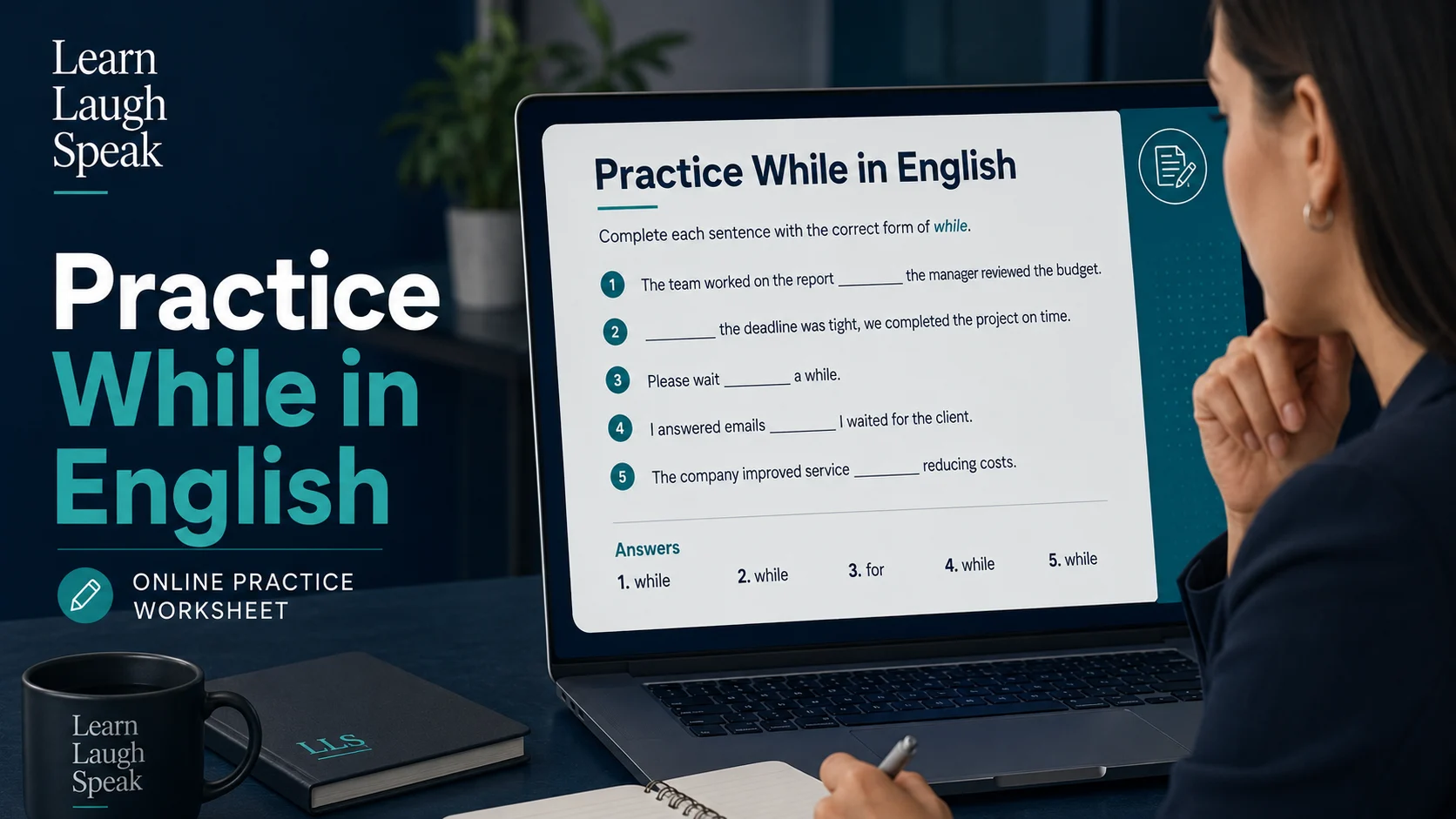
Practice Exercises: The Word While
Complete the sentences with while or another correct word.
- The team worked on the report ______ the manager reviewed the budget.
- ______ the deadline was tight, we completed the project on time.
- Please wait ______ a while.
- I answered emails ______ I waited for the client.
- The company improved service ______ reducing costs.
Suggested answers:
- while
- while
- for
- while
- while
Now try creating your own sentences using while for:
- two actions happening at the same time
- a contrast
- a business situation
- a short period of time
Improve Grammar and Business English with Learn Laugh Speak
Learn Laugh Speak helps adults understand English grammar in real situations, not just through rules.
That includes:
- using the word while correctly
- writing clearer emails
- explaining timelines
- speaking in meetings
- understanding grammar in context
- improving workplace English
Every student starts with a level assessment from A1 to C2. From there, learners follow a personalized path based on their level, goals, mistakes, and progress.
If you want to use English more clearly at work, Learn Laugh Speak helps you practise grammar, vocabulary, speaking, listening, reading, and writing step by step.
Final Thoughts on The Word While
The word while is small, but it is very useful in English.
You can use it to talk about actions happening at the same time:
“I listened while she explained the problem.”
You can use it to show contrast:
“While the task was difficult, we completed it successfully.”
You can also use it to talk about a short period of time:
“Please wait for a while.”
The best way to learn while is to practise it in real sentences.
Start with simple examples, then use it in emails, meetings, and everyday conversations.
Over time, the word will feel much more natural.

One thought on “The Word While: Meaning, Grammar, and Easy Examples”
Pingback: How to Give Feedback Professionally in English at Work