
 English
 Arabic
 Chinese (Simplified)
 Dutch
Dutch French
 German
 Italian
 Portuguese
 Russian
 Spanish
Learning how to describe a person’s personality in English can be difficult, especially when you want to sound natural, polite, and specific.
In English, there are many small differences between words.
For example, saying someone is friendly, polite, quiet, confident, or direct gives a much clearer picture than simply saying:
“He is nice.”
When you want to describe someone clearly, it helps to choose the right adjective and support it with a short example.
Instead of saying:
“She is a good person.”
You could say:
“She is thoughtful because she always remembers small details and checks how people are feeling.”
That sounds more natural, more useful, and more complete.
In this guide, you will learn simple personality adjectives, what they mean, and how to use them correctly in English.
Teacher tip: Improve your speaking by following this articles tips and reading aloud.
Quick Answer: How Do You Describe a Person’s Personality?
The easiest way to describe a person’s personality is to choose one clear adjective and support it with a real example.
For example:
“She is friendly because she always makes people feel welcome.”
“He is organized because he plans his work carefully.”
“They are confident because they speak clearly in meetings.”
A strong description usually includes:
- a personality adjective
- a simple explanation
- one real example
This makes your English sound more natural and specific.
Start with Behaviour, Not Appearance
When describing personality, focus on how someone acts, speaks, responds, and treats other people.
Do not guess someone’s personality from their physical appearance.
A person’s height, face, body, or style does not tell you who they are.
Instead, describe what you notice from their behaviour.
For example:
“She is reliable because she always finishes her work on time.”
“He is calm because he stays relaxed during stressful situations.”
“They are friendly because they welcome new people and help others feel comfortable.”
This is more accurate and more respectful.
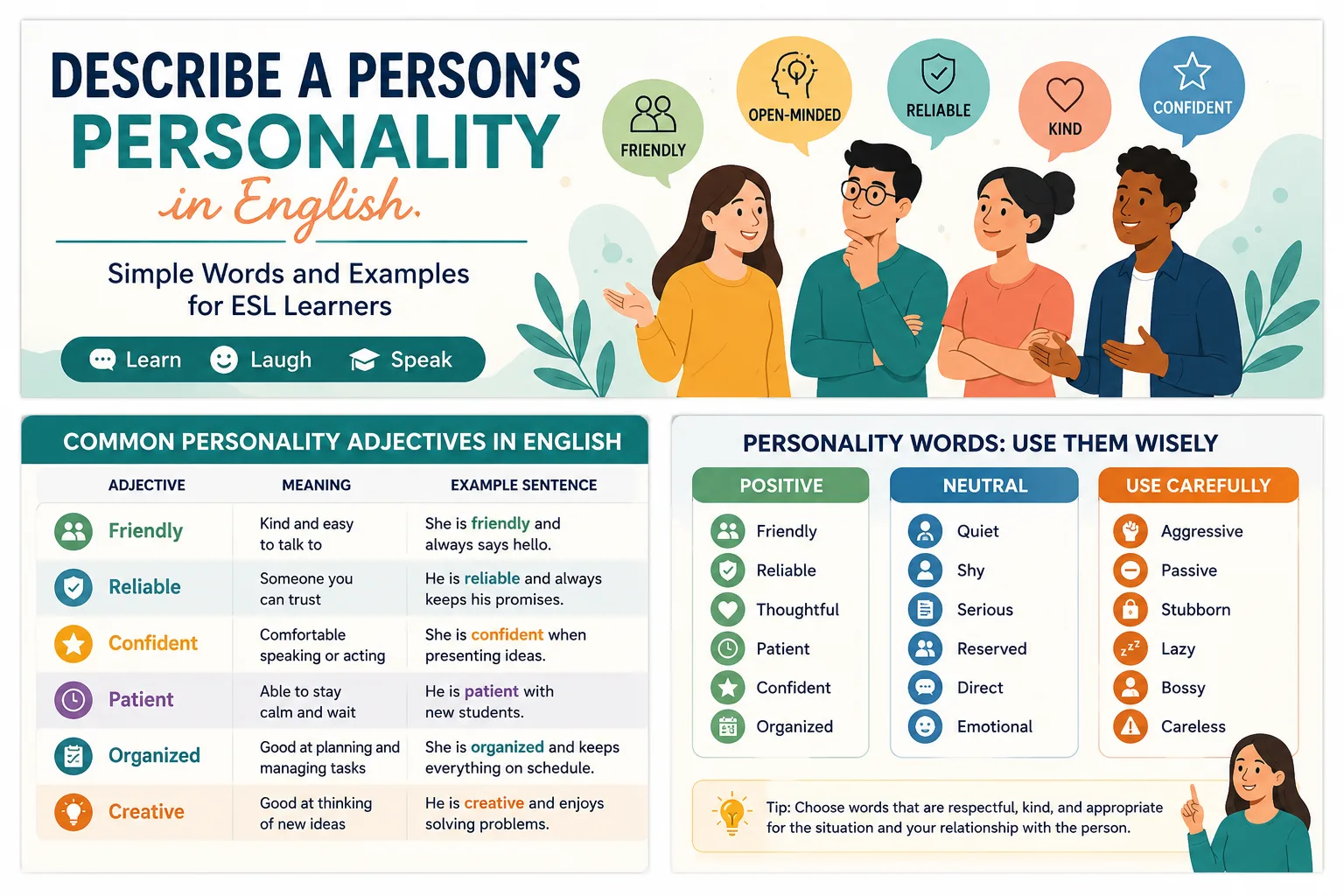
Common Personality Adjectives in English
Here are some useful personality words with simple meanings and examples.
| Personality Word | Meaning | Example Sentence |
|---|---|---|
| Friendly | Kind and easy to talk to | “She is friendly and always says hello.” |
| Reliable | Someone you can trust | “He is reliable and always keeps his promises.” |
| Confident | Comfortable speaking or acting | “She is confident when presenting ideas.” |
| Patient | Able to stay calm and wait | “He is patient with new students.” |
| Organized | Good at planning and managing tasks | “She is organized and keeps everything on schedule.” |
| Creative | Good at thinking of new ideas | “He is creative and enjoys solving problems.” |
| Shy | Quiet around new people | “She is shy at first, but very kind.” |
| Laid-back | Relaxed and not easily stressed | “He is laid-back and stays calm under pressure.” |
| Hard-working | Puts effort into tasks | “They are hard-working and always try their best.” |
| Thoughtful | Thinks about other people’s feelings | “She is thoughtful and remembers small details.” |
These words are useful in everyday conversations, workplace English, school descriptions, interviews, and writing tasks.
Positive, Neutral, and Careful Personality Words
Some personality words sound positive.
Some are neutral.
Some can sound negative if you use them in the wrong situation.
| Positive Words | Neutral Words | Use Carefully |
|---|---|---|
| friendly | quiet | aggressive |
| reliable | shy | passive |
| thoughtful | serious | stubborn |
| patient | reserved | lazy |
| confident | direct | bossy |
| organized | emotional | careless |
For example, direct can be neutral or positive in business English.
But bossy usually sounds negative.
Instead of saying:
“She is bossy.”
You could say:
“She likes to take charge.”
That sounds softer and more professional.
Friendly
Friendly means someone is kind, warm, and easy to talk to.
A friendly person usually makes others feel welcome.
Example:
“Tom is friendly. He always says hello and helps people when they need something.”
You can use friendly in many situations.
For example:
“The receptionist was very friendly.”
“My coworker is friendly and easy to work with.”
“She has a friendly personality.”
Laid-back
Laid-back means relaxed and not easily stressed.
A laid-back person usually stays calm and does not get upset quickly.
Example:
“Sarah is laid-back. She does not get stressed easily and stays calm when plans change.”
This word is usually positive or neutral.
It can be useful when describing someone who is relaxed, easygoing, and calm.
Example:
“He has a laid-back attitude, which helps the team stay relaxed.”
Be careful, though.
In some work situations, too laid-back can suggest someone is not serious enough.
So context matters.
Assertive
Assertive means someone can express their ideas clearly and confidently.
This is usually a positive word in professional English.
Example:
“She is assertive in meetings and explains her opinions clearly.”
Assertive does not mean rude.
It means the person can speak up in a respectful way.
Be careful with the word aggressive.
Aggressive usually sounds negative. It can mean someone is too forceful, angry, or confrontational.
Instead of saying:
“He is aggressive.”
You can say:
“He is very direct.”
or:
“He has a strong personality.”
These phrases are softer and safer in professional English situations.
Shy
Shy means someone feels quiet or nervous around other people, especially in new situations.
Example:
“Maria is shy at first, but once she feels comfortable, she is very friendly.”
This is a common personality word, but use it kindly.
Do not use shy to criticize someone.
You can also say:
“He is a little reserved.”
or:
“She takes time to open up.”
These phrases sound respectful.
Passive
Passive means someone does not often take action or express their opinion strongly.
Example:
“Bill can be passive in group discussions, so he may need encouragement to share his ideas.”
This word can sound negative if you use it too directly.
Instead of saying:
“He is passive.”
You could say:
“He usually prefers to listen before giving his opinion.”
or:
“He is quiet in meetings, but he has good ideas when asked.”
This sounds more balanced.
Conscientious
Conscientious means someone is careful, responsible, and tries to do things properly.
This is a very useful personality word for work or study.
Example:
“Harry is conscientious. He always checks his work carefully and likes to be prepared.”
A conscientious person usually pays attention to details.
They often want to do their best.
Other similar words include:
- responsible
- careful
- organized
- reliable
- hard-working
Extroverted and Introverted
Extroverted and introverted describe how someone usually gets energy and interacts with people.
An extroverted person is usually outgoing and enjoys being around others.
Example:
“She is extroverted and enjoys meeting new people.”
An introverted person may prefer smaller groups, quiet spaces, or time alone.
Example:
“He is introverted and prefers one-on-one conversations.”
Neither word is better than the other.
They simply describe different personality styles.
Open-minded
Open-minded means someone is willing to listen to new ideas, try new things, and consider different opinions.
Example:
“Our manager is open-minded and listens to suggestions from the whole team.”
This is a positive word.
It is useful in both social and professional English.
You can also say:
“She is curious and open to new experiences.”
or:
“He is willing to consider different points of view.”
Calm and Emotionally Steady
Instead of using technical words like neuroticism, it is often better for English learners to use simpler everyday words.
You can say someone is:
- calm
- emotionally steady
- anxious
- nervous
- sensitive
- relaxed
For example:
“She is calm under pressure.”
“He gets nervous before presentations, but he prepares well.”
“They are emotionally steady and handle difficult situations well.”
Be careful when describing someone’s emotions.
Words like anxious, nervous, or sensitive can feel personal.
Use them respectfully and only when appropriate.
Enthusiastic
Enthusiastic means someone is positive, excited, and interested in what they are doing.
Example:
“Anna is enthusiastic about learning English and always participates in class.”
This is a positive word.
You can use it for work, school, hobbies, and social situations.
Examples:
“He is enthusiastic about the new project.”
“She has an enthusiastic personality.”
“The teacher is enthusiastic and makes the class enjoyable.”
How to Describe Personality at Work
In professional English, it is important to choose respectful words.
You may need to describe a coworker, manager, employee, client, or teammate.
At work, it is important to describe a person’s personality respectfully and with examples, not personal criticism.
Useful examples:
“She is reliable and always meets deadlines.”
“He is organized and keeps the team on track.”
“They are proactive and often suggest solutions.”
“My manager is direct but fair.”
“Our colleague is supportive and easy to work with.”
At work, avoid overly personal or emotional descriptions.
Instead of saying:
“He is weird.”
Say:
“He has a different communication style.”
Instead of saying:
“She is lazy.”
Say:
“She may need more support with time management.”
This keeps your English polite and professional.
What Not to Say When Describing Someone
Some words can sound rude, judgmental, or too personal.
When you are speaking in English, especially at work, softer language is often better.
| Avoid Saying | Say This Instead |
|---|---|
| “He is lazy.” | “He may need more support with motivation or time management.” |
| “She is bossy.” | “She likes to take charge.” |
| “He is weird.” | “He has a different communication style.” |
| “She is too emotional.” | “She reacts strongly in stressful situations.” |
| “He is aggressive.” | “He is very direct.” |
| “She is boring.” | “She is quiet and reserved.” |
| “He is annoying.” | “His communication style can be challenging.” |
This does not mean you can never describe difficult personality traits.
It means you should choose words carefully.
Tone matters.
Examples: How to Describe a Person’s Personality
Here are some simple examples you can use as models.
Friendly
“Tom is friendly. He always says hello and makes people feel comfortable.”
Laid-back
“Sarah is laid-back. She stays calm and does not get stressed easily.”
Assertive
“John is assertive. He speaks clearly and shares his opinion with confidence.”
Shy
“Maria is shy at first, but she becomes more confident when she knows people better.”
Quiet
“Bill is quiet in meetings, but he listens carefully and gives thoughtful answers.”
Conscientious
“Harry is conscientious. He is organized, careful, and always tries to do his best.”
Extroverted
“Lisa is extroverted. She enjoys meeting new people and working in groups.”
Introverted
“Michael is introverted. He prefers quiet work and smaller conversations.”
Open-minded
“Emma is open-minded. She listens to different opinions and is willing to try new ideas.”
Enthusiastic
“Daniel is enthusiastic. He brings energy and positivity to the team.”
Simple Sentence Patterns for Personality Descriptions
These sentence patterns can help you speak or write more naturally.
[Name] is + adjective.
“Maria is friendly.”
[Name] is + adjective + because…
“Maria is friendly because she always welcomes new people.”
[Name] can be + adjective + in certain situations.
“He can be quiet in large groups.”
[Name] tends to + verb phrase.
“She tends to stay calm under pressure.”
[Name] is the kind of person who…
“He is the kind of person who always helps others.”
These patterns help you move beyond single-word answers.
Learn Personality Vocabulary with Learn Laugh Speak
Learn Laugh Speak helps adults build English vocabulary for real conversations.
That includes:
- personality adjectives in English
- workplace communication
- describing people respectfully
- speaking clearly
- writing better descriptions
- understanding tone and context
Every student starts with a level assessment from A1 to C2.
From there, learners follow structured lessons based on their level, mistakes, goals, and progress.
If you want to describe people naturally and confidently in English, Learn Laugh Speak helps you practise the vocabulary and phrases you need.

Final Thoughts
Learning how to describe a person’s personality in English is a useful skill for conversations, writing, and workplace communication.
It helps you speak more clearly, write better descriptions, and understand others more deeply.
The key is to choose specific words and support them with examples.
Instead of saying:
“She is nice.”
try saying:
“She is thoughtful and always makes people feel included.”
That small change makes your English sound more natural and complete.
Personality adjectives can be fun, interesting, and very useful.
The more you practise, the easier it becomes to describe people accurately and respectfully.
53 thoughts on “Easily Learn How to Describe a Person’s Personality in English”
Thank so much! Great to see your feedback on this lovely Monday morning! Have a great week!
whoah this blog is magnificent i love reading your posts. Keep up the good work! You know, a lot of people are looking around for this information, you can aid them greatly.
Hi there! Thank you so much for the feedback. So happy to hear you enjoy our blog!
Hiya! I know this is kinda off topic however I’d figured I’d ask.
Would you be interested in trading links or maybe
guest writing a blog post or vice-versa? My blog goes over a lot of the same subjects
as yours and I think we could greatly benefit from each other.
If you are interested feel free to send me an e-mail. I look forward to hearing from you!
Great blog by the way!
hi there. Send through your articles to info@learnlaughspeak.com and other information etc.
There is apparently a bunch to identify about this. I feel you made some good points in features also.
Thank you for the comment. Sure it is a big topic! Glad you liked it!
If some one wants expert view about blogging after that i advise
him/her to go to see this webpage, Keep up the good
work.
Thank you so much for the comment!
It’s really a great and useful piece of info. I’m happy that you simply shared this useful info with us.
Please keep us up to date like this. Thank you for sharing.
thanks for the comment! We are happy to write these articles for students!
Definitely believe that which you stated. Your favorite justification appeared to be on the web the easiest thing to be aware of. I say to you, I certainly get annoyed while people think about worries that they just don’t know about. You managed to hit the nail upon the top and defined out the whole thing without having side effect , people could take a signal. Will likely be back to get more. Thanks
thanks for the input! Will pass it onto our teachers! Much appreciated!
Hello there, You have done an incredible job. I?ll definitely digg it and personally recommend to my friends. I am confident they’ll be benefited from this web site.
thanks for the feedback!
Woah! I’m really digging the template/theme of this website.
It’s simple, yet effective. A lot of times it’s challenging
to get that “perfect balance” between user friendliness and visual appearance.
I must say you have done a fantastic job with this.
Also, the blog loads super fast for me on Firefox.
Superb Blog!
Thanks so much! We try to keep it informative as possible!
magnificent publish, very informative. I ponder why
the opposite experts of this sector don’t understand this. You must continue your writing.
I am sure, you have a huge readers’ base already!
so glad to hear this, will pass this feedback onto our teachers who write the articles! Take care!
Thankfulness to my father who shared with me
regarding this webpage, this web site is in fact amazing.
so glad to hear! Tell your father thank you!
You should take part in a contest for one of the finest blogs on the net.
I will highly recommend this web site!
Thank you!
Spot on with this write-up, I seriously think this web site needs much more attention. I’ll
probably be back again to read more, thanks
for the info!
thank you so much!
What’s Taking place i’m new to this, I stumbled
upon this I’ve discovered It absolutely useful and it has helped me out loads.
I’m hoping to contribute & assist other users like its aided me.
Great job.
thank you so much for the feedback. I will pass it on to our teachers.
Saved as a favorite, I love your site!
thank you glad you liked it!
I love your blog.. very nice colors & theme. Did you create this website yourself
or did you hire someone to do it for you?
Plz respond as I’m looking to construct my own blog and would like to find out where u
got this from. kudos
hi there, you can contact us for any help we are always happy to help others on teacher@learnlaughspeak.com
I needed to thank you for this good read!! I definitely enjoyed every little bit of it.
I’ve got you bookmarked to check out new things you post…
thank you for the feedback! Glad you liked it!
Unquestionably consider that that you said. Your favourite justification seemed to be at the internet the easiest factor to take into account of.
I say to you, I definitely get irked even as people consider concerns that they plainly do not understand about.
You controlled to hit the nail upon the highest and outlined out the entire thing without having side-effects
, people could take a signal. Will likely be again to get more.
Thank you
thank you.
Thank you for great information
Thank you for the lovely comment. You are most welcome!
Perfectly indited articles, appreciate it for information .
Thanks for the feedback!
Keep working ,terrific job!
thank you for the feedback!
so much good information on here, : D.
thank you so much!
When I originally commented I clicked the -Notify me when new surveys are added- checkbox and from now on when a comment is added I purchase four emails with similar comment. Is there by any means you can remove me from that service? Thanks!
A thoughtful insight and ideas I will use on my blog. You’ve obviously spent some time on this. Congratulations!
That is great to hear. Thank you for the comment.
It is in point of fact a great and useful piece of information. I am satisfied that you shared this helpful info with us.
Please keep us informed like this. Thank you for sharing.
thanks for the comment.
Thanks a lot for giving everyone remarkably nice chance to check tips from this website. It is always so useful plus full of a lot of fun for me personally and my office colleagues to search your web site at least 3 times in one week to find out the new guidance you have got. And definitely, I’m always impressed with the effective creative ideas you serve. Some 3 areas on this page are absolutely the simplest we’ve ever had.
Thank you for the comment. Lovely to hear!
I don’t ordinarily comment but I gotta tell regards for the post on this perfect one : D.
Glad to hear that. Have a nice weekend.
Thank you for great information
Comments are closed.