
 English
 Arabic
 Chinese (Simplified)
 Dutch
Dutch French
 German
 Italian
 Portuguese
 Russian
 Spanish
Learning strategies for adults should not be about studying harder for the sake of it.
Most adults already know how to work hard.
They have jobs.
Responsibilities.
Pressure.
Deadlines.
People depending on them.
The problem is not always effort.
The problem is that effort can go in the wrong direction.
An adult can spend hours reading, watching videos, taking notes, or repeating lessons and still feel like progress is slow.
That does not mean they are bad learners.
It often means the strategy is too passive, too general, or not connected enough to real use.
Adults need learning strategies that respect real life.
Not perfect study plans.
Not complicated systems.
Practical strategies that help them start from the right place, remember more, use what they learn, and keep moving even when life gets busy.
Although life gets busy, we must try to focus on lifelong learning and not stray away due to the fear of the unknown.
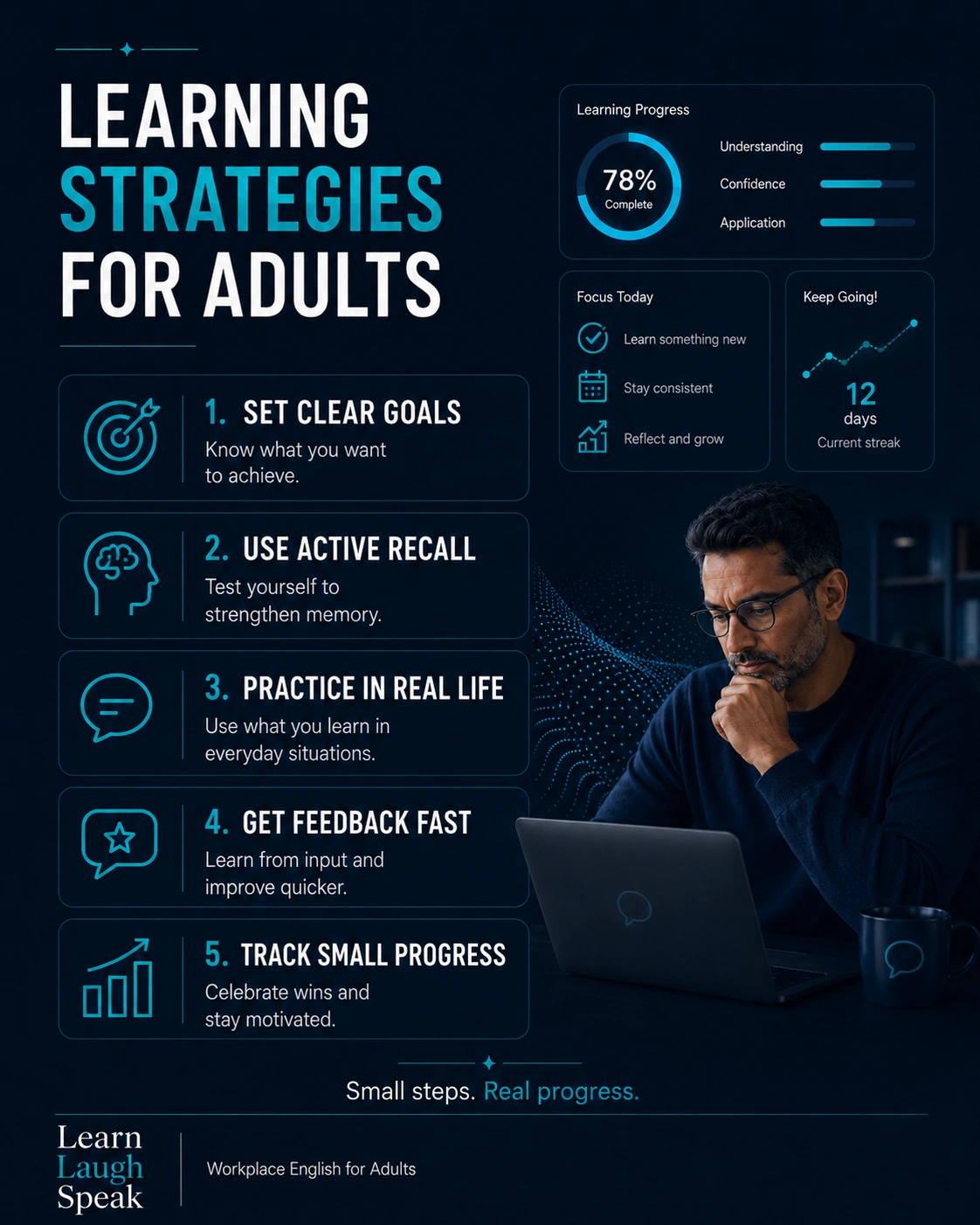
Learning Strategies for Adults: Address and Know the Problem
Before choosing a study method, adults need to know what the real problem is.
This sounds obvious, but it is often skipped.
A learner may say:
“I need to study more.”
But the real issue might be:
“I do not know what to study next.”
“I keep forgetting what I learn.”
“I understand the lesson but cannot use it.”
“I am repeating the same mistake.”
“I am learning things that are too easy.”
“I am avoiding the skill that makes me uncomfortable.”
Each problem needs a different strategy.
More study is not always the answer.
Better direction usually is.
This is why strong adult learning starts with diagnosis, not just content.
Adults learn in different ways. Not just provide bulk non-specific content.
Strategy 1: Start With a Clear Goal, Not a Random Lesson
Adults learn better when the reason is clear.
A goal gives learning direction.
Without a goal, study becomes random.
The learner may complete lessons, but still wonder if they are moving closer to anything useful.
A clear goal does not need to be complicated.
It can be:
“I want to write clearer work emails.”
“I want to speak with more confidence in meetings.”
“I want to understand online training materials.”
“I want to stop making the same grammar mistake.”
“I want to finish this level and move forward.”
The CDC’s adult learning principles explain that adults are often goal-oriented and prefer learning connected to personal or professional needs.
That is why goal-first learning works.
It gives the learner a reason to care.
And when adults understand why the learning matters, consistency becomes easier.
Strategy 2: Use Active Recall Instead of Only Reviewing
Many adults review by rereading.
They open the lesson again.
Look over notes.
Watch the video again.
Read the same explanation.
That can help, but it is not enough by itself.
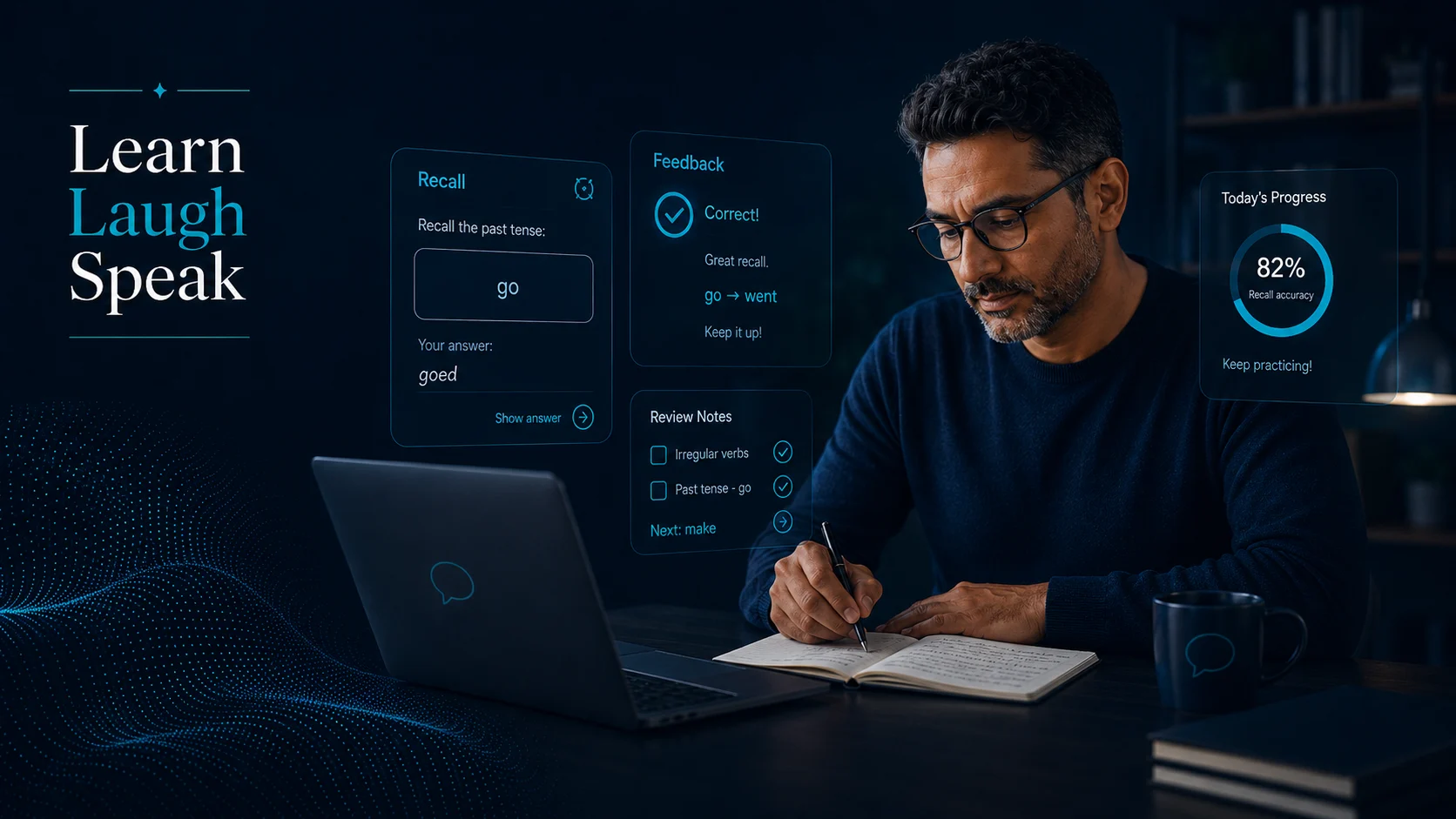
A stronger strategy is active recall.
That means closing the notes and trying to bring the information back from memory.
For example:
- Explain the idea without looking.
- Write the sentence again from memory.
- Answer a question before checking.
- Summarize yesterday’s lesson in your own words.
- Try the task first, then review the correction.
This is harder than rereading.
But that is the point.
The effort of remembering helps make the learning stronger.
Adults should not only ask:
“Did I understand this?”
They should ask:
“Can I bring it back when I need it?”
That second question is where real progress begins.
Because adults can forget when progress is lacking direction.
Strategy 3: Make Learning Practical Quickly
Adults usually do not want knowledge that sits in a notebook.
They want knowledge they can use.
This is why practical use is one of the most important learning strategies for adults.
A lesson becomes stronger when the learner applies it to something real.
Not someday.
Soon.
For example:
Learn a phrase, then use it in a message.
Learn a rule, then apply it in a sentence.
Learn a process, then use it in a task.
Learn feedback, then correct the next attempt.
Adult learning principles often emphasize relevance and application because adults are more likely to engage when learning connects to work, responsibilities, or real-life needs.
The faster learning becomes useful, the easier it is to keep.
Strategy 4: Use Feedback Before Mistakes Become Habits
Adults can practise for a long time and still repeat the same mistake.
That is frustrating.
But it is common.
Practice alone does not always fix mistakes.
Sometimes practice makes the mistake stronger if no correction happens.
That is why feedback matters.
Good feedback shows the learner:
what happened
why it happened
what to change
what to practise next
whether the same mistake keeps returning
The Education Endowment Foundation describes feedback as information given to learners about their performance in relation to learning goals, with the aim of improving outcomes.
For adults, feedback saves time.
It turns effort into direction.
Without feedback, a learner may work hard but keep circling the same problem.
With feedback, the next step becomes clearer.
Strategy 5: Build a Small Learning Routine That Can Survive Real Life
A perfect study routine often fails because adult life is not perfect.
Work gets busy.
Family needs attention.
Energy changes.
Plans break.
So the best routine is not the most ambitious one.
It is the one the learner can return to.
A useful routine might be:
- 10 minutes of review.
- One short practice task.
- One correction.
- One real-life use.
- One quick progress check.
That is enough to keep the learning alive.
OECD notes that adult learning systems need to become more flexible, responsive, and future-ready so adults can continue developing skills across working life.
This matters because adults do not need routines built for perfect weeks.
They need routines built for real weeks.
Strategy 6: Stop Measuring Progress Only by Time Spent
Time matters, but time alone does not prove progress.
An adult can study for two hours and learn very little.
Another can study for 20 focused minutes and make real progress.
The better question is not:
“How long did I study?”
It is:
“What can I do better now?”
Progress can look like:
- fewer repeated mistakes
- faster recall
- better confidence
- clearer writing
- stronger listening
- less hesitation
- more accurate use
- better understanding of feedback
Adults need visible progress because it protects motivation.
If they cannot see improvement, they may assume nothing is working.
But often, progress is happening in small ways.
The strategy is to notice it.
Strategy 7: Plan, Monitor, and Adjust
Adults often learn better when they are aware of their own learning process.
This is called metacognition.
In simple English, it means thinking about how you are learning.
Before learning, ask:
What am I trying to improve?
During learning, ask:
Is this working?
After learning, ask:
What should I change next time?
The Education Endowment Foundation explains that metacognitive and self-regulated learning approaches help learners plan, monitor, and evaluate their learning more explicitly.
This is useful for adults because they do not have time to waste on methods that are not helping.
A good learner does not only study.
They adjust.
Simple Learning Strategy Map for Adult Learners
| If the problem is… | Use this strategy |
|---|---|
| “I do not know where to start.” | Set a clear goal and check your level |
| “I forget quickly.” | Use active recall and spaced review |
| “I understand but cannot use it.” | Apply the skill in a real task |
| “I keep making the same mistake.” | Get feedback and practise the correction |
| “I lose motivation.” | Track small visible progress |
| “I do not have much time.” | Use shorter routines that repeat |
| “I feel lost with too many lessons.” | Follow a clear path |
This is the main point.
Adults do not need one magic strategy.
They need the right strategy for the problem in front of them.
Learning Strategies for Adults Doesn’t Need More Content
Modern learners have access to more content than ever.
Videos.
Apps.
Courses.
Articles.
AI tools.
Templates.
Guides.
The problem is not access.
The problem is selection.
What should the learner focus on?
What is actually missing?
What needs correction?
What is ready to move forward?
What should be repeated?
UNESCO describes lifelong learning as continuous education and skills development across all stages of life, which fits the reality that adults need learning that continues beyond formal education.
But lifelong learning does not mean endless content.
It means useful learning over time.
For adults, that difference matters.
Learn Laugh Speak Provides Learning Strategies for Adults
At Learn Laugh Speak, adult students do not begin from a random lesson.
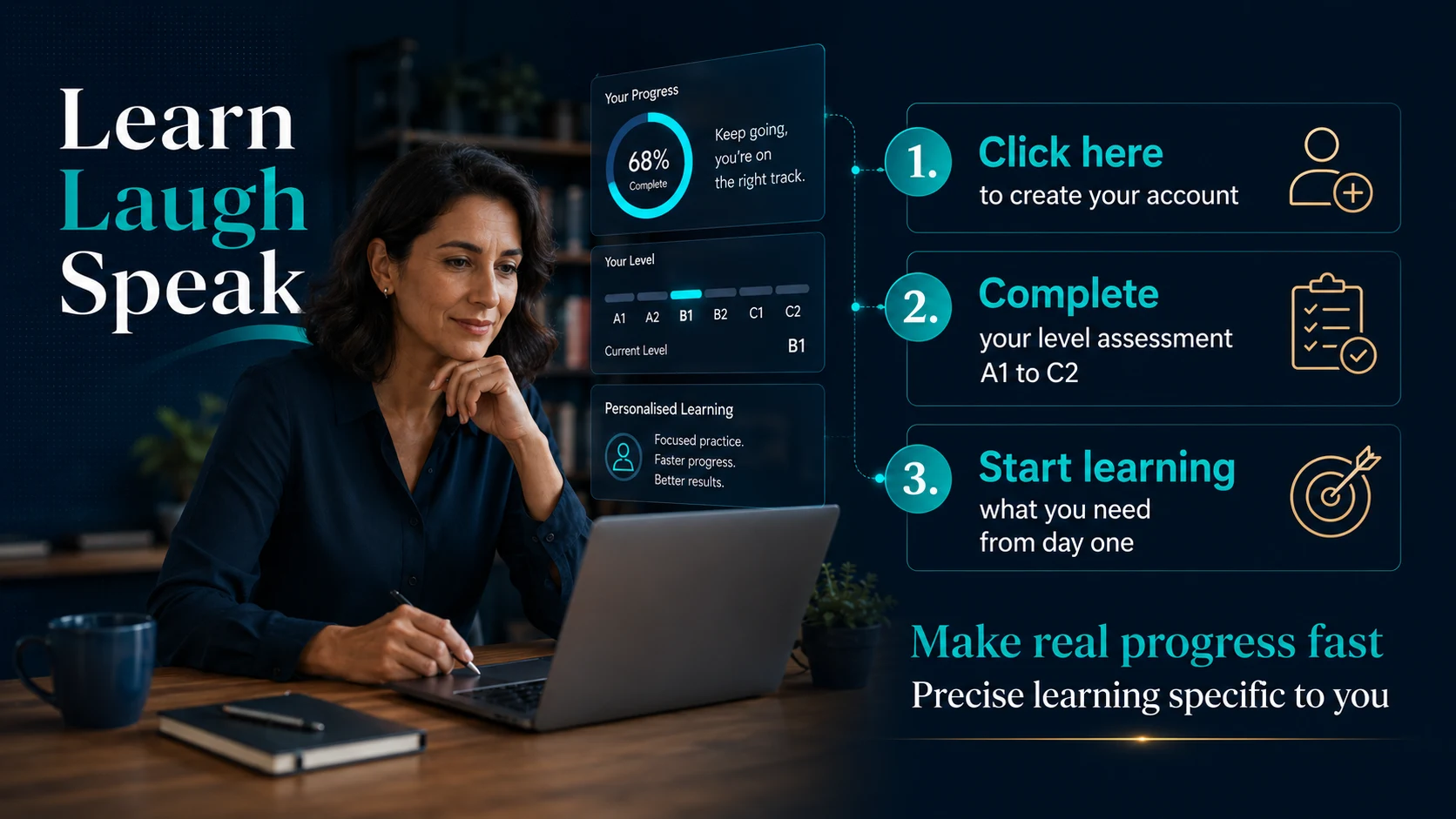
They begin with a level assessment so the platform can understand where they are now.
That matters because the right strategy depends on the learner’s starting point.
Some adults have prior learning experience.
Some have hidden gaps.
Some need feedback because repeated mistakes are slowing them down.
Some need flexibility because they are learning around work and real life.
Some can move faster because they already know parts of the level.
From there, each student follows a personalized learning path based on level, mistakes, progress, and needs.
This supports learning strategies for adults because the platform does not treat every learner the same.
Students learn what they need, when they need it.
They do not waste time repeating everything they already know.
They also do not skip the areas where mistakes are still appearing.
That makes learning more precise.
And for adults, precise learning is usually the difference between studying more and improving faster.
Learning Strategies for Adults What Not To Forget
A good learning strategy should make progress clearer.
Not heavier.
Not more complicated.
Not more stressful.
The right strategy helps adults use their time better.
It helps them know what to practise.
It helps them remember more.
It helps them fix mistakes sooner.
It helps them connect learning to real life.
And it helps them keep going when motivation is not enough.
Adults do not need to study like children.
They need strategies that match adult life.

Final Thought
Learning strategies for adults work best when they are practical, focused, and connected to real progress.
Adults need clear goals, active recall, useful feedback, real-life practice, flexible routines, and visible improvement.
They do not need endless content.
They need better direction.
The strongest learning strategy is not always the hardest one.
It is the one that helps the adult learner know what to do next, use what they learn, and keep improving in a way that fits real life.
That is why learning strategies for adults should be built around progress, not just study time.
4 thoughts on “7 Learning Strategies for Adults That Actually Help Progress”
Pingback: How to Choose the Right Compliance Training Platform - Learn Laugh Speak
Pingback: Why Adult Learning in 2026 Cannot Rely on Old Education Models
Pingback: Digital Education for Adults: Why Technology is Not Enough
Pingback: Personalized Education for Adults: One Learning Path Is Not Enough