
 English
 Arabic
 Chinese (Simplified)
 Dutch
Dutch French
 German
 Italian
 Portuguese
 Russian
 Spanish
How has adult learning in 2026 changed?
Traditional education often assumes a fixed path.
Everyone starts together.
Everyone moves at the same pace.
Everyone follows the same lessons.
Everyone is measured by completion.
That may be easier to organize, but it does not always fit adult learners.
Adults arrive with different histories.
One adult may have strong prior knowledge but low confidence.
Another may have forgotten parts of what they learned years ago.
Another may understand the theory but struggle to use the skill in real life.
Another may need flexibility because their schedule changes every week.
OECD’s 2025 report on adult learning looks at participation, delivery, barriers, and how adult learning systems can better support learners in changing labour markets.
That point matters because adult learning is not only about offering education.
It is about making education usable.
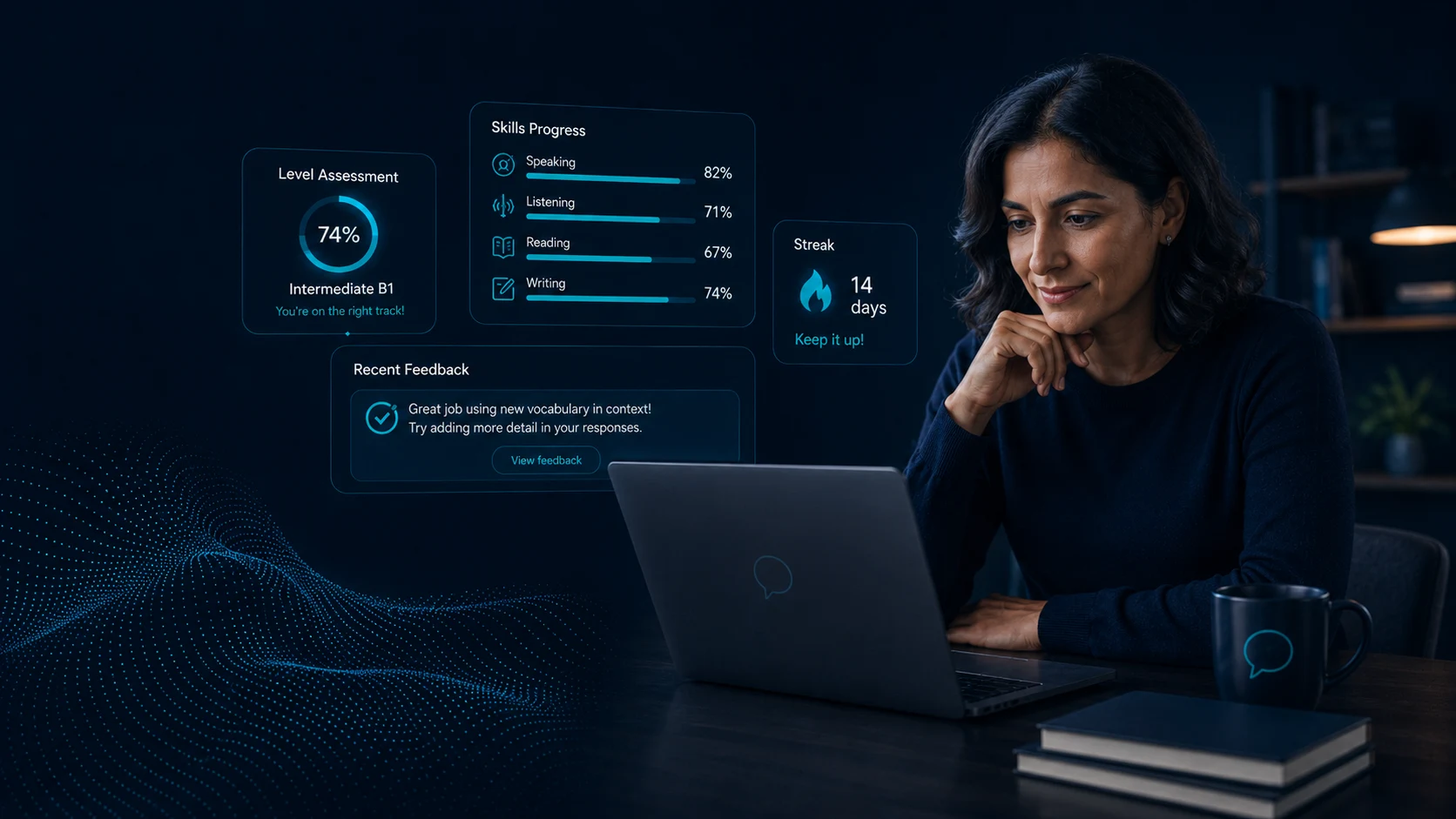
Change 1: From Content Access to Guided Learning
Access used to be the biggest problem.
Now, for many adults, the problem is overload.
There is too much information.
Too many courses.
Too many videos.
Too many tools.
Too many opinions about what to learn next.
An adult can spend hours looking for the right lesson before they even start learning.
That is why adult learning in 2026 needs guidance.
Guided learning helps adults answer practical questions:
Where should I start?
What do I already know?
What should I skip?
What should I repeat?
What is the next useful step?
This is a major shift.
Modern education cannot only give adults access to content.
It has to help them make better decisions about what to learn and when.
Learning strategies have changed for adults in 2026.
Change 2: From Fixed Courses to Personalized Pathways
A fixed course assumes everyone needs the same thing.
Adults rarely do.
Some adults need more support in one skill and less in another.
Some can move faster because they already have prior learning.
Some need to slow down because hidden gaps are holding them back.
Some need feedback more than explanation.
This is why personalized pathways matter.
Personalized learning does not mean making education easier.
It means making it more accurate.
The adult learner should not waste time repeating what they already know.
They also should not be pushed forward while mistakes are still appearing.
UNESCO describes lifelong learning as continuous education, skills development, and personal growth across all stages of life.
That idea fits modern adult education well because learning does not happen once.
It continues as adults change roles, face new challenges, and need new skills.
Change 3: From Completion Rates to Real Skill Progress
Finishing a course feels good.
But completion is not always the same as ability.
An adult can finish a module and still struggle to use the skill later.
They can watch a video and still forget the idea.
They can complete an exercise and still make the same mistake in real life.
So adult education needs better progress signals.
Instead of only asking:
“Did the learner finish?”
Modern learning should ask:
Can they use the skill?
Can they remember it later?
Can they apply it without help?
Can they correct the mistake next time?
Can they use the skill in a real situation?
This is one of the most important shifts for adult learning in 2026.
Adults do not need proof that they clicked through content.
They need proof that their ability is improving.
Change 4: From Passive Lessons to Active Practice
Passive learning can feel comfortable.
Reading.
Watching.
Listening.
Taking notes.
These can help, but they do not always create strong progress.
Adults need to practise.
They need to try.
They need to use the skill before it feels perfect.
They need to make mistakes and correct them.
Active practice is where learning becomes real.
For example, it is not enough to learn how to write a better email.
The adult needs to write one.
It is not enough to learn a communication phrase.
The adult needs to use it in context.
It is not enough to understand a concept.
The adult needs to apply it.
This is why modern adult education has to move from content consumption to skill use.
Learning should not stop at “I understand.”
It should move toward “I can do this.”
Change 5: From Delayed Correction to Faster Feedback
Adults do not have time to practise the wrong thing for months.
Feedback matters because it turns effort into direction.
Without feedback, repeated mistakes can become habits.
With feedback, the learner can see what happened, why it happened, and what to practise next.
The Education Endowment Foundation defines feedback as information given to learners about their performance relative to learning goals or outcomes, and says feedback should aim to improve learning.
That is exactly what adults need.
Not vague correction.
Useful correction.
Feedback should help the learner understand:
- what went wrong
- why it matters
- whether it keeps happening
- what the next step should be
- how to use the correction in context
In 2026, feedback should not feel like an extra feature.
It should be part of the learning path.
Change 6: From Rigid Schedules to Flexible Structure
Flexibility is important, but flexibility alone is not enough.
A folder full of lessons is flexible.
But it may not help the learner know what to do next.
A video library is flexible.
But it may still leave the adult guessing.
What adults need is flexible structure.
That means the learning can fit around real life, but still guide progress.
Adults may need shorter study sessions.
They may need to return after a break.
They may need to move faster through familiar material.
They may need extra practice where mistakes keep appearing.
OECD’s full adult learning report examines patterns of participation, delivery, and barriers that limit access, especially for disadvantaged groups.
This matters because adult learning has to work under real conditions.
Not perfect conditions.
A system that only works when life is calm is not really built for adults.
Change 7: From One-Time Education to Lifelong Learning
The old education model often treated learning as something people completed early in life.
School.
University.
Training.
Then work.
That separation no longer fits reality.
Adults now need to keep learning across their working lives.
Not because they failed before.
Because the world around them keeps changing.
New tools appear.
New roles appear.
New communication expectations appear.
New skills become important.
UNESCO’s Institute for Lifelong Learning describes learning for and at work as an integral part of adult education and lifelong learning, taking place across formal, non-formal, and informal settings.
That is the future direction.
Learning is not something adults leave behind.
It becomes something they keep using to stay ready.
The 2026 Adult Learning Shift
| 2026 Shift | What It Means for Adult Learners |
|---|---|
| More content is not enough | Adults need guidance, not just access |
| Courses need to adapt | Adults arrive with different gaps and prior learning |
| Skills matter more than completion | Progress should show what learners can actually do |
| Feedback must be faster | Mistakes should guide the next step |
| Learning must fit real life | Adults need flexible but structured paths |
| Education is ongoing | Adults need lifelong learning, not one-time training |
This is the difference between old adult education and modern adult learning.
Old education asks people to follow the course.
Modern learning helps the course respond to the person.
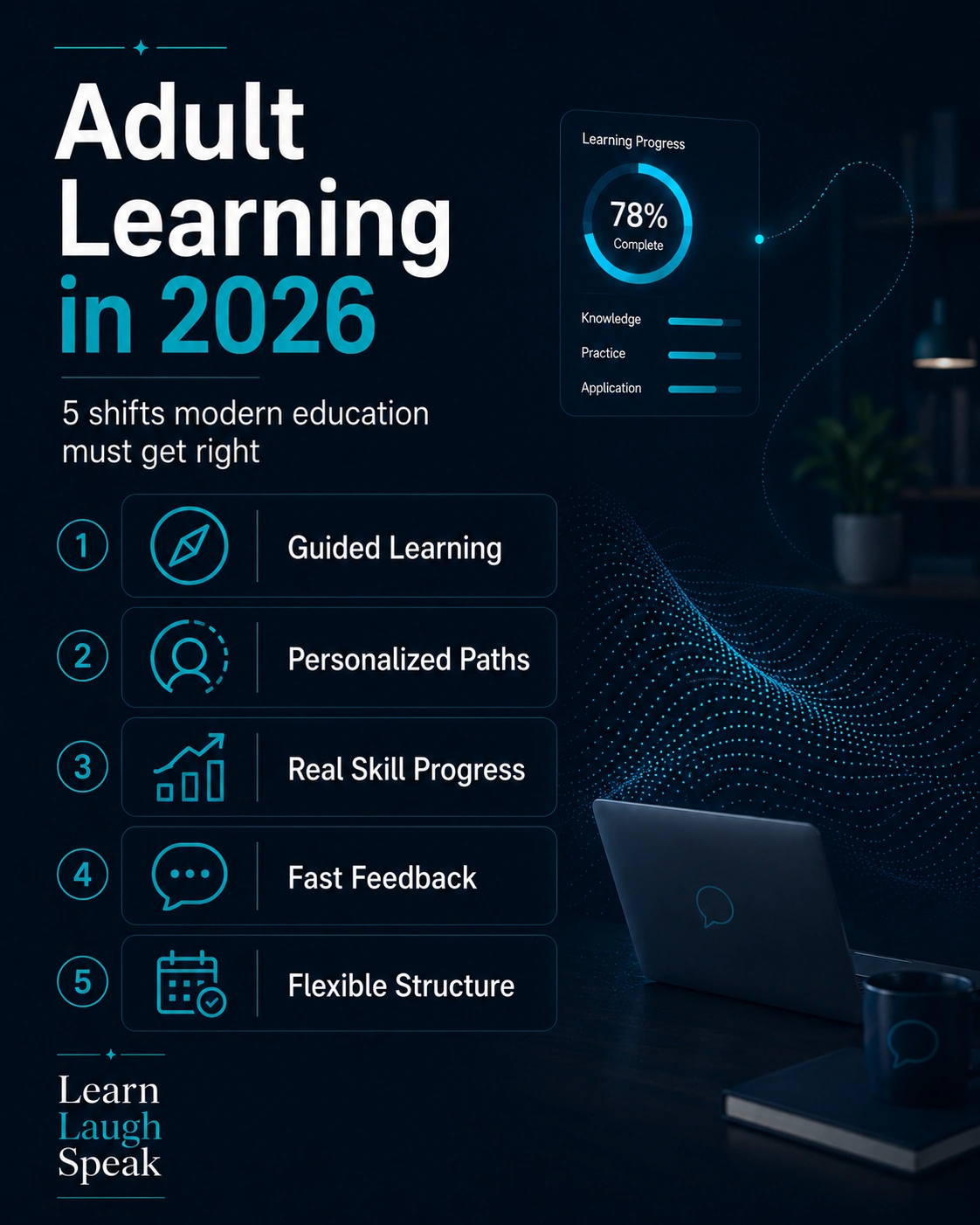
How Learn Laugh Speak Fits the 2026 Adult Learning Shift
Learn Laugh Speak is built around the idea that adult learners should not all follow the same generic path.
Every student starts with a level assessment so the platform can understand where they are now.
That matters because adults arrive with different histories.
Some have prior learning.
Some have hidden gaps.
Some can move faster through what they already understand.
Some need more support where mistakes are still appearing.
From there, each learner follows a personalized path based on level, progress, mistakes, and needs.
This fits the direction of adult learning in 2026 because the focus is not on random content.
It is on accurate learning.
Students learn what they need, when they need it.
They do not waste time repeating everything they already know.
They also do not skip the areas where support is still needed.
That is how adult learning becomes more useful, more efficient, and more connected to real progress.
Final Thought on Adult Learning in 2026
Adult learning in 2026 has to be more practical than traditional education.
Adults do not need endless content.
They need the right content.
At the right level.
With the right feedback.
At the right time.
They need learning that respects prior experience, real-life schedules, personal goals, and the need for visible progress.
The future of adult education will not be won by platforms that simply offer more lessons.
It will be won by learning systems that help adults actually move forward.
That is what modern education must get right.
2 thoughts on “Why Adult Learning in 2026 Cannot Rely on Old Education Models”
Pingback: How Bloggers Can Make AI Drafts Sound More Natural - Learn Laugh Speak
Pingback: International Schools That Feel Like Home - Learn Laugh Speak