
 English
 Arabic
 Chinese (Simplified)
 Dutch
Dutch French
 German
 Italian
 Portuguese
 Russian
 Spanish
Basketball is rhythm, teamwork, and intelligence all in motion. To truly follow and enjoy the game, learners need to understand the words that describe it. Mastering Basketball Vocabulary helps you communicate with clarity, understand commentary, and appreciate one of the world’s fastest and most expressive sports.
Quick Answer: What Is Basketball Vocabulary?
Basketball vocabulary means the words and phrases used to describe the game, including player positions, scoring, fouls, tactics, statistics, and slang.
Common basketball terms include dribble, rebound, assist, turnover, free throw, three-pointer, fast break, and slam dunk.
Learning basketball vocabulary helps English learners understand commentary, follow games, talk with other fans, and use sports expressions naturally in English.
Why Basketball Vocabulary Matters
Basketball is global. Whether you’re watching the NBA in the U.S., EuroLeague in Europe, or international FIBA tournaments, the same basketball vocabulary is used to explain strategies, fouls, and unforgettable moments.
Learning these terms helps English learners:
- Follow fast-paced commentary.
- Communicate with teammates in a friendly or professional setting.
- Use basketball expressions confidently in business or conversation.
Much like the game itself, basketball’s language is concise, energetic, and precise—three qualities that make Basketball Vocabulary exciting to learn.
Essential Terms in Basketball Vocabulary
Every great play begins with a shared understanding of basic terminology.
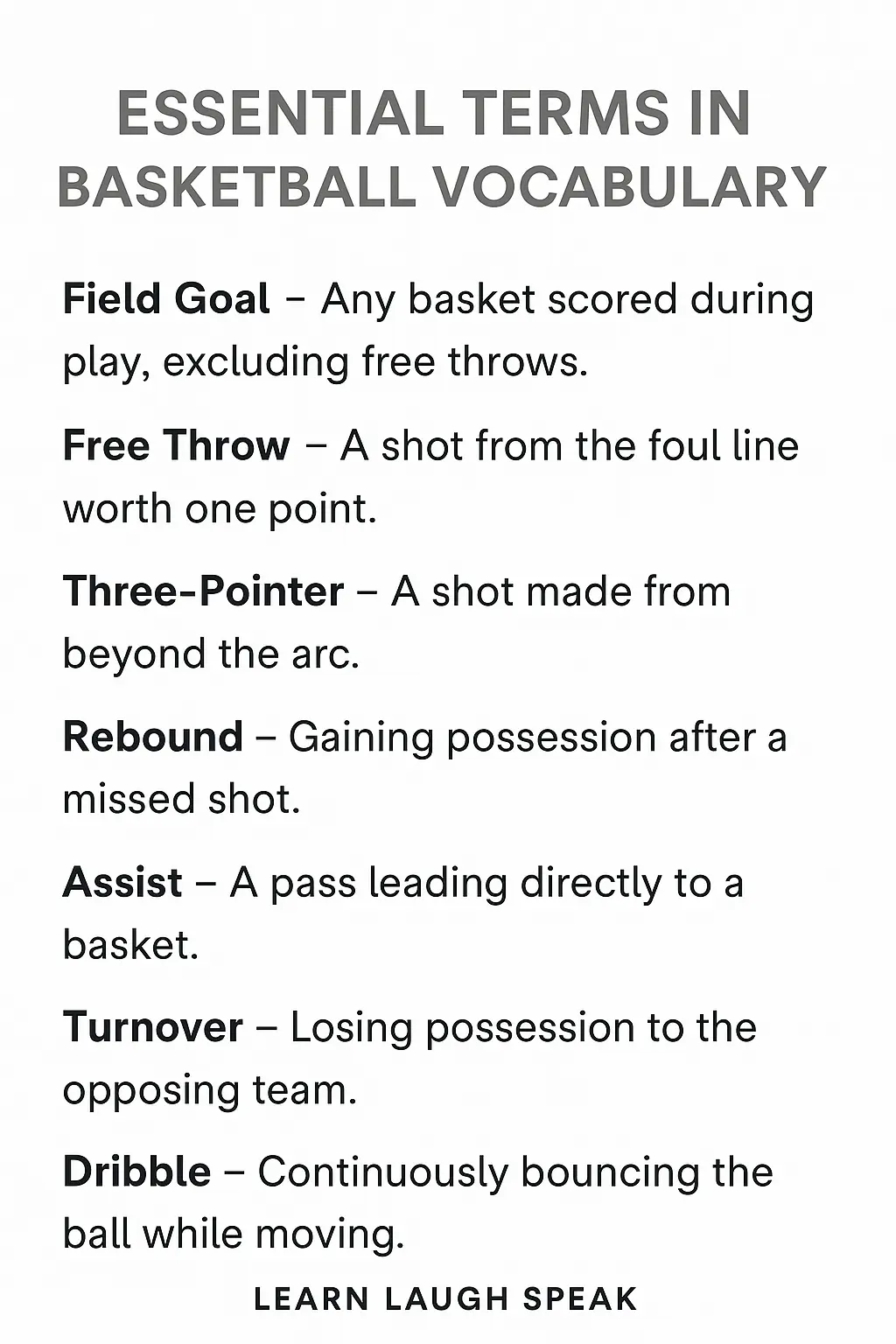
Here are the most important terms to build your foundation in basketball vocabulary:
| Basketball Term | Simple Meaning |
|---|---|
| Field Goal | Any basket scored during play, except free throws |
| Free Throw | A one-point shot taken from the foul line |
| Three-Pointer | A shot made from behind the three-point line |
| Rebound | Getting the ball after a missed shot |
| Assist | A pass that leads directly to a basket |
| Turnover | Losing possession of the ball |
| Dribble | Bouncing the ball while moving |
| Steal | Taking the ball from the other team |
| Block | Stopping or deflecting a shot |
| Foul | Illegal contact with another player |
Each of these terms adds depth to your understanding of both statistics and storytelling in basketball commentary.
Player Roles and Positions in Basketball Vocabulary
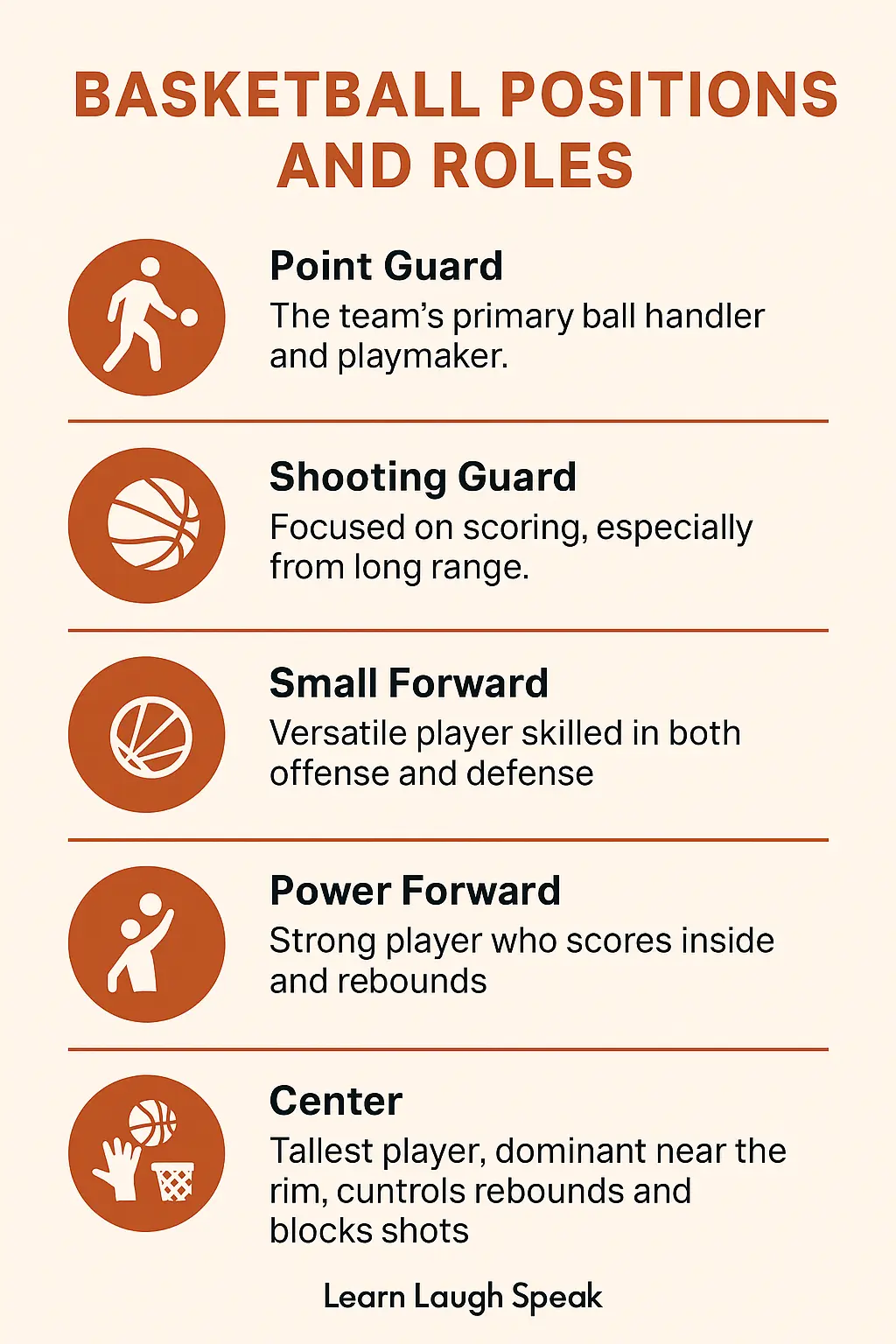
Basketball is built on balance and cooperation. Each position has a unique responsibility, expressed through its basketball vocabulary.
- Point Guard – The team’s primary ball handler and playmaker.
- Shooting Guard – Focused on scoring, especially from long range.
- Small Forward – Versatile player skilled in both offense and defense.
- Power Forward – Strong player who scores inside and rebounds.
- Center – Tallest player, dominant near the rim, controls rebounds and blocks shots.
Understanding these roles helps you follow team formations and player dynamics, which are central to mastering basketball vocabulary.
100+ Basketball Terms: Modern Slang, Moves, and Rules
Tactics and Strategy in Basketball Vocabulary
Basketball is a chess match at full speed. The strategies teams use are best understood through their terminology.
- Pick-and-Roll – Offensive play where a player screens (blocks) a defender to free a teammate.
- Isolation (Iso) – When one player attacks one-on-one.
- Fast Break – Rapid transition from defense to offense after a rebound or steal.
- Zone Defense – Players guard areas instead of specific opponents.
- Man-to-Man Defense – Each player marks one opponent.
- Full-Court Press – Aggressive defense applied across the entire court.
By learning these phrases, learners can visualize tactical battles and enjoy commentary with full understanding.
Common Basketball Slang and Phrases
Basketball vocabulary also includes slang used by players, fans, and commentators.
| Basketball Slang | Meaning |
|---|---|
| Bucket | A made basket |
| Brick | A badly missed shot |
| Dime | A great assist |
| Handles | Strong dribbling skills |
| Posterize | Dunking over another player |
| Clutch | Performing well under pressure |
| Heat check | Taking a difficult shot after making several shots |
| And-one | A basket made while being fouled |
| Buzzer-beater | A shot made just before time expires |
These basketball phrases are common in commentary, social media, and casual English conversations about the game.
Cricket Vocabulary: Mastering the Language of the Game
Common Fouls and Rules in Basketball Vocabulary
Basketball is also a game of control and discipline. Understanding the fouls and violations in basketball vocabulary is key to following the action.
- Personal Foul – Physical contact against an opponent.
- Charging – Offensive foul for running into a stationary defender.
- Blocking – Defensive foul for illegal movement during contact.
- Traveling – Moving without dribbling the ball.
- Double Dribble – Dribbling, stopping, and then dribbling again.
- Goaltending – Touching the ball while it’s on its downward arc toward the basket.
Every whistle has meaning, and this vocabulary gives you insight into fairness and decision-making in the game.
The Ultimate Glossary of Basketball Terms
Basketball Vocabulary in Everyday English
Basketball has given English many expressions that appear far beyond the court:
- “Slam dunk” – A guaranteed success or easy win.
- “Full-court press” – Intense effort in work or negotiation.
- “Pivot” – To change strategy quickly.
- “Take a shot” – To try something, even at risk of failure.
These idioms prove that Basketball Vocabulary influences everyday English, making it an ideal source of natural expressions for learners.
Analyzing Performance with Basketball Vocabulary
Understanding basketball vocabulary also helps when reading statistics and reports:
- Field Goal Percentage (FG%) – Accuracy of shot attempts.
- Assist-to-Turnover Ratio – Measures efficiency in passing.
- Player Efficiency Rating (PER) – Overall performance metric.
- Double-Double / Triple-Double – Achieving double digits in two or three categories (like points, rebounds, assists).
Knowing these terms enhances your ability to discuss games intelligently and professionally.
Cultural Insights Through Sports
The sport’s vocabulary reflects values of teamwork, creativity, and adaptability. In the U.S., saying someone “has court vision” means they can see opportunities others miss. In international contexts, basketball language represents inclusivity—players and fans from Tokyo to Toronto speak the same terminology.
Learning basketball vocabulary helps English learners tap into a global culture of motivation and teamwork.
How to Practice Basketball Vocabulary
- Watch post-game interviews to hear natural use of sports English.
- Listen to commentary clips on YouTube or podcasts, repeating sentences for rhythm.
- Write short game summaries using five new terms per match.
- Join online basketball forums where fans discuss stats and plays in English.
This active approach turns Basketball Vocabulary into a fun, living part of your daily learning.
A Professional Guide to Football Vocabulary for ESL Students
Grammar and Pronunciation Tips
- Pivot (short “i,” like “give”).
- Assist (emphasis on the second syllable).
- Box out (two words; used as a verb phrase).
- Grammar tip: make a pass, take a shot, set a screen—verbs matter as much as nouns in basketball English.
Using accurate pronunciation builds confidence when speaking about games with native speakers.
Complete Guide to Golf Vocabulary: Language of the Fairway
Final Thoughts
Basketball combines speed, intelligence, and communication—qualities mirrored in its language. Learning basketball vocabulary lets you follow the drama of every possession, understand team strategy, and use powerful idioms that translate beyond sport.
Whether you’re studying English, leading a team, or just watching highlights, fluency in most sports games will make every game more meaningful.
Once you understand the rhythm of basketball vocabulary, the court becomes not just a playing field—but a classroom for clarity, focus, and teamwork.
4 thoughts on “Guide to Basketball Vocabulary: The Language of the Court”
Pingback: Your Pro Guide to Tennis Vocabulary: Serving Success
Pingback: Baseball Vocabulary: Understanding America’s Pastime - Learn Laugh Speak
Pingback: Volleyball Terms: 100 Volleyball Words and Phrases Explained
Pingback: Pickleball Terms: 75 Words Every Player Should Know