
 English
 Arabic
 Chinese (Simplified)
 Dutch
Dutch French
 German
 Italian
 Portuguese
 Russian
 Spanish
Tennis is more than a game of speed and skill—it’s a conversation between power, precision, and patience. To follow it, you need to speak its language. Mastering Tennis Vocabulary allows learners to understand the sport’s structure, scoring, and spirit while also expanding their English fluency in a practical and enjoyable way.
Tennis Terms: A Comprehensive Guide to Tennis Slang
Rapid Fire Answer: What Is Tennis Vocabulary?
Tennis vocabulary means the words and phrases used to describe the sport, including scoring, shots, court areas, rules, tactics, and player behavior.
Common tennis terms include serve, ace, fault, rally, deuce, break point, forehand, backhand, volley, and match point.
Learning tennis vocabulary helps English learners follow matches, understand commentary, talk about sport confidently, and recognize tennis expressions used in everyday English.
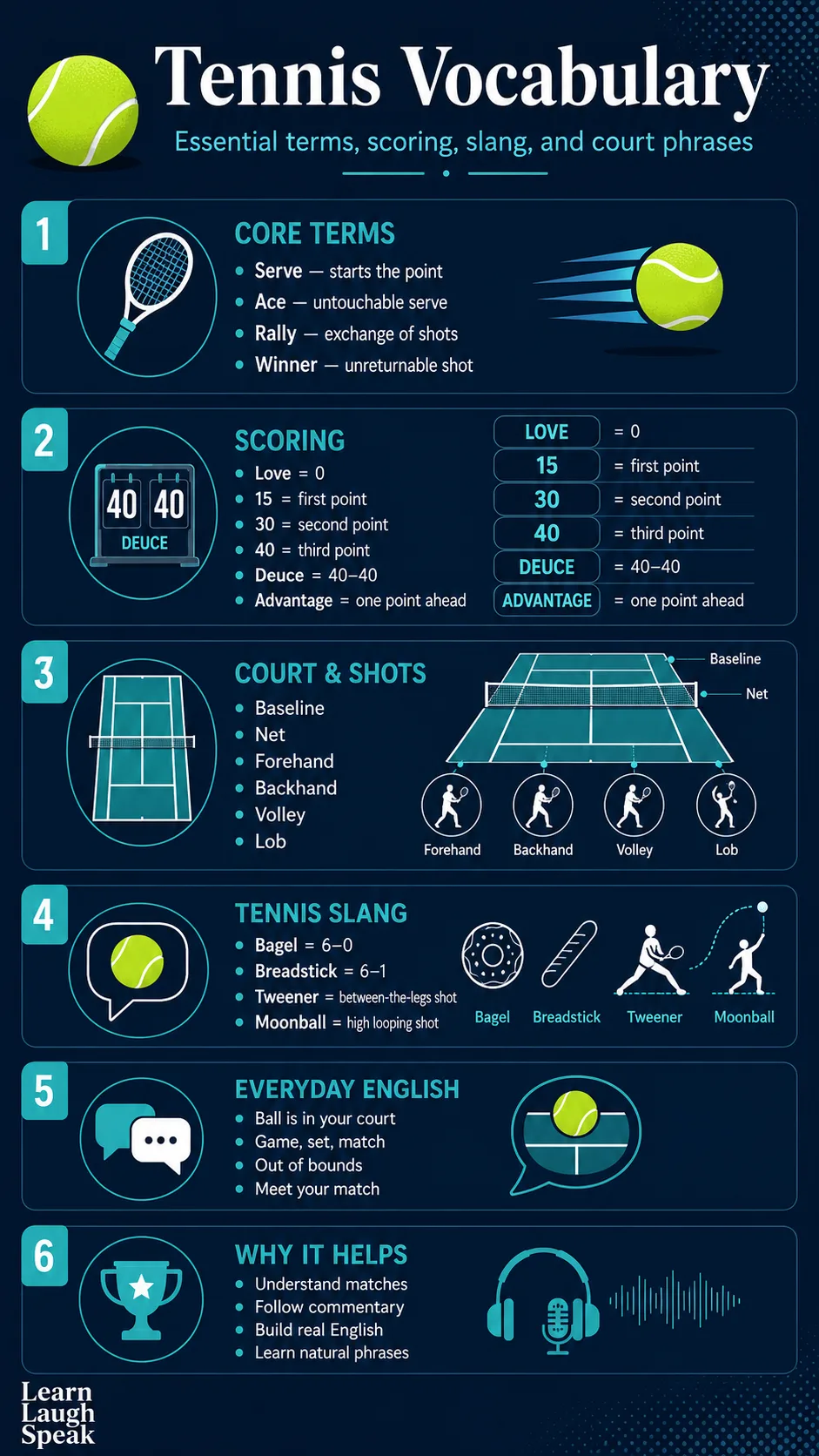
Why Learn Tennis Vocabulary in 2025
At first glance, tennis can seem simple: hit the ball over the net. But listen closely to the commentary, and you’ll hear a sophisticated vocabulary full of unique terms, idioms, and scoring patterns.
Learning Tennis Vocabulary helps you:
- Understand professional commentary during major tournaments like Wimbledon or the US Open.
- Describe your own games accurately and confidently.
- Recognize expressions from tennis that appear in everyday English.
The language of tennis teaches both precision and politeness—traits central to fluent English communication.
Guide to Basketball Vocabulary: The Language of the Court
Core Terms in Tennis Vocabulary
Let’s start with the essentials of Tennis Vocabulary—words every learner should know before stepping onto the court or watching a match.
These terms form the heart of any match description and are fundamental to understanding Tennis Vocabulary.
| Tennis Term | Simple Meaning |
|---|---|
| Serve | The shot that starts each point |
| Ace | A serve the opponent cannot touch |
| Fault | A missed serve |
| Double Fault | Two missed serves in a row |
| Rally | Several shots exchanged between players |
| Winner | A shot the opponent cannot return |
| Unforced Error | A mistake made without strong pressure |
| Break Point | A chance to win the opponent’s service game |
| Hold Serve | Winning your own service game |
| Match Point | A point that can win the match |
30 Tennis Slang Words To Get You Excited For Wimbledon
Scoring System in Tennis Vocabulary
The scoring system is famously unique. Here’s how to decode it:
Learning this aspect of Tennis Vocabulary makes watching or discussing matches effortless.
| Scoring Term | Meaning |
|---|---|
| Love | Zero points |
| 15 | First point won |
| 30 | Second point won |
| 40 | Third point won |
| Deuce | Both players are tied at 40–40 |
| Advantage | One player wins the point after deuce |
| Game | A completed scoring unit |
| Set | A group of games |
| Match | The full contest |
A Professional Guide to Football Vocabulary for ESL Students
Court Terms in Tennis Vocabulary
Tennis is also defined by its space. Understanding these terms gives structure to your visual and verbal comprehension.
- Baseline – The line at the back of the court.
- Service Box – The area where the serve must land.
- Alley – The narrow area between the singles and doubles sidelines.
- Net – Divides the court; crossing it ends play.
- Backcourt / Forecourt – Areas near the baseline or net.
These words help describe position, movement, and tactics in Tennis Vocabulary.
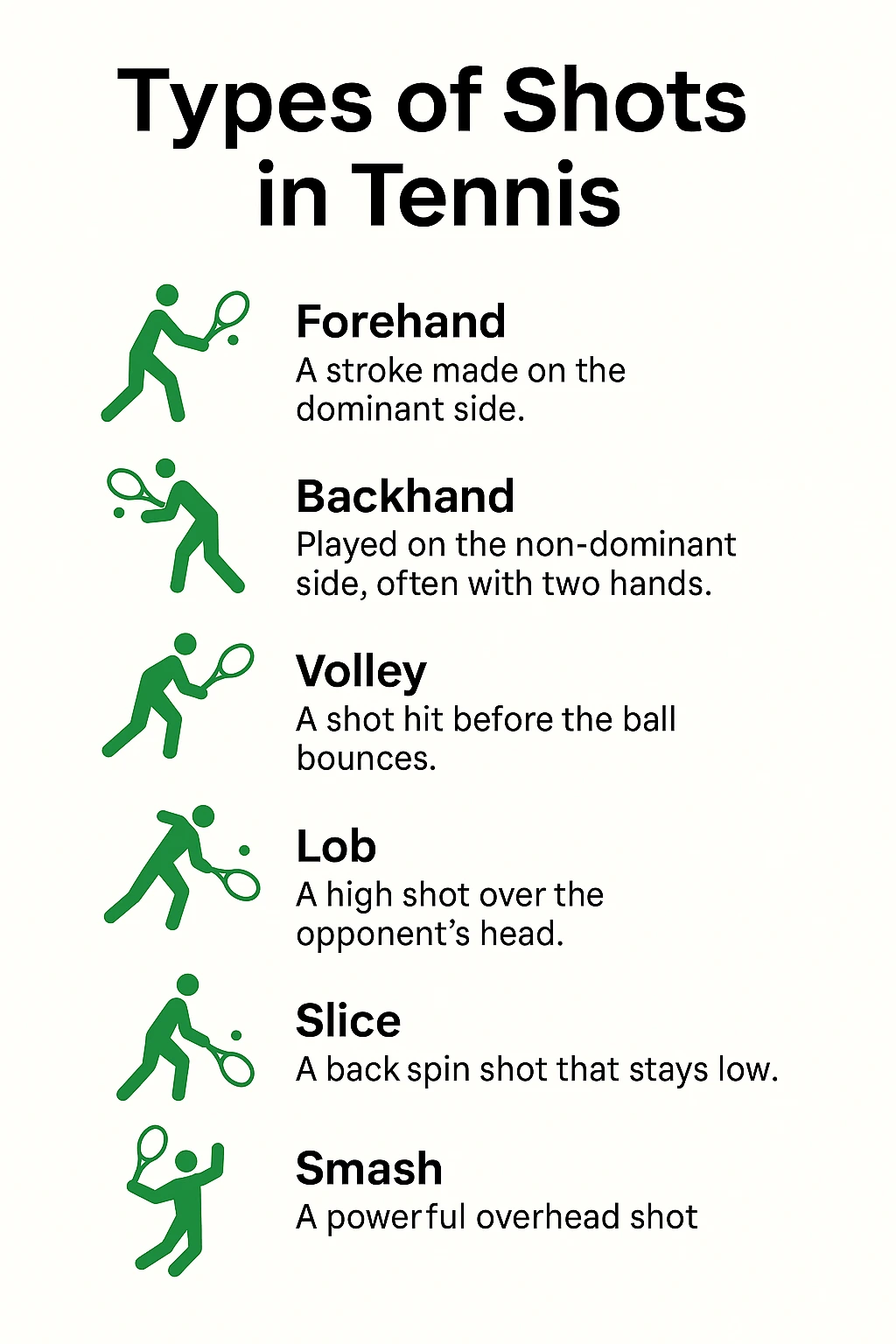
Types of Shots in Tennis Vocabulary
Every shot in tennis carries intention. Each word below reflects the player’s style and strategy.
- Forehand – A stroke made on the dominant side.
- Backhand – Played on the non-dominant side, often with two hands.
- Volley – A shot hit before the ball bounces.
- Lob – A high shot over the opponent’s head.
- Slice – A backspin shot that stays low.
- Smash – A powerful overhead shot.
Understanding these strokes helps learners talk about play in real time using authentic Tennis Vocabulary.
Complete Guide to Golf Vocabulary: Language of the Fairway
Tactics and Movement in Tennis Vocabulary
Tennis strategy depends on angles, rhythm, and anticipation. Here are key tactical expressions:
- Baseline Player – Stays deep, rallies consistently.
- Serve-and-Volley Player – Rushes the net after serving.
- Crosscourt Shot – Diagonal hit from one corner to the other.
- Down the Line – A straight shot parallel to the sideline.
- Unreturnable Serve – Too powerful or well-placed to return.
These are frequent phrases in professional commentary, making them vital parts of advanced Tennis Vocabulary.
Common Violations in Tennis Vocabulary
Like all sports, tennis has rules to maintain fairness and flow. Here are common ones described through Tennis Vocabulary:
- Foot Fault – Stepping on or over the baseline while serving.
- Let – When the serve touches the net but lands in the service box; the serve is replayed.
- Time Violation – Taking too long between points.
- Code Violation – For unsportsmanlike behavior, such as racket abuse or verbal outbursts.
Knowing these phrases ensures you understand both the game’s structure and its culture of respect.
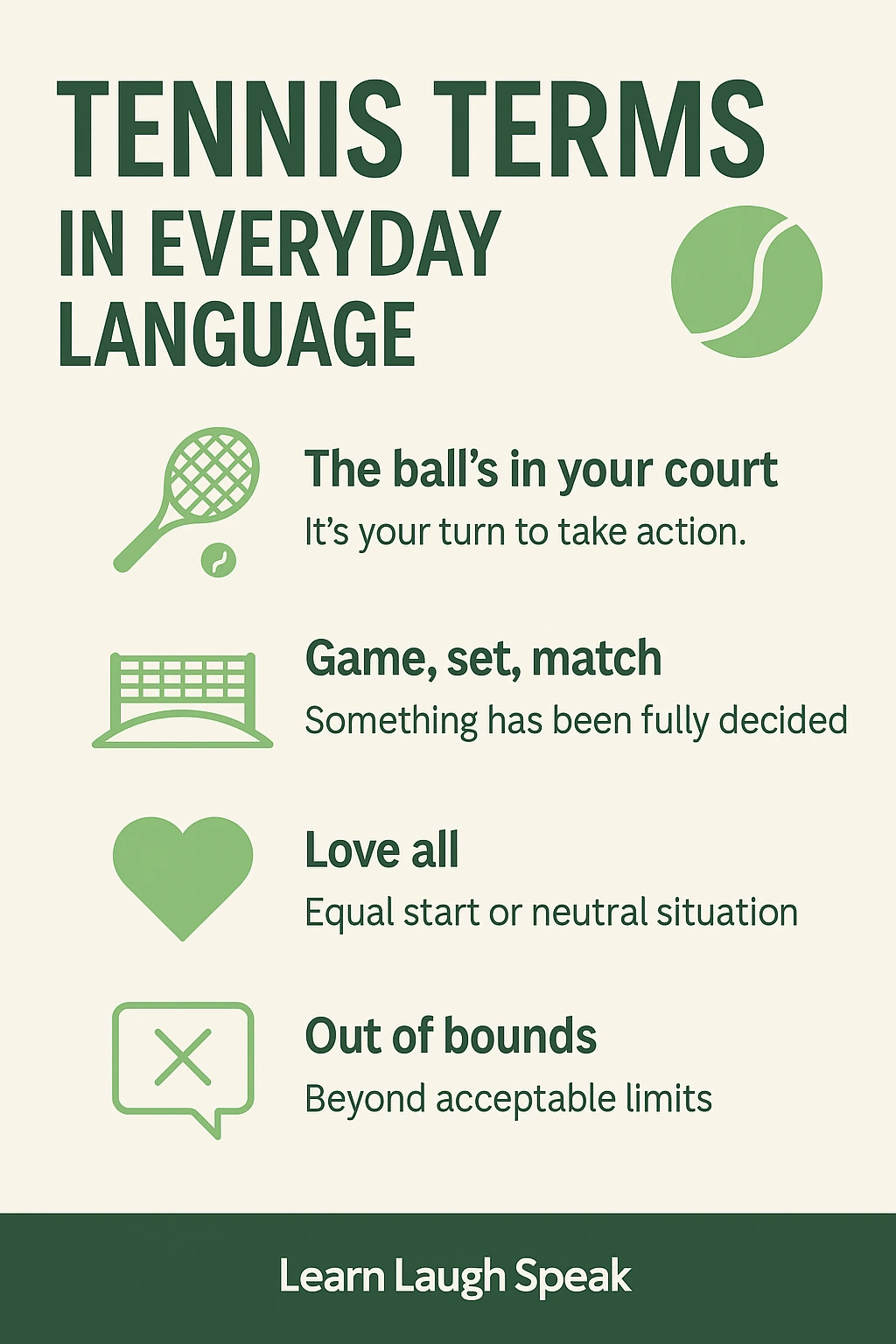
Tennis Vocabulary in Everyday English
Tennis has influenced everyday English. You may hear tennis expressions in offices, schools, or casual conversations.
| Tennis Phrase | Everyday Meaning | Example |
|---|---|---|
| The ball is in your court | It is your turn to act | “I sent the proposal, so now the ball is in your court.” |
| Game, set, match | The result is final | “After that final point, it was game, set, match.” |
| Out of bounds | Not acceptable or outside the limits | “That comment was out of bounds.” |
| Serve it up | Present or provide something | “Let’s serve up some new ideas.” |
| Meet your match | Face someone equally skilled | “In the debate, he finally met his match.” |
These expressions show how Tennis Vocabulary extends beyond sport, teaching rhythm, fairness, and timing.
Common Tennis Slang and Phrases
Tennis vocabulary also includes slang and short phrases used by players, fans, and commentators.
| Tennis Slang | Meaning |
|---|---|
| Bagel | Winning a set 6–0 |
| Breadstick | Winning a set 6–1 |
| Tweener | A shot hit between the legs |
| Moonball | A very high, slow shot |
| Clean winner | A shot that cannot be touched |
| On serve | Both players are holding their service games |
| Servebot | A player who relies heavily on a powerful serve |
| Choke | Lose after being in a strong winning position |
| Tank | Stop trying fully or give up mentally |
These tennis phrases are common in commentary, social media, and casual conversations about matches.
How to Practice and Learn
- Watch live matches with English commentary; note phrases for scoring and tactics.
- Repeat terminology aloud for pronunciation practice.
- Write short recaps of famous matches, focusing on proper use of Tennis Vocabulary.
- Learn in pairs—discuss and quiz each other on terms like deuce, slice, or break point.
Language memory grows when tied to real emotion—tennis offers plenty of those moments.
Pronunciation and Grammar Tips for Tennis Vocabulary
- Deuce (pronounced “dyoos”) and Volley (soft “vaw-lee”).
- Verbs: serve, return, win, hit, smash.
- Collocations: a heavy topspin forehand, a deep return, an unforced error.
Proper word combinations make you sound fluent and natural when using Tennis Vocabulary.
Cultural Insights Learnt Through Sports
Tennis vocabulary also teaches respect and professionalism. Players shake hands after matches, address umpires politely, and follow quiet conduct traditions. Phrases like “good game” or “well played” reinforce positive communication—making tennis not just a sport, but a model for language learners on how to express both competition and courtesy.
Learn Sports English with Learn Laugh Speak
Learn Laugh Speak helps adults learn English through real topics, useful vocabulary, and practical communication.
Sports vocabulary is a great way to build confidence because it connects listening, speaking, reading, and everyday expressions.
With Learn Laugh Speak, students start with a level assessment from A1 to C2 and follow a structured learning path based on their level, goals, mistakes, and progress.
Whether you are learning English for work, travel, study, or conversation, understanding tennis vocabulary helps you build stronger real-world English.
2 thoughts on “Your Pro Guide to Tennis Vocabulary: Serving Success”
Pingback: Baseball Vocabulary: Understanding America’s Pastime - Learn Laugh Speak
Pingback: Rugby Vocabulary: The Language of Strength and Strategy