
 English
 Arabic
 Chinese (Simplified)
 Dutch
Dutch French
 German
 Italian
 Portuguese
 Russian
 Spanish
Learning gaps in adults are not always easy to see.
That is the problem OR barrier to adult learning progress
Most adult students do not suddenly stop improving because they are lazy, unmotivated, or unable to learn.
More often, something smaller is happening underneath.
A missing step.
An old mistake.
A weak foundation.
A skill that was understood once but never fully built.
And because the gap is small, it can hide for a long time.
The student keeps studying.
Keeps trying.
Keeps showing up.
But progress feels slower than it should.
That is usually the moment to stop asking:
“Why am I not improving?”
And start asking:
“What is missing?”

First Sign: You Understand the Lesson, But Still Make the Same Mistake
This is one of the clearest signs of a learning gap.
The student understands the explanation.
They may even say:
“Yes, I know this.”
But then the same mistake appears again later.
That means the knowledge is not fully usable yet.
It exists in theory, but not in practice.
For example, an adult English learner may understand past tense rules in a lesson, but still write:
“Yesterday I go to the meeting.”
That does not mean they never learned the rule.
It means the rule has not become automatic.
That is a gap.
It is flexible learning for adults, which is what you should focus on.
Second Sign: One Skill Is Much Stronger Than Another
Adult learners often have uneven skills.
This is completely normal.
One student may read very well but struggle to speak.
Another may speak confidently but write with repeated errors.
Another may understand meetings but freeze when asked a direct question.
This is why one level label is not enough.
“Intermediate” does not explain the full picture.
Intermediate in reading?
Intermediate in writing?
Intermediate in speaking?
Intermediate under pressure?
Learning gaps in adults often hide inside these uneven skills.
The student looks strong in one area, so the weaker area gets missed.
Quick Gap Check
| What You Notice | Possible Hidden Gap |
|---|---|
| “I understand, but I still make mistakes.” | Knowledge has not become automatic |
| “I can read, but I cannot speak easily.” | Passive skills are stronger than active skills |
| “I forget words when I need them.” | Weak recall under pressure |
| “My writing sounds unclear.” | Sentence structure or word order gap |
| “I keep restarting lessons.” | Wrong starting level or missing foundation |
This table should not make students feel bad.
It should do the opposite.
It shows that the problem can often be identified.
And once it is identified, it becomes easier to fix.
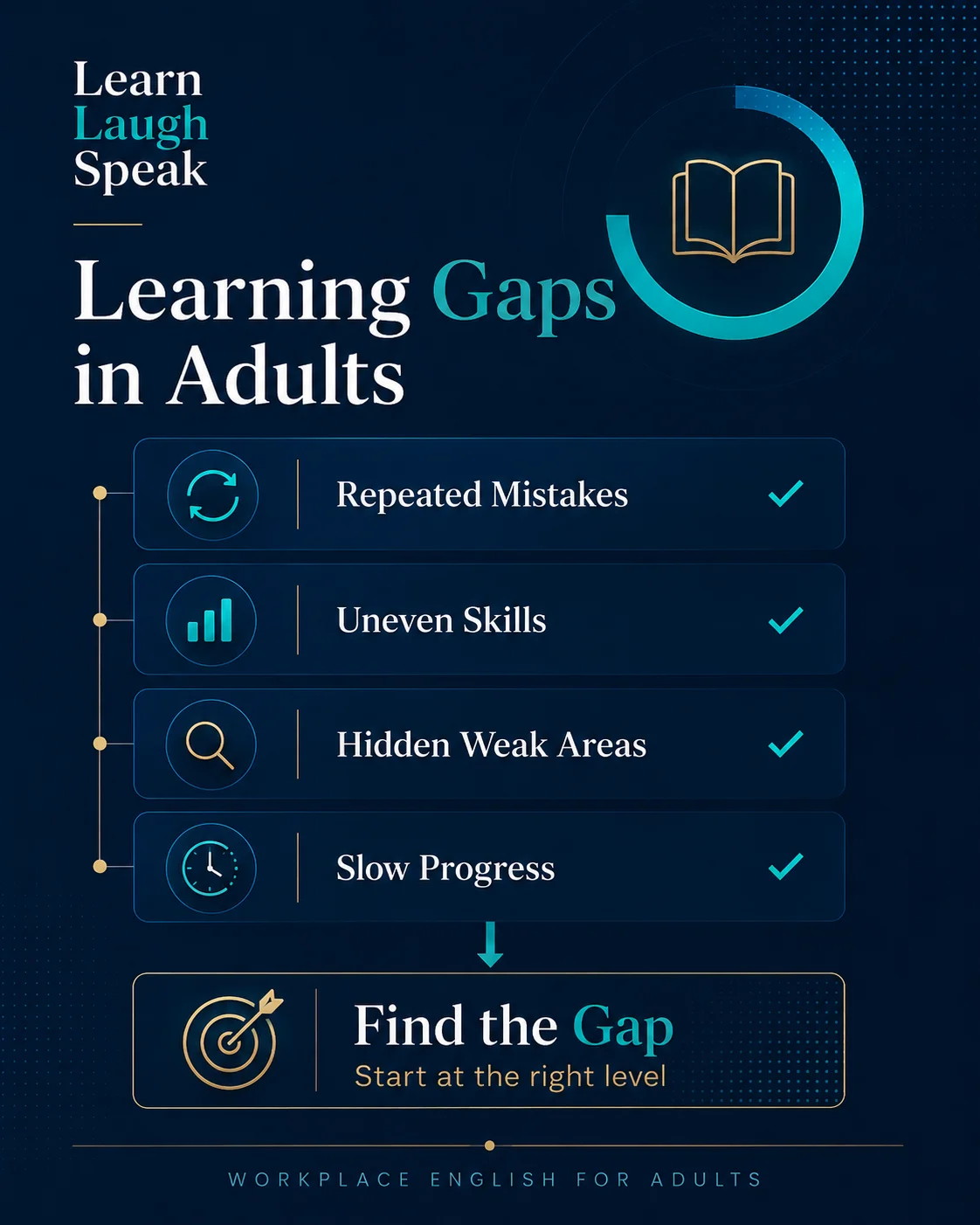
Third Sign: You Keep Studying More, But Not Improving Faster
This is where many adult students lose motivation.
They think the answer is more.
More lessons.
More videos.
More vocabulary.
More grammar.
Sometimes more helps.
But not if the problem is specific.
If the real issue is sentence structure, more vocabulary will not fix it.
If the real issue is listening speed, more grammar exercises will not solve it.
If the real issue is confidence when speaking, reading more articles may not be enough.
General study can feel productive while still missing the actual gap.
That is why adult learning needs to be more precise.
Personalized learning paths are a great way to be precise for adult learning!
Fourth Sign: You Can Recognize the Answer, But Cannot Produce It
Recognition feels like learning.
But it is not the same as use.
A student may recognize a correct sentence when they see it.
They may understand a phrase in an email.
They may know a word when someone else says it.
But when they need to create the sentence themselves, it disappears.
That is not failure.
It is a different skill.
Recognition is passive.
Production is active.
Many learning gaps in adults happen because passive knowledge is stronger than active ability.
This is especially common in English learning.
Why Learning Gaps in Adults Occur
Adult learners usually do not follow one smooth learning journey.
They may have studied years ago.
Stopped.
Started again.
Used English at work without correction.
Learned from different teachers.
Forgot some things.
Built habits around mistakes.
That creates uneven progress.
Not bad progress.
Uneven progress.
And uneven progress needs a smarter learning path.
The goal is not always to start again.
The goal is to find the missing piece.
Why Feedback Matters So Much
Most students can feel that something is wrong.
But they cannot always name the exact problem.
That is where feedback matters.
Good feedback does not just say:
“That is incorrect.”
It should show:
- what happened
- why it happened
- whether it keeps happening
- what to practise next
The Education Endowment Foundation explains that feedback is information given to learners about their performance in relation to learning goals, and its purpose is to improve learning outcomes.
That is exactly why feedback is so important for adults.
Without feedback, a learner may repeat the same mistake for months.
With feedback, the gap becomes visible.
And once it is visible, it can be fixed.

The Real Problem Is Often Under the Surface
When adults feel stuck, they often blame themselves.
They think:
“I am too slow.”
“I should know this already.”
“Maybe I am not good at learning.”
But often, the real problem is more practical.
They are working around a hidden gap.
A missing step in the path.
A weak area that was never corrected.
A starting level that was not accurate enough.
That is a very different problem.
And it has a better solution.
What Better Adult Learning Should Do
A strong adult learning system should not only deliver content.
It should diagnose.
It should ask:
Where is the learner now?
What do they already know?
What do they only recognize?
What can they actually use?
Which mistakes keep repeating?
What skill is slowing progress?
What should come next?
That is the difference between giving lessons and building a learning journey.
Adults usually do not have time to guess their way through learning.
They need direction.
How Learn Laugh Speak Finds Learning Gaps in Adults
At Learn Laugh Speak, adult students do not begin with random lessons.
They start with a level assessment so the platform can understand where they are now.
From there, the application tracks mistakes, gaps, and progress as the student learns.
That matters because learning gaps in adults are often specific.
One student may need more writing accuracy.
Another may need more listening practice.
Another may need to rebuild confidence in speaking.
Another may have prior learning experience and move faster through certain areas.
The platform helps students learn what they need, when they need it.
They do not waste time repeating everything they already know.
They also do not skip the areas where mistakes are still appearing.
That is what makes the learning path more accurate.
And for adults, accuracy saves time.
Why This Matters for Workplace English
Workplace English makes learning gaps visible quickly.
A small mistake in a lesson may not feel serious.
But at work, it can affect confidence.
An unclear email can cause confusion.
A slow response in a meeting can make a student feel less capable.
A repeated grammar mistake can make writing feel less professional.
This is not about perfection.
It is about control.
Adults need English they can use clearly when it matters.
That means gaps cannot stay hidden.
They need to be found, corrected, and practised in context.
A Better Way to See Learning Gaps
A learning gap is not a weakness in the student.
It is a missing step in the learning path.
That is a better way to think about it.
Because if a step is missing, the answer is not shame.
The answer is structure.
Find the gap.
Practise the weak area.
Get feedback.
Use it again.
Move forward when ready.
That is how progress becomes clearer.
Final Thought on Learning Gaps in Adults
Learning gaps in adults can be frustrating because they often hide under effort.
A student may be working hard, but still not improving as quickly as expected.
That does not mean the student is failing.
It usually means something specific is missing.
And once that missing piece is found, the learning journey becomes much easier to understand.
That is why learning gaps in adults need to be identified early, corrected properly, and connected to real use.
Adult students do not always need more learning.
Sometimes they need more accurate learning.

2 thoughts on “Learning Gaps in Adults: Why Progress Slows Even When Students Work Hard”
Pingback: Adult Learning Barriers: Why Motivated Students Struggle to Progress - Learn Laugh Speak
Pingback: Adult Learning Motivation: Why Adults Start Strong Then Stop