
 English
 Arabic
 Chinese (Simplified)
 Dutch
Dutch French
 German
 Italian
 Portuguese
 Russian
 Spanish
Flexible learning for adults matters because adult students are rarely learning under perfect conditions.
They are not sitting in a classroom with the whole day built around study.
They are learning after work.
Between responsibilities.
After long days.
Sometimes with confidence.
Sometimes with frustration.
Sometimes after years away from education.
That is why adult learning cannot be treated like a fixed school timetable.
A rigid path might look organized from the outside, but it often breaks down when real life gets involved.
And adult learners have a lot of real life involved.
Quick tip – According to UMA Ultimate Medical Academy this is how you build confidence in learning!
The Problem Is Not Always Motivation
Adult students are often highly motivated.
They know why they want to learn.
They want better work opportunities.
Better communication.
More confidence.
More independence.
But motivation alone does not solve the problem if the learning system does not fit their life.
A student can want to improve and still struggle if the course expects the same schedule, pace, and energy every week.
That is where many adult learners get stuck.
Not because they do not care.
Because the learning path is too rigid.
Adult Learning Is Uneven by Nature
One week, an adult student may study every day.
The next week, work becomes intense.
Then family responsibilities take over.
Then they return to the lesson and feel like they have lost momentum.
This is normal.
A good learning system should expect this.
It should help the learner continue, not make them feel like they have failed because life interrupted the plan.
That is one of the main reasons flexible learning for adults is so important.
It gives students a way back into learning without forcing them to restart every time life gets busy.
Flexible Learning Does Not Mean Easy Learning
This is worth saying clearly.
Flexible does not mean casual.
It does not mean students do less.
It does not mean learning has no structure.
The best flexible learning is still structured.
But the structure responds to the learner.
It adjusts around time, level, prior learning, mistakes, and progress.
That is very different from simply giving students access to online lessons and calling it flexible.
An online course can still be completely rigid.
A video library can still leave students lost.
A digital platform only becomes useful when it helps the learner move forward from where they actually are.
Tip: According to LearnDash this is how you feel progress when you are learning!
The Real Difference in Learning Styles
| Rigid Adult Learning | Flexible Adult Learning |
|---|---|
| Same pace for everyone | Progress based on readiness |
| Same content for everyone | Content based on need |
| Miss a week and fall behind | Continue from where you are |
| Prior learning is ignored | Prior learning is recognised |
| Mistakes are corrected later | Mistakes guide the next step |
The difference is not convenience.
The difference is accuracy.
Flexible learning helps adults spend more time on what they need and less time repeating what they already know.
Time Is the Barrier Most People Ignore
For adults, time is not a small detail.
It is often the main barrier.
Work schedules change.
Energy changes.
Family responsibilities change.
Even when adults are serious about learning, they may not have the same availability each week.
The OECD has noted that lack of time due to work or family responsibilities is one of the common barriers adults face when participating in learning and training. (oecd.org)
That matters because a learning system that ignores time is not really designed for adults.
It may work for full-time students.
But adults need something different.
They need learning that can continue even when life is not perfectly organised.
How to limit the wasted time? Prior learning experience can be one of the biggest advantages adult students have.

Prior Learning Changes Everything
Adults also bring history with them.
This is one of the biggest differences between adult learners and younger students.
An adult may have studied English years ago.
They may understand more than they can speak.
They may have strong reading skills but weak writing.
They may use English at work but make repeated mistakes.
They may have confidence in one area and insecurity in another.
That means one label — beginner, intermediate, advanced — is not always enough.
Adult learning is more uneven than that.
A flexible system has to recognise what the student already knows and what still needs work.
Otherwise, the student either wastes time or feels lost.
Sometimes both.
Teacher Tip – Learning by doing, actually is taking over in 2026. Rather than focusing on new learning focus on doing!
A Real Example
Imagine an adult student returning to English after years away.
They are not a beginner.
But they do not feel confident.
They can read emails.
They understand some meetings.
They remember grammar rules when they see them.
But when they need to write or speak, mistakes appear.
A fixed course may place them into a broad level and make them follow the same lessons as everyone else.
That might help a little.
But it may also waste weeks.
A flexible path asks better questions:
What does this student already know?
What do they keep getting wrong?
What do they need for work?
Where is confidence missing?
What should they practise next?
Those questions create a better learning journey.
Why Feedback Matters More for Adults
Flexible learning without feedback can become random.
Students need more than choice.
They need direction.
If an adult learner keeps making the same mistake, the system should notice.
If a student is ready to move faster, the system should not slow them down unnecessarily.
If a skill is weak, the student needs more practice in that area.
The Education Endowment Foundation describes feedback as information given to learners about their performance in relation to learning goals, with the aim of improving outcomes. (educationendowmentfoundation.org.uk)
That is important for adult learning.
Because adults usually do not have time to practise the wrong thing for months.
They need feedback that helps them know what to fix next.
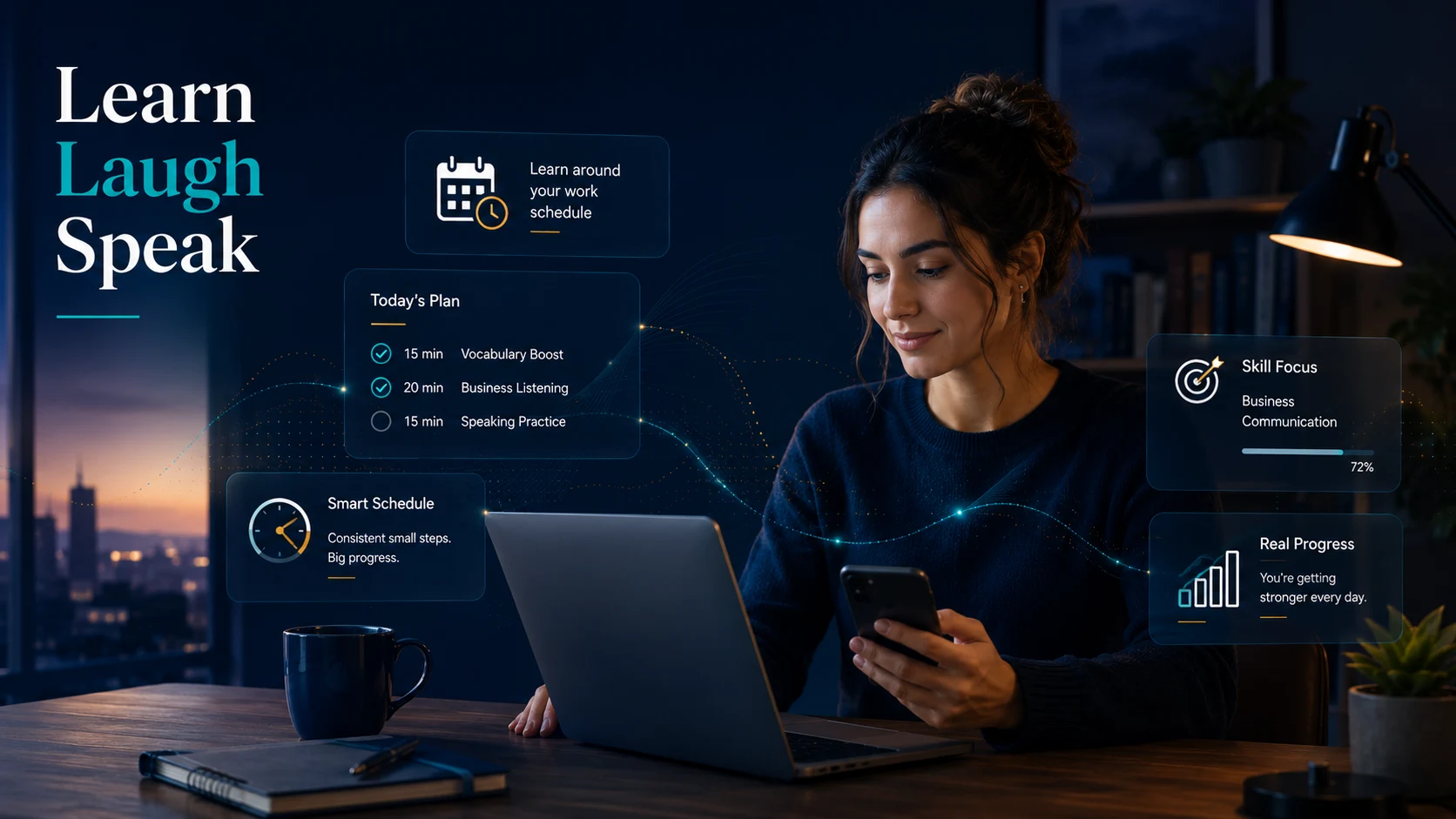
Flexible Learning for Adults Should Feel Personal
This is where many learning systems get it wrong.
They think flexibility means:
study anytime
watch anytime
learn anywhere
Those things help.
But they are only part of the picture.
True flexibility also means the content itself should respond.
If the student already knows something, do not force unnecessary repetition.
If the student keeps making a mistake, do not ignore it.
If the student has prior learning, use it.
If the student needs more support, give it.
That is what makes flexible learning more than convenience.
It becomes personalized progress.
How Learn Laugh Speak Applies Flexible Learning for Adults
At Learn Laugh Speak, adult students do not all follow the same generic path.
That is important because every adult learner arrives with a different history.
Some have prior learning experience.
Some understand English but lack confidence.
Some have strong reading but weak speaking.
Some can move faster because they already know parts of the level.
Others need more repetition because old gaps were never corrected properly.
That is why students begin with a free level assessment. Start your level assessment! Find your level within an hour.
The platform identifies where the learner is now, then helps guide the journey based on progress, mistakes, and needs.
Students learn what they need, when they need it.
They do not waste time repeating everything they already know.
They also do not skip the areas where they still need support.
That is what makes flexible learning for adults valuable.
It respects time.
It respects prior learning.
And it gives each learner a path that fits their actual progress.
Why This Keeps Adults Motivated
Motivation is not just about wanting to learn.
It is about feeling that progress is possible.
When adults feel misplaced, motivation drops quickly.
Too easy feels pointless.
Too hard feels discouraging.
Too general feels irrelevant.
Flexible learning helps because the student can see why the lesson matters.
The path feels connected to their real goals.
The progress feels more visible.
And when progress feels visible, adults are more likely to keep going.
What Modern Adult Learning Should Look Like
Modern adult learning should not be built around the idea that every student needs the same thing.
It should include:
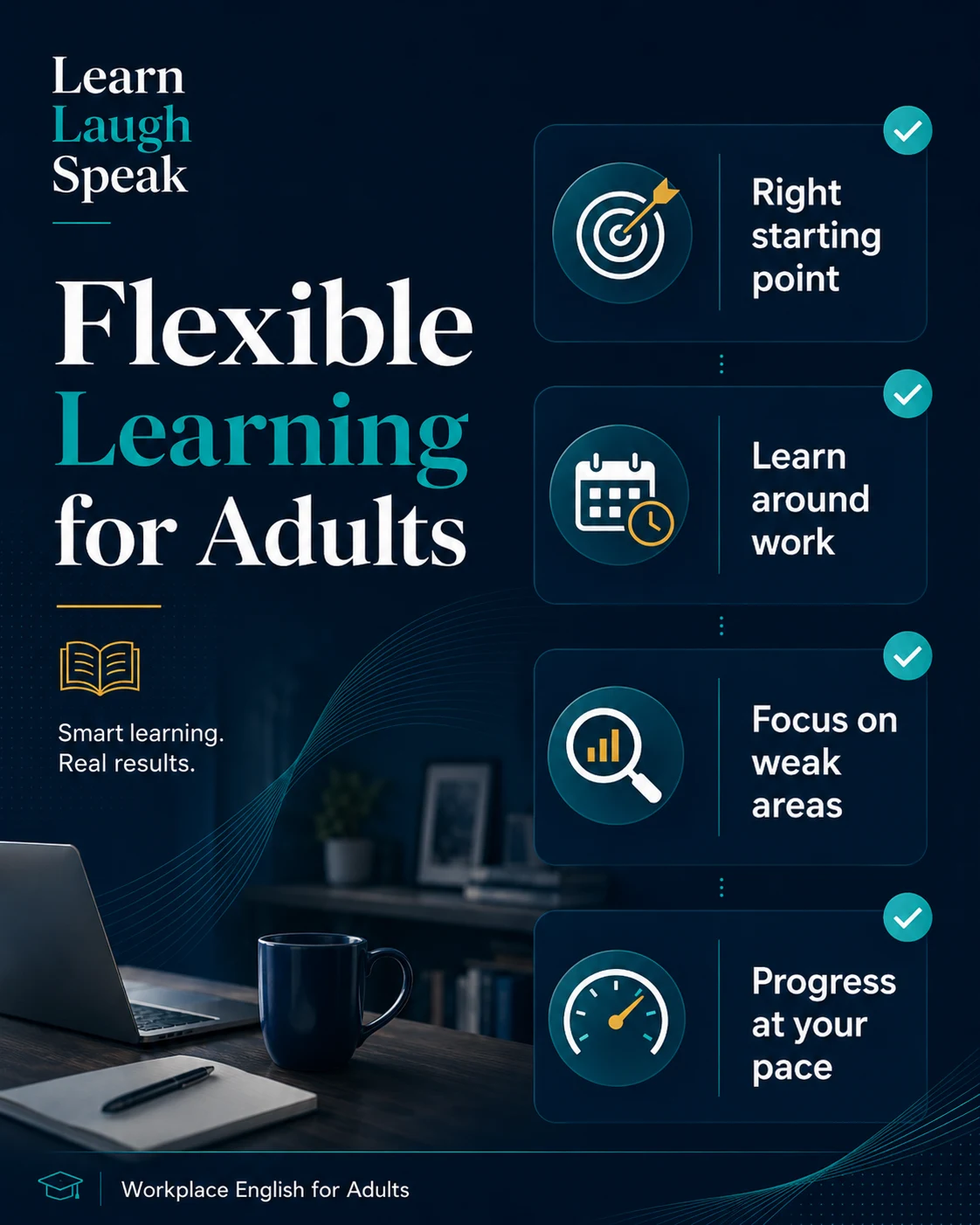
- a clear starting point
- recognition of prior learning
- feedback based on mistakes
- content that adapts to weak areas
- progress based on ability
- a way to continue after interruptions
This is not about making learning easier.
It is about making learning fit the learner better.
And for adults, that matters.
Final Thought on Flexible Learning for Adults
Flexible learning for adults is not just a modern education trend.
It is a response to reality.
Adults learn around work, family, old knowledge, limited time, and real goals.
They need learning that understands that.
A fixed path may be simple to organize, but adult learning is rarely simple.
The best systems help adults start from the right place, focus on what matters, and continue in a way that fits real life.
That is why flexible learning for adults is becoming one of the most important shifts in modern education.
One thought on “Why Flexible Learning for Adults Makes Education More Effective”
Pingback: Learning Gaps in Adults: Why Progress Slows Even When Students Work Hard - Learn Laugh Speak