
 English
 Arabic
 Chinese (Simplified)
 Dutch
 French
 German
 Italian
 Portuguese
 Russian
 Spanish
The best English reading material is not simply the longest book or the most advanced article you can find. It should match your current level, support the vocabulary you want to build and be interesting enough that you actually want to keep reading.
For English learners, reading works best when the text is challenging without becoming exhausting. If you can understand the main idea, follow most sentences and work out some unfamiliar words from context, the difficulty is probably useful.
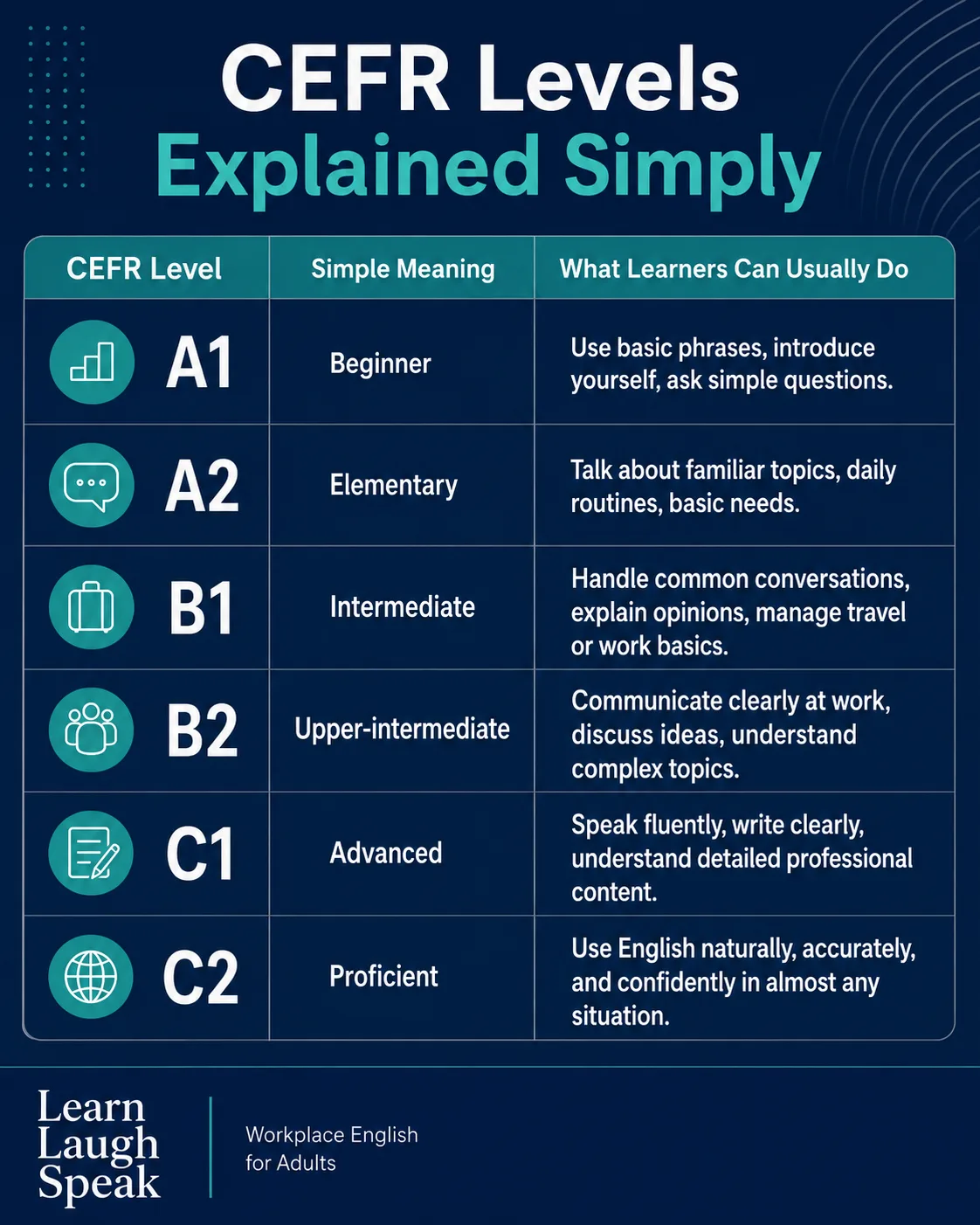
A good starting point is your CEFR level, from A1 to C2, or the level shown on a graded reader. Then read a short sample before committing to a full book or article.
This guide explains how to choose useful English reading material, where to find free and legal texts, how to use reading to improve vocabulary and what to do when a book feels too difficult.

Start With Your English Level
The first step is choosing a text that matches what you can currently understand.
The Common European Framework of Reference for Languages, or CEFR, describes language ability from A1 through C2. Learn Laugh Speak explains these levels in our guide to what the CEFR is and why it matters.
You can also compare the official Council of Europe CEFR level descriptions.
At lower levels, short texts with familiar vocabulary usually work better than long original novels.
A1–A2
Beginners can start with:
- short graded readers
- illustrated stories
- simple dialogues
- learner news
- short descriptions
- basic biographies
- everyday information
At this stage, useful English reading material should let you understand the general situation without stopping after every sentence.

B1–B2
Intermediate learners can move toward:
- adapted novels
- accessible nonfiction
- blogs
- interviews
- short original stories
- magazine articles
- learner-friendly professional content
You will meet more unfamiliar vocabulary, but you should still be able to follow the main argument or story.
C1–C2
Advanced learners can use authentic material more regularly:
- newspapers and magazines
- essays
- professional reports
- academic articles
- literary fiction
- specialised nonfiction
At these levels, you should expect occasional unfamiliar vocabulary.
That does not mean the text is too difficult.
The important question is whether you can still understand the argument, story or important information.

Test a Short Extract Before Choosing a Book
Do not choose a book only because someone says it is “good for learning English.”
Read one or two pages first.
Ask yourself:
- Can I understand the main idea?
- Can I follow most sentences?
- Are unknown words stopping me constantly?
- Can I guess some meanings from context?
- Do I actually want to continue reading?
If nearly every sentence requires a dictionary, the text may be too difficult for relaxed reading.
That does not mean you are incapable of reading it. It simply means it may be better for a short study session than for building reading fluency.
Useful English reading material should help you keep moving through the text.
Match Reading to Your Vocabulary Goal
Different texts teach different kinds of vocabulary.
When choosing English reading material for vocabulary growth, start with the language you actually want to use.
If you want everyday English, read material based on familiar situations such as:
- travel
- work
- shopping
- relationships
- food
- daily routines
Short fiction, interviews and practical articles are useful because words appear inside real situations rather than as isolated vocabulary lists.
If your goal is professional vocabulary, choose material connected to your job or industry.
For example:
Hospitality workers can read hotel, travel and customer-service articles.
Marketing professionals can read introductory marketing publications.
Project managers can read simple project updates and case studies.
Healthcare workers can read general workplace communication material related to their field.
Academic learners may benefit more from introductory textbooks, university articles and subject-specific reading.
The most useful English reading material is connected to the language you genuinely expect to use.
Choose Topics You Actually Like
Interest matters more than many learners realise.
You are more likely to finish an article about football if you love football than an article about architecture that somebody told you was “good English practice.”
Choose subjects such as:
- sport
- cooking
- travel
- history
- technology
- business
- music
- films
- science
- personal development
Background knowledge also helps comprehension.
If you already understand the subject, you can often infer the meaning of an unfamiliar word from the surrounding information.
This does not mean you will always guess the exact definition, but it can help you continue reading without interrupting yourself every few seconds.
Use Graded Readers When Original Books Feel Too Difficult
A graded reader is a book written or adapted for a particular language level.
The vocabulary, grammar and sentence length are controlled so learners can read more independently.
For beginners and intermediate students, graded readers can provide better English reading material than an original novel that is far above their current level.
An A2 learner may benefit much more from finishing a short graded story than from spending three weeks trying to understand the first chapter of an advanced novel.
Many graded readers also include:
- glossaries
- comprehension questions
- audio
- vocabulary exercises
- level labels
These features can help you continue reading without translating every sentence.
Find Free English Reading Material Legally
Free does not automatically mean illegal, and legal reading does not necessarily need to be expensive.
Public libraries are one of the best places to start.
Depending on your location and membership, a library may provide access to:
- e-books
- audiobooks
- magazines
- newspapers
- digital learning platforms
Public-domain collections are another useful option.
Older works whose copyright has expired may be available legally through established archives.
Universities, publishers and educational organisations may also provide:
- free sample chapters
- open-access textbooks
- learner articles
- educational reports
- public-domain texts
Before downloading something from an unfamiliar website, check:
- who operates the site
- whether copyright or licensing information is provided
- whether the file requires unusual software
- whether unnecessary personal information is requested
- whether the source is recognised and trustworthy
The goal is to find useful English reading material, not simply the largest number of free files.
What About Z-Library?
People searching for free books may encounter Z-Library or similar sites in search results.
Finding a website through a search engine does not establish that every book or file on it can legally be distributed.
Copyright status can depend on the book, edition, country and rights holder.
For English learners, the safer approach is to prefer:
- public libraries
- public-domain collections
- open-access repositories
- educational organisations
- university resources
- publisher-authorised materials
Also separate copyright from online safety.
A free file may not be legally shareable, and an unfamiliar download can also create privacy or security concerns.
Do not install unexpected software or provide unnecessary personal or financial information simply to access a book.
Separate Reading for Fluency From Reading for Study
One of the most useful ways to work with English reading material is to use two different reading modes.
Reading for Fluency
Read for the main idea.
Do not stop for every unknown word.
Keep going unless a word prevents you from understanding an important part of the text.
The goal is:
- reading volume
- confidence
- speed
- recognising familiar vocabulary automatically
Reading for Study
Choose a shorter section and slow down.
Look at:
- useful vocabulary
- sentence structures
- collocations
- expressions
- grammar patterns
You can reread the same paragraph several times.
Separating these two purposes prevents every reading session from becoming a dictionary exercise.
Do Not Save Every Unknown Word
A common mistake is writing down every new word you encounter.
This quickly becomes overwhelming.
Instead, save words that:
- appear several times
- are important to the subject
- connect to your personal goals
- prevent you from understanding an important sentence
- seem useful in your own speaking or writing
Save the sentence around the word as well.
Context makes vocabulary easier to remember.
If you still cannot understand a phrase, the strategies in our guide to asking for clarification professionally can also help you practise asking what unfamiliar language means.
Read Once Before Reaching for a Dictionary
When you see an unfamiliar word, first ask:
Can I understand the sentence without knowing this word exactly?
If the answer is yes, continue.
Then ask:
Can I make a reasonable guess from the context?
Only look up the word immediately if it blocks your understanding or appears important.
This habit helps you become less dependent on translation.
Good English reading material gives you opportunities to practise this because most of the text is understandable while a smaller amount remains new.
Use Translation as Support, Not as the Main Reading Method
Translation can be useful.
The problem begins when you translate every sentence before trying to understand it in English.
Try this order instead:
1. Read the sentence in English.
2. Look at the surrounding sentences.
3. Guess the general meaning.
4. Check one important word if necessary.
5. Use translation when the meaning is still unclear.
Then return to the English sentence.
The goal is gradually to reduce how often you need translation, not to avoid it completely.
Use Audio When It Is Available
Some graded readers and learner articles include audio.
Using audio and text together can help you connect:
- spelling
- pronunciation
- sentence rhythm
- vocabulary
- listening comprehension
Try reading a section first and then listening.
You can also listen once without looking at the text and read it afterward.
You do not need audio for everything.
However, it can be useful when you recognise a word easily in writing but struggle to identify the same word when someone speaks.
Create a Simple Reading Routine
You do not need to read for one hour every day.
Consistency matters more.
A simple routine could be:
Step 1: Choose something at a manageable level.
Step 2: Preview the title and headings.
Step 3: Read for 10–20 minutes without stopping constantly.
Step 4: Choose three to five useful words or phrases.
Step 5: Review those words inside their original sentences.
Step 6: Continue reading the next day.
This makes English reading material part of your normal English practice instead of a large project you keep postponing.
What to Do When a Book Is Too Difficult
Changing books is not failure.
If a text remains frustrating after several reading sessions, choose something easier.
You can return to the difficult book later.
There is a difference between productive difficulty and constant confusion.
A productive text makes you think but gives you enough information to continue.
An unproductive text makes you translate almost everything and forget the story or argument while you are translating it.
Reading enough understandable material helps you become familiar with common vocabulary and English sentence patterns.
What If the Reading Feels Too Easy?
Easy reading still has value.
Material below your maximum level can help improve:
- reading speed
- automatic vocabulary recognition
- confidence
- comprehension
- reading stamina
If you understand almost everything, challenge yourself differently.
You could:
- read faster
- summarise the text
- explain it aloud
- identify useful phrases
- write a short response
- retell the story without looking at the page
Difficulty is only one part of the learning task.
English Reading Material for Different Goals
Different goals require different texts.
General English
Choose learner stories, graded readers, interviews, short articles and practical nonfiction.
Vocabulary
Choose texts where important language appears repeatedly around one subject.
Professional English
Read workplace articles, professional emails, industry introductions, reports and practical guides related to your work.
Academic English
Use introductory textbooks, open educational resources and subject-specific articles.
Exam Preparation
Choose texts that resemble the topics, length, register and question styles used in your exam.
The best English reading material for exam preparation may be very different from the material you choose for relaxed reading.
How to Choose Your Next Text
Use this simple checklist.
1. Check Your Level
Start with your CEFR level or a graded-reader label.
2. Read a Sample
Make sure you can understand the main idea without translating every line.
3. Choose a Goal
Decide whether you are reading for:
- fluency
- vocabulary
- professional English
- academic English
- exam preparation
- enjoyment
4. Choose Something Interesting
Interest makes regular reading much easier.
5. Check the Source
Prefer legitimate libraries, open-access resources, public-domain collections and authorised publisher materials.
6. Start Reading
Do not spend so much time choosing resources that you never actually read anything.
The main goal is understanding and using English.
Final Thoughts
The best English reading material is something you can understand well enough to continue reading and interesting enough to make you return tomorrow.
Start with your level.
Choose a subject that matters to you.
Read for the main idea before studying individual words.
Save vocabulary selectively.
Use translation when it genuinely helps.
Choose legal and trustworthy sources.
And remember that changing to an easier book is not going backward.
Sometimes reading an easier text consistently is exactly what helps you become ready for the harder one.