
 English
 Arabic
 Chinese (Simplified)
 Dutch
Dutch French
 German
 Italian
 Portuguese
 Russian
 Spanish
To ask for clarification professionally, identify the exact word, instruction, or idea that is unclear and request the type of explanation you need. You might say, “Could you clarify what you mean by this?” or choose more precise vocabulary such as elaborate, rephrase, specify, or define.
These words are related, but they do not mean exactly the same thing. Knowing the difference helps you ask clearer questions, avoid mistakes, and sound more confident at work.

What Does Asking for Clarification Professionally Mean?
Clarification is an explanation or extra information that makes something easier to understand. The verb clarify means to make an unclear point clearer, often by adding details or using a simpler explanation.
For example:
Could you clarify what you mean by “priority client”?
You heard the words, but you do not fully understand what the speaker means. You are therefore asking for an explanation, not merely asking them to repeat the same sentence.
Learning to request clarification professionally helps you identify the missing information and ask for it politely.
Clarification, Repetition, and Confirmation: What Is Different?
These communication needs are closely related, which is why English learners sometimes use the wrong phrase.
| Communication need | What has happened | Useful request |
|---|---|---|
| Repetition | You did not hear the words | Could you say that again, please? |
| Clarification | You heard the words, but the meaning is unclear | Could you clarify what you mean? |
| Confirmation | You believe you understand and want to check | Could you confirm that the deadline is Friday? |
| More information | You understand the point but need additional detail | Could you elaborate on that? |
When you did not hear someone, use phrases for how to ask someone to repeat themselves politely.
When you think you understand but want to check, use professional phrases for confirming information in English or confirming your understanding.
This article focuses on the vocabulary used when the meaning itself is unclear.
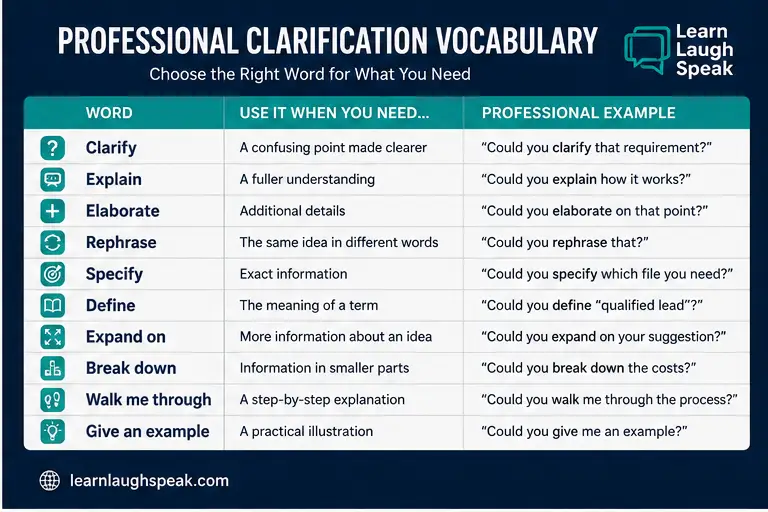
Professional Vocabulary for Asking for Clarification
The best clarification question depends on what you need from the other person.
Do you need:
- A clearer meaning?
- Additional detail?
- Different wording?
- An exact answer?
- A practical example?
- A step-by-step explanation?
The vocabulary below helps you make that request precisely.
Use “Clarify” for an Unclear Point
Clarify means to make something clear or easier to understand. The Cambridge Dictionary definition of clarify explains that this can involve giving more details or providing a simpler explanation.
Use clarify when a statement, instruction, responsibility, or expectation is ambiguous.
Could you clarify what you mean by “final version”?
Could you clarify which department is responsible?
I would appreciate it if you could clarify this requirement.
This is one of the safest verbs for a professional clarification request.
Use “Explain” When Clarification Needs More Context
Explain means to give information that helps someone understand how or why something happens.
Could you explain how the new system works?
Would you mind explaining why the deadline changed?
Could you explain what I need to do next?
Use explain when you need a broader understanding rather than one missing detail.
Use “Elaborate” to Ask for Clarification With More Detail
Elaborate means to add more information about something that has already been mentioned. The Cambridge Dictionary definition of elaborate describes the verb as adding information to or further explaining something already said.
Could you elaborate on the changes you mentioned?
Would you mind elaborating on that point?
Could you elaborate on what the client expects?
Elaborate on is common in meetings, interviews, presentations, and formal discussions.
Avoid:
Could you elaborate more?
Because elaborate already means to add more detail, the cleaner version is:
Could you elaborate on that?
Use “Rephrase” to Request Different Words
Rephrase means to communicate the same idea using different words.
Could you rephrase that, please?
Would you mind rephrasing the question?
Could you rephrase that in simpler terms?
You are not asking for more information. You are asking the speaker to express the same information differently.
This is useful when an explanation is too technical, complex, or unfamiliar.
Use “Specify” to Request Exact Information
Specify means to explain or describe something clearly and exactly. The Cambridge Dictionary definition of specify makes this a useful verb when the original message is too general.
Could you specify which documents you need?
Could you specify the date you would prefer?
Could you be more specific about the changes?
Compare these instructions:
Please update the document.
This is general.
Please update the pricing table on page four.
This is specific.
Use “Define” to Clarify a Term
Define means to explain the exact meaning of a word, phrase, measure, or concept.
Could you define what “active user” means in this report?
How are we defining success for this project?
Could you define that term in this context?
The words in this context are useful because professional terms can have different meanings across companies and industries.
Use “Expand On” for Additional Information
Expand on means to provide more information about an idea or point.
Could you expand on the second recommendation?
Would you mind expanding on what happened?
Could you expand on the customer feedback?
Expand on and elaborate on are similar. However, expand on often sounds slightly more conversational.
Use “Break Down” for Smaller, Clearer Parts
Break down means to explain something by separating it into smaller and more manageable parts.
Could you break down the costs for me?
Would you mind breaking down the process step by step?
Could you break down what each department needs to do?
This expression is useful when asking about budgets, data, instructions, processes, or technical information.
Use “Walk Me Through” for a Step-by-Step Explanation
Walk me through means to explain a process one stage at a time.
Could you walk me through the approval process?
Would you mind walking me through how you calculated this figure?
Could you walk us through what happens after a customer submits the form?
This phrase is professional but natural. It is common during training, demonstrations, meetings, and technical conversations.
Ask for an Example to Make the Meaning Clear
Sometimes the easiest way to understand an abstract idea is to ask for a practical example.
Could you give me an example?
Could you provide a practical example of what you mean?
What would that look like in a real customer conversation?
Could you show me how that would work in practice?
This works well when someone uses theoretical, technical, or general language.
Clarification Vocabulary: Quick Comparison
| Vocabulary | Use it when you need… | Professional example |
| Clarify | A confusing point made clearer | Could you clarify that requirement? |
| Explain | A fuller understanding | Could you explain how it works? |
| Elaborate | Additional details | Could you elaborate on that point? |
| Rephrase | The same idea in different words | Could you rephrase that? |
| Specify | Exact information | Could you specify which file you need? |
| Define | The meaning of a term | Could you define “qualified lead”? |
| Expand on | More information about an idea | Could you expand on your suggestion? |
| Break down | Information divided into smaller parts | Could you break down the costs? |
| Walk me through | A step-by-step explanation | Could you walk me through the process? |
| Give an example | A practical illustration | Could you give me an example? |
These are useful examples of professional English vocabulary because each verb communicates a different purpose.
Professional Clarification Phrases You Can Reuse
You do not need to memorize dozens of complete questions. Learn a few flexible sentence structures and replace the unclear information.
“Could You Clarify What You Mean By…?”
Could you clarify what you mean by “urgent”?
Could you clarify what you mean by improving the customer journey?
This structure is direct, polite, and suitable for most workplaces.
“Could You Be More Specific About…?”
Could you be more specific about the changes you need?
Could you be more specific about which customers are affected?
Use this question when a request is too broad.
“Could You Explain What… Refers To?”
Could you explain what “this amount” refers to?
Could you explain which customer the message refers to?
This structure is useful when words such as it, this, that, or they have an unclear reference.
“What Would This Look Like in Practice?”
What would excellent service look like in practice?
What would this process look like in practice for the reception team?
This question moves the conversation from a general idea to a realistic situation.
“Could You Clarify the Difference Between…?”
Could you clarify the difference between a refund and a chargeback?
Could you clarify the difference between the two membership options?
Use this phrase when two terms, processes, products, or instructions appear similar.
You can also use these structures when asking questions in a meeting, but keep your question focused on the exact point that needs explanation.
How to Soften a Professional Clarification Question
A softener makes your question sound less demanding without making it unclear.
| Direct | Softer and more professional |
| Explain this. | Could you explain this? |
| Be more specific. | Could you be a little more specific? |
| What does that mean? | Could you clarify what that means? |
| Give me an example. | Could you give me an example? |
| Define this term. | Would you mind defining this term? |
Useful softeners include:
- Could you…?
- Would you mind…?
- May I ask…?
- Would it be possible to…?
- A little
- In a little more detail
- When you have a moment
The British Council explains that could you and would you are polite structures for making requests. You can review its guide to polite requests, offers, and invitations.
Avoid putting too many softeners into one question.
Too indirect:
I was just wondering whether you might possibly be able to explain this a little more clearly.
Better:
Could you explain this in a little more detail?
Professional English should sound respectful, but it should also remain easy to understand.
Clarification Phrases by Level of Formality
The most formal phrase is not automatically the best one. Match your vocabulary to the relationship and situation.
Neutral Professional Clarification Phrases
These work in most professional situations:
- Could you clarify what you mean?
- Could you explain that in more detail?
- Could you be more specific?
- Could you provide an example?
- What does that term mean in this context?
- Could you walk me through the process?
Formal Clarification Phrases
Use these with clients, senior leaders, formal correspondence, or high-stakes conversations:
- Would you mind elaborating on that point?
- Could you provide further clarification regarding this requirement?
- I would appreciate some clarification on this section.
- Would it be possible to specify which option you prefer?
- Could you define how success will be measured?
Conversational Clarification Phrases
Use these with colleagues and managers you know well:
- What do you mean by that exactly?
- Could you break that down for me?
- Can you talk me through it?
- What would that look like in practice?
- Could you give me a quick example?
The British Council also advises international English speakers to ask questions and seek clarification when needed rather than staying silent. Its guide to speaking English internationally provides additional practical advice.
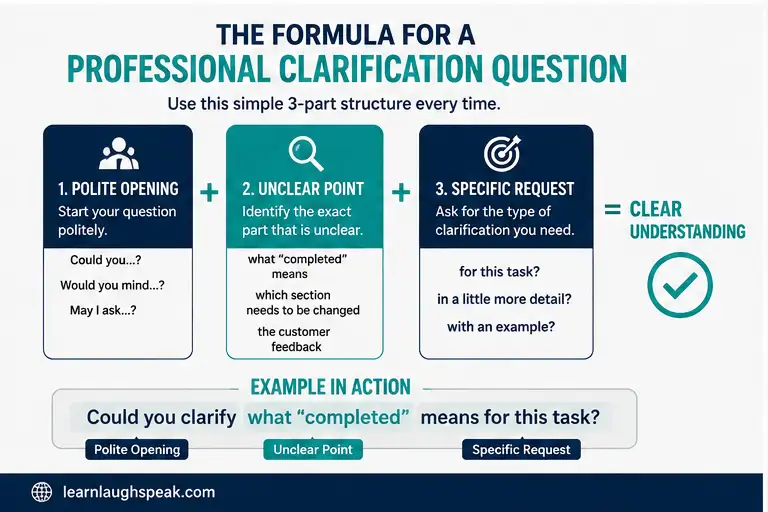
How to Ask for Clarification in Real Workplace Situations
A strong professional question identifies the unclear point instead of asking the other person to repeat everything.
Asking for Clarification About Instructions
Manager: Please make the presentation more engaging.
Employee: Could you be more specific about what you would like changed? For example, should I add more visuals or shorten the text?
The employee identifies the missing information and offers two possible interpretations.
Asking for Clarification About a Business Term
Colleague: We need to improve customer retention.
Employee: Could you clarify how we are defining retention for this report?
The speaker requests the exact meaning of a term within the company’s context.
Asking for Clarification About Customer Feedback
Manager: The client was not satisfied with the proposal.
Employee: Could you elaborate on the feedback they gave?
Elaborate is appropriate because the employee needs additional detail.
Asking for Clarification About Technical Language
IT specialist: The issue is related to an authentication token conflict.
Employee: Could you rephrase that in simpler terms?
The employee needs different wording rather than the same sentence repeated.
Asking for Clarification About a Process
Trainer: All requests need to go through the new approval system.
Employee: Could you walk me through how to submit the first request?
The employee asks for a step-by-step explanation.
These language functions are part of the practical Business English adults need at work.
Common Mistakes When Asking for Clarification
Small vocabulary differences can change the meaning of your question.
Clarify vs Confirm
Use clarify when something is unclear:
Could you clarify which report you mean?
Use confirm when you believe you know the answer but want to check:
Could you confirm that the report is due Friday?
Confirmation checks whether information is correct. Clarification asks for a clearer meaning or explanation.
Repeat vs Rephrase
Could you repeat that?
This asks the person to say the same words again.
Could you rephrase that?
This asks the person to use different words.
Could you explain that?
This asks the person to help you understand the meaning.
Avoid a Clarification Question That Is Too General
Less effective:
Can you explain everything again?
More effective:
Could you explain how the final payment is calculated?
A precise question is easier to answer and less likely to interrupt the entire conversation.
Avoid Blaming the Other Person
This may sound critical:
You are not being clear.
Focus instead on the information you need:
Could you clarify what the deadline applies to?
Could you be more specific about the expected result?
The goal is to improve shared understanding, not decide who caused the confusion.
A Simple Formula for Professional Clarification
Use this three-part structure:
Polite opening + unclear point + specific request
Could you + clarify what “completed” means + for this task?
Would you mind + expanding on the customer feedback + with an example?
Could you + walk me through + the approval process?
This formula helps you ask for clarification professionally without sounding uncertain or blaming the speaker.
Practice Asking for Clarification Professionally
Choose one realistic situation from your work. Write down the unclear message and then create three different questions.
For example:
Unclear message: “Please improve the customer experience.”
Question using clarify:
Could you clarify which part of the customer experience needs attention?
Question using specify:
Could you specify whether you mean response times, staff communication, or the checkout process?
Question asking for an example:
Could you give me an example of what an improved customer experience would look like?
Say each question aloud. This helps you practise both the vocabulary and the professional tone.
You can use the same exercise with:
- An unclear deadline
- A general instruction
- An unfamiliar technical term
- A complicated process
- Broad customer feedback
- A new performance target
FAQs About Asking for Clarification Professionally
What Is the Most Professional Way to Ask for Clarification?
A safe and natural option is:
Could you clarify what you mean by that?
It is polite, direct, and suitable for most workplace conversations.
What Is the Difference Between “Clarify” and “Explain”?
Clarify means making a confusing point clearer. Explain usually means providing a fuller account of how, what, or why something happens.
How Do I Professionally Ask Someone to Elaborate?
Say:
Could you elaborate on that point?
You can make the request more specific:
Could you elaborate on what the client disliked about the proposal?
How Do I Ask for Clarification Without Sounding Rude?
Use a polite request structure and focus on the information rather than the speaker.
Could you clarify which section needs to be changed?
This sounds more collaborative than saying, “Your instructions are unclear.”
Is “What Do You Mean?” a Professional Clarification Phrase?
It can be professional, but tone matters. A softer option is:
Could you clarify what you mean?
You can also identify the exact wording:
What do you mean by “additional support” in this context?
How Do I Ask Someone to Be More Specific Professionally?
Say:
Could you be more specific about what you need?
Offering possible interpretations can make the question easier to answer:
Do you mean changes to the design, the text, or both?
Ask for Clarification Professionally With More Precision
Learning how to ask for clarification professionally is not about memorizing one polite sentence. It is about choosing vocabulary that tells the other person exactly what you need.
Ask someone to:
- Clarify a confusing point
- Explain a broader idea
- Elaborate when you need more detail
- Rephrase when you need different words
- Specify when information is too general
- Define an unfamiliar term
- Break down complicated information
- Walk you through a process
- Give an example when an idea feels abstract
The more precise your question is, the easier it becomes for the other person to provide a useful answer.
Practise these phrases in real workplace situations, and asking for clarification will begin to feel like a normal professional skill rather than a sign that your English is weak.
One thought on “How to Ask for Clarification Professionally: Vocabulary and Phrases”
Pingback: How AI Video Generators Are Transforming Modern Content Creation - Learn Laugh Speak