
 English
 Arabic
 Chinese (Simplified)
 Dutch
 French
 German
 Italian
 Portuguese
 Russian
 Spanish
12 PM normally means noon or midday. 12 AM normally means midnight.
So:
12:00 PM = noon
12:00 AM = midnight
However, there is an important catch.
The terms 12 AM and 12 PM can be confusing because AM means “before noon” and PM means “after noon.” At exactly noon or midnight, that logic becomes less clear.
That is why official time authorities often recommend writing noon and midnight instead of 12 AM and 12 PM when the exact time matters.
For everyday English, though, the convention you will usually see is simple:
12 PM = noon
12 AM = midnight
This guide explains how the system works, how to convert these times to the 24-hour clock, and how to avoid mistakes with meetings, flights, hotel bookings and deadlines.

Table of Contents
- Quick Answer: Is 12 PM Noon or Midnight?
- What Does AM Mean?
- What Does PM Mean?
- 12 AM vs 12 PM
- Why Are 12 AM and 12 PM So Confusing?
- 12-Hour Clock vs 24-Hour Clock
- What Is 12 PM in 24-Hour Time?
- What Is 12 AM in 24-Hour Time?
- What About 12:30 AM and 12:30 PM?
- How to Say Noon and Midnight Clearly in English
- AM and PM in Meetings and Work
- AM and PM for Flights and Travel
- AM and PM in Hotels and Restaurants
- AM and PM for Deadlines
- Common AM and PM Mistakes
- 12 AM and 12 PM Examples
- Quick Quiz
- Frequently Asked Questions
- Final Thoughts
Quick Answer: Is 12 PM Noon or Midnight?
In normal modern usage:
| Time | Meaning | 24-Hour Time |
|---|---|---|
| 12:00 AM | Midnight | 00:00 |
| 6:00 AM | Morning | 06:00 |
| 11:59 AM | Just before noon | 11:59 |
| 12:00 PM | Noon / midday | 12:00 |
| 12:30 PM | Half past noon | 12:30 |
| 6:00 PM | Evening | 18:00 |
| 11:59 PM | Just before midnight | 23:59 |
So if somebody says:
“The meeting starts at 12 PM.”
they normally mean:
“The meeting starts at noon.”
And:
“The flight leaves at 12 AM.”
normally means:
“The flight leaves at midnight.”
For important appointments, tickets, contracts or deadlines, using noon, midnight, or the 24-hour clock can make the meaning clearer.
If expressions such as at noon, at midnight, on Monday and in the morning are difficult for you, our Learn Laugh Speak lesson on prepositions of time in English explains how these time expressions work in everyday sentences.
What Does AM Mean?
AM comes from the Latin phrase ante meridiem.
It means:
before midday
or:
before noon
AM covers the first part of the day.
Examples:
6:00 AM — early morning
8:30 AM — morning
10:45 AM — late morning
11:59 AM — one minute before noon
Example sentence:
“Our meeting starts at 9:00 AM.”
That clearly means nine o’clock in the morning.
What Does PM Mean?
PM comes from the Latin phrase post meridiem.
It means:
after midday
or:
after noon
PM covers the second half of the day.
Examples:
1:00 PM — early afternoon
4:30 PM — afternoon
7:00 PM — evening
11:00 PM — late evening
Example:
“Dinner starts at 7:30 PM.”
That clearly means half past seven in the evening.
12 AM vs 12 PM
This is where many English learners become confused.
A useful rule for everyday English is:
12 AM = midnight
12 PM = noon
Think of the clock changing from morning to afternoon:
11:58 AM
11:59 AM
12:00 PM
12:01 PM
Then later:
11:58 PM
11:59 PM
12:00 AM
12:01 AM
This makes the common convention easier to understand.
The entire hour after midday is labelled PM:
12:01 PM
12:15 PM
12:30 PM
12:59 PM
Likewise, the hour immediately after midnight uses AM:
12:01 AM
12:15 AM
12:30 AM
12:59 AM
Why Are 12 AM and 12 PM So Confusing?
The problem comes from the literal meanings of AM and PM.
AM means:
before noon
PM means:
after noon
But exactly 12:00 noon is neither before nor after noon.
It is noon.
The same issue exists at midnight.
For this reason, the U.S. National Institute of Standards and Technology recommends avoiding 12 AM and 12 PM when ambiguity matters and using clearer terms such as noon and midnight instead.
The UK’s National Physical Laboratory makes a similar point: although people generally understand 12 AM as midnight and 12 PM as midday, using midday, noon and midnight removes unnecessary confusion.
So there are two useful lessons for an English learner.
First, understand the common convention:
12 AM = midnight
12 PM = noon
But when you need to communicate an important time, consider writing:
noon
or:
midnight
instead.
12-Hour Clock vs 24-Hour Clock
English-speaking countries frequently use the 12-hour clock.
It divides the day into two periods:
AM — midnight to noon
PM — noon to midnight
The 24-hour clock avoids AM and PM completely.
For example:
| 12-Hour Clock | 24-Hour Clock |
|---|---|
| 12:00 AM | 00:00 |
| 1:00 AM | 01:00 |
| 6:00 AM | 06:00 |
| 9:00 AM | 09:00 |
| 12:00 PM | 12:00 |
| 1:00 PM | 13:00 |
| 3:00 PM | 15:00 |
| 6:00 PM | 18:00 |
| 9:00 PM | 21:00 |
| 11:00 PM | 23:00 |
The 24-hour system can be particularly useful for:
airline schedules
train timetables
international travel
medical settings
work schedules
transportation
Timeanddate’s explanation of AM and PM also recommends using expressions such as 12 noon and 12 midnight when clarity is more important than following the usual AM/PM convention.

What Is 12 PM in 24-Hour Time?
12 PM = 12:00 in 24-hour time.
This is easy to remember because the number does not change.
12:00 PM → 12:00
12:15 PM → 12:15
12:30 PM → 12:30
12:45 PM → 12:45
After 12:59 PM, you begin adding 12 to the hour.
For example:
1:00 PM → 13:00
2:00 PM → 14:00
4:30 PM → 16:30
8:00 PM → 20:00
What Is 12 AM in 24-Hour Time?
12 AM normally corresponds to 00:00.
So:
12:00 AM → 00:00
12:15 AM → 00:15
12:30 AM → 00:30
12:45 AM → 00:45
Then:
1:00 AM → 01:00
2:00 AM → 02:00
and so on.
This makes midnight one of the easiest times to recognize in the 24-hour system:
00:00 = midnight
What About 12:30 AM and 12:30 PM?
This is easier than exactly 12:00.
12:30 AM
12:30 AM means thirty minutes after midnight.
In 24-hour time:
12:30 AM = 00:30
If someone says:
“My flight arrives at 12:30 AM.”
you should expect to arrive in the middle of the night.
12:30 PM
12:30 PM means thirty minutes after noon.
In 24-hour time:
12:30 PM = 12:30
Example:
“Let’s have lunch at 12:30 PM.”
That means half past noon.
This distinction is especially important when reading travel bookings and appointments.
How to Say Noon and Midnight Clearly in English
In normal conversation, English speakers often simply say:
noon
or:
midnight
Instead of:
“Let’s meet at 12 PM.”
you can say:
“Let’s meet at noon.”
Instead of:
“The deadline is 12 AM.”
you can say:
“The deadline is at midnight.”
These are often clearer.
Other natural phrases include:
at midday
around noon
just after noon
before midnight
just after midnight
at twelve o’clock tonight
For learners, noon and midnight are useful words because they eliminate the AM/PM problem entirely.
If you want more practice with expressions such as at noon, before midnight and after lunch, our guide on how to learn prepositions easily in English gives more examples of learning short grammar words through complete phrases rather than memorizing them individually.
AM and PM in Meetings and Work
Understanding AM and PM is particularly important in professional English.
Imagine receiving this message:
“The meeting is at 12 PM.”
This means:
The meeting is at noon.
If you thought it meant midnight, you would be twelve hours late.
Other examples:
“The interview starts at 9:30 AM.”
“The presentation begins at 2:00 PM.”
“Lunch is scheduled for 12:00 PM.”
“The evening shift begins at 6:00 PM.”
When arranging meetings yourself, clarity is more important than using complicated language.
You could write:
“Can we meet at noon on Thursday?”
That is extremely clear.
AM and PM for Flights and Travel
This is one of the situations where a mistake can be expensive.
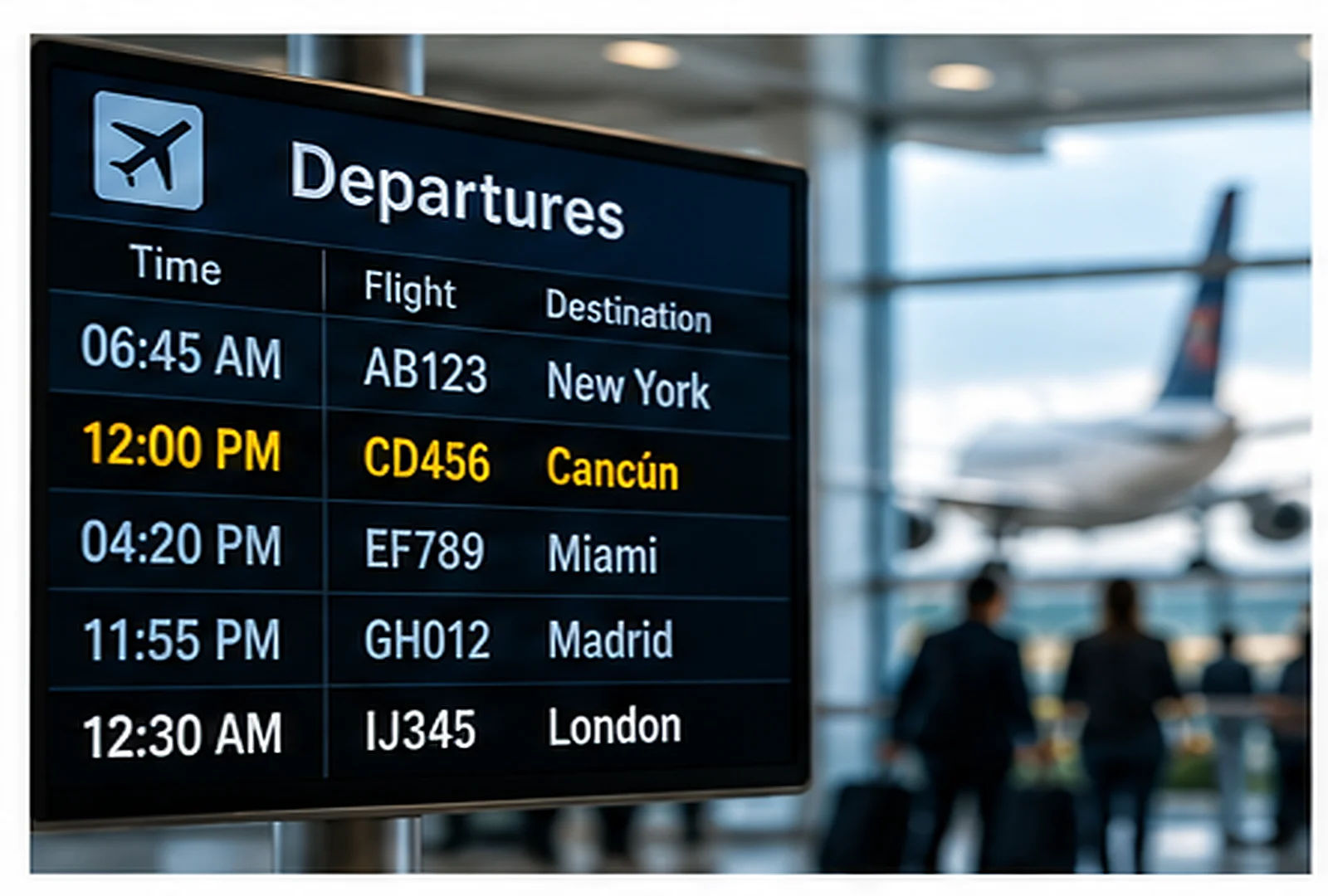
Imagine your ticket says:
Departure: 12:30 AM
That means thirty minutes after midnight.
It does not mean lunchtime.
Likewise:
Departure: 12:30 PM
means thirty minutes after noon.
For example:
6:45 AM — morning flight
12:00 PM — noon flight
4:20 PM — afternoon flight
11:55 PM — late-night flight
12:15 AM — shortly after midnight
When travelling internationally, you may also see the 24-hour clock.
Our Learn Laugh Speak guide to English travel phrases includes practical airport, hotel and transportation language you can use alongside time expressions such as departure times, arrival times and hotel schedules.
AM and PM in Hotels and Restaurants
Hotels and restaurants regularly use AM and PM for opening times and schedules.
Examples:
“Breakfast is served from 7 AM to 10 AM.”
“Check-out is at 11 AM.”
“Lunch starts at 12 PM.”
“Happy hour begins at 5 PM.”
“The restaurant closes at 11 PM.”
“The front desk is staffed until midnight.”
If hotel staff say:
“Your late checkout is approved until 12 PM.”
they normally mean:
noon
not midnight.
Our Learn Laugh Speak lesson on prepositions of time and place in hospitality also explains how expressions such as at 3 PM, on Friday, and in December are used when giving guests schedules and booking information.
AM and PM for Deadlines
Deadlines are where 12 AM can become particularly dangerous.

Imagine an assignment says:
“Submit the document by 12 AM Friday.”
Does that mean the very beginning of Friday?
Or the end of Friday night?
Many people will interpret it as midnight when Friday begins, but the wording can still cause uncertainty.
Official time guidance recommends avoiding ambiguous midnight expressions when the exact date matters.
One solution is to use a nearby unambiguous time such as:
11:59 PM Friday
or:
12:01 AM Saturday
Another solution is:
midnight at the end of Friday
For workplace deadlines, bookings, contracts and important reservations, clarity is more important than brevity.
Common AM and PM Mistakes
Mistake 1: Thinking 12 PM Means Midnight
Incorrect:
12 PM = midnight
Correct common usage:
12 PM = noon
Mistake 2: Thinking 12 AM Means Noon
Incorrect:
12 AM = noon
Correct common usage:
12 AM = midnight
Mistake 3: Saying “12 PM in the Afternoon”
This is unnecessary.
Instead of:
“12 PM in the afternoon”
say:
“12 PM”
or preferably:
“noon”
Likewise:
“8 AM in the morning”
is understandable but often repetitive.
8 AM already tells us that the time is in the morning.
Mistake 4: Confusing 12:30 AM and 12:30 PM
Remember:
12:30 AM = after midnight
12:30 PM = after noon
Mistake 5: Forgetting the Date at Midnight
Midnight marks the change from one date to another.
That means a phrase such as:
“midnight Friday”
can still be unclear.
When the date matters, be more specific.
12 AM and 12 PM Examples
Here are some practical examples.
Example 1
“The café opens at 7 AM and closes at 12 PM.”
Meaning:
It opens in the morning and closes at noon.
Example 2
“The party finishes at 12 AM.”
Meaning:
It finishes at midnight.
Example 3
“The meeting starts at 12:15 PM.”
Meaning:
It starts fifteen minutes after noon.
Example 4
“The flight departs at 12:45 AM.”
Meaning:
It leaves forty-five minutes after midnight.
Example 5
“Lunch is at 12 PM.”
Meaning:
Lunch is at noon.
Example 6
“Please submit the form before midnight.”
This is clearer than:
“Please submit the form before 12 AM.”
Example 7
“Our appointment is at 11:30 AM.”
Meaning:
It is thirty minutes before noon.
Example 8
“The restaurant closes at 11:30 PM.”
Meaning:
It closes thirty minutes before midnight.
Quick Quiz: AM or PM?
1. Is 12 PM noon or midnight?
A. Noon
B. Midnight
Answer: A — Noon
2. Is 12 AM noon or midnight?
A. Noon
B. Midnight
Answer: B — Midnight
3. What is 12 PM in 24-hour time?
A. 00:00
B. 12:00
C. 24:00
Answer: B — 12:00
4. What is 12 AM in 24-hour time?
A. 00:00
B. 12:00
C. 13:00
Answer: A — 00:00
5. What does 12:30 PM mean?
A. Thirty minutes after midnight
B. Thirty minutes after noon
Answer: B — Thirty minutes after noon
6. What does 12:30 AM mean?
A. Thirty minutes after midnight
B. Thirty minutes after noon
Answer: A — Thirty minutes after midnight
7. Which is clearer for an important deadline?
A. 12 AM Friday
B. Midnight at the end of Friday
Answer: B
Frequently Asked Questions About 12 PM
Is 12 PM noon or midnight?
In normal modern usage, 12 PM means noon.
For complete clarity, especially in important schedules or deadlines, you can simply write noon.
Is 12 AM midnight?
Yes. In the conventional 12-hour clock, 12 AM means midnight.
However, official time authorities often recommend using the word midnight because the AM/PM labels at exactly 12:00 can be ambiguous.
What time is 12 PM?
12 PM is 12 o’clock in the middle of the day, commonly called noon or midday.
What is 12 PM in 24-hour time?
12 PM is 12:00 in 24-hour time.
What is 12 AM in 24-hour time?
12 AM is normally written as 00:00.
Is 12:30 PM afternoon?
Yes.
12:30 PM is thirty minutes after noon, so it is early afternoon.
Is 12:30 AM morning?
Technically, 12:30 AM is thirty minutes after midnight and falls in the early hours of the morning.
In everyday conversation, many people would simply say:
“12:30 at night.”
Does PM mean afternoon?
PM means post meridiem, or after midday.
PM covers both the afternoon and evening.
For example:
2 PM — afternoon
7 PM — evening
11 PM — late evening/night
Why is 12 PM not 12 AM?
The usual convention changes from AM to PM when the clock reaches noon.
So the sequence is:
11:59 AM
12:00 PM
12:01 PM
At midnight:
11:59 PM
12:00 AM
12:01 AM
Is it better to write 12 PM or noon?
For everyday schedules, people commonly understand 12 PM as noon.
For maximum clarity, noon is better.
Is midnight the start or end of a day?
Midnight is the boundary between two days.
That is exactly why dates should be included when the precise meaning matters.
Instead of:
“midnight Friday”
you may want to write:
“11:59 PM Friday”
or give a complete date and time.
Final Thoughts: Remembering 12 PM and 12 AM
The easiest rule to remember is:
12 PM = NOON
12 AM = MIDNIGHT
Then:
12:30 PM = after noon
12:30 AM = after midnight
For everyday English, that will help you understand most schedules, meetings, flights and reservations.
But when the exact time is important, the clearest English is often even simpler:
noon
and:
midnight
Or use the 24-hour clock:
12:00 = noon
00:00 = midnight
Understanding this small difference can prevent very big mistakes — especially when you are catching a flight, attending a meeting, checking into a hotel or meeting an important deadline.
2 thoughts on “12 PM Meaning: Noon or Midnight? AM vs PM Explained”
Pingback: 5 Steps to Prepare Your English for Travel Ease - Learn Laugh Speak
Pingback: English Phrases to Use When Asking Questions in a Meeting - Learn Laugh Speak