
 English
 Arabic
 Chinese (Simplified)
 Dutch
Dutch French
 German
 Italian
 Portuguese
 Russian
 Spanish
There are times in professional settings when you need to say no, set boundaries, or communicate that your time is already booked. Knowing the right ways to say I’m not available in English can help you stay polite, clear, and confident without sounding abrupt.
Quick Answer: Ways to Say I’m Not Available Professionally
When you need polite ways to say I’m not available, use clear and respectful phrases that explain your availability without sounding rude or dismissive. A good professional response should mention that you are unavailable, give a brief reason if needed, and offer another time or option when possible.
For example:
“Thanks for reaching out. I’m not available at that time, but I’d be happy to find another time that works.”
This sounds professional because it is polite, clear, and still leaves the conversation open.
How To Nicely Say “No” (With 50 Examples)
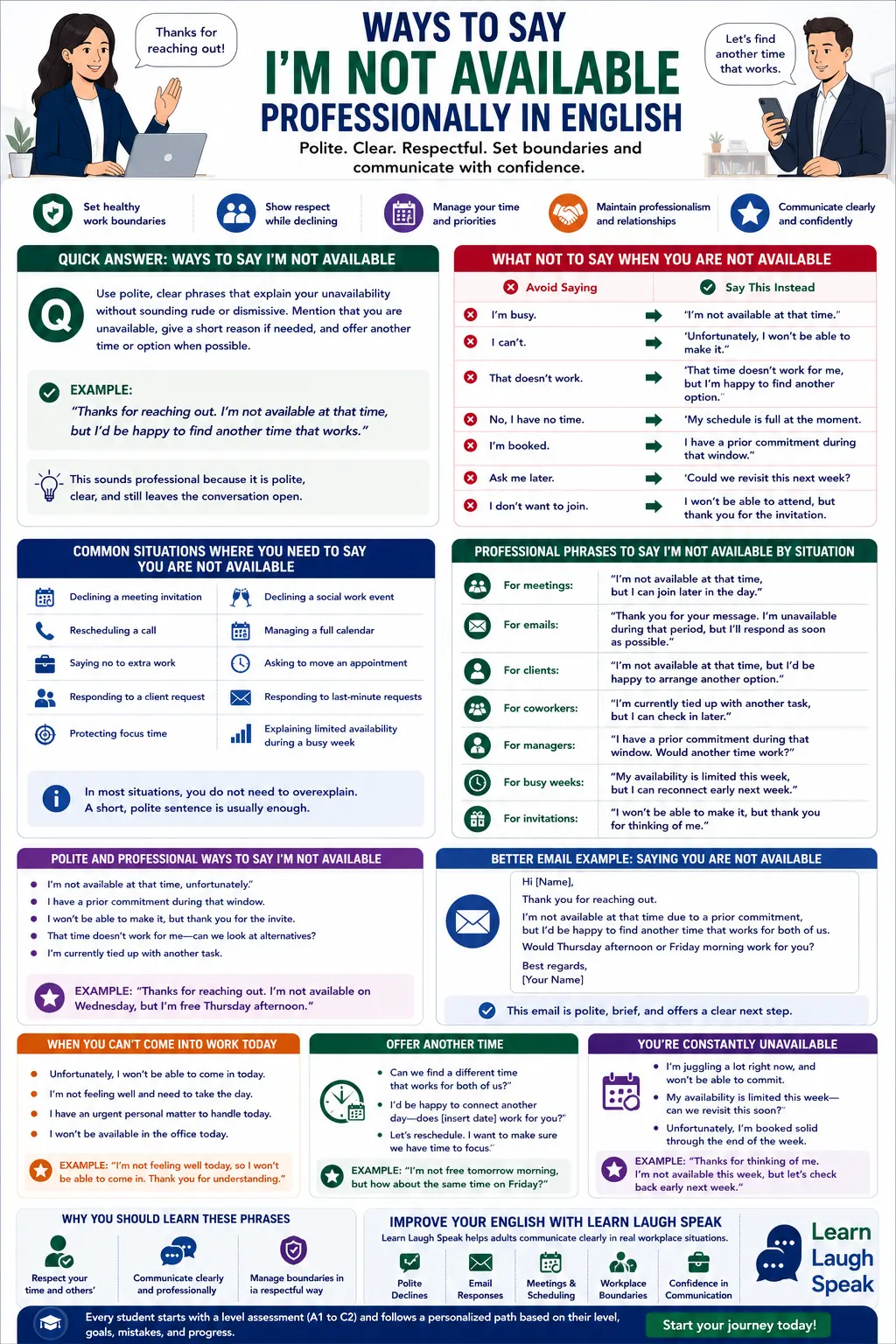
Why Learning Ways to Say I’m Not Available is Important
Being unavailable doesn’t have to be negative. With the right tone and words, you can:
- Set healthy work boundaries
- Show respect while declining
- Maintain professionalism and relationships
How To Respond to a Job Rejection Email (With Examples)

Polite and Professional Ways to Say I’m Not Available
Use these in meetings, emails, or conversations:
- “I’m not available at that time, unfortunately.”
- “I have a prior commitment during that window.”
- “I won’t be able to make it, but thank you for the invite.”
- “That time doesn’t work for me—can we look at alternatives?”
- “I’m currently tied up with another task.”
✅ Example: “Thanks for reaching out. I’m not available on Wednesday, but I’m free Thursday afternoon.”
When You Can’t Come Into Work Today Professionally
Ways to Say I’m Not Available: Being Unavailable
If you need to respond in writing:
- “Thank you for the message. I’m unavailable at that time but open to rescheduling.”
- “I appreciate your invite. Unfortunately, I’m not free during that period.”
- “I’m fully booked at the moment. Let’s connect next week instead.”
✅ Example: “Hi Sam, thanks for your email. I’m not available for the meeting on Monday but would be happy to join later in the week.”
Ways to Say I’m Not Available: Offer Another Time
Saying you’re not available doesn’t mean closing the door. Try:
- “Can we find a different time that works for both of us?”
- “I’d be happy to connect another day—does [insert date] work for you?”
- “Let’s reschedule. I want to make sure we have time to focus.”
✅ Example: “I’m not free tomorrow morning, but how about the same time on Friday?”
Words to Use When You’re Running Late
Ways to Say I’m Not Available: You’re Constantly Unavailable
Sometimes, your calendar may just be full. Be honest but respectful:
- “I’m juggling a lot right now, and won’t be able to commit.”
- “My availability is limited this week—can we revisit this soon?”
- “Unfortunately, I’m booked solid through the end of the week.”
✅ Example: “Thanks for thinking of me. I’m not available this week, but let’s check back early next week.”
What Not to Say When You Are Not Available
Some phrases can sound too direct, cold, or careless in professional English. It is better to protect your time while still sounding respectful.
| Avoid Saying | Say This Instead |
|---|---|
| “I’m busy.” | “I’m not available at that time.” |
| “I can’t.” | “Unfortunately, I won’t be able to make it.” |
| “That doesn’t work.” | “That time doesn’t work for me, but I’m happy to find another option.” |
| “No, I have no time.” | “My schedule is full at the moment.” |
| “I’m booked.” | “I have a prior commitment during that window.” |
| “Ask me later.” | “Could we revisit this next week?” |
| “I don’t want to join.” | “I won’t be able to attend, but thank you for the invitation.” |
These small changes help you sound more professional while still being clear about your availability.
Common Situations Where You Need to Say You Are Not Available
Professionals often need to say they are unavailable in meetings, emails, scheduling messages, interviews, customer service conversations, and daily workplace communication. The key is to match your phrase to the situation and the relationship.
Common situations include:
- declining a meeting invitation
- rescheduling a call
- saying no to extra work
- responding to a client request
- protecting focus time
- declining a social work event
- managing a full calendar
- asking to move an appointment
- responding to last-minute requests
- explaining limited availability during a busy week
In most situations, you do not need to overexplain. A short, polite sentence is usually enough.
Professional Phrases to Say I’m Not Available by Situation
Use these phrases when you need to sound polite, clear, and professional.
- For meetings: “I’m not available at that time, but I can join later in the day.”
- For emails: “Thank you for your message. I’m unavailable during that period, but I’ll respond as soon as possible.”
- For clients: “I’m not available at that time, but I’d be happy to arrange another option.”
- For coworkers: “I’m currently tied up with another task, but I can check in later.”
- For managers: “I have a prior commitment during that window. Would another time work?”
- For busy weeks: “My availability is limited this week, but I can reconnect early next week.”
- For invitations: “I won’t be able to make it, but thank you for thinking of me.”
Better Email Example: Saying You Are Not Available
Hi [Name],
Thank you for reaching out.
I’m not available at that time due to a prior commitment, but I’d be happy to find another time that works for both of us.
Would Thursday afternoon or Friday morning work for you?
Best regards,
[Your Name]
This email works because it is polite, brief, and offers a clear next step.

Improve Professional English with Learn Laugh Speak
Learn Laugh Speak helps adults communicate clearly in real workplace situations.
That includes:
- saying you are not available professionally
- declining requests politely
- rescheduling meetings
- writing professional emails
- setting boundaries respectfully
- using confident workplace English
Every student starts with a level assessment from A1 to C2. From there, learners follow a personalized path based on their level, goals, mistakes, and progress.
If you want to sound more natural and professional in English at work, Learn Laugh Speak helps you practise the phrases you need for real conversations.
4 thoughts on “Ways to Say I’m Not Available Professionally in English”
Pingback: How to Cancel a Meeting Professionally in English | Learn Laugh Speak
Pingback: Easy Calm English Phrases for High-Pressure Situations - Learn Laugh Speak
Pingback: How to Sound Clear and Confident in Business English Emails
Pingback: Spring vs Autumn Trekking in Nepal: Which Is Better? - Learn Laugh Speak