
 English
 Arabic
 Chinese (Simplified)
 Dutch
Dutch French
 German
 Italian
 Portuguese
 Russian
 Spanish
The formula for skill based learning is changing the way we learn in 2026.
For years, education followed a simple formula:
Learn it.
Memorize it.
Repeat it on a test.
For a long time, that was considered progress.
If you could remember the answer, you were doing well.
But the world has changed.
Information is no longer difficult to access.
Facts are no longer hard to find.
Answers are everywhere.
Which raises an important question:
If information is always available, what should education actually focus on now?
That question is shaping modern education more than ever.
And the answer is becoming clearer:
Less memorization.
More real skills.
This is why skill based learning is becoming more important in modern education. It does not remove knowledge. It changes what knowledge is for.
Because in today’s world, remembering information is not enough.
Learners need to understand, apply, adapt, and use knowledge in real situations.
According to Harvard reports from Harvard Health – Practicing a new and challenging activity is a good bet for building and maintaining cognitive skills.
Why Skill Based Learning Matters Now
The shift is not happening because memorization is useless.
It is happening because memorization is incomplete.
A student can remember a formula but still not know when to use it.
A learner can memorize grammar rules but still freeze when speaking.
A professional can complete training but still struggle when the real situation appears.
That is the gap modern education is trying to close.
Skill based learning focuses on what learners can actually do with what they know.
That matters because education should not only prepare people to pass tests.
It should prepare them to use knowledge confidently after the test is over.
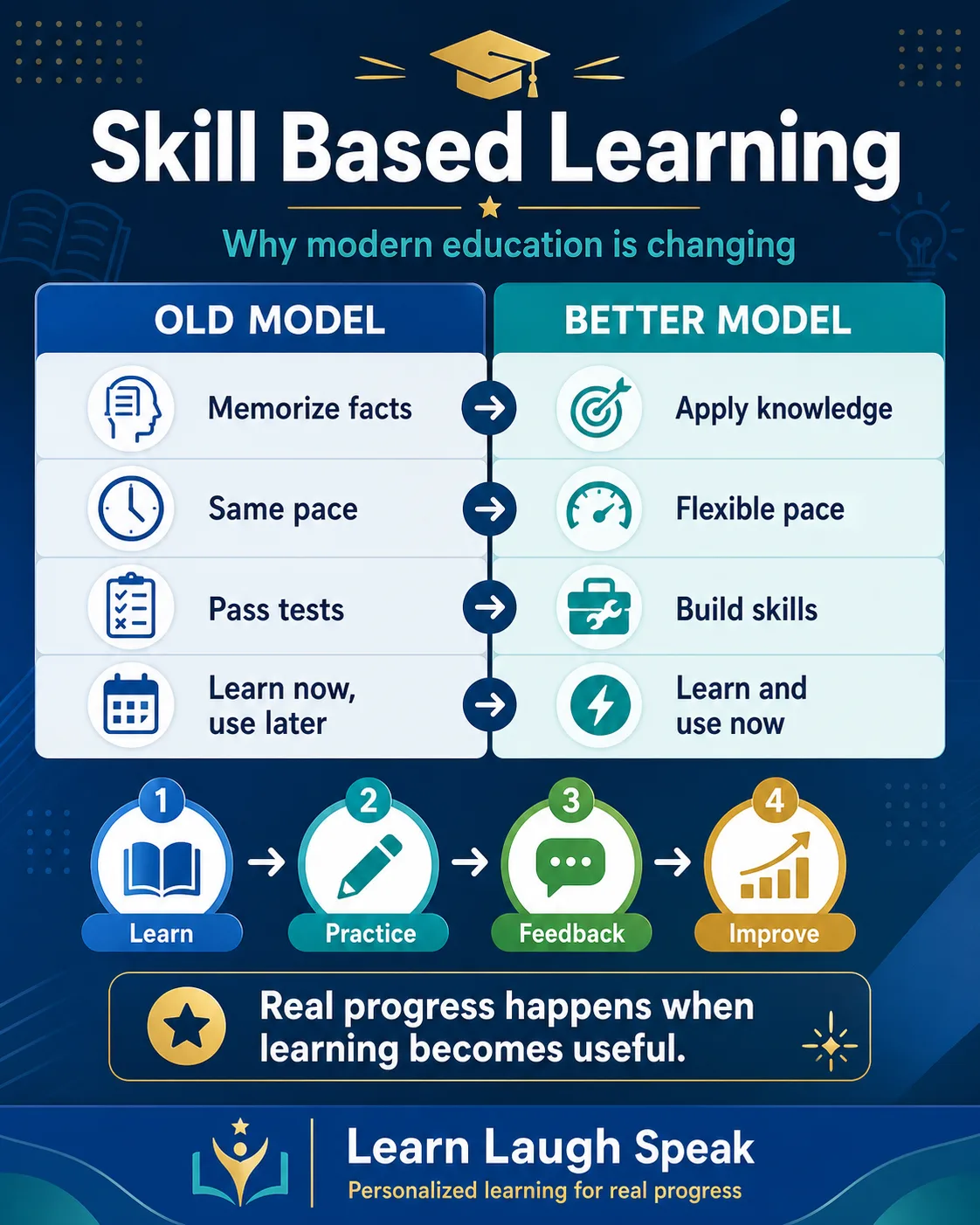
Memorization Gives You Information. Skills Show You Can Use It.
There is a difference between knowing something and being able to use it.
That difference matters more than people think.
A learner might know the correct answer in a quiet classroom, but struggle when the same knowledge needs to be used under pressure.
That does not mean the learner failed.
It means the learning was never fully transferred into skill.
This is why skill based learning focuses less on repeating information and more on using knowledge in context.
The goal is not just to remember.
The goal is to apply.
This report by The University of North Carolina at Chapel Hill explains some great ways for adults to memorize information quickly.
The Old Model vs What Learners Need Now
| Old Education Model | Modern Learning Need |
|---|---|
| Memorize facts | Apply knowledge |
| Pass the test | Use the skill |
| Same pace for everyone | Flexible progress |
| Learn now, use later | Learn and apply quickly |
| Correct answers | Real-world performance |
The old model was easier to measure.
The modern model is harder, but more useful.
Because life rarely asks people to repeat information exactly as they learned it.
It asks them to solve problems.
Why Students Forget So Much After Learning
Most people have experienced this.
You study something.
You remember it for the exam.
A few weeks later, it fades.
That is not always laziness.
Often, it is the result of learning that never becomes active.
When learners only memorize, the knowledge can stay shallow.
It may help in the short term.
But without review, practice, or real use, it often disappears quickly.
In simple terms:
If learners only read or memorize, the knowledge is fragile.
If they retrieve, apply, explain, and use it, the knowledge becomes stronger.
That is one reason skill based learning is gaining attention.
It gives knowledge somewhere to go.
Is personalized learning more effective than traditional learning? We break it down in this article for you!
What Actually Helps Learning Stay
| Learning Method | What Usually Happens |
|---|---|
| Reading only | Easy to forget |
| Memorizing only | Useful short term |
| Practicing | Stronger retention |
| Applying in context | Better long-term use |
| Teaching or explaining | Deeper understanding |
This is where skill based learning becomes powerful.
It turns knowledge into action.
And once knowledge becomes action, it becomes easier to remember.
Why Modern Education Is Moving Toward Real-World Skills
The world moves faster now.
People need to:
adapt quickly
learn continuously
solve new problems
communicate clearly
make decisions with incomplete information
That requires skill.
Not just stored knowledge.
This is especially true in areas like:
language learning
technology
business
communication
adult education
The more dynamic the field, the less useful pure memorization becomes.
A learner does not only need to know the rule.
They need to use it at the right time.
The Quiet Problem with Good Grades
Good grades can show effort.
They can show discipline.
They can show memory.
But they do not always show readiness.
A student can pass a test and still struggle to apply the knowledge later.
That is not an attack on exams.
It is a reminder that exams measure only part of learning.
Skill based learning asks a different question:
Can the learner do something meaningful with what they know?
That question matters more in real life.
Because outside the classroom, people are rarely judged on what they can repeat.
They are judged on what they can do.
Why Skill Based Learning Is Different
Skill based learning is not about making education easier.
It is about making learning more useful.
Instead of asking learners to simply remember information, it asks them to use it.
That changes the learning process.
Students need to:
practice more often
apply knowledge sooner
receive feedback faster
repeat the areas they struggle with
move forward when they are ready
This creates a stronger connection between learning and progress.
It also helps learners see why the lesson matters.
And when learning feels relevant, motivation usually improves.
Does your learning feel irrelevant when speed of learning is slow?
Why Personalized Learning Supports Skill Based Learning
Not every learner struggles with the same thing.
Not every learner moves at the same pace.
And not every learner needs the same lesson at the same time.
That is why personalized learning fits so naturally with skill based learning.
If the goal is to build real ability, the system needs to know:
what the learner already understands
where they are making mistakes
which skills are weak
what needs more practice
when they are ready to move forward
A fixed system cannot always do that well.
A personalized system can.
This is especially important for adults, because adult learners often have prior knowledge, different goals, and less time to waste.
A Real Example: Language Learning
Language learning makes this easy to see.
A student may memorize:
vocabulary
grammar rules
sentence structures
But when speaking?
They freeze.
Why?
Because memory is not the same as real use.
A learner might know the word.
They might know the grammar.
But if they cannot use it in a real sentence, under real pressure, the skill is not fully built yet.
That is why practical learning matters so much.
Skill comes from repetition in context.
Not just memorization.
And that is one reason many adult learners improve faster when learning becomes practical, personalized, and based on real performance.
What This Means for Teachers and Learning Platforms
If education is moving toward skills, teaching has to change too.
It is no longer enough to simply provide information.
Teachers and platforms need to understand:
where the learner struggles
what mistakes repeat
what skills are not transferring
what needs to be practiced again
when the learner is ready for the next step
This is where feedback becomes essential.
Without feedback, learners may keep repeating the same mistakes.
With feedback, learning becomes more precise.
And precision is what helps learners improve faster.
How We Apply Skill Based Learning at Learn Laugh Speak
At Learn Laugh Speak, this idea is central to how the platform works.
Students are not placed into a generic path and expected to move like everyone else.
They complete a level assessment so their learning begins from the right point.
From there, the application tracks mistakes, gaps, and progress, helping each student follow a learning journey based on what they actually need.
That means students do not waste time repeating what they already know.
They also do not skip the areas they struggle with.
Some students can move through levels faster because they already have prior learning experience.
Others take more time where they need support.
Both paths are correct.
The goal is not to finish lessons for the sake of finishing.
The goal is to build usable English that students can apply in real life.
That is the real value of skill based learning.
It respects the learner’s level, speed, mistakes, and progress.

Why This Matters for Adult Learners
Adult learners usually do not want to study just to complete lessons.
They want results.
They want to:
speak better at work
understand more clearly
write with confidence
communicate professionally
improve without wasting time
That is why skill based learning is so important for adults.
It focuses on what the learner needs to do, not just what they need to know.
This makes learning feel more connected to real goals.
And when learning connects to real goals, students are more likely to stay motivated.
What Skill Based Learning Means for Students
For students, this shift is encouraging.
It means learning is not just about being “good at school.”
It is about progress that can be seen and used.
A student who struggles with memorization may still become excellent when learning is practical.
A student who forgets theory may still improve quickly when they apply it repeatedly.
A student who feels slow in traditional education may progress faster when learning is personalized.
That matters.
Because many learners are not failing.
They are simply learning in a system that was not designed around how they improve best.
What Modern Education Will Look Like Next
The future of education will likely focus even more on:
personalization
real-world application
continuous feedback
skill development
flexible progress
learning speed
The classroom will not disappear.
Memorization will not disappear either.
But the structure will keep changing.
Because learners are changing.
And education has to follow.
The strongest learning systems will not only ask:
Did the student finish?
They will ask:
Can the student use what they learned?
That is the question that matters.
Final Thought on Skill Based Learning
Memorization still has a place.
Students need foundations.
They need knowledge.
They need structure.
But memorization cannot be the final goal anymore.
Modern education is moving toward skill based learning because learners need more than answers.
They need the ability to use what they know.
And that is the real shift.
Not less learning.
Better learning.
Skill based learning is not new, but it is become more and more common. Still have questions send us a message or email today!
One thought on “Skill Based Learning Is Replacing Memorization in Education”
Pingback: Why Learning by Doing Is Changing Modern Education in 2026