
 English
 Arabic
 Chinese (Simplified)
 Dutch
Dutch French
 German
 Italian
 Portuguese
 Russian
 Spanish
Everyone: “Personalized learning is more effective”
Everyone: “Traditional education is being faded out by tech”
There’s a reason more people are starting to question how they’ve been taught.
Not because traditional education failed completely.
But because it treats everyone the same — and learning doesn’t work that way.
Some people move faster.
Some need repetition.
Some only improve when they apply things immediately.
Yet most systems still assume:
👉 one structure fits everyone
And that’s where the problem starts.
Each school seems to be taking a different approach according to this report and article understood.org
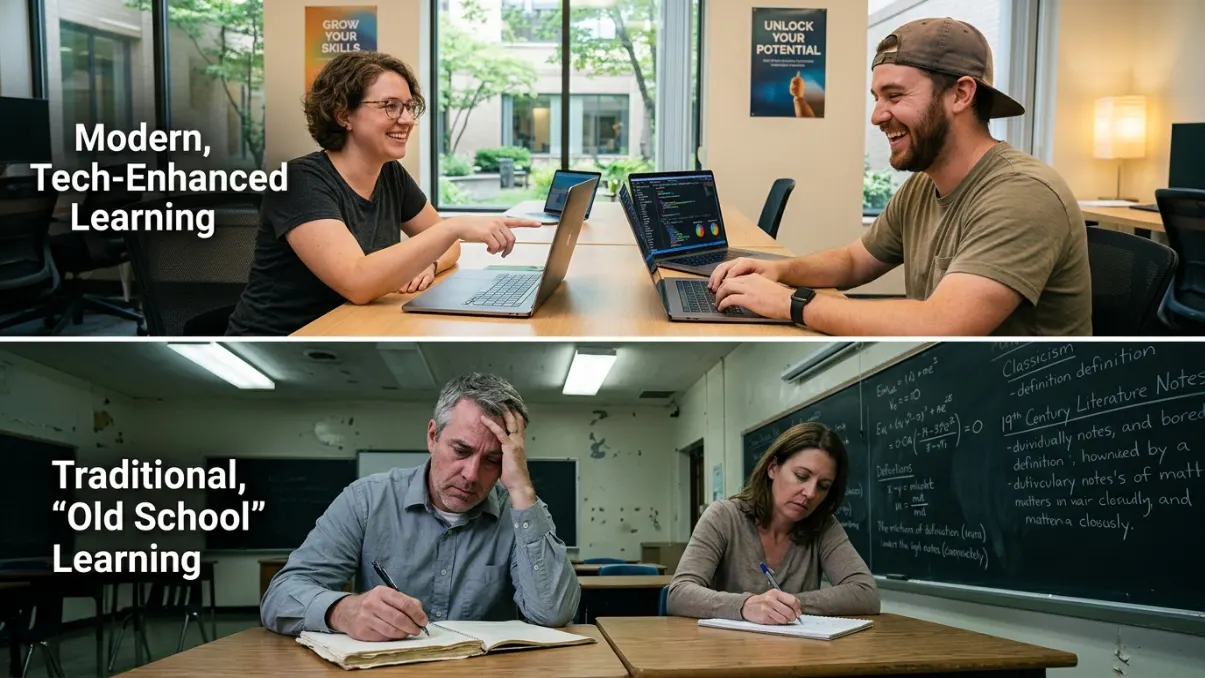
🔹 Why Personalized Learning Is More Effective Than Traditional Education (Simple Answer)
Personalized learning is more effective than traditional education because it adapts to the learner — instead of forcing the learner to adapt to the system.
The Core Problem with Traditional Education
Traditional learning is built on consistency.
Same lessons.
Same pace.
Same expectations.
That creates stability.
But it also creates limitations.
Because learning is not consistent.
It’s uneven.
And when a system ignores that, progress slows down.
Traditional Learning vs Personalized Learning (At a Glance)
| Traditional Education | Personalized Learning |
|---|---|
| Fixed pace | Flexible pace |
| Same content for all | Tailored content |
| Theory-first | Application-first |
| Passive learning | Active learning |
| Delayed feedback | Immediate feedback |
This difference isn’t small.
It changes how quickly — and how effectively — people improve.
Why Personalized Learning Is More Effective for Retention
One of the biggest gaps in traditional learning is retention.
You learn something.
You don’t use it immediately.
You forget parts of it.
This cycle repeats constantly.
Personalized learning reduces that gap by aligning learning with use.
👉 You learn something because you need it
👉 You apply it quickly
👉 You remember it longer
What Research Shows About Personalized Learning
Educational research — including findings referenced by OECD — shows that learners perform better when education is:
- adaptive
- relevant
- feedback-driven
Rather than fixed and standardized.
This supports the shift toward personalized models.
🔹 Why Learners Progress Faster with Personalized Learning
| Factor | Traditional | Personalized |
|---|---|---|
| Speed | Fixed | Variable |
| Repetition | Same for all | Based on need |
| Difficulty | General | Adaptive |
| Progress | Time-based | Skill-based |
This is why two learners in the same system can have very different results.
The Hidden Advantage Most People Don’t See
Personalized learning doesn’t just improve results.
It improves confidence.
Because instead of:
falling behind
or feeling held back
You move at a pace that fits you.
That removes a lot of unnecessary pressure.
Why Personalized Learning Is More Effective for Adults
Adults don’t learn the same way students do.
They:
have less time
need practical results
focus on application
So when learning is:
slow
general
or disconnected
It feels inefficient.
Personalized learning solves that by focusing on what matters immediately.
🔹 A Simple Example
Traditional approach:
Learn a full unit → test later
Personalized approach:
Struggle with something → learn it → apply it immediately
That shift alone can change how quickly someone improves.
What Makes Personalized Learning Work
It’s not just about “custom content.”
It’s about:
continuous adjustment
As you learn, the system adapts.
What you struggle with gets repeated.
What you already know gets skipped.
That’s where real efficiency comes from.
Where Traditional Education Still Works
It’s important to be balanced.
Traditional systems still work well for:
structured knowledge
foundational learning
early education
But they struggle when:
speed matters
flexibility matters
real-world application matters
Does it affect children learning differently compared with adults?
The Real Shift in Learning
Learning is moving from:
time-based progress
to:
skill-based progress
Instead of:
“complete this in 3 months”
It becomes:
“complete this when you’re ready”
That’s a major change.
Why Traditional Learning No Longer Works the Way It Used To? Check out another article from us!
🔹 What This Means for Learners Today
Instead of asking:
“What should I study next?”
You start asking:
“What do I actually need right now?”
That question leads to faster progress.
How We Apply This at Learn Laugh Speak
At Learn Laugh Speak, we’ve built everything around this idea.
Instead of putting every learner on the same path, we:
- assess each student’s level precisely
- track mistakes and gaps in real time
- adjust what they learn based on what they need
- allow faster progression for those with prior experience
That means:
👉 no wasted time
👉 no repeating what you already know
👉 no being held back by a fixed structure
Every student follows their own learning journey — based on how they actually learn.
And that’s why some learners can move through levels faster, while others take the time they need to build correctly.

Final Thought
Personalized learning isn’t just a trend.
It’s a response to a problem that’s been there for a long time.
People don’t learn at the same pace.
They don’t struggle with the same things.
They don’t need the same content.
So systems shouldn’t treat them the same.
The more learning adapts to the individual, the more effective it becomes.
And that’s where real progress starts to happen.
So, the real progress is quick when it is personalized.
Do you agree with the statement that personalized learning is more effective? Send us a message and let us know your thoughts.
3 thoughts on “Personalized Learning Is More Effective Than Traditional Education”
Pingback: Skill Based Learning Is Replacing Memorization in Education
Pingback: The Real Reason Why Students Forget What They Learn
Pingback: Why Personalized Learning Paths Help Adult Students Faster