
 English
 Arabic
 Chinese (Simplified)
 Dutch
Dutch French
 German
 Italian
 Portuguese
 Russian
 Spanish
Meeting phrases English professionals use at work should be simple, clear, and natural.
Not too formal.
Not too casual.
Not robotic.
And definitely not the kind of English that sounds like it came from an old textbook.
This guide is written for adult English learners who need practical phrases for real workplace meetings, not classroom scripts.
Work meetings move quickly.
People ask questions.
Someone changes the topic.
A manager asks for an update.
A client wants clarification.
A colleague disagrees.
Someone needs to close the meeting and confirm the next steps.
In these moments, adult English learners do not always need advanced grammar.
They need the right phrase at the right time.
That is why practical meeting English matters.
It helps professionals speak clearly, participate with confidence, and avoid staying silent when they have something useful to say.
Quick answer: Meeting phrases English professionals need at work include phrases for opening meetings, asking questions, clarifying details, giving updates, interrupting politely, disagreeing respectfully, confirming decisions, and closing clearly.
PRO TIP – SAVE THIS IMAGE – PRINT IT – PUT IT ON YOUR WALL – REMEMBER THE TIPS AND PHRASES
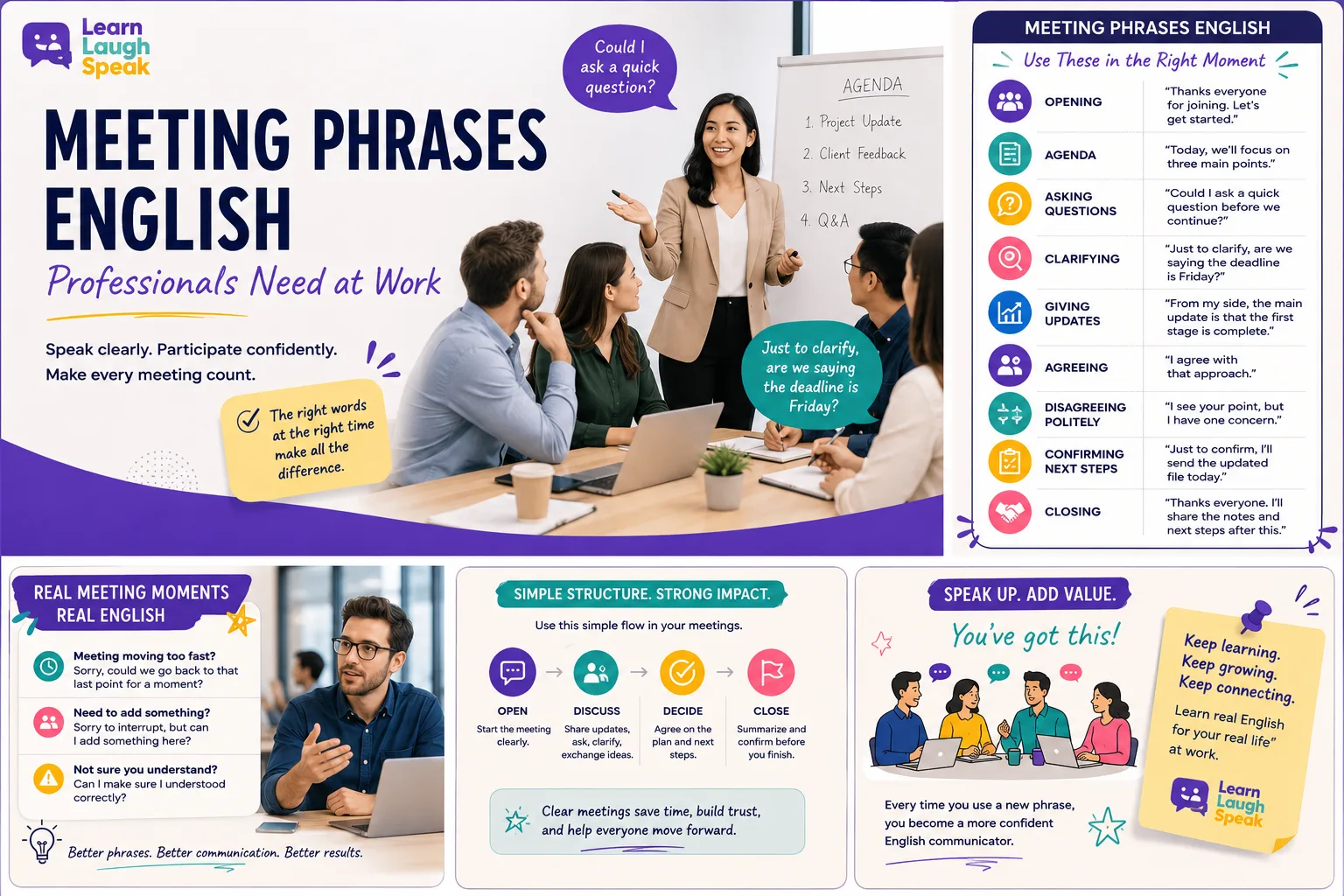
Why Meeting Phrases Matter in Workplace English
A meeting is not only a conversation.
It has a purpose.
People meet to decide, explain, update, solve, plan, or agree on what happens next.
That means the English needs to be functional.
You may need to:
open the meeting
explain the agenda
give an update
ask for clarification
interrupt politely
agree or disagree
ask for opinions
confirm a decision
close the meeting
If you do not have the phrase ready, you may lose the moment.
You might understand the meeting but not speak.
You might know the answer but feel unsure how to start.
You might want to ask a question but worry it will sound rude.
That is why learning meeting phrases English professionals actually use is so valuable.
It gives adults the language to participate, not just listen.
Wondering how to interrupt without being rude in English? Try this link!
The Quick Meeting Phrase Bank
Here are some of the most useful phrases for meetings at work.
| Situation | Meeting phrase |
|---|---|
| Opening a meeting | Thanks everyone for joining. Let’s get started. |
| Introducing the agenda | Today, we’ll focus on three main points. |
| Asking a question | Could I ask a quick question before we continue? |
| Clarifying | Just to clarify, are we saying the deadline is Friday? |
| Giving an update | From my side, the main update is that the first stage is complete. |
| Agreeing | I agree with that approach. |
| Disagreeing politely | I see your point, but I have one concern. |
| Interrupting politely | Sorry to interrupt, but can I add something here? |
| Confirming next steps | Just to confirm, I’ll send the updated file today. |
| Closing the meeting | Thanks everyone. I’ll share the notes and next steps after this. |
These phrases are simple, but they work.
They help you sound professional without overcomplicating your English.
Meeting Phrases to Open a Meeting
Starting a meeting can feel difficult because everyone is waiting for direction.
You do not need a long introduction.
You need a clear opening.
Use these phrases:
Thanks everyone for joining. Let’s get started.
Good morning everyone. Thanks for making the time today.
Let’s begin with the main points for today.
The purpose of today’s meeting is to review our progress and agree on next steps.
We have three things to cover today.
I’ll quickly go through the agenda, then we can open it up for questions.
A strong opening does two things.
It welcomes people.
It tells them what the meeting is about.
For example:
Thanks everyone for joining. The purpose of today’s meeting is to review the project timeline, discuss the client feedback, and confirm the next steps.
That is clear.
It tells people why they are there.
Professional communication is essential for non native students using English as a second language at work.
Meeting Phrases for Introducing the Agenda
The agenda is the map of the meeting.
If you explain it clearly, people understand the direction.
Useful phrases include:
Today, we’ll focus on three main points.
The first item is the project update.
After that, we’ll review the client feedback.
Then we’ll finish by confirming the next steps.
I’d like to keep the meeting focused on these key areas.
If we have time at the end, we can discuss any extra questions.
You can also use a simple structure:
First, we’ll look at…
Then, we’ll discuss…
Finally, we’ll agree on…
Example:
First, we’ll look at the current numbers. Then, we’ll discuss the delay. Finally, we’ll agree on who is responsible for each next step.
This sounds professional and easy to follow.
Sounding professional is not always the only thing you can do.
Meeting Phrases English Learners Can Use for Updates
Updates are common in workplace meetings.
The problem is that many learners start too generally.
They say:
Everything is good.
Or:
We are working on it.
These are not wrong, but they are not specific enough.
Better phrases include:
From my side, the main update is that we have completed the first stage.
At the moment, we are waiting for final approval.
We are on track with the timeline.
There has been a small delay, but we have a plan to manage it.
The main issue right now is the missing information from the client.
We should be ready to send the final version by Thursday.
A strong update should answer three questions:
What happened?
Where are we now?
What happens next?
Example:
From my side, the main update is that the first draft is complete. We are now reviewing the final details, and I expect to send the updated version by tomorrow afternoon.
That is much better than:
We are working on it.
When Your Manager Asks for an Update
This is a real meeting moment many English learners find stressful.
Your manager asks:
Can you give us a quick update?
You know the answer.
But you need a clear way to begin.
Try one of these:
Yes, of course. From my side, the main update is…
Sure. The current status is…
Yes. We have completed the first part, and we are now working on…
The main progress this week is…
The main issue we are managing right now is…
A good update does not need to be long.
It needs to be organized.
Try this structure:
Status + issue + next step
Example:
The current status is that the first version is ready. The only issue is that we are still waiting for final approval. The next step is to send the updated file once we receive confirmation.
That sounds clear, calm, and professional.
Meeting Phrases for Asking Questions
Questions are important because they show you are engaged.
But in a meeting, the way you ask matters.
Use these phrases:
Could I ask a quick question?
Can I check one detail before we move on?
Could you explain that point again?
Do you mean that we need approval before Friday?
Can you give an example of what you mean?
Who will be responsible for that part?
When do we need to complete this?
What is the next step after this meeting?
If you are worried about interrupting, use:
Sorry, could I ask a quick question before we continue?
That sounds polite and professional.
It also stops the meeting from moving too far ahead before you understand the point.
Meeting Phrases for Clarifying Information at Work
Clarifying is one of the most important meeting skills.
It helps avoid mistakes.
It also shows that you care about understanding correctly.
Use these phrases:
Just to clarify, are we saying that the deadline is Friday?
Can I make sure I understood correctly?
So, the next step is for me to send the report, right?
When you say “final version,” do you mean the client-ready version?
Could you clarify what you mean by urgent?
Can we confirm the exact date?
I just want to make sure we are aligned.
A strong clarification phrase often starts with:
Just to clarify…
Example:
Just to clarify, are we sending the proposal today, or are we waiting for the client’s comments first?
This phrase is useful because it sounds careful, not confused.
When the Meeting Is Moving Too Fast
Sometimes the meeting moves faster than your English.
This happens often in real work.
People speak quickly.
They use short phrases.
They move from one topic to another.
You may understand 80% of the conversation but miss one important detail.
In this situation, do not stay silent.
Use one of these phrases:
Sorry, could we go back to that last point for a moment?
Can I quickly check I understood that correctly?
Could you repeat the deadline one more time?
Sorry, I missed the last part. What was the final date?
Just to make sure I understood, are we changing the plan or keeping it the same?
These phrases do not make you sound weak.
They make you sound responsible.
In work meetings, guessing is often more dangerous than asking.
Meeting Phrases for Interrupting Politely
Sometimes you need to speak before the conversation moves on.
The key is to interrupt softly.
Use phrases like:
Sorry to interrupt, but can I add something here?
Can I jump in quickly?
Before we move on, could I add one point?
Can I pause us for one second?
Sorry, just to clarify one thing.
I’ll be quick. I just wanted to mention one detail.
Do not say:
Stop.
Wait.
Listen to me.
You are wrong.
These can sound too direct.
Better:
Sorry to jump in, but I think there may be one small correction.
That phrase keeps the tone respectful.
It also helps you correct information without making the other person feel attacked.
Meeting Phrases for Agreeing
Agreeing in a meeting can be simple.
But it helps to say more than just:
Yes.
Useful phrases include:
I agree with that.
That makes sense to me.
I think that is a good approach.
I’m aligned with that plan.
That works from my side.
I agree, especially on the timeline.
I think we should move forward with that option.
If you want to sound more professional, add a reason.
Example:
I agree with that approach because it gives us more time to review the final details.
That sounds stronger than just:
I agree.
Meeting Phrases for Disagreeing Politely
Disagreeing is harder than agreeing.
You need to be clear without sounding rude.
Use these phrases:
I see your point, but I have one concern.
That makes sense, although I see it slightly differently.
I agree with part of that, but I think we should also consider another option.
Can I offer a different perspective?
I understand the idea, but I’m not sure it solves the main issue.
I have a slightly different view on that.
My concern is that the timeline may be too short.
The best structure is:
Acknowledge + concern + reason
Example:
I see your point, but I have one concern. If we send the file today, we may not have enough time to check the final numbers properly.
That sounds professional because you are not just disagreeing.
You are explaining why.
Sometimes we go blank when we focus to much on structure and struggle to get the words out hence the need for prep.
When You Disagree but Want to Stay Professional
A direct disagreement can sound stronger in English than many learners expect.
For example:
No, I disagree.
This is clear, but it can feel sharp in a meeting.
A softer phrase gives you more control.
Try:
I see your point, but I have one concern.
I understand the idea, but I see one possible issue.
That could work, although I think we may need to consider the timeline.
I agree with the goal, but I’m not sure this is the best option.
This helps you disagree with the idea, not attack the person.
That is the real skill.
Meeting Phrases for Asking for Opinions
Good meetings are not only one person speaking.
Sometimes you need to invite others into the conversation.
Use these phrases:
What do you think about this?
Does anyone have any concerns?
I’d like to hear your thoughts on this.
What is your view from the client side?
Does that work for everyone?
Is everyone comfortable with this approach?
Would anyone like to add anything before we move on?
These phrases are especially useful if you are leading a meeting.
They help people participate.
They also make you sound more natural and confident.
Meeting Phrases for Confirming Decisions
Many meetings fail because the decision is not clear.
People talk.
People agree.
Then everyone leaves with a different understanding.
Use these phrases to confirm:
Just to confirm, we have agreed to move forward with option two.
So the decision is to send the proposal on Friday.
To make sure we are aligned, Maria will update the file and I will send it to the client.
Can we confirm who is responsible for each next step?
Just so everyone is clear, the deadline is Thursday at 5 p.m.
I’ll write this in the meeting notes so we have it confirmed.
This is important.
A good meeting does not only include discussion.
It includes clear decisions.
When Nobody Has Confirmed the Next Step
This is one of the most useful moments to speak.
A meeting may sound finished, but nobody has clearly said who will do what.
You can help by saying:
Before we finish, can we confirm the next steps?
Just to make sure we are aligned, who is taking the first action?
Can we quickly confirm the deadline before we close?
I’ll send the notes, but can we confirm the owners for each task?
So from my side, I’ll update the file and send it by Friday. Is that correct?
This kind of phrase makes you sound organized.
It also helps the team avoid confusion after the meeting.
Meeting Phrases for Closing a Meeting
Closing a meeting should feel organized.
Do not just say:
Okay, bye.
Better phrases include:
Thanks everyone. That’s all for today.
Before we finish, let’s quickly confirm the next steps.
I’ll send the meeting notes after this.
Thanks for your time. I’ll follow up with the action points.
That covers everything from my side.
Let’s reconnect next week with the updates.
Thanks everyone. Have a great day.
A strong closing should confirm:
what was decided
who will do what
when the next step happens
Example:
Thanks everyone. Before we finish, let’s confirm the next steps. I’ll send the updated file today, Maria will review the pricing, and we’ll reconnect on Friday.
That sounds clear and professional.
Meeting Phrases English Learners Should Avoid
Some phrases are understandable, but they can sound too direct or unnatural at work.
| Avoid saying | Say this instead |
|---|---|
| I don’t understand. | Could you clarify that point? |
| You are wrong. | I think there may be one small correction. |
| Wait. | Can I pause us for one second? |
| I want to say something. | Can I add something here? |
| Repeat. | Could you repeat that last part, please? |
| What? | Sorry, could you say that again? |
| No, I disagree. | I see your point, but I have one concern. |
| Finish? | Are there any other points before we close? |
This does not mean the first phrases are always impossible.
But in professional English, softer phrases usually work better.
They help you sound respectful and confident at the same time.
Meeting Phrase Bank by Situation
Here is a quick phrase bank you can save and practise.
| Situation | Phrase |
|---|---|
| Start | Thanks everyone for joining. Let’s get started. |
| Agenda | Today, we’ll focus on three main points. |
| Update | From my side, the main update is… |
| Ask | Could I ask a quick question? |
| Clarify | Just to clarify, are we saying that…? |
| Interrupt | Sorry to interrupt, but can I add something? |
| Agree | That makes sense to me. |
| Disagree | I see your point, but I have one concern. |
| Confirm | Just to confirm, we have agreed to… |
| Close | Thanks everyone. I’ll send the notes after this. |
This is the kind of meeting phrases English learners should practise often.
Not memorized like a script.
Practised until they feel natural.
How to Practise Meeting Phrases
Reading phrases is useful.
Using them is better.
To practise, choose five phrases and use them in short examples.
For example:
Could I ask a quick question?
Could I ask a quick question about the deadline?
Just to clarify…
Just to clarify, are we sending the report today?
I see your point, but…
I see your point, but I think the timeline may be too short.
From my side…
From my side, the main update is that the client approved the first draft.
Before we move on…
Before we move on, could I add one small correction?
This kind of practice helps adults move from recognition to real use.
That is the goal.
Not just knowing the phrase.
Using it when the moment comes.
How Learn Laugh Speak Helps Adults Use Meeting English at Work
At Learn Laugh Speak, we help adults learn English for real workplace situations.
Meetings are one of the most important examples.
Adult learners need to ask questions, clarify details, give updates, disagree politely, interrupt respectfully, and confirm decisions.
That is why students start with a level assessment from A1 to C2.
From there, each student follows a personalized learning path based on their level, progress, mistakes, and needs.
Adults do not all need the same English.
Some need meeting English.
Some need email English.
Some need customer service phrases.
Some need presentation skills.
Some need confidence speaking.
Learn Laugh Speak helps adults learn what they need, when they need it, so they can use English more clearly and confidently at work.

Final Thought
Meeting phrases English professionals use at work should be clear, natural, and useful.
You do not need complicated sentences to participate in a meeting.
You need phrases that help you open the conversation, ask questions, clarify details, give updates, agree, disagree, interrupt politely, confirm next steps, and close clearly.
The right phrase can help you speak at the right moment.
It can help you avoid confusion.
It can help you sound more professional.
And most importantly, it can help you take part instead of staying silent.
That is why meeting phrases English learners practise should always connect to real workplace situations.
Because meetings are not just about English.
They are about being heard, understood, and ready to contribute.
2 thoughts on “Meeting Phrases English Professionals Need at Work Everyday”
Pingback: How to Say No Professionally & Sound Respectful in English
Pingback: How to Improve Your Speaking Skills on Your Own - Learn Laugh Speak