
 English
 Arabic
 Chinese (Simplified)
 Dutch
Dutch French
 German
 Italian
 Portuguese
 Russian
 Spanish
Learning how to improve your speaking skills alone in English can feel difficult at first.
Many adults understand English well when reading or listening, but speaking feels completely different.
You may know vocabulary.
You may understand grammar.
But when it is time to speak, your mind suddenly feels blank.
This is one of the most common challenges for English learners.
The good news is that improving your speaking skills does not always require a classroom or a speaking partner.
You can improve your English speaking skills on your own by building simple daily speaking habits.
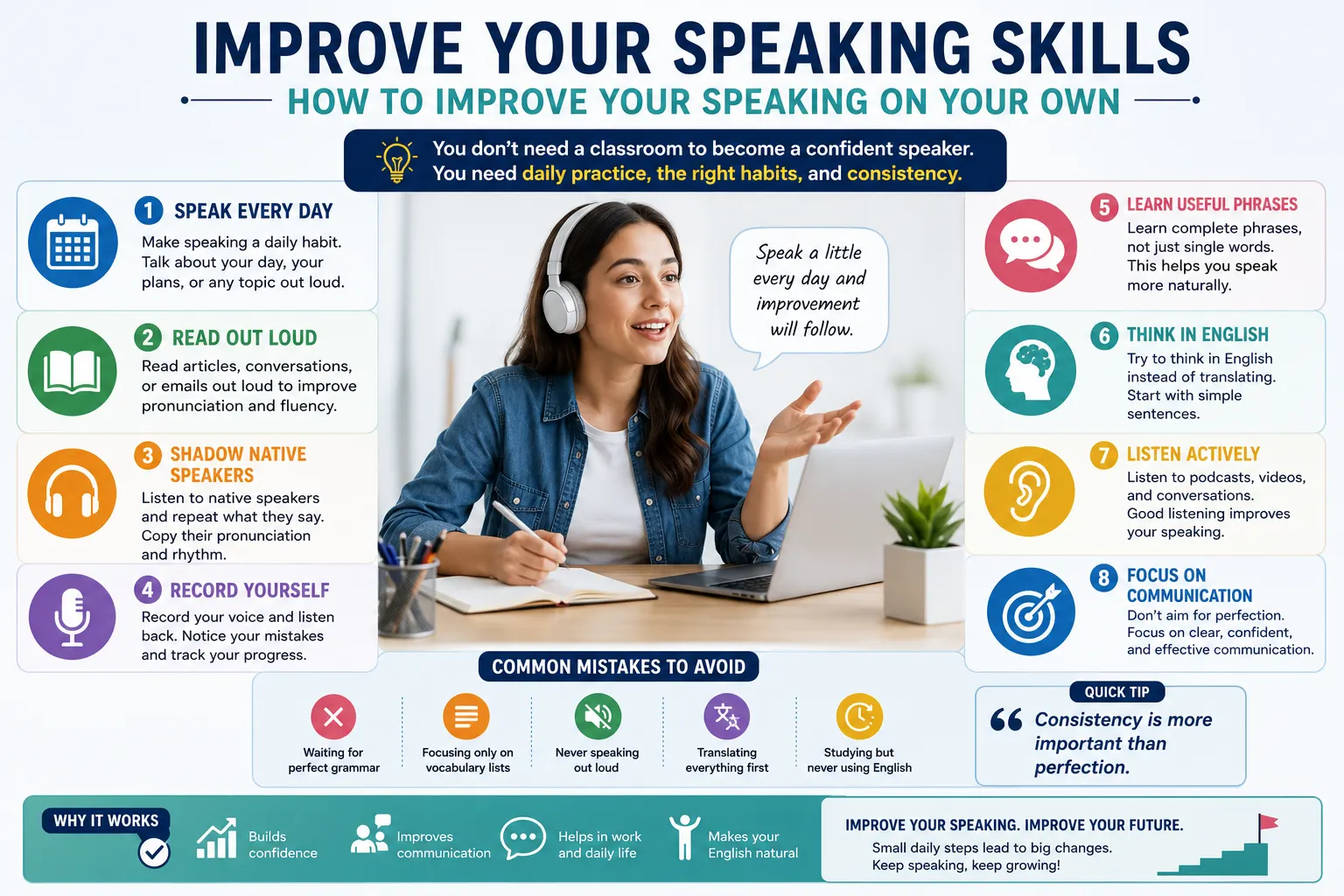
Quick Answer – To improve your speaking skills alone, focus on daily speaking practice, listening repetition, reading out loud, shadowing native speakers, learning useful phrases, recording yourself, and speaking consistently instead of trying to speak perfectly.
Why Speaking Skills Matter
Strong speaking skills help you:
- communicate more confidently
- express ideas clearly
- participate in meetings
- improve workplace communication
- build confidence in conversations
- sound more natural in English
Speaking English is not only about grammar.
It is about using English comfortably in real situations.
1. Improve Your Speaking Skills by Speaking Every Day
The biggest mistake many learners make is studying English without actually speaking it.
Speaking is a skill.
Like any skill, it improves with repetition.
Even 10–15 minutes of speaking practice each day can make a huge difference over time.
Simple daily speaking practice ideas
- describe your day in English
- talk about your plans
- explain what you are doing
- summarize a video you watched
- answer questions out loud
- practise workplace phrases
✅ Example:
“This morning I had a meeting, then I worked on emails and finished a client report.”
Small daily speaking habits build confidence naturally.
2. Improve Your Speaking Skills Alone by Reading Out Loud
Reading silently helps comprehension.
Reading out loud helps speaking.
This improves:
- pronunciation
- rhythm
- confidence
- sentence flow
Choose simple English content:
- articles
- emails
- conversations
- subtitles
- workplace phrases
Read slowly and clearly.
Do not worry about sounding perfect.
The goal is to become comfortable producing English out loud.
✅ Example practice:
“Thank you for your email. I’ll review the document and send my feedback tomorrow afternoon.”
This type of practice helps business English learners significantly.
Many people want to improve their speaking skills specifically for meeting speaking!
3. Improve Your Speaking Skills on Your Own with Shadowing
Shadowing is one of the best speaking exercises for English learners.
Shadowing means:
- listening to native English
- repeating immediately after the speaker
- copying pronunciation and rhythm
You can shadow:
- YouTube videos
- podcasts
- interviews
- meetings
- TV shows
How to practise shadowing
- Listen to one sentence.
- Pause.
- Repeat it out loud.
- Try to copy the pronunciation and timing.
✅ Example:
Native speaker:
“Let’s schedule another meeting for next Thursday.”
You repeat:
“Let’s schedule another meeting for next Thursday.”
This helps your brain become more comfortable producing natural English patterns.
4. Improve Your Speaking Skills On Your Own by Learning Phrases
Many learners focus too much on individual vocabulary words.
Real speaking becomes easier when you learn complete phrases.
For example:
Instead of learning:
- schedule
- update
- review
learn full phrases:
- “Can we schedule a meeting?”
- “I wanted to give you a quick update.”
- “I’ll review the document today.”
Phrase learning improves:
- speaking speed
- confidence
- fluency
- workplace communication
This is especially useful for business English learners.
5. Improve Your Speaking Skills Alone by Recording Yourself
Recording yourself speaking can feel uncomfortable at first.
But it is one of the fastest ways to improve.
When you listen back, you notice:
- pronunciation problems
- repeated mistakes
- pauses
- unclear words
- confidence issues
Simple recording exercise
Choose one topic:
- your job
- your weekend
- your goals
- a meeting
- a customer situation
Speak for one minute.
Then listen back and identify:
- what sounded good
- what needs improvement
Over time, you will notice major progress.
6. Improve Your Speaking Skills by Thinking in English
Many learners translate everything in their head first.
This slows speaking down.
Instead, start building the habit of thinking directly in English.
Simple ways to practise
- name objects around you
- describe situations in English
- think about your schedule in English
- talk to yourself in English
- mentally explain what you are doing
✅ Example:
Instead of translating:
“I need to answer emails after lunch.”
try thinking directly:
“I need to answer emails after lunch.”
This becomes easier with practice.
7. Improve Your Speaking Skills Through Listening
Good speaking starts with good listening.
Listening helps you:
- hear pronunciation
- learn sentence patterns
- understand natural rhythm
- learn common phrases
Try listening to:
- business podcasts
- interviews
- workplace conversations
- English YouTube channels
- meeting discussions
Focus on:
- how sentences are connected
- how native speakers pause
- common workplace expressions
The more English you hear, the easier speaking becomes.
Learning professional English and learning phrases to be prepared can help your speaking.
8. Improve Your Speaking Skills Alone for Work
Many adults learn English because of work.
Speaking confidence is important for:
- meetings
- presentations
- interviews
- customer communication
- teamwork
- phone calls
That is why workplace speaking practice matters.
Workplace speaking phrases
- “Can you clarify that point?”
- “I’d like to add something.”
- “I’ll send the update this afternoon.”
- “Could we schedule another meeting?”
- “I agree with that approach.”
Learning practical workplace phrases helps speaking feel more natural in professional situations.
9. Improve Your Speaking Skills on your Own by Focusing on Communication, Not Perfection
One of the biggest speaking problems is fear of mistakes.
Many learners wait until their grammar feels perfect before speaking.
That usually slows progress.
Good communication matters more than perfect grammar.
Native speakers make mistakes too.
The goal is:
- clear communication
- confidence
- consistency
Not perfection.
If you speak regularly, your confidence improves naturally.
Common Mistakes When Trying to Improve Speaking Skills
Many English learners:
- study grammar only
- avoid speaking out loud
- translate every sentence first
- focus too much on perfection
- never practise real conversations
- memorize words without using them
Speaking improves when English becomes active, not passive.
You must use the language regularly.
Simple Daily Habits to Improve Speaking Skills
Here are some easy daily habits that help improve speaking:
| Habit | Why It Helps |
|---|---|
| Reading out loud | Improves pronunciation |
| Shadowing videos | Builds fluency |
| Recording yourself | Increases awareness |
| Speaking daily | Builds confidence |
| Learning phrases | Improves natural speaking |
| Listening to English | Improves rhythm and vocabulary |
Consistency matters more than long study sessions.
Improve Your Speaking Skills with Learn Laugh Speak
At Learn Laugh Speak, adults improve their English speaking skills through practical real-world English.
Students learn:
- workplace English
- conversation skills
- meeting communication
- pronunciation
- listening
- confidence speaking
Every student starts with a level assessment from A1 to C2.
From there, learners follow a personalized path based on their level, goals, mistakes, and progress.
Adults do not all need the same English.
Some need workplace communication.
Some need speaking confidence.
Some need customer service English.
Some need help speaking naturally in meetings.
Learn Laugh Speak helps adults build speaking confidence step by step.

Final Thought
Learning how to improve your speaking skills takes practice, repetition, and consistency.
You do not need perfect English to become a better speaker.
You simply need regular speaking habits.
Simple activities like:
- reading out loud
- shadowing native speakers
- recording yourself
- learning useful phrases
- speaking every day
can dramatically improve your confidence over time.
Because the best way to improve speaking is not by waiting.
It is by speaking more often.
12 thoughts on “How to Improve Your Speaking Skills on Your Own”
Pingback: How to Professionally Disagree in a Meeting in English
Pingback: How to Speak Without Stopping in English Easily
Pingback: How to Professionally Accept Offers in English
Pingback: Accent Listening: Easily Understand Fast English on Calls
Pingback: How to Learn Memes in English Confidently & Correctly - Learn Laugh Speak
Pingback: How to Improve Your Professional Speaking Alone - Learn Laugh Speak
Pingback: Best Way to Learn English for Work as an Adult in 2026
Pingback: Professional English Phrases for Every Workplace Situation
Pingback: The Word While Explained Simply & Easily For Students - Learn Laugh Speak
Pingback: Easily Learn How to Describe a Person's Personality in English - Learn Laugh Speak
Pingback: How to Pronounce Words Clearly and Speak Fluently in English - Learn Laugh Speak
Pingback: Provoking Questions in English: How to Keep Learners Engaged - Learn Laugh Speak