
 English
 Arabic
 Chinese (Simplified)
 Dutch
 French
 German
 Italian
 Portuguese
 Russian
 Spanish
Prepositions are some of the smallest words in English, but they are also some of the most important.
Words such as in, on, at, to, from, with, under, between and through help us explain where something is, when something happens, how something moves and how different parts of a sentence are connected.
This list of prepositions gives you more than 100 useful English prepositions, but you do not need to memorize all of them at once.
If you are learning English, begin with the most common prepositions first. Then learn them inside real phrases and sentences.
For example:
at 8:00
on Monday
in July
under the table
between two buildings
through the tunnel
Learning the complete phrase is usually much easier than trying to memorize the preposition alone.

Table of Contents
- Quick Answer: What Is a Preposition?
- 25 Common English Prepositions to Learn First
- List of Prepositions in English A–Z
- Types of Prepositions
- Prepositions of Time
- Prepositions of Place
- Prepositions of Movement and Direction
- Other Useful Prepositions
- Common Multi-Word Prepositions
- The Most Confusing English Prepositions
- Prepositions Used With Verbs
- Prepositions Used With Adjectives
- Prepositions in Everyday Sentences
- How to Learn Prepositions More Easily
- Prepositions Quiz
- Frequently Asked Questions About Prepositions
- Final Thoughts on This List of Prepositions
Quick Answer: What Is a Preposition?
A preposition is a word or group of words that shows the relationship between different parts of a sentence.
That relationship can describe:
Place:
The keys are on the table.
Time:
The meeting starts at 9:00.
Movement:
She walked into the room.
Direction:
We drove toward the city.
Connection:
This gift is for you.
Method:
We travelled by train.
Prepositions are commonly followed by a noun, pronoun or noun phrase.
For example:
under the bed
with him
after dinner
near the hotel
The Cambridge Dictionary guide to prepositions explains how English uses prepositions to show relationships involving space, time and other connections between words.
If prepositions are difficult for you, our Learn Laugh Speak guide on how to learn prepositions easily in English explains practical ways to understand them through context instead of simply memorizing long lists.
25 Common English Prepositions to Learn First
There are many prepositions and prepositional expressions in English, but beginners do not need all of them immediately.
Start with these 25:
| Preposition | Simple Example |
|---|---|
| about | We talked about work. |
| above | The picture is above the bed. |
| after | Call me after lunch. |
| at | Meet me at 6:00. |
| before | Wash your hands before dinner. |
| behind | The car is behind the house. |
| below | The temperature is below zero. |
| between | Sit between Maria and John. |
| by | We travelled by bus. |
| for | This present is for you. |
| from | She is from Mexico. |
| in | The keys are in my bag. |
| inside | Wait inside the building. |
| into | She walked into the room. |
| near | The pharmacy is near the hotel. |
| of | I’d like a cup of coffee. |
| off | Take your shoes off the bed. |
| on | Your phone is on the table. |
| over | The plane flew over the city. |
| through | We walked through the park. |
| to | I’m going to work. |
| under | The bag is under the chair. |
| until | Stay here until tomorrow. |
| with | Come with me. |
| without | Don’t leave without your passport. |
If you are an A1 or A2 English learner, these words are far more important than trying to memorize every rare preposition in English.
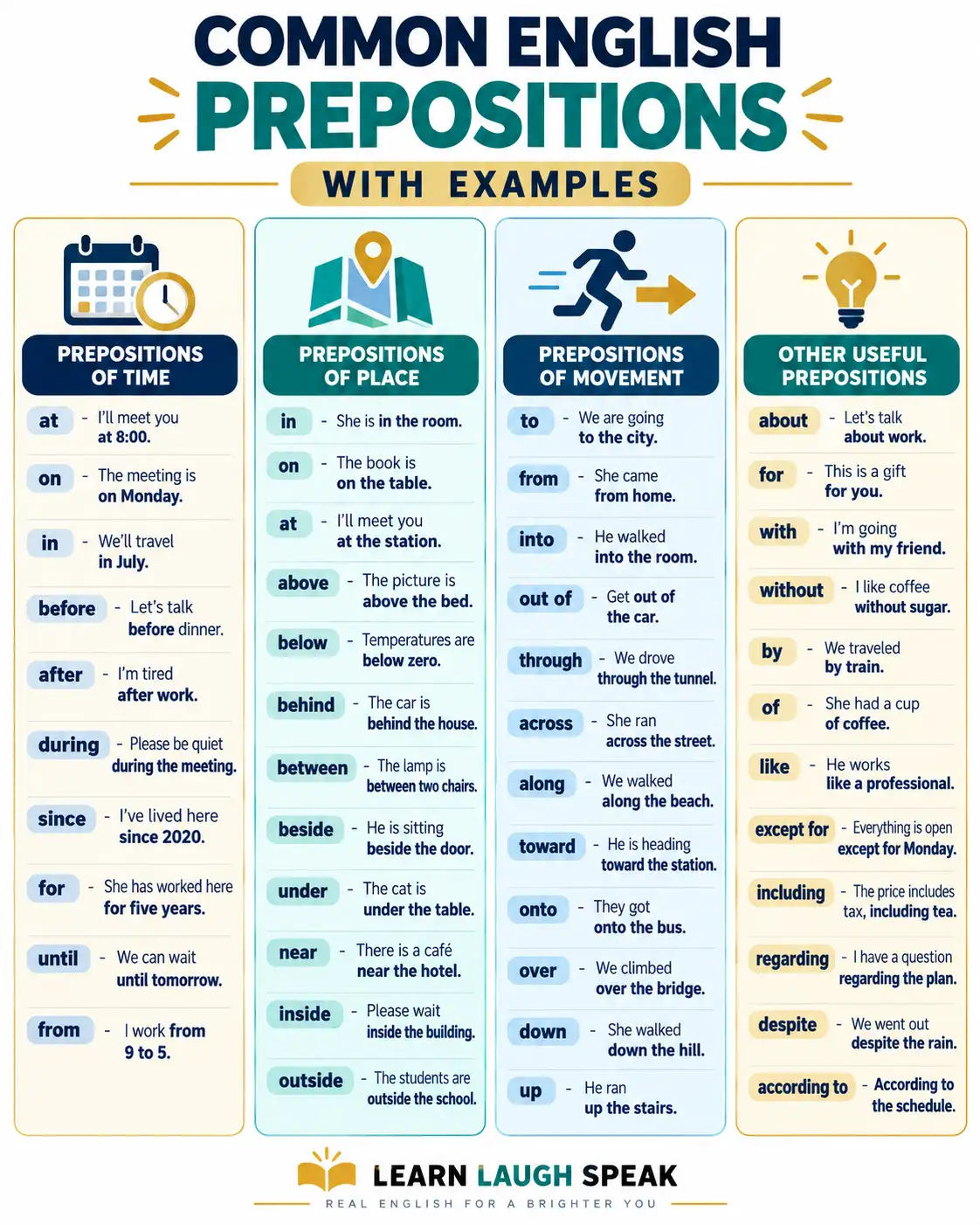
List of Prepositions in English A–Z
Here is a larger list of prepositions you may see in spoken and written English.
Remember that some English words can perform different grammatical jobs depending on how they are used in a sentence.
A
aboard
about
above
across
after
against
along
alongside
amid
amidst
among
amongst
around
as
at
atop
B
before
behind
below
beneath
beside
besides
between
beyond
by
C
concerning
considering
D
despite
down
during
E
except
excluding
F
following
for
from
I
in
including
inside
into
L
like
N
near
notwithstanding
O
of
off
on
onto
opposite
outside
over
P
past
pending
per
R
regarding
round
S
since
T
than
through
throughout
till
to
toward
towards
U
under
underneath
unlike
until
up
upon
V
via
W
with
within
without
You may notice that some letters of the alphabet have no common English prepositions beginning with them. That is normal.
The important goal is not to memorize this list alphabetically.
The goal is to understand how prepositions work in real sentences.
Types of Prepositions
A long preposition list becomes much easier to understand when the words are grouped by meaning.
Some of the most useful groups are:
- prepositions of time
- prepositions of place
- prepositions of movement
- prepositions of direction
- prepositions of method or means
- prepositions showing relationships or connections
The same preposition can sometimes belong to more than one group.
For example:
in the room → place
in December → time
That is one reason prepositions can be difficult for English learners.
Prepositions of Time
Prepositions of time tell us when something happens.
Some common examples are:
at
on
in
before
after
during
since
for
until
from
to
At
Use at for specific times.
at 7:00
at noon
at midnight
Example:
“The meeting starts at 9:30.”
On
Use on for days and dates.
on Monday
on my birthday
on October 21
Example:
“We’re meeting on Friday.”
In
Use in for months, years, seasons and longer periods.
in October
in 2026
in summer
Example:
“They moved here in 2024.”
A simple way to remember the basic pattern is:
AT → specific time
ON → day or date
IN → longer period
If these three words still cause problems, see our complete Learn Laugh Speak guide to prepositions of time in English with more examples of at, on and in.
Prepositions of Place
Prepositions of place tell us where somebody or something is.
Common examples include:
at
in
on
above
below
behind
between
beside
inside
near
opposite
outside
over
under
In
Use in when something is inside an area or space.
“The clothes are in the closet.”
“She lives in Canada.”
“They are in the kitchen.”
On
Use on when something is on a surface.
“The phone is on the table.”
“The picture is on the wall.”
“Our office is on the third floor.”
At
Use at when thinking about a specific point or location.
“Meet me at reception.”
“She is at work.”
“I’ll see you at the station.”
The British Council guide to prepositions of place also explains the important differences between in, on and at when talking about location.
For more examples, you can also practise with our Learn Laugh Speak guide to prepositions of place, including words such as in, on, at, under, behind, beside and between.
If you use English at work, our lesson on prepositions of time and place in hospitality shows how these words are used for hotel directions, times, restaurants, meetings and guest communication.

Prepositions of Movement and Direction
These prepositions tell us where somebody or something is moving.
Common examples include:
across
along
around
down
from
into
onto
out of
past
through
to
toward
up
Compare:
“The cat is in the box.”
This describes its location.
Now:
“The cat jumped into the box.”
This describes movement.
Another example:
“The book is on the table.”
This describes location.
“She put the book onto the table.”
This describes movement toward a surface.
Across
Movement from one side to another.
“She walked across the street.”
Through
Movement inside something and out the other side.
“We drove through the tunnel.”
Along
Movement following a path or line.
“They walked along the beach.”
Toward
Movement in the direction of something.
“He walked toward the door.”
From and To
Use these to describe a starting point and destination.
“We travelled from Cancún to Mexico City.”
Other Useful Prepositions
Not every preposition simply describes time, place or movement.
By
By can describe method or transport.
“We travelled by plane.”
“You can pay by card.”
It can also identify the person who performed an action.
“The book was written by George Orwell.”
With
Use with to show accompaniment or an instrument.
“Come with me.”
“She cut the bread with a knife.”
Without
Without means not having something.
“Don’t travel without your passport.”
“He drinks coffee without sugar.”
For
For has many uses.
“This is for you.”
“We stayed there for three days.”
“Thank you for your help.”
Of
Of often describes connection, quantity or possession.
“A cup of coffee.”
“The end of the road.”
“One of my friends.”
Common Multi-Word Prepositions
Not every preposition is a single word.
English also uses groups of words that function together as prepositional expressions.
Common examples include:
according to
ahead of
along with
apart from
as for
as of
aside from
away from
because of
by means of
close to
due to
except for
far from
in addition to
in front of
in place of
in relation to
in spite of
instead of
next to
on account of
on behalf of
on top of
out of
owing to
prior to
regardless of
thanks to
together with
up to
with regard to
with respect to
Let’s look at some common examples.
Because of
“The flight was delayed because of the weather.”
In Front of
“The taxi is waiting in front of the hotel.”
Next to
“The pharmacy is next to the bank.”
Instead of
“I’ll have tea instead of coffee.”
In Spite of
“We went outside in spite of the rain.”
According to
“According to the schedule, the flight leaves at 8:00.”
Learning these as complete expressions is usually easier than trying to analyse every word individually.
The Most Confusing English Prepositions
Some groups create far more mistakes than others.
In, On and At
For time:
at 8:00
on Monday
in July
For place:
at the station
on the table
in the room
Do not try to translate each word directly from your first language. Learn the English combinations.
In vs Into
In usually describes location:
“She is in the pool.”
Into usually describes movement:
“She jumped into the pool.”
On vs Onto
On usually describes location:
“The keys are on the desk.”
Onto usually describes movement toward a surface:
“She put the keys onto the desk.”
Between vs Among
Use between when discussing separate or clearly identified people or things.
“The hotel is between the bank and the restaurant.”
Use among when something is part of a larger group.
“She was standing among the crowd.”
Beside vs Besides
These look similar but usually mean different things.
Beside means next to.
“Sit beside me.”
Besides usually means in addition to.
“Besides English, she speaks Spanish.”
Since vs For
Use since with a starting point.
“I’ve lived here since 2020.”
Use for with a period of time.
“I’ve lived here for six years.”
This is one of the most common mistakes made by English learners.
Prepositions Used With Verbs
Some verbs naturally combine with particular prepositions.
For example:
agree with
“I agree with you.”
apply for
“She applied for the job.”
belong to
“This bag belongs to me.”
depend on
“It depends on the weather.”
listen to
“I listen to music every morning.”
look at
“Look at the screen.”
pay for
“I’ll pay for dinner.”
talk about
“We talked about work.”
wait for
“I’m waiting for my friend.”
There is not always a simple rule that tells you which preposition goes with a particular verb. The British Council guide to verbs and prepositions is a useful reference for learning these combinations as complete phrases.
Some verb combinations are also related to phrasal verbs. If you want to continue practising, see our Learn Laugh Speak guide on how to learn phrasal verbs in English with examples and exercises.
Prepositions Used With Adjectives
Adjectives can also combine with particular prepositions.
Examples include:
afraid of
“She is afraid of spiders.”
angry with
“I’m angry with him.”
bad at
“I’m bad at remembering names.”
different from
“This is different from the original.”
excited about
“We’re excited about the trip.”
famous for
“Mexico is famous for many different foods.”
good at
“She is good at English.”
interested in
“I’m interested in learning Spanish.”
proud of
“They are proud of their daughter.”
ready for
“Are you ready for the meeting?”
Again, it is usually better to learn the combination rather than the individual preposition.
Prepositions in Everyday Sentences
Here are 30 examples showing how common prepositions work naturally.
- The phone is on the table.
- My passport is in my bag.
- Meet me at the airport.
- We arrived before lunch.
- I’ll call you after work.
- She’s sitting between two friends.
- The dog is sleeping under the chair.
- The hotel is near the beach.
- We walked through the park.
- He drove across the bridge.
- She came with her family.
- Don’t leave without your wallet.
- This package is for you.
- We travelled by train.
- I’m going to the supermarket.
- She came from Australia.
- The plane flew over the city.
- They’re waiting inside the restaurant.
- He walked into the office.
- She put the box onto the table.
- I’ll stay until Friday.
- We’ve been here since Monday.
- They lived there for five years.
- The bank is opposite the hotel.
- The car is parked behind the building.
- We walked along the beach.
- He ran toward the bus.
- The café is beside the bookstore.
- We stayed indoors because of the rain.
- The restaurant is in front of the hotel.
Notice how much easier these prepositions are to understand when they appear inside a complete sentence.
How to Learn Prepositions More Easily
A list of prepositions is useful as a reference, but reading a list repeatedly is not the fastest way to learn them.
1. Learn Complete Phrases
Instead of memorizing:
at
learn:
at work
at home
at 8:00
at reception
Instead of memorizing:
on
learn:
on Monday
on the table
on the bus
on the second floor
Your brain remembers meaningful phrases more easily than isolated words.
2. Group Prepositions by Meaning
Study:
time
then:
place
then:
movement
Do not try to learn 100 prepositions in one session.
3. Use Your Own Environment
Look around you.
Say:
“My phone is on the desk.”
“My keys are in my pocket.”
“The chair is next to the table.”
“The door is behind me.”
Real examples are easier to remember.
4. Practise Common Combinations
Learn:
interested in
good at
listen to
wait for
depend on
as complete expressions.
5. Listen for Prepositions
When watching a movie, video or English lesson, notice short words such as:
in
on
at
to
for
with
You will begin hearing them constantly.
Prepositions Quiz
Choose the correct answer.
1. The meeting starts ___ 8:30.
A. in
B. at
C. on
Answer: B — at
2. We are meeting ___ Monday.
A. on
B. in
C. at
Answer: A — on
3. She was born ___ 1998.
A. at
B. on
C. in
Answer: C — in
4. The keys are ___ the table.
A. on
B. into
C. to
Answer: A — on
5. She walked ___ the room.
A. in
B. into
C. at
Answer: B — into
6. The restaurant is ___ the bank and the hotel.
A. among
B. between
C. through
Answer: B — between
7. I’ve lived here ___ 2021.
A. for
B. since
C. during
Answer: B — since
8. I’ve lived here ___ five years.
A. since
B. during
C. for
Answer: C — for
9. I’m waiting ___ my friend.
A. for
B. at
C. with
Answer: A — for
10. She is interested ___ learning English.
A. at
B. in
C. for
Answer: B — in
Frequently Asked Questions About Prepositions
What is a preposition?
A preposition is a word or group of words that shows a relationship between other parts of a sentence.
Prepositions commonly describe time, place, movement, direction and other relationships.
What are 10 common prepositions?
Ten extremely common English prepositions are:
at, by, for, from, in, of, on, to, with and about.
What are the most important prepositions for beginners?
Beginners should concentrate first on common words such as:
in, on, at, to, from, for, with, by, under, over, between, before and after.
How many prepositions are there in English?
There is no single universally agreed number because English grammar changes depending on how certain words and multi-word expressions are classified.
For learners, knowing the most frequently used prepositions is much more important than knowing the exact total.
What are the three main prepositions of time?
The three learners usually study first are:
at
on
and:
in
For example:
at 7:00
on Monday
in January
What are common prepositions of place?
Some common prepositions of place are:
in, on, at, under, above, below, behind, beside, between, near, opposite and inside.
What is the difference between in and into?
In usually describes location.
“The dog is in the house.”
Into usually describes movement.
“The dog ran into the house.”
What is the difference between on and onto?
On generally describes location on a surface.
“The phone is on the desk.”
Onto generally describes movement toward a surface.
“She put the phone onto the desk.”
Should I memorize a complete preposition list?
You can use a preposition list as a reference, but do not try to memorize every word immediately.
Learn the most common prepositions inside phrases and sentences first.
For example, learning:
at work
is more useful than memorizing at by itself.
Final Thoughts on This List of Prepositions
There are many English prepositions, but you do not need to learn all of them at the same time.
Start with the words you hear every day:
in
on
at
to
from
for
with
by
under
over
and:
between
Then practise them inside complete phrases:
in the office
on Monday
at 9:00
to the airport
from Mexico
with my friends
under the table
The most important lesson from this list of prepositions is not how many words you can memorize.
It is whether you can use the right preposition naturally when you speak and write English.
Learn them in context, practise them in real sentences and pay attention when you hear them.
Over time, many of the combinations that seem difficult today will begin to sound natural.