
 English
 Arabic
 Chinese (Simplified)
 Dutch
Dutch French
 German
 Italian
 Portuguese
 Russian
 Spanish
Are you curious about caprese pronunciation in English?
This Italian food word can be tricky, especially for English learners. You may see it on a menu, hear it in a restaurant, or want to order a caprese salad confidently without feeling unsure.
The good news is that once you break the word into sounds, it becomes much easier.
The most common English pronunciation is:
kuh-PRAY-zee
You may also hear:
kuh-PRAY-zay
The most important part is the middle syllable:
PRAY
That is where the stress goes.
In this article, you’ll learn what caprese means, how to pronounce it clearly, common mistakes to avoid, and examples of how to use the word in everyday English.

Quick Answer: Caprese Pronunciation
The easiest way to remember caprese pronunciation is:
kuh-PRAY-zee
Break it into three parts:
kuh
PRAY
zee
Say it slowly first:
kuh — PRAY — zee
Then say it naturally:
kuh-PRAY-zee
The stress is on the second syllable:
PRAY
So do not say the word flat. Make the middle sound stronger.
You may also hear some English speakers say:
kuh-PRAY-zay
Both versions are commonly understood in English, but kuh-PRAY-zee is a safe and natural pronunciation to practise.
What Does Caprese Mean?
Before we focus more on caprese pronunciation, it helps to understand the word.
Caprese is a traditional Italian dish, often served as a salad.
A classic caprese salad usually includes:
Fresh mozzarella cheese.
Tomatoes.
Olive oil.
Sometimes balsamic glaze.
It is a simple dish, but it is popular because the ingredients are fresh and full of flavor.
You may see caprese used in different food names, such as:
Caprese salad.
Caprese sandwich.
Caprese pizza.
Caprese pasta.
Caprese skewers.
Caprese chicken.
So, if you are at a restaurant and see the word caprese, it usually means the dish includes tomato, mozzarella, basil, and Italian-style flavors.
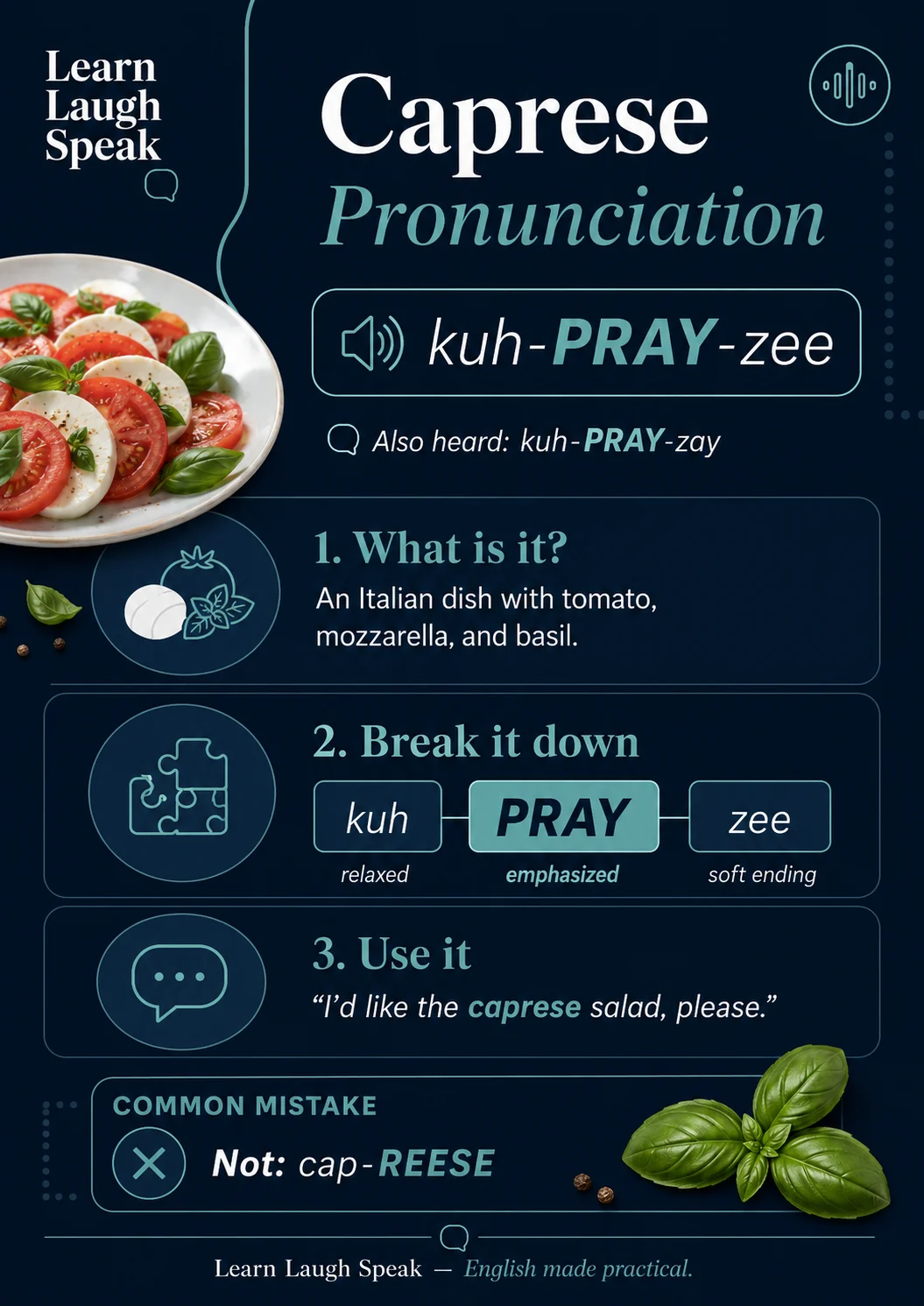
Caprese Pronunciation Broken Into Syllables
Now let’s break down the word into smaller parts.
This makes caprese pronunciation easier to practise.
| Part | Sound | Tip |
|---|---|---|
| ca | kuh | Short and soft, not “cap” like a hat |
| pre | PRAY | This is the stressed syllable |
| se | zee / zay | Both are heard in English, depending on accent |
The full word sounds like:
kuh-PRAY-zee
or sometimes:
kuh-PRAY-zay
The most important rule is:
Stress the middle syllable.
Do not say:
CAP-reese
Do not say:
cap-RESS
A better pronunciation is:
kuh-PRAY-zee
Try saying it three times:
kuh-PRAY-zee
kuh-PRAY-zee
kuh-PRAY-zee
The more you practise it out loud, the more natural it will feel.
How to Pronounce Caprese Correctly
To pronounce caprese correctly in English, start slowly.
First sound:
kuh
This is soft and short.
It should not sound like cap.
Second sound:
PRAY
This is the strongest part of the word.
Make it clear and confident.
Third sound:
zee
This is the final sound in one common English pronunciation.
Now put it together:
kuh-PRAY-zee
If you hear someone say:
kuh-PRAY-zay
That is also common.
The difference is mainly the final sound.
Some speakers finish with zee.
Some speakers finish with zay.
Both are understandable, especially in everyday English conversation.
Common Mistakes When You Pronounce Caprese
Many learners make the same mistakes with this word.
Here are the most common ones.
| Mistake | Better Pronunciation | Why |
| cap-REESE | kuh-PRAY-zee | The stress is not on “reese.” |
| cap-ress | kuh-PRAY-zee | The final sound is not “ress.” |
| kah-preh-zay only | kuh-PRAY-zee / kuh-PRAY-zay | English speakers often use “PRAY.” |
| saying every syllable flat | kuh-PRAY-zee | Stress the middle syllable. |
The biggest mistake is putting the stress in the wrong place.
Remember:
Not CAP-reese.
Not cap-RESS.
Say:
kuh-PRAY-zee
Our Learn Laugh Speak pronunciation guide is a good article to review.

Caprese Pronunciation in Example Sentences
Now that you understand caprese pronunciation, let’s look at how to use the word in real sentences.
Practise saying these examples out loud.
- “I would like to order a caprese salad, please.”
- “Have you ever tried caprese pizza? It’s delicious.”
- “She prepared caprese skewers for the party.”
- “The caprese sandwich at that café is a must-try.”
- “The caprese pasta salad is perfect for a summer picnic.”
- “He loves making caprese bruschetta as an appetizer.”
- “They served caprese-stuffed chicken at the wedding reception.”
- “I’m craving caprese with balsamic glaze right now.”
These examples help you practise the word in context.
That is important because pronunciation becomes easier when you use the word inside full sentences.
How to Order Caprese in English
If you are at a restaurant, you can use simple phrases like these:
“I’d like the caprese salad, please.”
“How do you make the caprese sandwich?”
“Does the caprese pizza come with fresh basil?”
“Can I order the caprese as an appetizer?”
“Is the caprese salad vegetarian?”
These are useful because you are not only practising caprese pronunciation.
You are also practising real restaurant English.
If you feel unsure, slow down slightly and say:
caprese salad
kuh-PRAY-zee salad
Most people will understand you clearly.
Simple Tips to Practise Caprese Pronunciation
Here are a few easy ways to practise.
1. Break the word into parts
Say:
kuh
PRAY
zee
Then combine them:
kuh-PRAY-zee
2. Stress the middle sound
Make PRAY stronger than the other syllables.
This helps the word sound more natural.
3. Practise with food phrases
Say:
caprese salad
caprese pizza
caprese sandwich
caprese pasta
caprese appetizer
This helps you use the word in real situations.
4. Record yourself
Say the word out loud and record it.
Then listen again.
Check if the middle syllable sounds clear:
PRAY
5. Use it in a full sentence
For example:
“I’d like the caprese salad, please.”
This is more useful than only repeating the word by itself.
Caprese Meaning and Pronunciation Together
When learning a new English word, it helps to connect meaning and sound.
Caprese means a dish or food style connected with tomato, mozzarella, basil, and olive oil.
The pronunciation is:
kuh-PRAY-zee
So when you see this word on a menu, remember:
caprese salad = a salad with tomato, mozzarella, basil, and olive oil.
caprese pronunciation = kuh-PRAY-zee
This simple connection makes the word easier to remember.
Final Thoughts on Caprese Pronunciation
Learning caprese pronunciation is useful if you enjoy food, restaurants, travel, or everyday English conversation.
The word may look difficult at first, but it becomes much easier when you break it into parts.
Remember:
caprese = kuh-PRAY-zee
The middle syllable is the most important:
PRAY
You may also hear:
kuh-PRAY-zay
Both are understood, but kuh-PRAY-zee is a strong and natural version to practise in English.
Keep saying it out loud, use it in sentences, and soon you’ll be able to order caprese salad or talk about caprese dishes with confidence.

Learn English Pronunciation With Learn Laugh Speak
At Learn Laugh Speak, we know that English pronunciation can be challenging for adults.
Some words look simple but sound very different when spoken.
That is why our platform helps learners practise speaking, listening, reading, and writing at the correct level.
With Learn Laugh Speak, students complete a full level assessment and begin learning from the exact point that matches their ability.
You can practise pronunciation, build confidence, and improve your English step by step with structured lessons and instant corrections.
Whether you are learning words like caprese, practising restaurant English, or improving your speaking for work and daily life, Learn Laugh Speak helps you make progress clearly and correctly.
If you still have doubts about caprese pronunciation or other English words, you can practise with Learn Laugh Speak and build your confidence one lesson at a time.