
 English
 Arabic
 Chinese (Simplified)
 Dutch
Dutch French
 German
 Italian
 Portuguese
 Russian
 Spanish
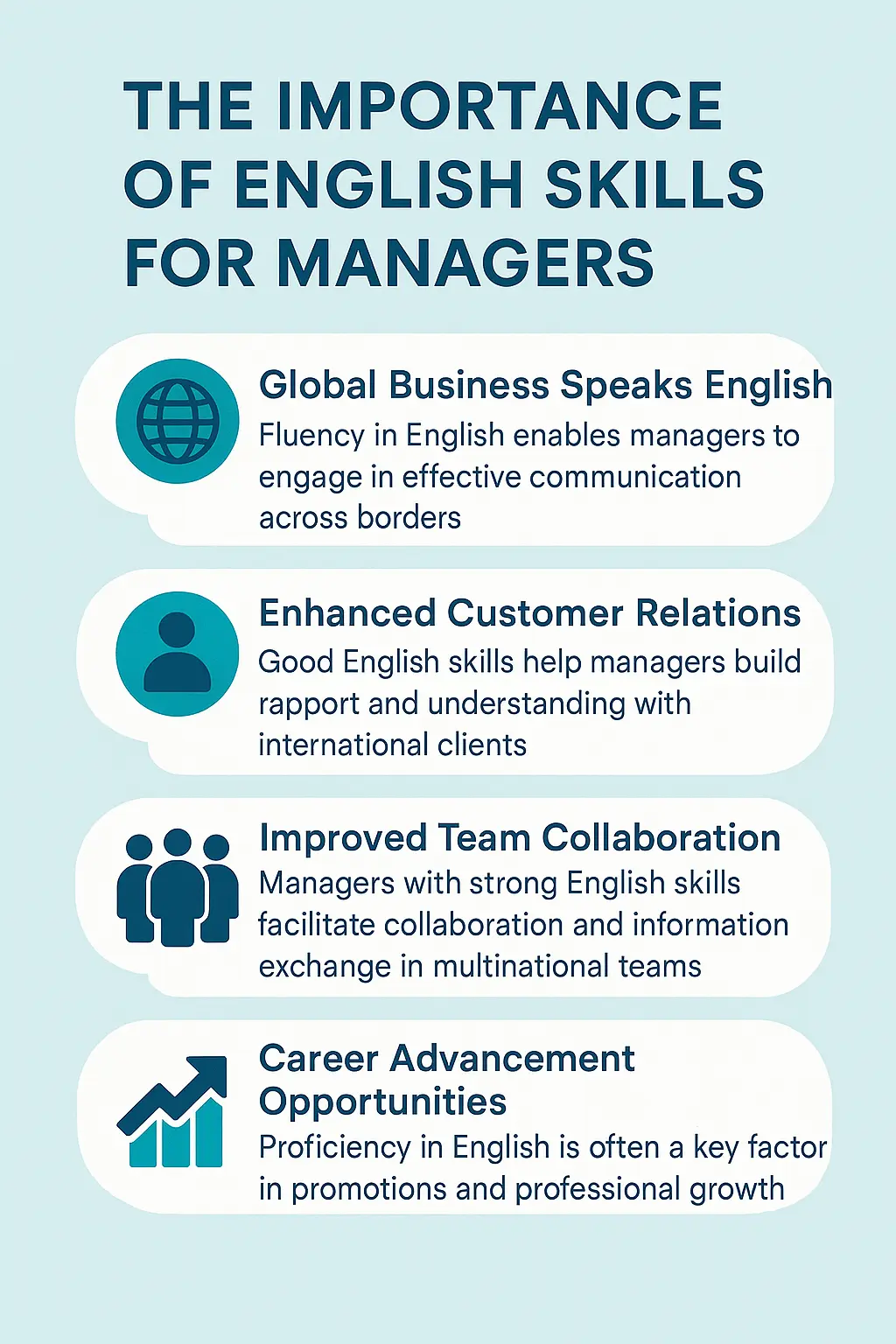
In today’s global economy, managers face a level of communication complexity never seen before. They lead multicultural teams, present to international clients, negotiate with partners in different time zones, and write reports read across multiple departments. Because of this, English skills for managers are no longer optional — they are essential for leadership success.
Research consistently shows that communication ability is one of the strongest predictors of managerial performance. According to a recent global study, hundreds of international companies have officially adopted English as their corporate language. This shift means managers must be ready to communicate clearly, confidently, and professionally in English at all times.
This guide explores the essential English skills every manager needs — from meetings and writing to negotiation and leadership — along with evidence-backed strategies to develop them.

Why English Skills for Managers Matter in Global Workplaces
English is the lingua franca of modern business. Whether a manager works in marketing, operations, hospitality, technology, or logistics, effective English communication influences everything from daily workflows to long-term strategic projects.
Leadership research confirms this. According to this leadership research, communication breakdowns are among the top reasons leadership efforts fail. Managers who communicate clearly are viewed as more credible, trustworthy, and effective by both employees and executives.
Strong English skills for managers ensure:
Better team alignment
Clarity in expectations
Smoother delegation
Higher employee confidence
Better decision-making
Stronger negotiation outcomes
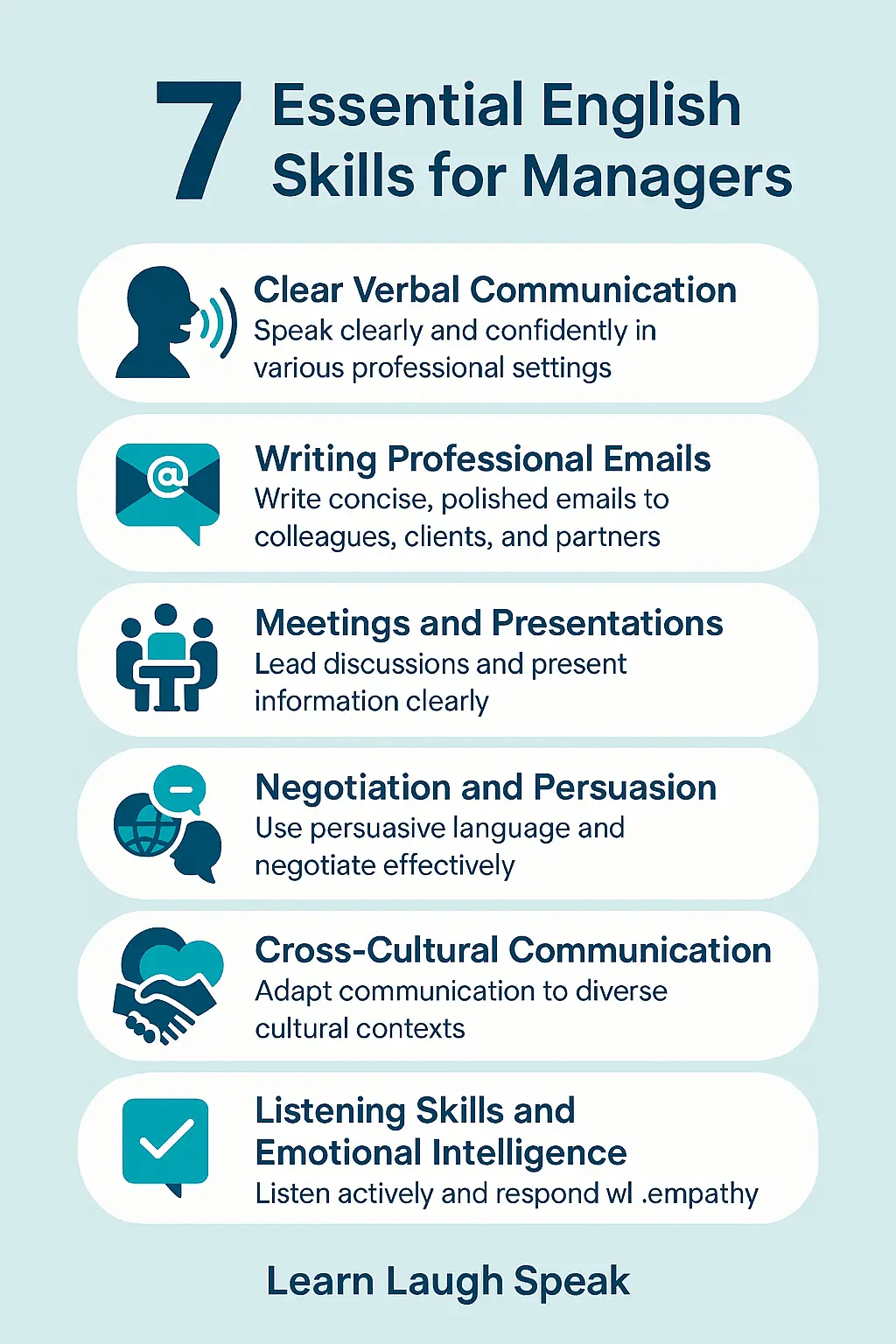
1. English Skills for Managers: Mastering Clear Verbal Communication
Managers must be able to speak clearly and confidently in different professional settings — from one-on-one conversations to hybrid team meetings.
Clear verbal English allows managers to:
Explain expectations without confusion
Guide teams through change
Prevent misunderstandings
Resolve conflicts quickly
Represent the company professionally
According to an international analysis, leaders with strong clarity in communication gain higher trust and performance from their teams.
To improve spoken clarity, managers can:
Slow down pacing
Use shorter sentences
Avoid idioms in international teams
Emphasize key points with pauses
Use simple transitions like “first,” “next,” “to summarize”
Managers who speak with confidence and clarity immediately elevate team performance.
Cross-Cultural Communication in English at Work
2. English Skills for Managers: Writing Professional Emails and Reports
Written communication is one of the most frequent responsibilities for managers. Emails, performance notes, project summaries, and client proposals must be polished and professional.
Effective written English includes:
Concise language
A clear purpose
Structured paragraphs
A professional tone
Proper grammar and punctuation
Managers who write clearly reduce errors, strengthen their credibility, and save time across departments. Strong writing is seen as a sign of leadership maturity and professionalism.
3. English Skills for Managers in Meetings and Presentations
Managers lead meetings weekly — sometimes daily. English proficiency is crucial for:
Opening a meeting with clarity
Setting expectations
Managing discussion flow
Encouraging participation
Handling disagreement diplomatically
Summarizing key points and action steps
Presentation English is equally important. Managers must present updates, deliver proposals, or speak to executives with confidence and authority.
Helpful phrases include:
“The goal of this meeting is…”
“Let me clarify…”
“One moment, let’s review the key points…”
“To conclude, here are our next steps…”
Managers who communicate effectively in meetings build stronger, more aligned teams.
Speak in Meetings Professionally (English Student Guide)
4. English Skills for Managers in Negotiation and Persuasion
Managers negotiate constantly — with vendors, clients, supervisors, and employees.
Research from this communication-focused study shows that strong communication ability significantly improves negotiation outcomes and leadership influence.
Key negotiation English includes:
Offering alternatives diplomatically
Using persuasive transitions (“the benefit of this approach is…”)
Asking clarifying questions
Managing tension professionally
Managers who master persuasive English gain better results while preserving relationships.
5. Cross-Cultural English Skills for Managers
Modern teams are diverse. Managers must communicate effectively across cultures.
A workplace communication report highlights that cross-cultural communication is now one of the top leadership competencies.
Managers should adjust English by:
Avoiding slang and idioms
Using universal examples
Respecting communication styles (direct vs. indirect)
Using inclusive language (“we,” “our team,” “let’s work on this together”)
Clear, culturally aware English strengthens team connection and reduces misunderstandings.
6. Listening Skills and Emotional Intelligence in English
Strong communication is not only about speaking — listening matters just as much.
According to a study on leadership listening leaders who actively listen improve employee trust and engagement.
Managers should practice:
Paraphrasing (“So what you’re saying is…”)
Asking follow-up questions
Recognizing tone and nonverbal cues
Showing empathy verbally
Clarifying misunderstanding gently
Listening skills improve team relationships and prevent conflict.
7. Real-World English Skills for Managers in Daily Tasks
Managers need English in dozens of daily scenarios, such as:
Reviewing KPIs
Conducting performance evaluations
Guiding projects
Speaking to a client
Writing task updates
Giving constructive feedback
Handling tense conversations
Practical English — not just textbook vocabulary — is what leaders truly need.
According to an international adult skills report adults learn fastest when practicing real-world tasks.
Useful Phrases for Online Meetings in English
8. Developing English Skills for Managers Through Practice
To develop strong English skills, managers should focus on consistent, relevant practice.
Effective training methods include:
Self-recording practice
Helps managers evaluate tone, pacing, and clarity.
Role-play scenarios
Useful for negotiation, conflict resolution, and performance reviews.
Microlearning
10–15 minute lessons fit easily into busy schedules.
Leadership-focused vocabulary building
Strategy, communication, HR, decision-making, and client-related vocabulary.
Regular writing practice
Emails, project summaries, or quick daily reflections.
Consistency is more important than long study sessions.
9. English Skills for Managers Across CEFR Levels
| CEFR Level | Workplace Communication Ability |
|---|---|
| A2 | Can give basic instructions and simple explanations |
| B1 | Can participate in meetings and explain tasks |
| B2 | Can lead meetings, write professional emails, and negotiate common issues |
| C1 | Can handle complex discussions, deliver presentations, and persuade effectively |
| C2 | Can lead international teams and communicate with executive-level fluency |
Tracking CEFR progress helps managers identify strengths and develop leadership-ready communication.
10. How Learn Laugh Speak Supports English Skills for Managers
Learn Laugh Speak is built specifically for adult learners — including managers who need real-world English they can use immediately.
Our platform includes:
33,000 CEFR-aligned lessons
Workplace English modules
Leadership and communication practice
Pronunciation and speaking feedback
Microlearning tools for busy schedules
Real-time progress tracking
Managers build English communication skills faster, more confidently, and more efficiently.
Summary
Strong English skills for managers lead to better leadership, stronger negotiation, improved employee relations, and smoother collaboration across borders.
In modern workplaces, English isn’t just a language — it’s a leadership tool.
Managers who master communication gain credibility, influence, and long-term career growth.
One thought on “English Skills for Managers: Guide for Workplace Leaders”
Pingback: Empowering Educators, Creators, and Students: The Digital Tools Shaping Modern Learning and Personal Branding - Learn Laugh Speak