
 English
 Arabic
 Chinese (Simplified)
 Dutch
Dutch French
 German
 Italian
 Portuguese
 Russian
 Spanish
Fintech English helps you understand and talk about modern money apps, digital payments, IBAN accounts, cards, SEPA transfers, fiat currencies, and crypto wallets. If you use English at work, while travelling, or when managing money online, learning this vocabulary can help you read app instructions, understand financial services, and explain digital banking more clearly.
Digital banking is now part of daily life. Many people use apps to send money, receive payments, manage cards, check balances, and move money between accounts. Some fintech platforms also include crypto wallets, which means users can manage traditional money and digital assets in one place.
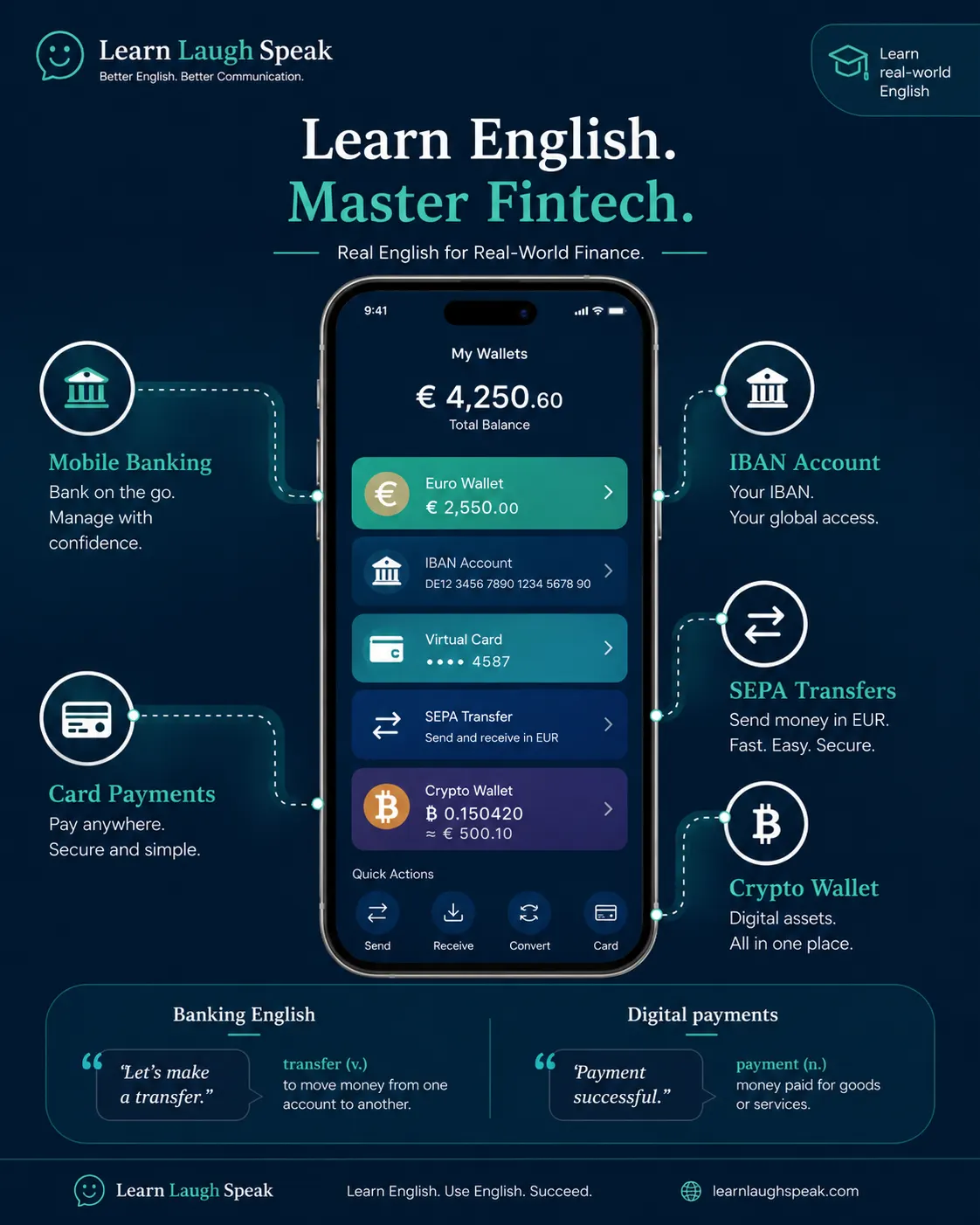
For English learners, this creates a new area of practical vocabulary. You may already know words like bank, card, and payment, but fintech apps often use more specific terms such as IBAN account, SEPA transfer, multi-wallet, fiat currency, crypto wallet, and exchange rate.
This article will help you understand useful English for fintech apps and digital money management.
Why English Learners Should Know Fintech Vocabulary
Financial technology is used around the world, and many apps, support pages, help centres, and payment instructions are written in English.
If you understand fintech vocabulary, you can:
- read app instructions more easily
- understand account and card features
- explain payment problems clearly
- manage money while travelling
- talk about digital payments at work
- understand banking and crypto terms
- feel more confident using financial services in English
For example, if an app says:
“Your SEPA transfer is pending.”
you need to understand that the payment has not been completed yet.
If it says:
“Add funds to your wallet.”
you need to know that funds means money and wallet means the place where your money or digital assets are stored inside the app.
What Is a Fintech App?
A fintech app is a digital tool that helps people manage money through technology.
A modern fintech app may include:
- mobile banking
- IBAN accounts
- debit or virtual cards
- SEPA transfers
- digital payments
- currency management
- crypto wallet features
- multi-wallet services
Instead of using different apps for every financial task, some platforms combine several services in one place.
For example, a user may be able to hold euros, make a card payment, send a SEPA transfer, and manage crypto assets from the same app.
This is why fintech vocabulary is useful. It helps you understand what each feature means and how to w.
Key Fintech Words in English
Here are some important words and phrases.
| Term | Meaning |
|---|---|
| Mobile banking | Managing your bank account from a phone app |
| IBAN account | A bank account number used for international and European payments |
| Card payment | Paying with a physical or virtual card |
| SEPA transfer | A euro bank transfer used in the Single Euro Payments Area |
| Fiat currency | Traditional money, such as euros, dollars, or pounds |
| Crypto wallet | A digital wallet used to hold cryptocurrency |
| Multi-wallet service | A platform that lets users manage different wallets or currencies |
| Digital payment | A payment made electronically |
| Exchange rate | The value of one currency compared with another |
| Transaction | A payment, transfer, deposit, or withdrawal |
| Balance | The amount of money available in an account or wallet |
| Transfer | To send money from one account or wallet to another |
These words are common in banking apps, payment platforms, fintech articles, and customer support messages.
Mobile Banking English
Mobile banking means using an app to manage your money.
Useful phrases:
“I checked my balance in the app.”
“The payment is still pending.”
“I need to update my card details.”
“The transfer has been completed.”
“I received a notification about the transaction.”
A common customer support message might be:
“Hello, I made a transfer yesterday, but it is still showing as pending. Could you please check the status?”
This is clear, polite, and professional.
IBAN Account Vocabulary
An IBAN account is often used for sending and receiving payments, especially in Europe.
Useful English phrases:
“Could you send me your IBAN?”
“The payment was sent to my IBAN account.”
“Please check that the IBAN is correct before sending the transfer.”
“I added my IBAN details to receive the payment.”
Important words connected to IBAN accounts include:
- account holder
- bank details
- transfer reference
- payment confirmation
- recipient
- sender
- processing time
Example:
“Please include the invoice number as the payment reference.”
This means the person should add the invoice number so the payment can be identified.
SEPA Transfer English
SEPA transfers are common for euro payments. If you work with European clients, freelancers, suppliers, or online services, you may see this term often.
Useful phrases:
“The SEPA transfer usually takes one to two business days.”
“I sent the payment by SEPA transfer.”
“The transfer is still processing.”
“Could you confirm when the payment arrives?”
Example message:
“Hi Clara, I sent the SEPA transfer this morning. Please let me know once it reaches your account.”
This is a useful phrase for business English and finance communication.
Card and Digital Payment Vocabulary
Fintech apps often include physical cards, virtual cards, or both.
Useful phrases:
“I used my virtual card for the online payment.”
“My card was declined.”
“I need to freeze my card.”
“The payment went through successfully.”
“I received a card transaction notification.”
“The refund should return to the same card.”
Important words:
- virtual card
- physical card
- cardholder
- contactless payment
- transaction limit
- declined payment
- refund
- merchant
- card details
Example:
“My payment was declined, but I have enough balance. Could you help me check the reason?”
This is polite and clear.
Crypto Wallet English
Some fintech apps now include a crypto wallet. A crypto wallet is used to manage digital assets such as cryptocurrency.
Useful phrases:
“I manage my crypto wallet through the app.”
“I want to check the value of my crypto assets.”
“The app shows both my fiat and crypto balances.”
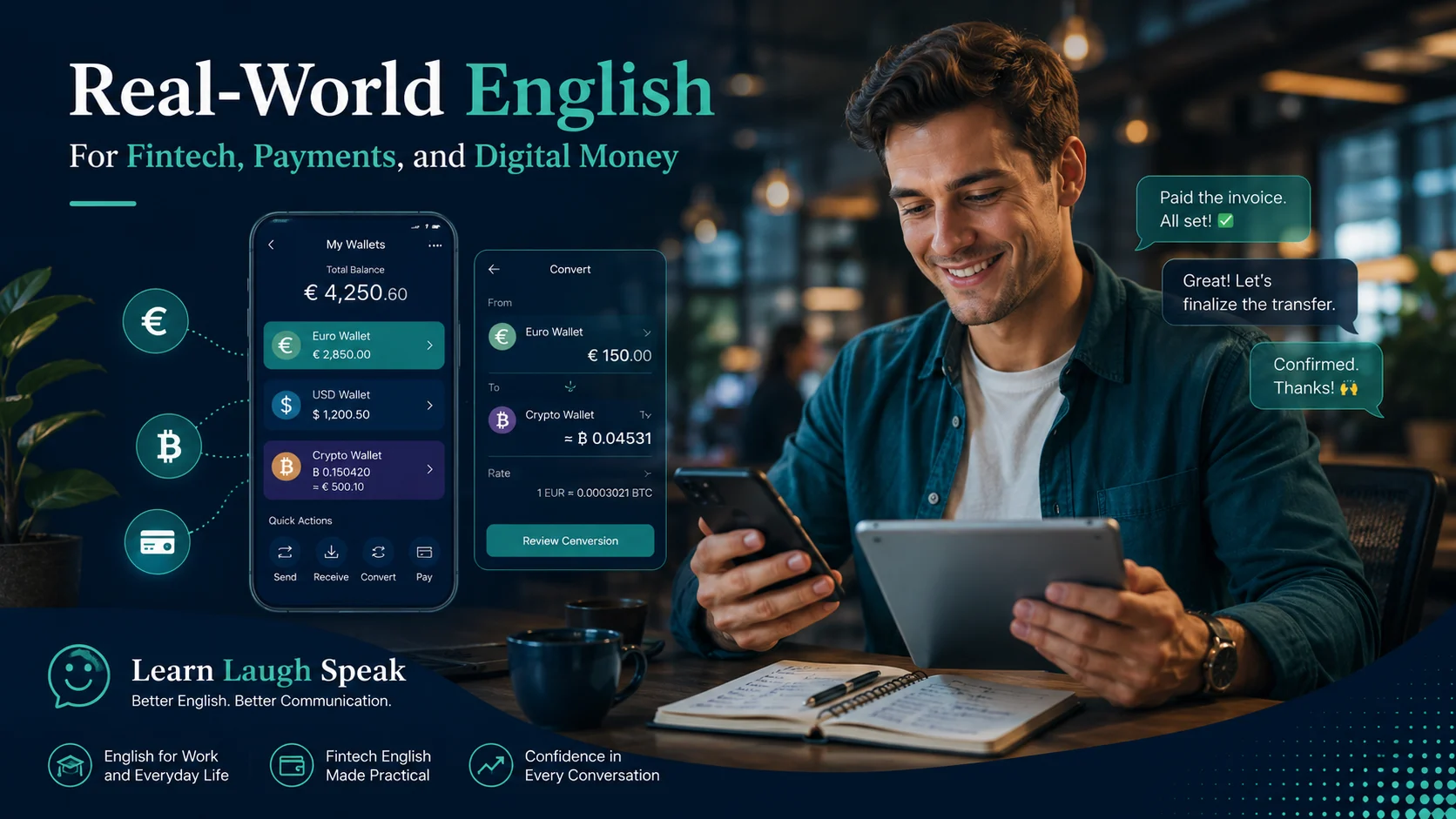
“I need to review the exchange rate before converting.”
“The transaction is waiting for confirmation.”
A fintech platform that combines fiat and crypto tools can be described as a multi-wallet service. This means users may manage different types of money or assets inside one platform.
For English learners, the important point is vocabulary. You do not need to be a finance expert to understand the basic language.
Talking About Fiat and Crypto in One App
The word fiat means traditional government-issued currency, such as euros, dollars, or pounds.
The word crypto means digital assets such as Bitcoin or other cryptocurrencies.
A fintech app may allow users to manage both fiat and crypto in one place. This can make money management more convenient because users do not need to switch between several different services.
Example sentence:
“The app allows users to manage fiat and crypto assets in one multi-wallet platform.”
Another example:
“Users can check their euro balance, card transactions, and crypto wallet from the same app.”
If you are learning business English, this kind of sentence is useful because it helps you explain technology and finance together.
Useful English for Currency Conversion
Currency conversion means changing one currency or asset into another.
Common phrases include:
“I want to convert dollars to euros.”
“What is the current exchange rate?”
“The conversion fee is shown before the transaction.”
“Please check the rate before confirming.”
“The final amount may depend on the market rate.”
For example, if someone is learning how to talk about digital assets and euro balances, they may come across the phrase crypto to euro convert. This is not the most natural spoken English phrase, but it can appear as search language when people are looking for tools that explain conversion between crypto and euros.
A more natural sentence would be:
“I want to convert crypto to euros.”
or
“How can I check the crypto-to-euro exchange rate?”
Natural English Phrases for Fintech Apps
Here are practical phrases you can use.
Asking about a transfer
“How long does the transfer usually take?”
“Could you confirm whether the payment has been received?”
“The transfer is still pending. Is there anything I need to do?”
Asking about a card
“My card payment was declined. Could you help me check why?”
“Can I use a virtual card for online payments?”
“How do I freeze or replace my card?”
Asking about a wallet
“Where can I see my wallet balance?”
“Can I manage different currencies in the same app?”
“Does the app support both fiat and crypto wallets?”
Asking about conversion
“What exchange rate will be used?”
“Are there any fees for converting?”
“Can I review the amount before I confirm?”
These phrases are useful for customer support, travel, online banking, and business communication.
What Not to Say and What to Say Instead
| Less natural English | Better English |
|---|---|
| I want make transfer. | I want to make a transfer. |
| My money not arrive. | My payment has not arrived yet. |
| I need change crypto to euro. | I need to convert crypto to euros. |
| My card no work. | My card is not working. |
| I send money yesterday. | I sent the money yesterday. |
| Where is my balance? | Where can I check my balance? |
| I want know fees. | I would like to know the fees. |
| Payment still wait. | The payment is still pending. |
Small changes make your English clearer and more professional.
Business English Example: Explaining a Fintech App
Here is a short example of how you could describe a fintech app in professional English:
“This fintech app combines mobile banking, IBAN accounts, payment cards, SEPA transfers, and a crypto wallet in one platform. It helps users manage fiat and crypto assets from a single multi-wallet service, making digital money management more convenient.”
This kind of description is useful if you work in:
- fintech
- customer support
- digital banking
- marketing
- sales
- product management
- finance
- international business
Customer Support Example
Here is an example message:
Hi, I made a SEPA transfer from my IBAN account yesterday, but it is still pending. Could you please check the status and let me know if any further information is needed?
This message is professional because it is:
- polite
- clear
- specific
- easy to understand
- action-focused
Why This Vocabulary Matters for Work
Many jobs now involve digital payment tools. Even if you do not work in banking, you may need to understand payment language.
For example:
- freelancers receive international payments
- businesses pay suppliers online
- customer service teams answer payment questions
- finance teams check transfers and invoices
- travellers manage cards and currency abroad
- marketers explain app features
- sales teams describe fintech products
This is why fintech English is a useful part of modern business English.
Learn Fintech and Business English with Learn Laugh Speak
Learn Laugh Speak helps adults learn English for real work and daily situations.
Fintech vocabulary is part of modern English because people now use apps for banking, cards, transfers, payments, and digital wallets. If you can understand these words and use them correctly, you can communicate more clearly in professional and personal situations.
With Learn Laugh Speak, students practise reading, writing, speaking, listening, vocabulary, grammar, and pronunciation at the right level. This helps learners build the English they need for work, travel, business, customer service, and digital communication.
Practice Activity: Fintech English
Rewrite the sentences below in better English.
- My card no work.
- I send money yesterday.
- I want know the fee.
- Payment still wait.
- I need crypto to euro convert.
Suggested answers:
- My card is not working.
- I sent the money yesterday.
- I would like to know the fee.
- The payment is still pending.
- I need to convert crypto to euros.
You may also see the search phrase crypto to euro convert when people look online for information about changing crypto into euros, but in natural English, “convert crypto to euros” usually sounds better.
FAQs About Fintech English
What is fintech English?
Fintech English is vocabulary and phrases used to talk about financial technology, including banking apps, digital payments, cards, transfers, crypto wallets, and online money management.
What does IBAN mean?
IBAN stands for International Bank Account Number. It is used to identify bank accounts for certain types of payments, especially international and European transfers.
What is a SEPA transfer?
A SEPA transfer is a euro payment sent within the Single Euro Payments Area.
What is a crypto wallet?
A crypto wallet is a digital wallet used to store or manage cryptocurrency and other digital assets.
What does fiat currency mean?
Fiat currency means traditional money issued by governments, such as euros, dollars, and pounds.
How do you say “crypto to euro convert” naturally?
A more natural way to say it is “convert crypto to euros” or “check the crypto-to-euro exchange rate.”
Final Thoughts
Fintech apps are changing how people manage money. Mobile banking, IBAN accounts, cards, SEPA transfers, digital payments, and crypto wallets are now part of everyday financial language.
For English learners, this is a useful opportunity. By learning fintech vocabulary, you can understand apps more easily, ask better questions, contact support clearly, and talk about money management with more confidence.
The most important rule is simple: use clear English. Whether you are talking about a card payment, a transfer, a wallet, or a conversion, clear words help you avoid mistakes and communicate with confidence.
One thought on “English for Fintech Apps: Banking, Cards, Transfers, and Crypto Vocabulary”
Pingback: Common Fintech Language in 2026: 50 Terms English Learners Should Know - Learn Laugh Speak