
 English
 Arabic
 Chinese (Simplified)
 Dutch
Dutch French
 German
 Italian
 Portuguese
 Russian
 Spanish
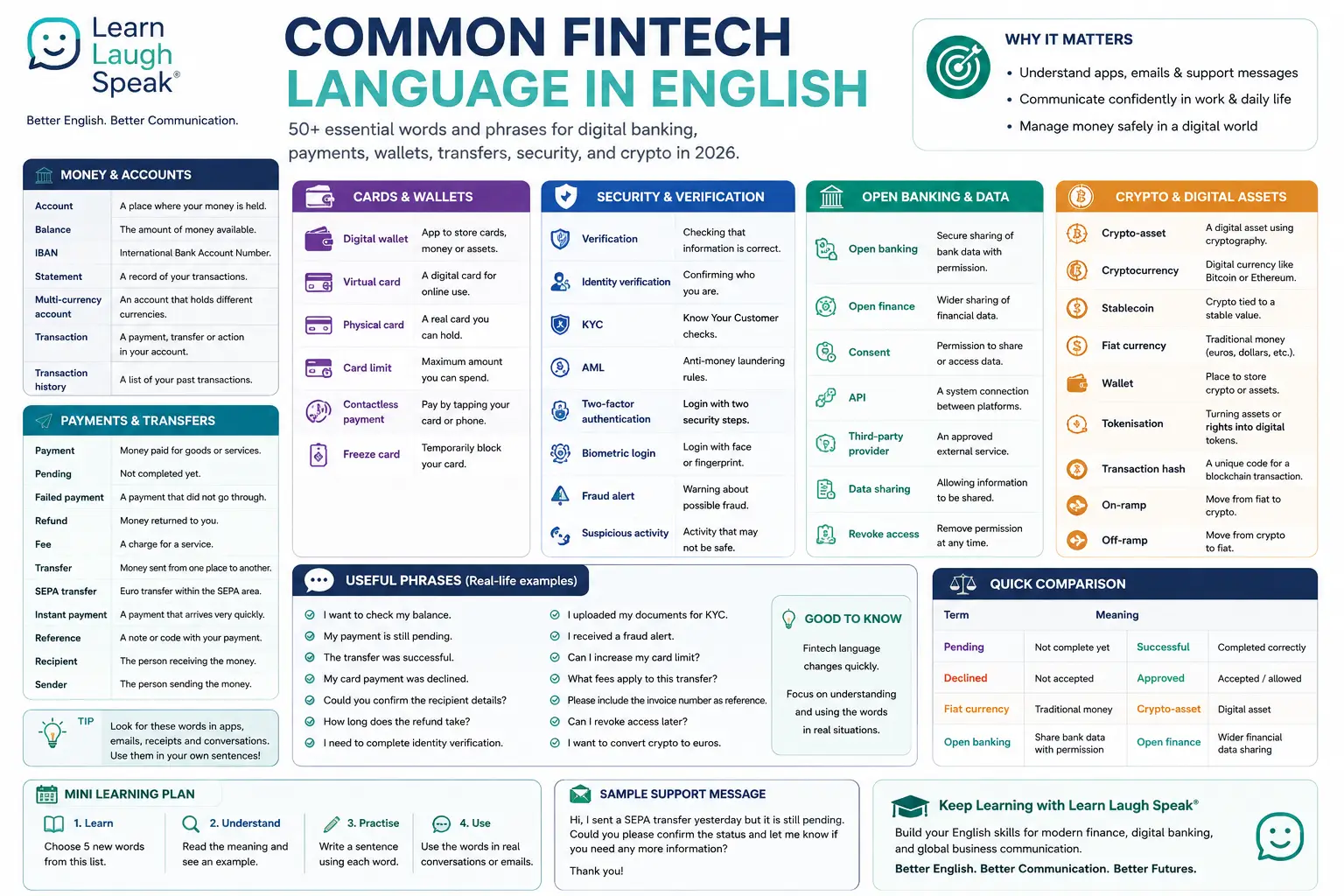
Common fintech language means the words and phrases people use to talk about digital banking, payments, financial apps, online security, crypto-assets, open banking, and modern money services. For English learners, these terms are useful because they appear in apps, customer support messages, business emails, finance articles, and workplace conversations.
Fintech is no longer a small topic for banks and technology companies. It is part of normal life. People use mobile apps to send money, verify accounts, manage cards, check balances, receive payments, and understand fees.
At work, fintech language also appears more often. Customer support teams answer questions about failed payments. Freelancers talk about transfers and invoices. Sales teams explain digital services. Finance teams discuss compliance, verification, and transaction records. Even people outside the finance industry now see words like wallet, pending, KYC, open banking, stablecoin, and tokenisation.
This guide is designed for English learners who want to understand common fintech language in 2026 without getting lost in complicated financial explanations.
You do not need to become a finance expert. You only need to understand the words well enough to read, ask questions, explain problems, and communicate clearly.
Why Common Fintech Language Matters in 2026
Modern money is more digital than before. People do not only visit banks. They use apps, cards, wallets, QR payments, international transfers, and online identity checks.
Because of this, fintech vocabulary is now part of practical English.
You may see this language when you:
- use a banking app
- contact payment support
- receive money from clients
- pay invoices
- work in customer service
- read fintech news
- manage digital wallets
- verify your identity online
- discuss business payments
- work with international customers
For example, if a message says:
“Your transaction is pending.”
you need to know that the payment has started but is not complete yet.
If a support agent writes:
“Please complete verification before increasing your card limit.”
you need to understand words like verification and card limit.
The more familiar these words become, the easier it is to communicate in digital finance situations.
50 Common Fintech Language You Need to Learn
Here are 50 useful fintech terms for English learners. The definitions are simple so you can understand and use them quickly.
| Term | Simple meaning | Example sentence |
|---|---|---|
| Fintech | Financial technology | Fintech apps help people manage money online. |
| Digital banking | Banking through apps or websites | Digital banking lets users check accounts from their phone. |
| Mobile banking | Banking on a mobile phone | I use mobile banking to check my balance. |
| Account | A place where money is held | I opened a new account. |
| Balance | The amount of money available | My balance is €500. |
| Transaction | A payment, transfer, or money movement | I can see the transaction in my history. |
| Transaction history | A record of payments and transfers | Please check your transaction history. |
| Payment | Money sent for goods or services | The payment was successful. |
| Pending | Not finished yet | The payment is still pending. |
| Failed payment | A payment that did not work | I need help with a failed payment. |
| Declined | Refused or not accepted | My card was declined. |
| Refund | Money returned to a customer | The refund should arrive soon. |
| Fee | A cost for a service | Is there a transfer fee? |
| Exchange rate | Value of one currency compared with another | Check the exchange rate before converting. |
| Transfer | Sending money from one place to another | I made a transfer this morning. |
| Recipient | The person receiving money | Please confirm the recipient details. |
| Sender | The person sending money | The sender name must match the account. |
| Reference | A note or code for a payment | Add the invoice number as the reference. |
| IBAN | International bank account number | Please send the payment to my IBAN. |
| SEPA transfer | Euro bank transfer in the SEPA area | I paid by SEPA transfer. |
| Instant payment | A payment that arrives very quickly | The app supports instant payments. |
| Digital wallet | A tool for storing cards, money, or assets | I added my card to my digital wallet. |
| Mobile wallet | A wallet used on a phone | Mobile wallets make contactless payments easier. |
| Virtual card | A card used online, not always physical | I used a virtual card for the purchase. |
| Physical card | A card you can hold | My physical card arrived today. |
| Card limit | Maximum amount you can spend | I need to increase my card limit. |
| Contactless payment | Payment by tapping a card or phone | Contactless payment is fast and easy. |
| Freeze card | Temporarily block a card | I froze my card after losing it. |
| Verification | Checking that something is true | I need to complete verification. |
| Identity verification | Confirming who a user is | Identity verification protects the account. |
| KYC | Know Your Customer checks | KYC is required before using some services. |
| AML | Anti-money laundering rules | AML checks help prevent financial crime. |
| Two-factor authentication | Login with two security steps | I use two-factor authentication. |
| Biometric login | Login with face or fingerprint | Biometric login is available in the app. |
| Fraud alert | Warning about possible fraud | I received a fraud alert. |
| Suspicious activity | Account activity that may not be safe | The bank noticed suspicious activity. |
| Open banking | Secure sharing of bank data with permission | Open banking can connect accounts. |
| Open finance | Wider financial data sharing with permission | Open finance goes beyond bank accounts. |
| API | A system connection between platforms | The app connects through an API. |
| Consent | Permission | You can give or remove consent. |
| Third-party provider | Another approved company or service | A third-party provider may request access. |
| Embedded finance | Finance services inside another platform | Some shops offer embedded finance at checkout. |
| Buy now, pay later | Paying in instalments after purchase | Buy now, pay later is common in online shopping. |
| Crypto-asset | A digital asset using crypto technology | Some platforms support crypto-assets. |
| Cryptocurrency | Digital currency such as Bitcoin | Cryptocurrency prices can change quickly. |
| Stablecoin | A crypto-asset designed to keep a stable value | A stablecoin may be linked to a fiat currency. |
| Fiat currency | Traditional money like euros or dollars | Euros and dollars are fiat currencies. |
| Tokenisation | Turning rights or assets into digital tokens | Tokenisation is used in modern finance discussions. |
| CBDC | Central bank digital currency | A CBDC is digital money issued by a central bank. |
| Digital euro | A possible digital form of the euro | The digital euro is often discussed in Europe. |
| Compliance | Following laws and rules | Compliance is important in fintech. |
This list gives you the foundation. You can return to it whenever you see an unfamiliar term.
Common Fintech Language in Apps
Some fintech terms are very common on app screens. These are useful because they help you understand what action to take.
Balance
Balance means the amount of money available.
Example:
“Your available balance is €320.”
Useful phrase:
“My balance has not updated yet.”
Pending
Pending means the action has started but is not complete.
Example:
“Your transfer is pending.”
Useful phrase:
“How long will the payment stay pending?”
Declined
Declined means the payment or card action was not accepted.
Example:
“Your card was declined.”
Useful phrase:
“My card was declined, but I have enough balance.”
Verification
Verification means checking information.
Example:
“Please complete verification to continue.”
Useful phrase:
“I uploaded my documents for verification.”
These words are small, but they are important.
Fintech Words for Payments and Transfers
Payments and transfers are part of everyday fintech English.
Useful words include:
- payment
- transfer
- sender
- recipient
- reference
- fee
- refund
- exchange rate
- processing time
- transaction history
Example support message:
“I sent a transfer yesterday, but it is still pending. Could you please confirm the status?”
This message is clear because it explains:
- what happened
- when it happened
- what help is needed
Another example:
“Could you confirm whether the recipient details are correct before I send the payment?”
This is useful when you want to avoid sending money to the wrong account.
Fintech Words for Security and Identity
Security language is very important in fintech.
You may see words like:
- identity verification
- KYC
- AML
- two-factor authentication
- passcode
- biometric login
- suspicious activity
- fraud alert
These words often appear when an app wants to protect your account.
Example:
“We noticed suspicious activity on your account.”
This means something may not be normal or safe.
Example:
“Please complete identity verification.”
This means the app needs to confirm who you are.
Useful English phrases:
“I need help completing verification.”
“I did not recognise this transaction.”
“I received a fraud alert.”
“Could you help me reset my passcode?”
“I cannot access my account.”
This kind of English is useful for customer support, online banking, and workplace finance.
Fintech Words for Open Banking and Open Finance
Open banking and open finance are important fintech topics in 2026.
In simple English, open banking means a customer can give permission for an approved service to access certain bank information.
Open finance is similar, but broader. It can include more types of financial data.
Useful words:
- open banking
- open finance
- consent
- account information
- data sharing
- third-party provider
- API
- access permission
Example:
“The app asks for consent to connect to your bank account.”
This means the app wants your permission.
Another example:
“You can revoke access at any time.”
This means you can remove permission later.
Useful phrases:
“What data will be shared?”
“Can I remove access later?”
“Is this third-party provider approved?”
“Why does the app need my consent?”
These phrases help you ask smart questions in English.
Fintech Words for Crypto and Digital Assets
Some fintech vocabulary comes from crypto and digital assets. Even if you do not use crypto, you may see these words in articles and finance discussions.
Important words include:
- crypto-asset
- cryptocurrency
- stablecoin
- wallet
- fiat currency
- exchange rate
- tokenisation
- transaction hash
- on-ramp
- off-ramp
Here are simple meanings.
Crypto-asset means a digital asset that uses cryptographic technology.
Stablecoin means a crypto-asset designed to keep a stable value, often connected to a fiat currency.
Fiat currency means traditional money, such as euros, dollars, or pounds.
Tokenisation means turning an asset or right into a digital token.
Useful phrases:
“The transaction is waiting for confirmation.”
“I want to check the exchange rate first.”
“The platform shows both fiat and crypto balances.”
“Could you explain the fee before I confirm?”
This vocabulary is useful for reading finance news and understanding modern digital money discussions.
Fintech Words for Business and Work
If you work in business, finance, sales, customer service, or operations, fintech language can appear in professional communication.
Useful work phrases:
“The customer’s payment is still pending.”
“Please confirm the transaction reference.”
“The refund has been processed.”
“The account requires additional verification.”
“The payment failed due to incorrect card details.”
“The transfer should arrive within the normal processing time.”
“We need to review the compliance requirements.”
These phrases sound professional and clear.
Common Fintech Language in Customer Support
Customer support is one of the most practical places to use fintech English.
Here are useful message templates.
Failed payment
Hi, my payment failed, but I have enough balance in my account. Could you please check the reason?
Pending transfer
Hello, I sent a transfer yesterday, but it is still pending. Could you please confirm the status?
Refund question
Hi, the merchant approved my refund. Could you let me know when it should appear in my account?
Verification problem
Hello, I uploaded my documents for identity verification, but the review is still pending. Could you please check this?
Card issue
Hi, my card was declined during payment. Could you help me understand what happened?
These examples are short, polite, and clear.
What Not to Say and What to Say Instead
Here are common mistakes English learners make when talking about fintech.
| Less natural English | Better English |
| My card no work. | My card is not working. |
| Payment still wait. | The payment is still pending. |
| I send money yesterday. | I sent the money yesterday. |
| I want know fee. | I would like to know the fee. |
| Where my refund? | Where can I check my refund status? |
| I cannot enter my account. | I cannot access my account. |
| I need change money. | I need to convert money. |
| App ask my document. | The app asked me to upload my documents. |
| My payment no arrive. | My payment has not arrived yet. |
| I want cancel access. | I want to revoke access. |
Clear English makes payment problems easier to solve.
Fintech Verbs English Learners Should Know
Verbs are important because they help you explain actions.
| Verb | Meaning | Example |
| send | move money to someone | I sent the payment. |
| receive | get money | I received the transfer. |
| process | complete a payment action | The payment is processing. |
| confirm | check or approve | Please confirm the details. |
| verify | prove or check identity | I need to verify my account. |
| freeze | block temporarily | I froze my card. |
| refund | return money | The company refunded the payment. |
| convert | change currency or asset | I converted dollars to euros. |
| revoke | remove permission | I revoked access. |
| approve | accept or allow | The payment was approved. |
Learn these verbs with full phrases, not alone.
For example:
“confirm the payment”
“verify my identity”
“freeze my card”
“revoke access”
“process a refund”
These combinations sound natural.
Common Fintech Language Nouns
Here are useful nouns.
| Noun | Example phrase |
| balance | check my balance |
| fee | pay a fee |
| refund | receive a refund |
| wallet | open a wallet |
| card | use a card |
| account | access my account |
| transfer | send a transfer |
| transaction | check a transaction |
| reference | add a reference |
| verification | complete verification |
These nouns appear in app screens, support emails, and business conversations.

Common Fintech Language Adjectives
Adjectives help describe the status of a payment, account, or service.
| Adjective | Meaning | Example |
| pending | not complete | The payment is pending. |
| successful | completed correctly | The transfer was successful. |
| declined | not accepted | The card was declined. |
| available | ready to use | Your balance is available. |
| verified | checked and approved | The account is verified. |
| suspicious | possibly unsafe | There was suspicious activity. |
| instant | very fast | The app supports instant payments. |
| secure | safe | This is a secure login. |
| eligible | allowed or qualified | You are eligible for this service. |
| inactive | not active | The account is inactive. |
These words help you understand status messages.
Short Fintech Dialogues for Practice
Dialogue 1: Asking about a payment
Customer: My payment is still pending.
Support: I understand. Could you please send the transaction reference?
Customer: Yes, I’ll send it now.
Support: Thank you. I’ll check the status for you.
Dialogue 2: Card problem
Customer: My card was declined.
Support: I’m sorry about that. Did you receive an error message?
Customer: Yes, it said the transaction could not be completed.
Support: Thank you. Let me check your card settings.
Dialogue 3: Verification
Customer: I need help with identity verification.
Support: Of course. Have you uploaded your documents?
Customer: Yes, but the review is still pending.
Support: Thank you. I’ll check the review status.
Dialogue 4: Open banking consent
User: Why does the app need access to my account?
Support: The app needs your consent to show your account information.
User: Can I remove access later?
Support: Yes, you can revoke access at any time.
These dialogues help you practise real fintech English.
Mini Quiz: Check Your Understanding
Choose the best answer.
- Pending means:
A. finished
B. not complete yet
C. cancelled - Refund means:
A. money returned
B. money borrowed
C. money exchanged - KYC is connected to:
A. identity checks
B. weather updates
C. delivery tracking - Revoke access means:
A. give permission
B. remove permission
C. make a payment - Transaction history means:
A. a list of past activity
B. a new card
C. a password
Answers:
- B
- A
- A
- B
- A
Common Fintech Language with Learn Laugh Speak
Learn Laugh Speak helps adult English learners build practical English for real situations.
Common fintech language is useful because people now use English to talk about payments, cards, accounts, refunds, transfers, verification, digital wallets, and online security.
With Learn Laugh Speak, students practise reading, writing, speaking, listening, vocabulary, grammar, and pronunciation at the right level. This helps learners communicate clearly in business, customer service, finance, travel, and daily life.
The goal is simple: learn the English you actually need.

FAQs About Common Fintech Language
What is common fintech language?
Common fintech language means the words and phrases used to talk about digital banking, payments, financial apps, cards, wallets, transfers, security checks, and crypto-related services.
What are examples of fintech terms?
Examples include payment, balance, transaction, refund, digital wallet, virtual card, KYC, open banking, stablecoin, and tokenisation.
Why should English learners study fintech vocabulary?
English learners should study fintech vocabulary because many banking apps, payment tools, support messages, and business finance services use English.
What does pending mean in fintech?
Pending means a payment, transfer, or account action has started but has not finished yet.
What does KYC mean?
KYC means Know Your Customer. It is a process financial companies use to verify a customer’s identity.
What is a digital wallet?
A digital wallet is an app or online tool used to store cards, money, payment methods, or digital assets.
What is open banking?
Open banking allows users to give permission for approved services to access certain bank account information securely.
What is the difference between fiat and crypto?
Fiat means traditional money, such as euros or dollars. Crypto means digital assets such as cryptocurrencies.
Is fintech English part of business English?
Yes. Fintech English is part of modern business English because it is used in payments, banking, customer support, finance, and digital services.
Final Thoughts on Common Fintech Language
Learning common fintech language helps you understand the English used in modern finance.
Start with practical words first: balance, payment, pending, transfer, fee, refund, wallet, verification, and transaction. Then move into newer 2026 terms like open banking, open finance, stablecoin, CBDC, and tokenisation.
You do not need to learn everything at once. Learn the words you see most often, practise them in full sentences, and use them in real situations.
The more familiar this vocabulary becomes, the more confident you will feel when using English for digital banking, payments, finance, and work.