
 English
 Arabic
 Chinese (Simplified)
 Dutch
Dutch French
 German
 Italian
 Portuguese
 Russian
 Spanish
Knowing how to confirm a meeting in English professionally is an important workplace communication skill. Whether you are replying to a meeting invitation, confirming a client appointment, or checking a rescheduled meeting time, the right words help you sound clear, respectful, and reliable.
A short confirmation message can prevent confusion about the date, time, location, agenda, or meeting link. It also shows that you respect the other person’s time and are prepared for the conversation. In professional English, confirming a meeting is not just a simple reply — it is a way to build trust and keep communication organized.
How to Reply to an Email to Confirm an Appointment (With Examples)
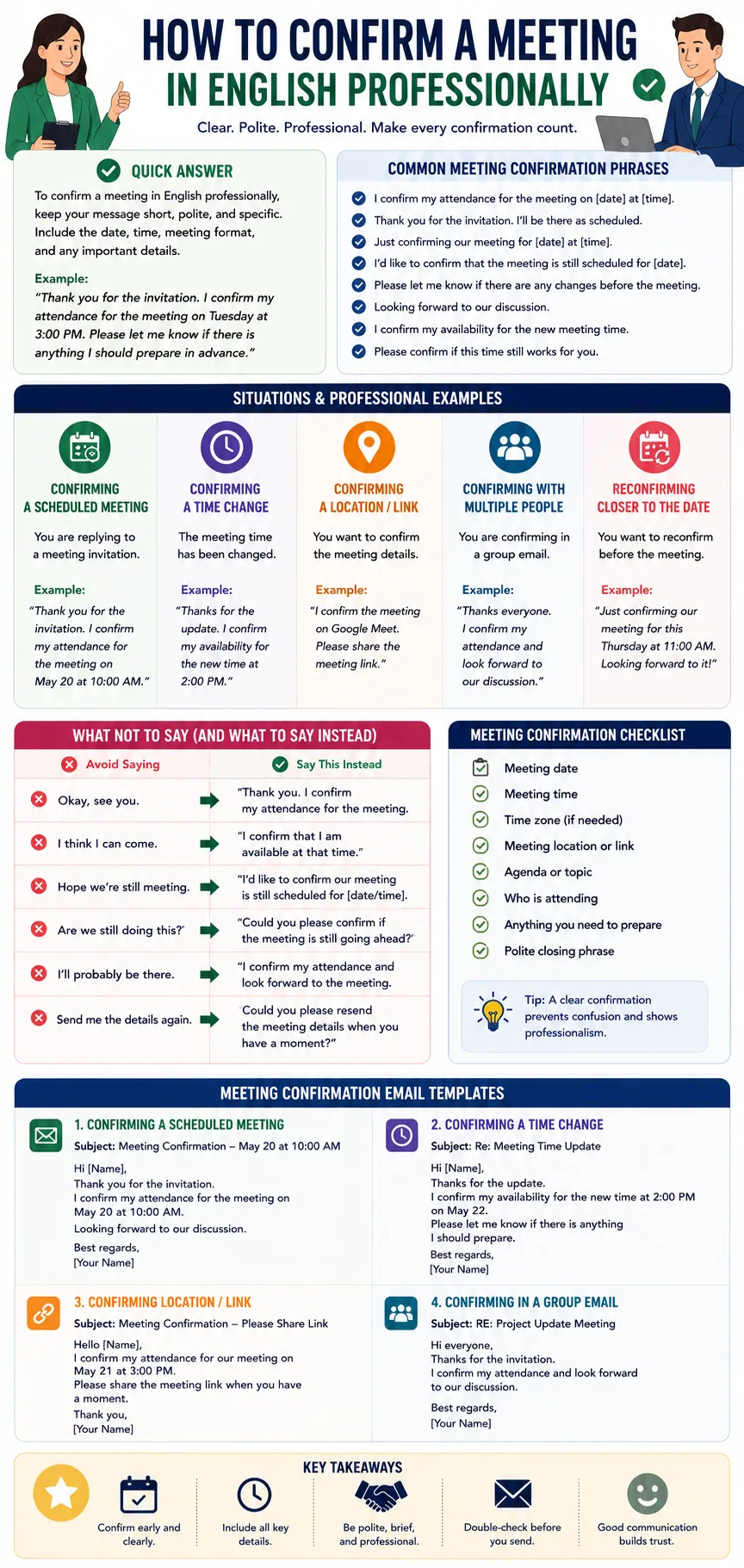
Quick Answer: How to Confirm a Meeting in English Professionally
To confirm a meeting in English professionally, keep your message short, polite, and specific. Include the date, time, meeting format, and any important details.
Example:
“Thank you for the invitation. I confirm my attendance for the meeting on Tuesday at 3:00 PM. Please let me know if there is anything I should prepare in advance.”
This sounds professional because it confirms clearly, shows appreciation, and leaves space for any final details.
Common Meeting Confirmation Phrases
Use these phrases when you need to confirm a meeting clearly and politely:
- “I confirm my attendance for the meeting on [date] at [time].”
- “Thank you for the invitation. I’ll be there as scheduled.”
- “Just confirming our meeting for [date] at [time].”
- “I’d like to confirm that the meeting is still scheduled for [date].”
- “Please let me know if there are any changes before the meeting.”
- “Looking forward to our discussion.”
- “I confirm my availability for the new meeting time.”
- “Please confirm if this time still works for you.”
What Not to Say When Confirming a Meeting
Some meeting confirmation phrases can sound too casual, vague, or unprofessional. Use clear and respectful language instead.
| Avoid Saying | Say This Instead |
|---|---|
| “Okay, see you.” | “Thank you. I confirm my attendance for the meeting.” |
| “I think I can come.” | “I confirm that I am available at that time.” |
| “Hope we’re still meeting.” | “I’d like to confirm our meeting is still scheduled for [date/time].” |
| “Are we still doing this?” | “Could you please confirm if the meeting is still going ahead?” |
| “I’ll probably be there.” | “I confirm my attendance and look forward to the meeting.” |
| “Send me the details again.” | “Could you please resend the meeting details when you have a moment?” |
Confirming Meeting Details Checklist
Before sending a meeting confirmation, check that your message includes the most important details.
- meeting date
- meeting time
- time zone, if needed
- meeting location or video link
- agenda or topic
- who is attending
- anything you need to prepare
- polite closing phrase
This small checklist helps avoid confusion and makes your message more professional.
1. Why Confirming a Meeting in English Professionally is Important
Confirming a meeting ensures clarity, prevents misunderstandings, and demonstrates professionalism. It reassures participants that the meeting will take place as planned and allows for any necessary adjustments. Additionally, it shows respect for others’ time and helps avoid last-minute cancellations.
Benefits When You Confirm a Meeting in English Professionally:
- Avoids miscommunication about the meeting time and place.
- Reinforces professionalism and reliability.
- Gives participants a chance to reschedule if necessary.
- Ensures all parties are prepared with the necessary information.
10 Professional Meeting Confirmation Emails for Any Scenario
2. How to Confirm a Meeting in English Professionally in Different Situations
a) Confirm a Meeting After Receiving an Invitation
When someone invites you to a meeting, it’s polite and professional to confirm your attendance.
Key Phrases to Confirm a Meeting in English Professionally:
- “I confirm my attendance for the meeting on [date] at [time].”
- “Thank you for the invitation. I will be there as scheduled.”
- “Looking forward to our meeting on [date] at [time].”
- “I appreciate the invitation. Please consider this confirmation of my attendance.”
Email Template:
Subject: Confirmation of Meeting on [Date]
Dear [Name],
Thank you for inviting me to the meeting. I confirm my attendance on [date] at [time]. Please let me know if there are any changes or additional details I should prepare for.
Looking forward to our discussion.
Best regards,
[Your Name]
What Not to Do:
❌ Don’t respond too casually, e.g., “Okay, see you then.”
❌ Avoid vague responses like “I think I’ll be there.”
❌ Don’t ignore the email and assume they know you’ll attend.
How to Cancel a Meeting Professionally
b) Confirm a Meeting You Scheduled
If you scheduled the meeting, confirming it with participants helps avoid confusion and improves attendance.
Key Phrases to Confirm a Meeting in English Professionally:
- “I want to confirm our meeting scheduled for [date] at [time].”
- “Just a quick confirmation for our meeting on [date]. Please let me know if everything is on track.”
- “Looking forward to meeting with you as planned on [date].”
- “Please confirm your availability for our scheduled meeting.”
Email Template:
Subject: Confirmation: Meeting on [Date]
Dear [Name],
I would like to confirm our meeting scheduled for [date] at [time]. Please let me know if you have any updates or if there is anything specific you’d like to discuss.
Looking forward to our conversation.
Best regards,
[Your Name]
What Not to Do:
❌ Don’t forget to include the date and time.
❌ Avoid assuming people remember without a reminder.
❌ Don’t phrase it aggressively: “I expect you to be there at [time].”
c) Confirming a Rescheduled Meeting
When a meeting is rescheduled, it’s important to reconfirm the new date and time.
Key Phrases to Confirm a Meeting in English Professionally:
- “I appreciate the update. I confirm the new meeting time on [date] at [time].”
- “Thanks for rescheduling. I confirm my availability for the new meeting date.”
- “Looking forward to our rescheduled meeting on [date].”
- “Just confirming that our meeting has been moved to [new date] at [new time].”
Email Template:
Subject: Reconfirmation: Meeting on [New Date]
Dear [Name],
Thank you for rescheduling our meeting. I confirm my availability for [new date] at [new time]. Please let me know if there are any additional details I should be aware of.
See you then!
Best regards,
[Your Name]
What Not to Do:
❌ Don’t assume everyone is aware of the new time.
❌ Avoid confusion by confirming the exact date and time.
❌ Don’t be passive-aggressive: “I guess we have to reschedule now…”
d) Confirm a Meeting with a Client or Superior
When confirming a meeting with a client, boss, or executive, keep it formal and polite.
Key Phrases to Confirm a Meeting in English Professionally:
- “I would like to confirm our scheduled meeting on [date] at [time].”
- “Please confirm if the proposed meeting time still works for you.”
- “I appreciate your time and look forward to our discussion on [date].”
- “I’d like to reconfirm our appointment to ensure everything is set.”
Email Template:
Subject: Meeting Confirmation: [Date & Time]
Dear [Client’s/Boss’s Name],
I hope you’re doing well. I would like to confirm our meeting scheduled for [date] at [time]. Please let me know if the time still works for you or if any adjustments are needed.
Looking forward to our discussion.
Best regards,
[Your Name]
What Not to Do:
❌ Don’t use overly casual language with a superior.
❌ Avoid sending a confirmation at the last minute.
❌ Don’t be unclear: “Hope we’re still on for that meeting?”

3. Final Tips to Confirm a Meeting in English Professionally
- Be clear and concise – Keep your confirmation short and to the point.
- Use a polite tone – Professionalism matters in business communication.
- Double-check details – Ensure accuracy in the date, time, and location.
- Offer flexibility if needed – If changes arise, show willingness to adjust.
- Confirm in writing – Even if discussed verbally, send a written confirmation for clarity.
Mastering the skill of how to confirm a meeting in English professionally will help you maintain credibility, build strong business relationships, and ensure smooth communication.
Cancel Plans in English Correctly Without Offense
2 thoughts on “How to Confirm a Meeting in English Professionally”
Pingback: English Phrases to Use When Asking Questions in a Meeting
Pingback: How to Pronounce Shein in English Correctly - Learn Laugh Speak