
 English
 Arabic
 Chinese (Simplified)
 Dutch
Dutch French
 German
 Italian
 Portuguese
 Russian
 Spanish
You know your business better than anyone else, yet that knowledge means very little when people struggle to follow your message. A great product, years of experience, or a strong idea won’t carry the conversation on their own.
Clients, investors, employees, and partners all make decisions based on what they understand at the moment. Clear storytelling closes that gap. It helps you explain complex ideas in a way people remember and trust without making them feel confused.
The reasons behind that growing value reach far beyond marketing, and they reveal why this skill now sits near the top of every modern leader’s toolkit.
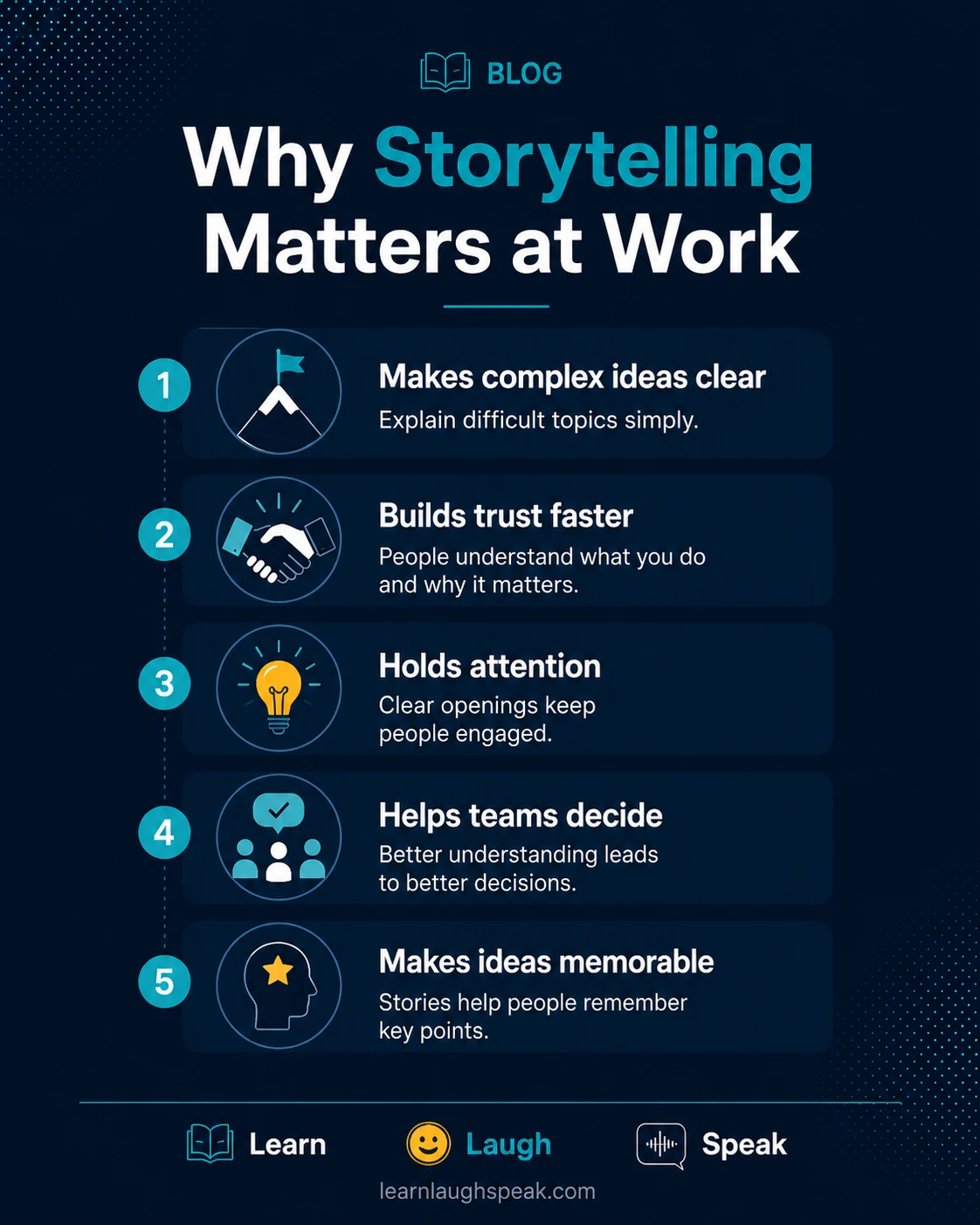
Information Is Everywhere, but Clear Communication Is Rare
You have access to more information today than any business leader before you. Reports, market data, research papers, AI tools, podcasts, and online courses make learning faster than ever. But the hard part comes from making sense of it and explaining it in a way other people understand.
That difference shows up every day. One founder explains a product in five minutes and leaves everyone confused. Another founder explains the same idea in two minutes using a simple story, and people immediately understand why the product matters.
Both know their business well, but only one communicates it clearly.
And according to research, people are about 22 times more likely to remember information when it is shared through stories instead of facts alone.
Facts still matter because they build credibility. Stories simply give those facts a structure that people are more likely to remember.
“Founders often believe they need to explain everything they’ve built, but the best communicators focus on the one problem they’re solving and why it matters. Once people understand that story, the features, data, and technical details have a place to fit. Without that structure, even great ideas are easy to lose,” says Julian Tillotson, CEO & Founder of Indirap.
That’s why storytelling shows up in almost every part of business. In meetings, sales calls, presentations, interviews, and investor pitches, people rarely remember every statistic you shared. They remember the customer challenge, the turning point, and the story that made the numbers meaningful. When facts and stories work together, your message becomes much easier to understand—and much harder to forget.

Business Decisions Depend on Understanding Before Agreement
Every important business decision starts with one simple requirement: the other person has to understand what you’re saying. That applies whether you’re asking an investor to fund your company, presenting a new strategy to your team, speaking with a client, or introducing a product to the market. Even the strongest idea struggles if people cannot quickly understand why it matters.
Many business opportunities slow down because the message isn’t clear enough. People ask the same questions repeatedly. Meetings become longer than they need to be. Emails go back and forth without reaching a decision. In most cases, the problem isn’t the idea itself. It’s that people have to work too hard to understand it.
Matthew Weinberg, Owner & Teacher of Grammar and Stone Publishing, believes, “People don’t stop listening because a topic is too complicated. They stop listening when they have to work too hard to follow the explanation. Clear writing forces you to organize your thinking, remove unnecessary details, and guide people from one idea to the next. When that happens, understanding becomes much easier, and good decisions often follow.”
That same principle becomes even more important when you’re explaining a new product, service, or business idea. Clear storytelling gives people a path they can follow. Instead of jumping between different points, you explain the problem, why it matters, and how your solution fits naturally into the picture.
Every idea builds on the one before it, making the conversation easier to follow from beginning to end.
There’s another benefit that people often don’t notice until much later. “The businesses that earn long-term trust usually explain complex ideas in ways that feel simple and useful,” says Seph Fontane Pennock, Founder & CEO of FatFire. “The goal isn’t to impress people with how much you know. It’s to leave them thinking. When people understand your ideas without feeling confused, they’re much more likely to remember your message, share it with others, and come back when they need your help.”
That’s why clear storytelling does much more than improve communication. It shortens meetings, reduces unnecessary questions, strengthens presentations, and helps people make decisions with confidence because they understand not only what you’re offering, but also why it matters.

Expertise Alone No Longer Builds Authority
Many professionals spend years building knowledge in their field. They earn degrees, solve difficult problems, manage large projects, and gain valuable experience. Yet many still struggle to earn attention outside their own industry because they explain their work in language that only other experts understand.
People usually trust someone who makes a difficult topic feel simple. That does not mean leaving out important details. It means presenting those details in a way that fits the audience instead of trying to impress them with technical language.
The same lesson appears across marketing as well. Tanya Alain, CMO at Upfluence, has found that the campaigns people remember are rarely the ones with the most complicated message. She said, “Whether you’re introducing a product or explaining an idea, people connect with clarity before they connect with expertise. When your message is easy to understand, your audience spends less time trying to figure out what you mean and more time thinking about why it matters. That’s when trust and engagement begin to grow.”
You can see this approach in many respected business leaders. Warren Buffett has spent decades explaining investing through everyday examples instead of complicated financial language. His annual shareholder letters attract readers far beyond the investment world because the ideas are easy to follow, even when the subject itself is complex.
That matters even more today, when people are surrounded by content every day. Edward Tian, CEO of GPTZero, believes clear thinking has become one of the easiest ways to stand out. He said, “AI has made it simple to produce more content than ever before, but producing content isn’t the same as communicating an idea. The people who stand out are the ones who can take something complicated, explain it clearly, and leave others with a perspective they didn’t have before.”
The same principle applies to entrepreneurs and industry experts. Clients don’t expect you to sound like a textbook. They want practical answers they can understand. Employees want a clear direction. Investors want to see the opportunity without having to decode complicated language. When your message is simple, people spend less time interpreting it and more time believing it.
Attention Has Become One of the Hardest Things to Earn
Every business competes for the same limited resource today—people’s attention. Your audience reads emails, checks messages, watches short videos, joins meetings, and scrolls through social media before the workday even reaches lunch. A long explanation has very little room to succeed unless people quickly understand why they should keep listening.
People often assume attention is something they earn at the end of a conversation, but Kyle R Smith, Director of Boost Promotional Products, believes it is won much earlier. He said, “Whether it’s a branded product or a business presentation, people decide very quickly whether something feels worth their time. If you show the value early and make your message relevant to them, they’re far more likely to stay engaged and hear the rest of what you have to say.”
Clear storytelling respects your audience’s time. You get to the point early, explain why the topic matters, and build the conversation step by step. People stay engaged because each part answers the question they already have instead of forcing them to wait for the main point.
This has become especially important for entrepreneurs and executives. You often get one meeting to present a proposal, one interview to explain your company, or one chance to introduce yourself at an event. A confusing explanation leaves people with unanswered questions, while a clear story gives people a reason to continue the conversation.
Companies like Apple have followed that approach for years. Their product launches rarely begin with technical specifications. They first explain the problem they’re solving and why it matters. Once the audience understands the purpose, the technology becomes much easier to appreciate.
That same approach stands out in the media, where people decide within seconds whether they’ll keep watching or move on. Oscar Fullmer, Co-Founder of Fast Hippo Media, said, “One of the biggest mistakes people make is believing they have several minutes to earn someone’s attention. In reality, the opening moments set the direction for everything that follows. When your story gives people a reason to care immediately, they’re much more likely to stay with you until the end.”

Trust Grows Faster When People Understand Your Story
Trust does not grow because you list more achievements or mention more credentials. People trust you when your message stays clear from the first conversation to the last. They understand what you do, why you do it, and how you solve problems.
Many businesses lose trust without realizing it. Their website says one thing, their sales team says another, and their executives describe the company in a completely different way. Even when every statement is accurate, the mixed message creates doubt. People start wondering what the business actually stands for.
A clear story removes that confusion. Every conversation points back to the same purpose. Whether someone reads your LinkedIn profile, visits your website, listens to your podcast, or meets you in person, they hear the same message explained in language that feels natural.
Research even shows that 80% of investors are more likely to invest in a company with clear communication.
Trust grows one conversation at a time. Clear storytelling gives people fewer reasons to second-guess what you mean and more reasons to believe you will deliver what you promise.
Strong Personal Brands Are Built on Clear Stories
People rarely remember someone because they posted every day. They remember people who consistently teach something useful or share experiences that help others solve real problems.
That explains why many respected entrepreneurs and executives spend less time talking about themselves and more time sharing lessons they have learned.
A founder might explain why a product launch failed and what the team fixed. A consultant might share a client challenge without revealing private details and explain how it was solved. An executive may describe a difficult decision and the thinking behind it. Those stories give people something practical they can use themselves.
In an interview, Daniyal Shaikh, AI Designer & Developer at Virtual Ring Try On, shares, “People gain confidence when they can clearly picture the outcome instead of trying to imagine it on their own. The same applies to business communication. Facts are important, but stories help people visualize the problem, understand the solution, and remember why it mattered. That’s usually what stays with them long after the conversation ends.”
You can see this in the way Satya Nadella communicates.
When he speaks about technology, the discussion often starts with people, customers, and business problems before moving into technical details. That approach helps audiences with different backgrounds follow the conversation without feeling left behind.
Every Industry Is Becoming More Complex
Business has become harder to explain than it was just a few years ago. New technology, artificial intelligence, cybersecurity, global supply chains, changing regulations, and changing customer expectations have added new layers of complexity to almost every industry. Even experienced professionals sometimes need time to understand what these changes mean for their work.
Timothy Allen, Sr. Corporate Investigator at Oberheiden P.C., mentions, “The most effective professionals aren’t always the ones with the most knowledge. They’re the ones who can organize complex information into a clear story that other people can understand and act on. Whether you’re explaining an investigation or a business strategy, clarity builds confidence.”
That creates a new challenge for leaders. You already understand your field because you work in it every day. Your customers, employees, investors, and partners do not. They need someone who can explain what matters without turning every conversation into a technical lesson.
Healthcare offers a good example. Patients do not expect doctors to explain every medical term they learned in school. They expect clear answers about their condition, treatment, and next steps. The same principle applies in finance, software, manufacturing, law, and almost every other profession. People value experts who make difficult subjects easier to understand.
The same is true inside a business. Teams make better decisions when everyone understands the goal. Customers feel more confident when they know exactly what they are buying, and partnerships move forward more smoothly when expectations are clear from the beginning.
Desmond Dorsey, Chief Marketing Officer at Bayside Home Improvement, shares, “We’ve learned that people don’t make decisions based on how much information you give them. They make decisions when they clearly understand why something matters to them. The businesses that communicate with clarity earn trust faster because customers feel confident instead of overwhelmed.”
Clear Storytelling Helps Your Ideas Travel Further
Good ideas rarely create opportunities on their own. People need to understand them first, then remember them, and finally feel confident enough to share them with someone else. Clear storytelling makes that possible.
The moment someone else explains your business correctly, your message starts working without you. Savas Bozkurt, Owner of Royal Restoration DMV, said, “The homeowners who recommend us usually don’t remember every step of a restoration project. They remember that we solved the problem, explained everything clearly, and made a stressful situation easier to understand. That’s the story they pass on to friends and family, and it’s often what brings the next customer through the door.”
You never know where your next opportunity will come from. A client may recommend you after one meeting. An employee may explain your company to a talented candidate. A journalist may quote you in an article. A podcast host may invite you after reading one LinkedIn post. In every case, someone else carries your message forward.
That only happens when your ideas are easy to understand and easy to repeat. Long explanations usually stop with the first listener because they’re difficult to remember. A clear story gives people a simple way to explain your work without losing the main point.
Marketing follows the same principle. Ákos Doleschall, Managing Director at Hustler Marketing, said, “The campaigns people share most aren’t always the most creative — they’re the ones people understand immediately. That’s one reason a strong UGC advertising agency focuses on authentic, easy-to-follow stories instead of complicated messages. When someone can quickly understand the value and repeat it in their own words, your marketing keeps working long after the first impression.”
Every presentation, interview, article, keynote, and customer conversation adds to the way people see you. Over time, those moments build a reputation for clear thinking and strong leadership. That reputation often opens doors before you even have to ask.
Where This Skill Takes You Next
Every entrepreneur, executive, and industry expert has knowledge that others can learn from. The difference comes from how well that knowledge reaches people. Clear storytelling helps your ideas make sense, helps your message stay memorable, and helps people trust what you say without extra explanation.
Business will keep becoming more competitive, and information will keep growing. The people who stand out won’t always be the ones with the most experience or the biggest platform. They will be the ones who explain complex ideas in a clear, useful, and human way.
That skill keeps opening doors long after a meeting ends, making it one of the smartest investments you can make in your career and your business.