
 English
 Arabic
 Chinese (Simplified)
 Dutch
Dutch French
 German
 Italian
 Portuguese
 Russian
 Spanish
For many ESL professionals, understanding colleagues and clients during phone or video meetings can feel overwhelming. Different accents, reduced sounds, and connected speech make accent listening challenging, especially when dealing with fast English on calls. But with the right strategies, you can improve your comprehension and feel more confident on every call.
The Right Words and Phrases to Use on a Sales Call
Why Accent Listening Is Difficult in Fast English on Calls
Fast English is not just about speed — it’s about reduction, linking, and stress patterns:
Reductions: Words are shortened, e.g., “going to” → “gonna.”
Linking: Sounds connect, e.g., “pick it up” sounds like “pikitup.”
Weak forms and schwa: Common words like “of,” “to,” and “for” often lose their full sound.
When you improve accent listening, these speech patterns start making sense — even when fast English on calls feels hard to follow.
How to Improve Your Speaking Skills in English
5 Tactics to Improve Accent Listening for Fast English on Calls
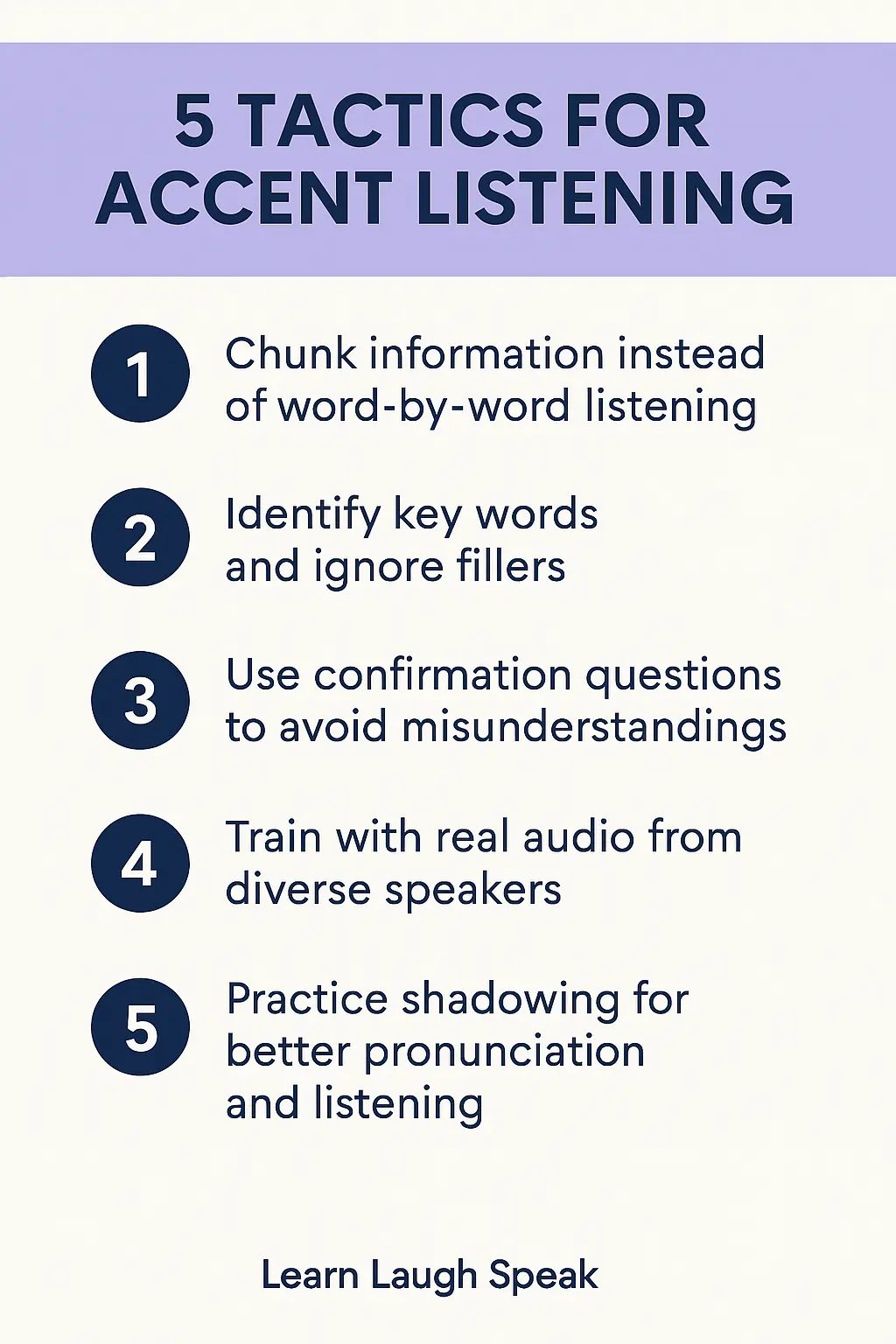
1. Chunk Information Instead of Word-by-Word Listening
Focusing on every single word can make you feel lost. Instead, listen in meaningful chunks:
“I’ll send the report later today” → focus on “send report” + “later today.”
This helps you capture the overall message quickly.
2. Identify Key Words and Ignore Fillers
During fast English on calls, listen for key nouns, verbs, and numbers. Skip unnecessary fillers like “you know” or “basically.”
Example:
“We’re basically just waiting for approval.”
Key takeaway: “Waiting for approval.”
3. Use Confirmation Questions to Avoid Misunderstandings
Polite clarifications build confidence and accuracy:
“Just to confirm, the deadline is Friday, correct?”
“Did I understand correctly that we’ll meet at 3 PM?”
Using confirmation questions during fast English on calls ensures you understand before acting.
4. Train Accent Listening with Real Audio
Expose yourself to different accents regularly:
Podcasts
YouTube interviews
Business meetings or recorded webinars
This improves accent listening naturally, helping you handle diverse speakers and fast English on calls.
Does Accent Matter in Today’s Call Center?
5. Practice Shadowing for Better Pronunciation and Listening
Shadowing involves repeating what you hear at the same speed and rhythm as the speaker.
Choose short audio clips.
Play, pause, and repeat until your pronunciation and pacing match theirs.
This improves both accent listening and speaking fluency.
16 Business English Idioms for Customer Service
Templates for Handling Fast English on Calls
Clarifying an Update
“Just to confirm, we’ll receive the files by 5 PM today?”
Asking for a Repeat
“Sorry, I missed that last point. Could you repeat it slowly?”
Summarizing to Check Understanding
“So, to confirm, we need to send the report before Friday, correct?”
Learn Laugh Speak Can Help You Master Accent Listening
At Learn Laugh Speak, we help ESL professionals improve listening, speaking, and workplace communication. Our platform covers 12 CEFR-aligned levels, from Pre-A1 to C2, with lessons that focus on:
Accent listening skills
Understanding fast English on calls
Connected speech, schwa, and weak forms
Workplace-specific communication strategies
Start with your full English level assessment today:
www.learnlaughspeak.com/pricing
Final Thought
Improving accent listening and mastering fast English on calls isn’t about understanding every single word — it’s about training your ear, capturing key information, and building confidence. With practice and the right strategies, you’ll follow conversations naturally, no matter the speed or accent.