
 English
 Arabic
 Chinese (Simplified)
 Dutch
 French
 German
 Italian
 Portuguese
 Russian
 Spanish
Reading a work document in English can feel very different from completing a language exercise. A training guide may contain unfamiliar instructions, a project brief may use internal terminology, and a simple deadline can be easy to miss inside a long paragraph.
For adults learning English, these documents offer useful practice because the language connects directly to a task. The challenge is understanding the information while gradually becoming more confident with the original English.
A document translation tool can provide a reference version for checking difficult passages. Doc-Translator.org translates DOCX files and returns an editable document, allowing readers to compare the original with the translated copy. A structured reading routine helps turn that support into active practice.
Begin With the Document’s Purpose
Before translating anything, identify what the document is asking you to do.
Look at its title, headings, tables, and numbered steps. Decide whether it explains a process, assigns work, introduces a policy, or summarizes a project. This first scan gives unfamiliar vocabulary a context.
For example, a document titled “Preparing for Your First Client Meeting” is likely to contain instructions about preparation, responsibilities, and follow-up. You can begin looking for those ideas even if you do not understand every sentence.
Choose a short section for your first reading. A page or a few paragraphs is easier to work through carefully than an entire handbook.
Read Once for the Main Message
During the first reading, focus on the overall meaning. Mark difficult expressions and continue where possible.
Pay particular attention to who performs an action, what they need to do, and when it should happen. Words such as “before,” “after,” “unless,” and “by” can change how an instruction is understood.
Consider this sentence:
“Send the revised schedule to your manager by Thursday, unless the client requests further changes.”
The main action is sending the schedule. Thursday is the deadline, and the final clause introduces a condition. Recognizing these relationships is often more useful than translating each word separately.
Write a brief note about what you think the passage means before checking a translation.
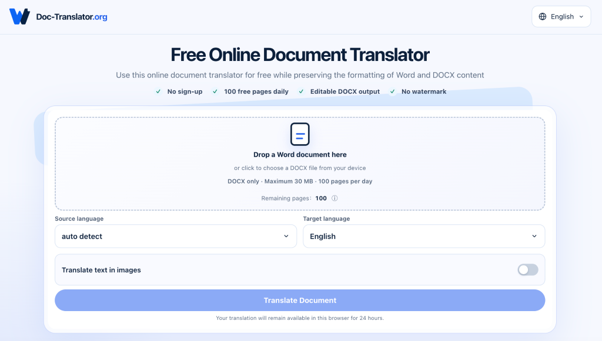
If the document is available as a DOCX file, you can translate DOCX online and use the result alongside the original.
Doc-Translator.org accepts DOCX files up to 30 MB and offers a free allowance of 100 pages per day. Users can choose the source language or use automatic detection, select a target language, and download an editable DOCX file.
The tool is designed to preserve common Word elements, including headings, paragraphs, tables, images, lists, headers, and footers. Retaining those elements can make it easier to locate corresponding sections, although the layout should still be checked after translation.
For workplace materials, follow your employer’s rules about using online services. Public guides, approved training materials, and documents without confidential information are practical starting points.
Compare the Passage You Found Difficult
Use the translated version to check your initial understanding. Focus on the sentence or section that caused difficulty, then return to the English.
Ask what made it hard. Was the vocabulary unfamiliar? Did you miss a condition? Was the sentence longer than expected? Did a familiar word have a different meaning in this context?
In a project document, “deliverable” usually refers to an output that must be provided. “Outstanding actions” generally means tasks still requiring attention. Recording the complete expression helps preserve its workplace meaning.
Translations can also contain mistakes or ambiguous wording. If a passage affects an important decision, ask the document owner or a suitable reviewer to clarify it.
Build a Small Collection of Useful Expressions
Choose a few phrases that relate to your own work. Keep the original sentence, a short explanation, and an example you could realistically use.
| Expression | Meaning in context | Practice sentence |
| By the end of the day | Before the working day finishes | I will send the updated file by the end of the day. |
| Subject to approval | Dependent on permission being given | The revised timeline is subject to approval. |
| Follow up on | Check progress or take further action | I will follow up on the equipment request tomorrow. |
Keep the collection manageable. Five expressions that you understand and practise are more useful than a long list you rarely revisit.
Check whether an expression is formal, informal, or specific to your organisation. This helps you choose where to use it appropriately.
Turn Reading Into Speaking and Writing
After comparing the versions, close the translation and explain the section in your own English.
A short spoken summary could answer three questions: What is the task? Who is responsible? What happens next?
Then write a brief response related to the document. For a training guide, describe the first step. For a project brief, summarize your responsibility. For a schedule, confirm the deadline.
You could also practise asking for clarification:
- “Could you explain what ‘final approval’ means in this section?”
- “Do I need to complete this before the training session?”
- “Who should I contact if the instructions do not match what I see?”
- “Could you confirm which version of the document I should use?”
These questions connect reading practice with the conversations you may need to have at work.
Keep the Original and Translation Clearly Labelled
Save the source document and translated reference as separate files. Include the language and version date in their names so you can identify them later.
Check that table entries, numbered steps, and page breaks remain understandable. A translation that moves a note away from the instruction it explains may be harder to follow.
If the source changes, update your reference copy. Mark personal vocabulary notes separately from the document’s official wording so they cannot be mistaken for approved instructions.
Gradually Reduce How Often You Check
As you become familiar with a document type, try reading a larger section before consulting the translation.
You might begin by checking individual sentences, then move to checking a paragraph after writing your own summary. Keep using support when necessary, especially for unfamiliar or important information.
The aim is to understand more of the English independently while retaining a reliable way to check uncertainty. Repeated practice with relevant documents gives you opportunities to recognize familiar wording and use it in your own communication.
FAQ
Can Translated Documents Help With English Practice?
They can provide a reference for checking meaning. Read the English first, compare difficult passages, and then practise explaining the information without looking at the translation.
Can Doc-Translator.org Translate a Word Document?
It currently accepts DOCX files and returns editable DOCX output. Older DOC files need to be saved as DOCX before use.
Should I Translate Every Unfamiliar Word?
Start with the document’s purpose and main message. Check words and expressions that prevent you from understanding the task, condition, or deadline.
What If the Translation and Original Seem Inconsistent?
Recheck the surrounding sentences and ask for clarification when needed. Important workplace instructions should be confirmed with the appropriate person.
How Can I Use What I Read in Conversation?
Summarize the task aloud, write a short response, and practise questions you could ask a colleague or manager about the document.