
 English
 Arabic
 Chinese (Simplified)
 Dutch
Dutch French
 German
 Italian
 Portuguese
 Russian
 Spanish
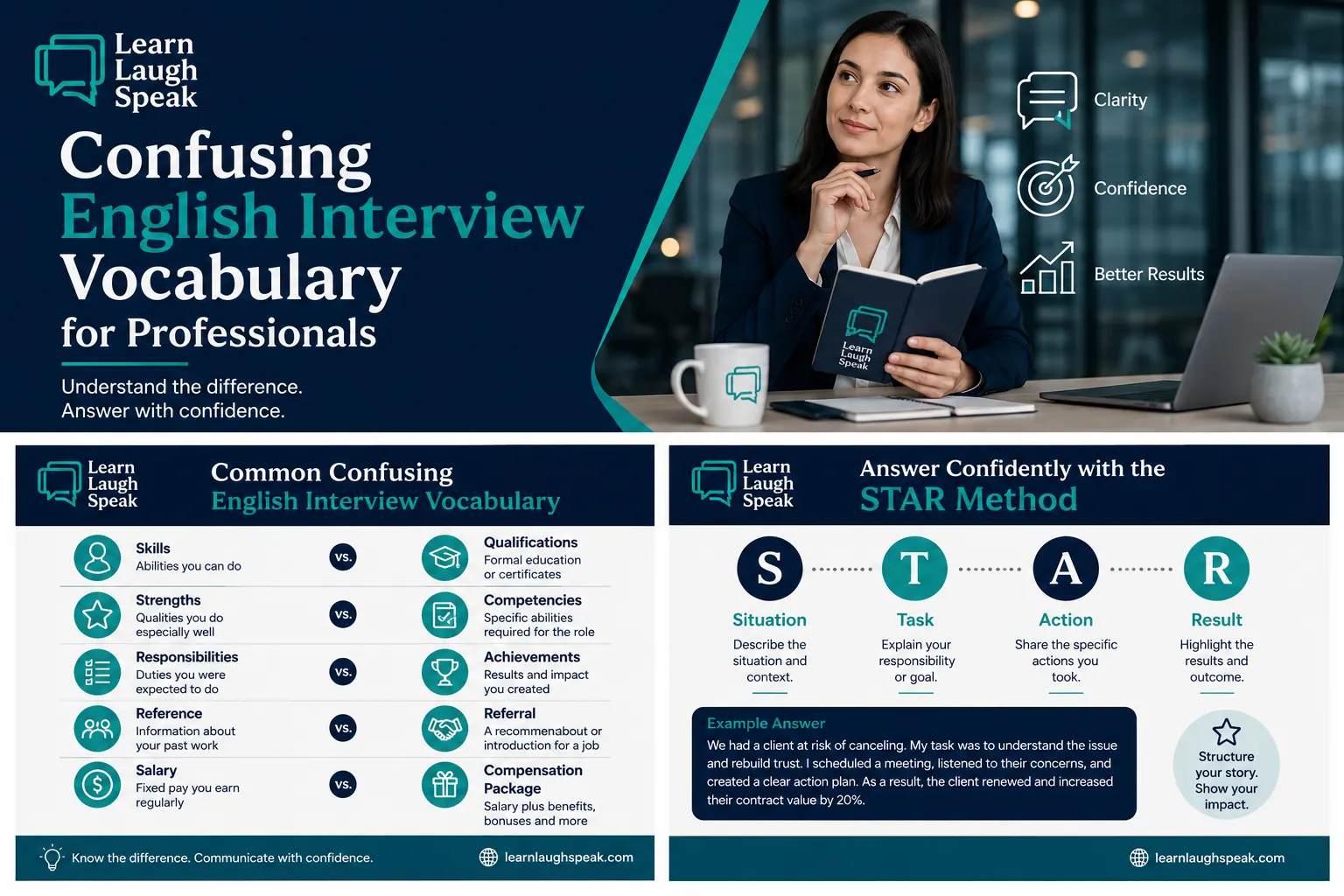
Confusing English interview vocabulary includes recruitment words that sound similar but ask for different information. Common examples include skills and qualifications, responsibilities and achievements, reference and referral, and salary and compensation. Understanding these differences helps professionals recognise what an interviewer is asking and give a clear, relevant answer.
A job interview can become difficult before you even begin answering.
The interviewer asks about your professional background, but you start listing your qualifications. They ask for an achievement, but you describe your daily responsibilities. They mention a screening interview, hiring manager, or compensation package, and you understand the individual words without fully understanding what they mean together.
This does not necessarily mean your English is poor. Interview language has its own vocabulary, and familiar words often take on a more specific meaning during recruitment.
This guide explains common confusing English interview vocabulary with practical definitions, realistic examples, and professional answers you can adapt to your own experience.
For a broader introduction to workplace communication, read our guide to what business English is and why it matters.
Why English Interview Vocabulary Can Be Confusing
Interview English combines normal vocabulary with specialised recruitment language.
Consider the word background. In everyday English, it may describe what is behind a person in a photograph. During an interview, your professional background means the experience, education, industries, and skills that have shaped your career.
The word package normally describes something wrapped in a box. A compensation package, however, includes the salary, bonuses, benefits, insurance, leave, commission, and other rewards connected to a position.
The question may sound simple, but answering the wrong interpretation can make a strong candidate appear unprepared.
The goal is not to memorise complicated words. It is to recognise what information the interviewer wants.
Quick Guide to Confusing Interview Terms
| Interview term | What the interviewer wants to know |
|---|---|
| Professional background | The relevant story of your career |
| Experience | Work you have done |
| Qualifications | Formal education, training, licences, or requirements |
| Skills | Abilities you can use |
| Strengths | Abilities or qualities you perform particularly well |
| Responsibilities | Duties you were expected to complete |
| Achievements | Positive results you produced |
| Competency | A skill or behaviour needed for the position |
| Behavioural question | What you did in a real past situation |
| Situational question | What you would do in a possible future situation |
| Reference | Information about your previous work or character |
| Referral | A recommendation or introduction to an employer |
| Compensation | Salary and other financial benefits |
| Notice period | Time required before leaving your current employer |
| Availability | When you can interview or begin work |
Job, Role and Position
These three words are closely connected, but there are small differences.
Job
A job is paid employment in general.
I’m looking for a job in customer success.
Role
A role focuses on what a person does and how they contribute.
My current role involves managing enterprise clients.
Position
A position is a specific job within an organisation.
I applied for the account manager position.
In many interviews, role and position can be used in similar ways.
A natural answer could be:
I’m interested in this position because its responsibilities are closely connected to my current role.
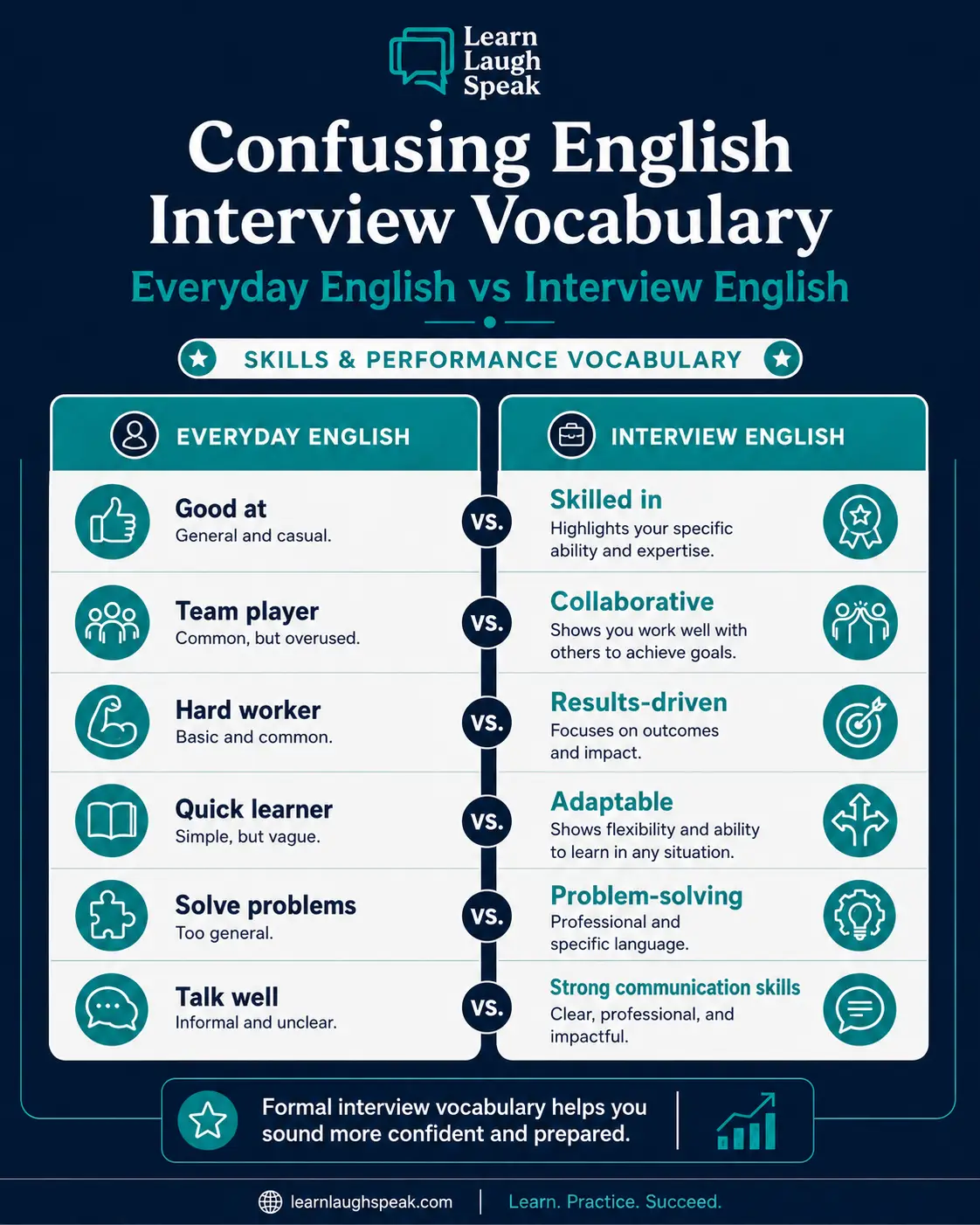
Skills, Strengths, Qualifications and Competencies
These are among the most common examples of confusing English interview vocabulary.
Skills
A skill is an ability you have learned or developed.
Examples include:
- negotiation
- project management
- customer service
- data analysis
- public speaking
- relationship management
- software development
One of my key skills is explaining complicated information clearly.
Strengths
A strength is something you do particularly well.
A strength may be a skill, but it can also be a personal quality.
One of my main strengths is remaining calm during difficult client conversations.
Qualifications
Qualifications are the formal achievements or stated requirements that show you are suitable for a role.
They can include:
- degrees
- diplomas
- professional certificates
- licences
- specialist training
- required years of experience
I have the qualifications and client-management experience listed in the job description.
Competencies
A competency is a measurable ability, behaviour, or quality required for successful performance.
Examples include:
- leadership
- adaptability
- analytical thinking
- communication
- decision-making
- conflict management
Structured interviews are often designed to assess specific job-related competencies. The U.S. Office of Personnel Management explains that structured interviews use predetermined questions and consistent evaluation standards to assess candidates more accurately.
The simple difference
| Term | Simple meaning |
|---|---|
| Skill | Something you can do |
| Strength | Something you do especially well |
| Qualification | Formal evidence that you meet a requirement |
| Competency | A job-related ability or behaviour being assessed |
Experience, Background and Track Record
These expressions describe your career from different angles.
Experience
Your experience is the work you have done and what you learned from it.
I have six years of experience managing customer relationships.
Professional background
Your professional background is the broader story of your career. It can include employment, industries, education, training, and major career changes.
My professional background is in hospitality management, business development, and client relationships.
Track record
Your track record is the evidence of results you have produced over time.
I have a strong track record of retaining high-value clients.
Use track record when you can support the statement with a result, number, improvement, or specific example.
For more help choosing appropriate workplace language, see how to improve your professional language in English.
Responsibilities, Duties and Achievements
Candidates frequently confuse these terms.
Responsibilities
Your responsibilities are the areas of work you were expected to manage.
I was responsible for a portfolio of thirty enterprise accounts.
Duties
Your duties are the individual tasks involved in the position.
My duties included preparing account reviews, monitoring product usage, and organising client meetings.
Achievements
Your achievements are the positive results you produced.
I retained an at-risk client and increased product adoption across its regional teams.
Employers need to understand what you did, but they are usually more interested in what happened because of your work.
Compare these answers
Responsibility only:
I managed customer accounts and organised quarterly reviews.
Responsibility with achievement:
I managed thirty customer accounts and introduced a more structured review process that helped improve client retention.
The second answer gives the interviewer evidence.
Achievement and Accomplishment
These words have almost the same meaning.
Both describe something successful that required effort, judgement, or ability.
My greatest professional achievement was rebuilding the company’s onboarding process.
One accomplishment I’m proud of was retaining a client that had planned to cancel.
Achievement is especially common in British and international business English. Accomplishment is also common, particularly in American English.
You can use either one.
Behavioural, Situational and Competency-Based Questions
Understanding the question type helps you choose the correct answer structure.
Behavioural questions
A behavioural question asks what you did in a real situation from your past.
Common openings include:
- “Tell me about a time when…”
- “Give me an example of…”
- “Describe a situation where…”
Tell me about a time when you dealt with an unhappy customer.
Yale’s career guidance describes behavioural interviews as questions that ask candidates to provide examples of previous accomplishments and actions. These examples help the interviewer understand how the candidate has applied their skills in real situations.
Situational questions
A situational question asks what you would do in an imagined or possible future situation.
What would you do if an important customer threatened to cancel?
Because the situation has not necessarily happened, you may use language such as:
- “I would begin by…”
- “My first step would be…”
- “I would make sure that…”
- “If that happened, I would…”
Competency-based questions
A competency-based question looks for evidence of a specific ability required for the role.
Tell me about a time when you demonstrated leadership under pressure.
The interviewer may be assessing:
- leadership
- communication
- problem-solving
- teamwork
- commercial awareness
- organisation
- adaptability
Structured interview
A structured interview means candidates are asked the same predetermined questions and assessed using the same standards.
Structured questions may focus on past behaviour, proposed behaviour in a hypothetical situation, or both. This format is designed to create more consistent and job-related evaluation.
Quick comparison
| Interview type | Main question |
|---|---|
| Behavioural | What did you do previously? |
| Situational | What would you do? |
| Competency-based | How can you prove a required ability? |
| Structured | Can all candidates answer the same standardised questions? |
The STAR Method
The STAR method helps you organise answers to behavioural and competency-based questions.
STAR means:
- Situation: What was happening?
- Task: What did you need to achieve?
- Action: What did you personally do?
- Result: What happened?
Yale recommends STAR as a practical framework for building concise accomplishment stories and preparing a reusable “story bank” for different interview questions.
Example STAR answer
Question:
Tell me about a time when you solved a difficult client problem.
Situation:
A major client was considering cancellation because its employees were not using our platform.
Task:
I needed to identify the adoption problem and rebuild the client’s confidence before renewal.
Action:
I interviewed the main users, simplified the onboarding plan, and introduced weekly progress meetings.
Result:
Usage improved during the following two months, and the client renewed its agreement.
The action should focus on what you did. Do not spend most of the answer describing the company, team, or problem.

Recruiter, Hiring Manager and Interview Panel
Understanding who is interviewing you can help you adjust your answer.
Recruiter
A recruiter usually manages the early stages of the process.
They may discuss:
- your general background
- suitability for the role
- salary expectations
- location
- work authorisation
- notice period
- interview availability
Hiring manager
The hiring manager usually leads the team or department that has the vacancy.
They are more likely to ask about:
- your practical experience
- role-specific challenges
- performance expectations
- management style
- technical or professional skills
Interview panel
An interview panel includes two or more interviewers.
Panel members may represent different teams and assess different competencies. Structured interviews are often conducted by panels, with interviewers rating responses against agreed standards.
Screening Interview, First Round and Final Round
Screening interview
A screening interview is an early conversation used to decide whether you should continue in the process.
It may be conducted by phone, video, or a short online meeting.
Harvard’s interview guidance notes that phone interviews have traditionally been used to assess communication, interest, salary requirements, and general qualifications, although phone and video interviews are now sometimes used for more detailed assessment as well.
First-round interview
The first round is normally the first detailed interview after initial screening.
Final-round interview
The final round takes place near the end of the process and may include:
- senior leaders
- potential colleagues
- a panel
- a presentation
- a work sample
- a case exercise
Being invited to the final round means you are being seriously considered. It does not mean the job has already been offered.
Live, Recorded and Asynchronous Interviews
Modern recruitment includes several interview formats.
Live interview
You speak to the interviewer in real time, either in person or online.
Recorded interview
A recorded interview is saved for later review.
Asynchronous video interview
In an asynchronous interview, you receive questions and record your answers without a live interviewer present.
You may also see terms such as:
- video prescreen
- one-way video interview
- recorded response
- timed answer
Prepare these answers as carefully as a live interview. Look at the camera, keep your response structured, and avoid reading a complete script.
“Tell Me About Yourself”
This does not mean the interviewer wants your full personal history.
They usually want a short professional introduction that answers four questions:
- What do you do now?
- What relevant experience do you have?
- What can you contribute?
- Why does this opportunity make sense?
Harvard recommends a past–present–future structure, keeping the answer under approximately one or two minutes and connecting it clearly to the position.
Example
I’m a customer success professional with more than five years of experience managing B2B client relationships. In my current role, I manage enterprise accounts and focus on adoption, retention, and renewals. Before moving into technology, I worked in hospitality management, where I developed strong communication and problem-solving skills. I’m now looking for a position where I can use that relationship experience in a growing international team.
“Walk Me Through Your Résumé”
This means:
Explain the most relevant parts of your career in a clear order.
Do not read every line from your résumé.
Focus on:
- important career changes
- relevant roles
- major achievements
- reasons for moving
- connection to the vacancy
A clear transition could sound like this:
After managing hospitality operations, I moved into business development because I wanted to focus more directly on client relationships and commercial growth.
“Why Should We Hire You?”
This question is asking:
How does your experience solve our problem?
Avoid vague statements such as:
I’m hardworking and passionate.
A stronger answer connects the employer’s needs to evidence:
You need someone who can manage strategic clients, identify risks early, and communicate clearly with senior stakeholders. Those are central parts of my current position, and I have a strong record of retaining accounts that were at risk of leaving.
Strength and Weakness
Strength
A strength should be relevant and supported with an example.
One of my main strengths is making complicated information easier to understand. In my current position, I regularly translate technical updates into clear next steps for clients.
Weakness
A weakness should be genuine, manageable, and connected to improvement.
Earlier in my career, I sometimes spent too long perfecting small details. I now set clearer time limits and decide which tasks genuinely require that level of attention.
Do not say that you have no weaknesses.
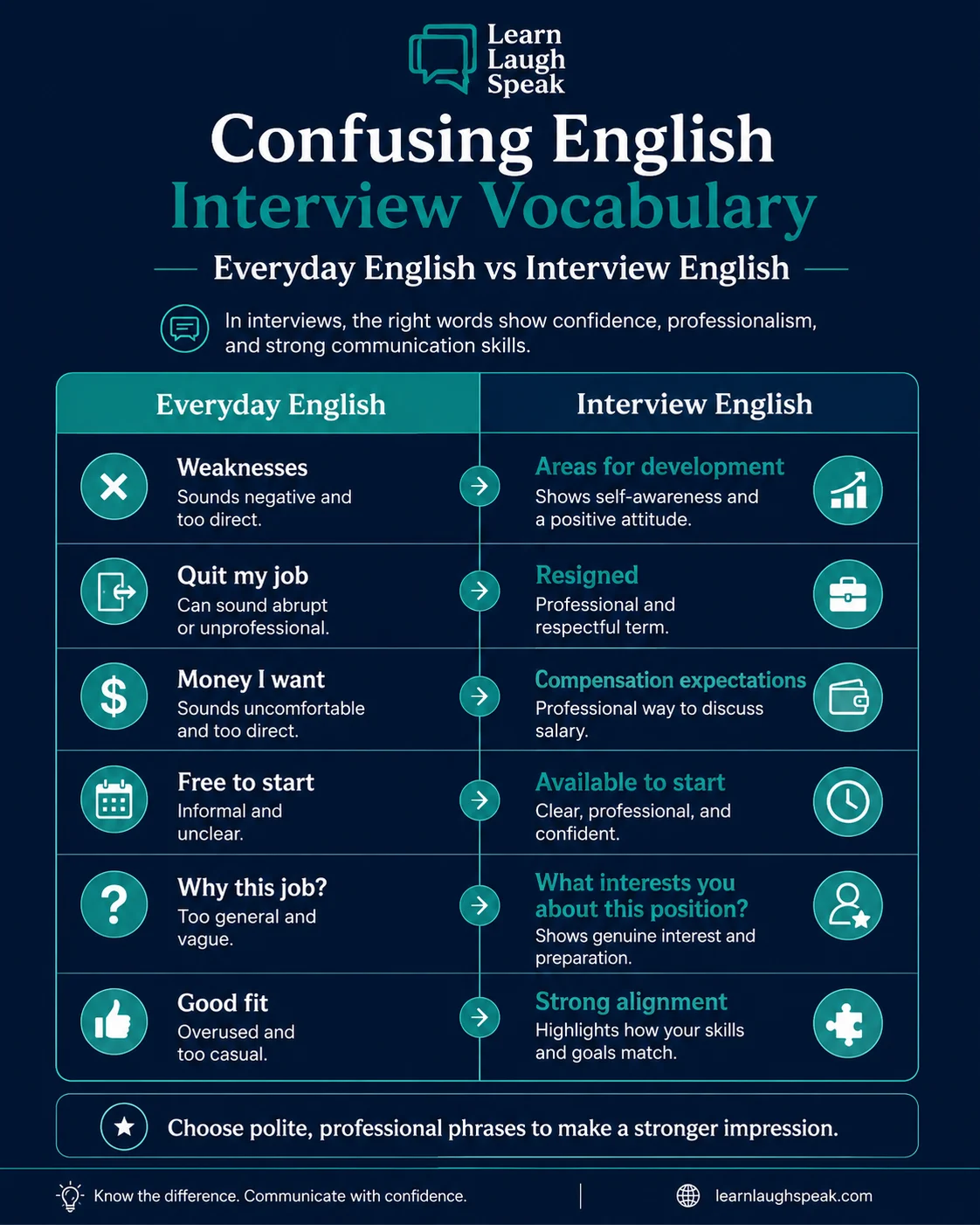
Weakness and Development Area
A development area is something you are actively improving.
It sounds more constructive than weakness, but it should not be used to avoid the question.
Public speaking has been an important development area for me, so I have started volunteering to lead more internal presentations.
Problem, Challenge and Obstacle
Problem
Something has gone wrong and needs to be solved.
We discovered a problem with the customer data.
Challenge
A difficult situation that requires effort, judgement, or adjustment.
The main challenge was correcting the data without interrupting service.
Obstacle
Something that blocks or slows progress.
A lack of reliable data was the biggest obstacle.
Challenge often sounds more constructive, but do not use it to minimise a serious problem.
Feedback and Criticism
Feedback
Information intended to help someone understand or improve performance.
My manager gave me feedback about making reports more concise.
Constructive feedback
Feedback that identifies a problem and offers a useful direction for improvement.
Criticism
A negative judgement about a fault or problem.
I received criticism because the report was delivered late.
A strong interview answer shows that you listen without becoming defensive.
I ask questions to make sure I understand the feedback, decide what action is needed, and follow up after making the change.
Leadership and Management
These words are connected, but not identical.
Management
Management often involves:
- planning
- organising
- assigning work
- reviewing performance
- managing budgets
- controlling resources
Leadership
Leadership involves:
- setting direction
- influencing others
- creating trust
- supporting decisions
- helping people work towards a shared goal
You can demonstrate leadership without having a management title.
I was not the formal manager, but I took the lead in redesigning the onboarding process and coordinating the people involved.
Collaboration and Teamwork
Teamwork
People cooperating as members of the same team.
Strong teamwork helped us complete the launch on time.
Collaboration
Different people, departments, organisations, or specialists working together.
The project required collaboration between sales, product, finance, and customer support.
Colleague, Coworker and Peer
Colleague
Someone you work with.
Coworker
Someone employed by the same organisation.
Peer
Someone at a similar professional level.
I asked a senior colleague for advice and then reviewed the proposal with my peers.
Colleague is normally the safest term in international professional English.
Manager, Supervisor and Team Lead
Manager
Usually responsible for employees, results, budgets, or a business area.
Supervisor
Usually oversees daily work and employee performance.
Team lead
Coordinates and supports a team but may not have all the formal authority of a manager.
Job titles vary between companies. Explain what you actually did.
Although my title was team lead, I also managed scheduling, coaching, and performance reviews.
Reference, Referee and Referral
These words look similar but have different meanings.
Reference
Information about your previous employment, performance, or character.
The company requested two professional references.
Referee
The person who provides a reference.
My former manager agreed to act as a referee.
In American English, reference is often used for both the recommendation and the person providing it.
Referral
A recommendation or introduction that helps connect you to a job opportunity.
I learned about the position through an employee referral.
Quick comparison
| Word | Meaning |
|---|---|
| Reference | Information about your previous work |
| Referee | Person providing the information |
| Referral | Introduction or recommendation for an opportunity |
Recruit, Hire and Onboard
These describe different stages.
Recruit
Search for and attract potential candidates.
Hire
Officially employ someone.
Onboard
Help a newly hired employee enter the organisation and begin working effectively.
The company recruited internationally, hired five people, and created a two-week onboarding programme.
Shortlisted, Selected and Offered
Shortlisted
You are part of a smaller group still being considered.
I was shortlisted for the second interview.
Selected
The organisation has chosen you as its preferred candidate.
I was selected as the preferred candidate, subject to reference checks.
Offered
The employer has formally proposed the job.
I was offered the position on Friday.
Being shortlisted is not the same as receiving an offer.
Job Offer, Conditional Offer and Contract
Job offer
The employer proposes that you join the company.
Conditional offer
The offer depends on requirements such as:
- reference checks
- background screening
- proof of qualifications
- work authorisation
- medical checks where legally permitted
- successful completion of another requirement
Employment contract
The formal agreement describing the terms of employment.
I received a conditional offer first and the employment contract after the checks were completed.
Salary, Wage, Compensation and Package
Salary
A fixed amount normally expressed annually or monthly.
The salary is $60,000 per year.
Wage
Payment normally calculated hourly, daily, or weekly.
The position pays an hourly wage of $25.
Compensation
The financial return you receive for your work.
Compensation package
The complete financial offer, which may include:
- base salary
- commission
- performance bonuses
- insurance
- paid leave
- retirement contributions
- stock or equity
- other benefits
I’m open to discussing the complete compensation package, including the base salary and performance bonus.
Base Salary, Bonus and Commission
Base salary
Your regular guaranteed salary before additional payments.
Bonus
Additional payment based on performance, company results, or another condition.
Commission
Payment linked to sales or revenue.
The role includes a base salary, quarterly bonus, and uncapped commission.
Uncapped commission means there is no fixed maximum commission amount.
Salary Expectations
Your salary expectations are the amount or range you hope to receive.
A professional answer could be:
Based on the responsibilities and my experience, I’m looking for a base salary between $65,000 and $72,000. However, I’m open to discussing the complete package.
Prepare a researched range before the conversation. Harvard’s career guidance treats salary expectations as a standard interview topic candidates should prepare for rather than improvise.
Notice Period, Availability and Start Date
Notice period
The time you must continue working after telling your current employer you are leaving.
My contractual notice period is four weeks.
Availability
When you are free for an interview or work commitment.
I’m available for a second interview next Tuesday.
Start date
The specific date you can begin employment.
Subject to completing my notice period, I could start on September 1.
Required, Preferred and Desirable
These words often appear in job descriptions.
Required
You are normally expected to meet this condition.
Three years of account-management experience is required.
Preferred
The employer would like it, but may consider candidates without it.
Experience in SaaS is preferred.
Desirable
Helpful and valuable, but not necessarily essential.
A second language is desirable.
Do not automatically reject yourself because you are missing one preferred or desirable item.
Transferable Skills
Transferable skills can be used across roles and industries.
Examples include:
- communication
- leadership
- organisation
- negotiation
- customer service
- problem-solving
- commercial awareness
- relationship management
Although my background is in hospitality, my sales and client-relationship skills are directly transferable to this position.
Culture Fit and Culture Add
Culture fit
How well your working style and values align with the organisation.
Culture add
What new experience, perspective, or strength you bring to the organisation.
My collaborative style would fit the team, while my international client experience would add a different perspective.
You should not feel pressure to copy the personality of the existing team. A strong employer should also consider the value you add.
Work Authorisation and Visa Sponsorship
Work authorisation
Legal permission to work in a particular country.
Visa sponsorship
Employer support for a visa or immigration process connected to employment.
A recruiter may ask:
Are you currently authorised to work in this country?
That is different from asking about your nationality.
In the United States, employers may explain that work eligibility must be verified after hiring, but most employers should not ask whether an applicant is a U.S. citizen before an offer. Rules differ by country, so candidates should check the law where the role is located.
Reasonable Accommodation
A reasonable accommodation is an adjustment that helps a qualified person participate in recruitment or perform a role.
This may include:
- accessible interview arrangements
- additional time for a task
- assistive technology
- a different interview format
- physical workplace adjustments
In the United States, employers generally cannot ask disability-related questions before a conditional offer, although they may ask whether a candidate can perform the essential duties and may discuss an accommodation needed for a particular interview or job task.
This section is general information, not legal advice. Employment rules differ by country and location.
Personal Questions During an Interview
Questions about age, religion, pregnancy, family plans, disability, race, or other protected personal characteristics may be inappropriate or restricted depending on local law.
U.S. EEOC guidance recommends keeping pre-employment questions focused on information genuinely required to determine whether a person is qualified for the position.
A calm response to an uncomfortable question could be:
Could you explain how that relates to the responsibilities of the position?
Or redirect it:
I can confirm that I’m able to meet the travel and scheduling requirements listed for the role.
What Not to Say and What to Say Instead
| Avoid | Better alternative |
|---|---|
| I am perfect for this job. | My experience closely matches the main requirements. |
| I have no weaknesses. | One development area I’m actively working on is… |
| My old boss was terrible. | I was looking for an environment with clearer communication and development opportunities. |
| I did everything myself. | I led my part of the project and collaborated with… |
| I need more money. | I’m looking for compensation that reflects the responsibilities of the role. |
| I don’t know what your company does. | I reviewed your services, and I’d like to understand more about… |
| I’m a hard worker. | One example that demonstrates my work ethic is… |
| We had lots of problems. | We faced several challenges, including… |
| My English is bad. | English is not my first language, but I communicate confidently in professional situations. |
| I don’t understand. | Could you clarify what you mean by that? |
When a question is unclear, asking for clarification is better than guessing. Our guide to professionally clarifying a misunderstanding provides phrases you can use in interviews and workplace conversations.
A Realistic Interview Dialogue
Interviewer:
Tell me about your professional background.
Candidate:
My background is in customer service, hospitality operations, and account management. In my current role, I manage business clients and support them throughout the customer lifecycle.
Interviewer:
What would you say is your greatest strength?
Candidate:
My main strength is building trust with clients. I listen carefully, identify the real issue, and agree on clear next steps.
Interviewer:
Tell me about a time when a client relationship was at risk.
Candidate:
One client was considering cancellation because its team had not adopted the platform. I reviewed the usage data, spoke with the key users, and created a shorter onboarding plan. Adoption improved over the following weeks, and the client renewed.
Interviewer:
What are your salary expectations?
Candidate:
Based on the role and my experience, I’m looking for a base salary between $55,000 and $62,000, although I’m open to discussing the complete compensation package.
Interviewer:
When would you be available to start?
Candidate:
My notice period is four weeks, so I could begin at the start of the following month.
A Better Way to Learn Confusing English Interview Vocabulary
Do not try to memorise this entire guide before an interview.
Use a smaller, practical system.
Step 1: Choose the vocabulary connected to your interview
Start with five terms:
- professional background
- transferable skills
- key achievement
- development area
- salary expectations
Step 2: Write your own definition
Do not copy a dictionary definition. Explain each term in language you naturally understand.
Step 3: Prepare one example
Transferable skills: Skills I can use in another job or industry.
Example: My hospitality experience gave me transferable skills in sales, service, and relationship management.
Step 4: Practise speaking aloud
Reading an answer silently is not enough.
Record yourself and listen for:
- long pauses
- unclear structure
- repeated words
- answers that are too long
- words that feel unnatural
Yale’s interview preparation guidance recommends practising aloud, recording responses, and building a collection of adaptable examples rather than preparing one rigid answer for every possible question.
Step 5: Keep the English simple
Interviewers need to understand your value.
They do not need to hear the most complicated vocabulary you know.
For additional speaking practice, read how to build real confidence when speaking English and our guide to common business English mistakes.
How Learn Laugh Speak Helps Professionals Prepare
Learn Laugh Speak helps adults practise English for real professional situations.
An interview requires more than vocabulary. You must understand the question, organise the answer, choose a useful example, and communicate your value clearly.
Professionals can practise:
- introducing themselves
- explaining their professional background
- describing responsibilities and achievements
- answering behavioural questions
- using the STAR structure
- discussing salary and availability
- asking for clarification
- improving pronunciation and listening
- preparing questions for the interviewer
The goal is not to sound overly formal.
The goal is to sound clear, prepared, and confident.
Practice Activity
Choose the correct word.
1. Skill or qualification?
A project-management certificate is a formal ________.
Answer: qualification
2. Responsibility or achievement?
Increasing client retention by 15% was an ________.
Answer: achievement
3. Reference or referral?
A former colleague introduced me to the hiring manager through a ________.
Answer: referral
4. Behavioural or situational?
“What would you do if two colleagues disagreed?” is a ________ question.
Answer: situational
5. Salary or compensation package?
Salary, bonus, insurance, and paid leave form the complete ________.
Answer: compensation package
6. Notice period or availability?
The four weeks I must work before leaving my current employer is my ________.
Answer: notice period
FAQs About Confusing English Interview Vocabulary
What is confusing English interview vocabulary?
Confusing English interview vocabulary includes recruitment words that have similar or specialised meanings, such as skills, strengths, qualifications, references, referrals, salary, and compensation.
What is the difference between skills and qualifications?
Skills are abilities you can demonstrate. Qualifications are formal achievements or requirements such as degrees, certificates, licences, or training.
What is the difference between responsibilities and achievements?
Responsibilities are the duties you were expected to perform. Achievements are the successful results you produced.
What is the difference between a reference and a referral?
A reference provides information about your previous performance or employment. A referral happens when someone recommends or introduces you for a job opportunity.
What does professional background mean?
Your professional background is the combined story of your employment, education, industries, training, and relevant development.
What is a screening interview?
A screening interview is an early conversation used to assess basic suitability before inviting a candidate into a more detailed stage.
What is a behavioural interview question?
A behavioural question asks you to describe how you handled a real situation in the past.
What is a situational interview question?
A situational question asks what you would do in a possible or hypothetical situation.
What is the STAR method?
STAR stands for Situation, Task, Action, and Result. It provides a clear structure for answering questions about your previous experience.
What does salary expectation mean?
Your salary expectation is the amount or range of compensation you hope to receive.
What does transferable skill mean?
A transferable skill is an ability you can use in different jobs, roles, or industries.
Should I use difficult vocabulary in an interview?
No. Use accurate and professional English, but prioritise clarity. Complicated words will not improve an answer if they make it sound unnatural.
Final Thoughts on Confusing English Interview Vocabulary
Understanding confusing English interview vocabulary helps you recognise what an interviewer is really asking.
Focus especially on the differences between:
- skills, strengths, qualifications, and competencies
- experience, background, and track record
- responsibilities and achievements
- behavioural and situational questions
- reference and referral
- salary and compensation
- notice period, availability, and start date
You do not need perfect English to perform well in an interview.
You need relevant examples, organised answers, and language that clearly communicates what you can contribute.
Learn the vocabulary before the interview so you can spend the conversation explaining your experience—not translating the question in your head.