
 English
 Arabic
 Chinese (Simplified)
 Dutch
 French
 German
 Italian
 Portuguese
 Russian
 Spanish
A formal letter format follows a clear professional structure. The goal is simple: help the reader understand who is writing, why the message matters and what action should happen next.
In most situations, use this order:
Sender details → Date → Recipient details → Greeting → Subject → Opening paragraph → Main body → Closing paragraph → Sign-off → Signature
Here is the basic structure:
Your Name
Your Address
City, State/Postcode
Email | Phone
Date
Recipient Name
Job Title
Company
Address
Dear Mr/Ms/Dr [Surname],
Subject: Reason for Writing
I am writing regarding [reason for your letter].
[Explain the important details clearly.]I would appreciate it if you could [action you would like the reader to take].
Thank you for your time and consideration. I look forward to hearing from you.
Sincerely,
Your Name
This structure works well for professional requests, complaints, applications, business enquiries, official correspondence and many workplace situations.
This guide explains each part, provides a reusable template, compares US and UK conventions and gives practical examples for adult English learners.
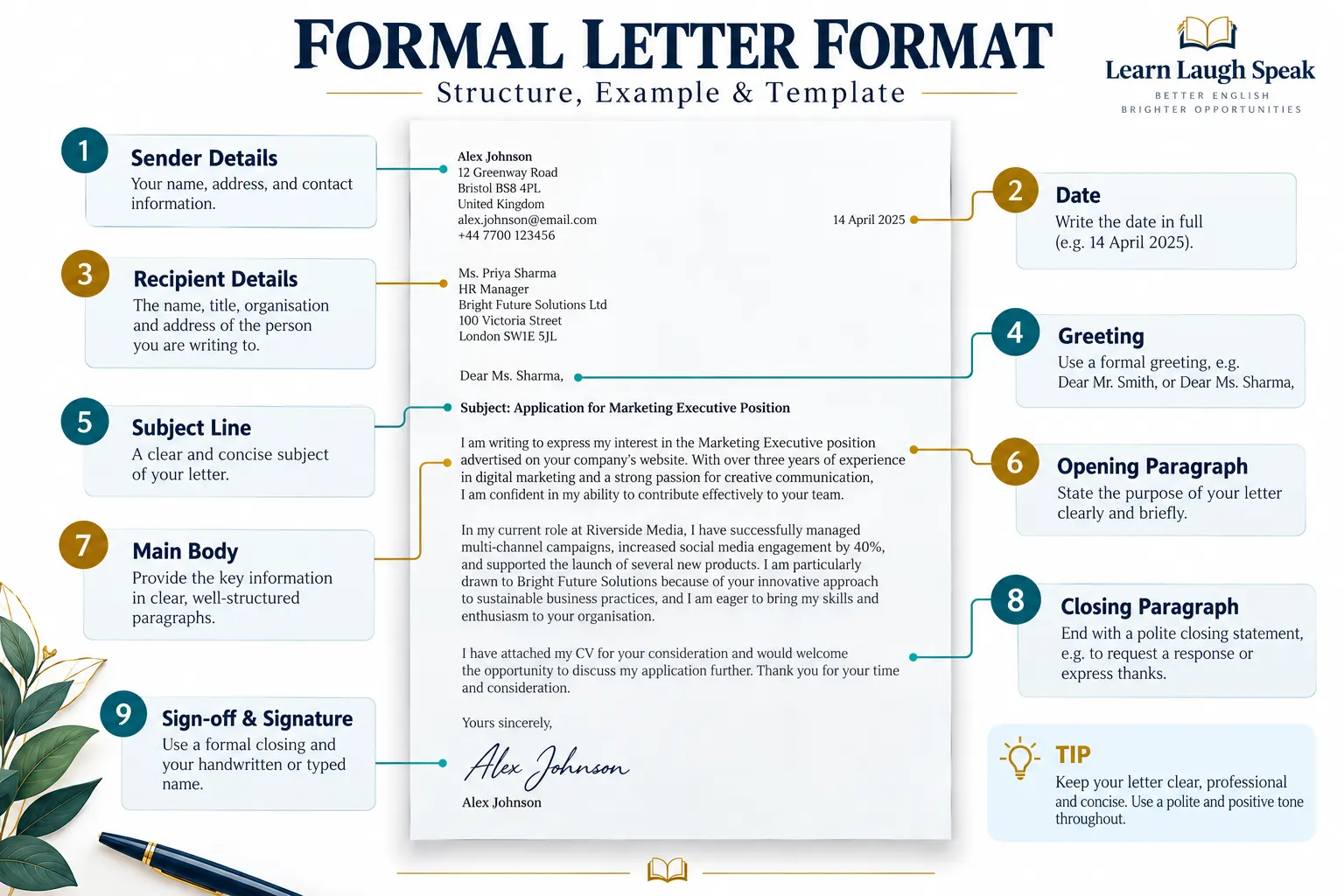
Quick Answer: What Is the Correct Structure?
A professional letter normally contains the following elements:
| Part | What to Include |
|---|---|
| Sender details | Your name and contact information |
| Date | The date the letter was written |
| Recipient details | Name, position, company and address |
| Greeting | Dear Mr/Ms/Dr [Surname], or a suitable professional role |
| Subject | A short description of why you are writing |
| Opening | State the purpose immediately |
| Body | Give the necessary facts or explanation |
| Closing paragraph | Explain the response or action you expect |
| Sign-off | Sincerely, Yours sincerely, Yours faithfully, etc. |
| Signature | Your signature and printed name |
For most adult English learners, a simple full-block layout is an easy professional choice. In block style, the text is generally aligned to the left, paragraphs are not indented and space separates each paragraph.
For a detailed reference on professional business-letter layout, see the Purdue OWL business-letter guide.
The Parts of a Formal Letter
1. Sender Details
Start with your contact information.
Depending on the situation, include:
- full name
- job title
- company
- street address
- city and postcode or ZIP code
- email address
- phone number
If you are using official company letterhead, some of this information may already appear at the top.
2. Date
Add the date the letter was completed.
US and UK date styles differ.
US English:
October 22, 2026
UK and many international contexts:
22 October 2026
Writing the month as a word can prevent confusion.
For example:
10/11/2026
could mean October 11 in the United States or 10 November in countries that use day/month/year.
3. Recipient Details
Next, add the details of the person receiving the letter.
For example:
Maria Chen
Operations Manager
ABC International
125 Market Street
Chicago, IL 60601
If you do not know the person’s name, use a specific professional role or department when possible.
Examples:
Customer Service Manager
Human Resources Department
A named recipient is usually better than a completely general greeting because it makes the communication more direct.
4. Greeting or Salutation
If you know the recipient:
Dear Mr Williams,
Dear Ms Chen,
Dear Dr Patel,
If you do not know which title a person uses, their full name or professional role can be safer:
Dear Jordan Taylor,
Dear Hiring Manager,
Traditional British correspondence also uses:
Dear Sir or Madam,
The important point is consistency. Choose a greeting that fits the situation and level of formality.
For more examples, see our Learn Laugh Speak lesson on formal English greetings and introductions.
5. Subject Line
A subject line is not compulsory in every printed letter, but it can make the purpose immediately clear.
Examples:
Subject: Request for Updated Contract
Subject: Complaint Regarding Order 28451
Subject: Application for Operations Manager Position
Subject: Request for Further Information
Keep the subject short and specific.

Copyable Formal Letter Template
Use this template as a starting point:
[Your Full Name]
[Your Address]
[City, State/Postcode]
[Email Address]
[Phone Number]
[Date]
[Recipient’s Full Name]
[Recipient’s Job Title]
[Company/Organisation]
[Address]
[City, State/Postcode]
Dear [Mr/Ms/Dr Surname],
Subject: [Reason for Letter]
I am writing regarding [briefly explain why you are contacting the person].
[Explain the important facts, background or situation. Keep the information relevant to the purpose of the letter.] [If necessary, add another short paragraph with dates, reference numbers, order numbers or supporting information.]I would appreciate it if you could [clearly explain the action you would like the person to take].
Thank you for your time and consideration. I look forward to hearing from you.
Sincerely,
[Signature][Your Full Name]
[Job Title, if relevant]
How to Write a Formal Letter Step by Step
Step 1: Decide What You Want the Letter to Achieve
Before writing, decide exactly why you are contacting the reader.
You may want to:
- request information
- ask someone to take action
- make a complaint
- apply for a position
- confirm an agreement
- request permission
- respond to an earlier message
A professional letter becomes much easier to write when its purpose is clear.
Step 2: Identify the Reader
Ask yourself:
Who will read this?
What information do they need?
What action do I want them to take?
A complaint to a company will use different language from a job application, but both should be clear, respectful and professional.
Step 3: Use a Clear Layout
Do not write the entire message as one large paragraph.
The reader should be able to scan the page and quickly understand:
- who sent it
- why they are writing
- what happened
- which facts matter
- what should happen next
Step 4: State Your Purpose Early
Do not make the reader search for the reason you are writing.
Useful opening sentences include:
I am writing regarding…
I am writing to request…
I am writing to enquire about…
I am writing to express my concern regarding…
I am writing in response to…
I am writing to confirm…
This same principle works in workplace emails. Our guide to professional email templates provides more examples of getting to the point while remaining polite.
Step 5: Give Only the Information the Reader Needs
Keep the body factual and relevant.
Instead of:
“I have been really stressed recently and lots of things have happened at work and I do not know what to do.”
write:
“Due to a change in my work schedule, I am unable to attend the meeting on the agreed date.”
The second sentence is shorter, clearer and more useful to the reader.
Step 6: Tell the Reader What You Need
Do not explain a problem without explaining the next step.
Compare:
“There was a problem with my order.”
with:
“I would appreciate it if you could arrange a replacement.”
The second version gives the reader a clear action.
Step 7: Finish Politely
A strong final paragraph can include a request, next step or expression of thanks.
Examples:
I would appreciate a response by Friday, if possible.
Thank you for your time and consideration.
I look forward to hearing from you.
Please let me know if you require any further information.
How to Start a Formal Letter
Your first paragraph should normally answer one question:
Why are you writing?
Making a Request
I am writing to request further information regarding your training programme.
Making an Enquiry
I am writing to enquire about availability for the position advertised on your website.
Making a Complaint
I am writing to express my dissatisfaction with the service I received on October 18.
Referring to Previous Communication
I am writing regarding our telephone conversation on October 20.
Responding to a Message
I am writing in response to your letter dated October 15.
Confirming an Arrangement
I am writing to confirm the arrangements discussed during our meeting.
Good professional writing does not require difficult vocabulary. It requires accurate words, a clear purpose and a tone appropriate for the relationship.
Our Learn Laugh Speak guide on how to ask questions professionally gives additional examples of polite professional wording.
How to Write the Body
A useful three-part structure is:
Paragraph 1 — Purpose
Explain why you are writing.
Paragraph 2 — Details
Give the relevant facts, dates, background or supporting information.
Paragraph 3 — Action
Explain what you would like the reader to do.
Longer letters may need another supporting paragraph, but more words do not automatically make a message more professional.
Each paragraph should have a reason to be there.
How to End a Formal Letter
The final paragraph should make the next step clear.
Useful phrases include:
I would appreciate it if you could…
I would be grateful if you could…
Please let me know if…
I would appreciate your response by…
Thank you for considering my request.
I look forward to hearing from you.
Please do not hesitate to contact me if you require any further information.
These phrases are polite without being vague.
The British Council guide to formal requests and professional sign-offs is also useful for learners who want more practice with formal written English.
US vs UK Letter Conventions
There is no single international system used everywhere.
US and UK correspondence share the same basic structure, but several conventions differ.
| Feature | US English | UK English |
|---|---|---|
| Common layout | Full block format is common | Block and traditional layouts are common |
| Date | October 22, 2026 | 22 October 2026 |
| Formal salutation | A colon is traditional in many business letters | A comma is common |
| Named recipient | Dear Ms Smith: / Dear Ms Smith, | Dear Ms Smith, |
| Common closing | Sincerely, | Yours sincerely, |
| Unknown recipient | Role-based greeting is common | Dear Sir or Madam is traditional |
| Traditional closing when name is unknown | Sincerely / Respectfully | Yours faithfully |
In traditional British professional writing:
Dear Ms Patel → Yours sincerely
Dear Sir or Madam → Yours faithfully
For international business communication, clarity matters more than trying to combine several regional conventions.
Choose one style and use it consistently.

Example 1: Professional Request
Daniel Brooks
48 West Street
Austin, TX 78701
daniel.brooks@example.com
October 22, 2026
Rachel Morgan
Training Manager
Global Skills Ltd
810 Market Avenue
Austin, TX 78702
Dear Ms Morgan:
Subject: Request for Information About Business English Training
I am writing to request further information about the Business English training programmes offered by your organisation.
Our company is currently reviewing training options for a team of approximately 20 employees who regularly communicate with international clients. We are particularly interested in courses that focus on professional speaking, email communication and customer service.
I would appreciate it if you could provide details regarding course duration, pricing, availability and whether programmes can be adapted for different English levels.
Thank you for your assistance. I look forward to hearing from you.
Sincerely,
Daniel Brooks
Example 2: Complaint
Anna Rivera
18 Park Avenue
Miami, FL 33101
anna.rivera@example.com
October 22, 2026
Customer Service Manager
ABC Electronics
420 Commerce Drive
Miami, FL 33102
Dear Customer Service Manager:
Subject: Complaint Regarding Order #45892
I am writing regarding an order I received from your company on October 18, 2026.
I ordered a new laptop through your website on October 12. Although the package arrived on time, the screen was damaged when I opened the box. I contacted your customer service department on October 19 and was advised to submit the issue in writing.
I have attached photographs of the damaged product together with a copy of the original receipt.
I would appreciate it if you could arrange either a replacement or a full refund. Please let me know if you require any additional information.
Thank you for your assistance. I look forward to your response.
Sincerely,
Anna Rivera
A complaint is usually more effective when the language is calm, specific and focused on a solution.
For more workplace language for checking facts and avoiding misunderstandings, see how to confirm understanding professionally.
Example 3: Business Enquiry
Michael Torres
Operations Coordinator
Westline Events
Dallas, TX 75201
October 22, 2026
Sales Department
Premier Transport Services
Dallas, TX 75202
Dear Sales Team:
Subject: Enquiry Regarding Corporate Transportation Services
I am writing to enquire about transportation services for a corporate event taking place in Dallas in January 2027.
We expect approximately 120 attendees and require airport transfers as well as daily transportation between the hotel and event venue.
Could you please provide information regarding vehicle capacity, pricing, availability and booking requirements?
If possible, I would also appreciate details about your cancellation and payment policies.
Thank you for your time. I look forward to receiving your response.
Sincerely,
Michael Torres
Operations Coordinator
Formal Letter vs Formal Email

Formal letters and professional emails use similar language, but their layouts are different.
A printed or attached letter normally includes:
sender address
recipient address
date
greeting
body
closing
signature
A professional email normally includes:
subject line
greeting
opening
body
closing
email signature
You usually do not need full postal-address blocks at the beginning of an ordinary email.
The writing principles are the same:
be clear
be polite
be specific
make the next action easy to understand
Useful Professional Phrases
Explaining Why You Are Writing
I am writing regarding…
I am writing in connection with…
I am writing to enquire about…
I am writing to request…
I am writing to confirm…
I am writing in response to…
Making a Polite Request
I would appreciate it if you could…
I would be grateful if you could…
Could you please provide…
Would it be possible to…
I would appreciate your assistance with…
Providing Information
Please note that…
I would like to confirm that…
For your reference…
As discussed…
Please find enclosed…
Making a Complaint
I am writing to express my concern regarding…
I am writing to express my dissatisfaction with…
Unfortunately, I have experienced a problem with…
I would appreciate it if this matter could be resolved as soon as possible.
Asking for a Response
I look forward to hearing from you.
I would appreciate your response at your earliest convenience.
Please let me know if you require any additional information.
I would be grateful for a response by [date].
Closing Politely
Thank you for your time and consideration.
Thank you for your assistance.
I appreciate your attention to this matter.
I look forward to your response.
Informal vs Formal English
Formal English does not mean complicated English.
It normally means choosing language that is respectful, clear and appropriate for the situation.
| Too Informal | More Professional |
|---|---|
| Send me the information. | Could you please provide the information? |
| I want to know… | I would like to know… |
| Thanks for getting back to me. | Thank you for your response. |
| Sorry about this. | Please accept my apologies. |
| I can’t come. | Unfortunately, I am unable to attend. |
| Tell me what happens next. | Please let me know what the next steps are. |
| I need this ASAP. | I would appreciate receiving this as soon as possible. |
| What’s going on with my order? | I am writing to request an update regarding my order. |
The tone should sound professional without becoming robotic.
Purdue OWL’s guide to tone in business writing is a useful additional reference on keeping workplace writing courteous, confident and appropriate.
Common Mistakes to Avoid
1. Hiding the Reason for Writing
Weak:
“I hope you are well. I wanted to contact you because I have been thinking about something for a while…”
Better:
“I am writing to request an update regarding my application.”
2. Writing One Huge Paragraph
Use short paragraphs with one purpose each.
3. Using Slang
Avoid overly casual expressions such as:
“Hey”
“What’s up?”
“ASAP!!!”
unless the relationship genuinely allows them.
4. Trying Too Hard to Sound Formal
Long words do not automatically sound professional.
Simple, accurate English is often better.
5. Being Too Direct
“Send me the contract today.”
can sound demanding.
A better version is:
“Could you please send the contract by the end of today, if possible?”
6. Being Too Indirect
Polite does not mean vague.
Instead of:
“I was just wondering if maybe there could perhaps be a possibility of discussing the issue.”
write:
“I would appreciate the opportunity to discuss this issue.”
7. Forgetting the Action You Want
A complaint should explain the solution you expect.
A request should explain what you need.
An enquiry should make the questions clear.
8. Mixing Regional Conventions
If you choose a US business-letter style, keep it consistent.
If you choose a traditional British style, do the same.
9. Forgetting to Proofread
Check:
names
dates
job titles
company names
reference numbers
attachments
spelling
grammar
contact details
A small error in a name or date can make an otherwise strong letter look careless.
Professional Letter Checklist
Before sending, ask:
Does the reader immediately know why I am writing?
Have I used the correct recipient name and title?
Is the date clear?
Have I included only the important facts?
Does each paragraph have a purpose?
Have I clearly stated what I want the recipient to do?
Is the tone polite and professional?
Have I used a suitable closing?
Have I checked names, dates, numbers and attachments?
If the answer is yes, the letter is probably ready to send.
Frequently Asked Questions
What is the correct formal letter format?
A professional letter normally includes sender details, the date, recipient details, a greeting, the reason for writing, the main body, a closing, an appropriate sign-off and a signature.
For many business situations, a simple block layout is an effective choice.
How do I start a formal letter?
If you know the recipient, use their name and suitable title:
Dear Ms Chen,
Dear Dr Patel,
If you do not know the person’s name, a professional role can work well:
Dear Hiring Manager,
Dear Customer Service Team,
Traditional British English also uses:
Dear Sir or Madam,
How should I start the first paragraph?
State the reason for writing early.
For example:
“I am writing to enquire about…”
or:
“I am writing regarding…”
How many paragraphs should a professional letter have?
There is no fixed number.
Three or four short paragraphs work well for many situations:
purpose
important details
supporting information if necessary
requested action or closing
What is the best ending?
In American business English, Sincerely is a common professional closing.
In traditional British English:
Yours sincerely is generally used when you know the recipient’s name.
Yours faithfully is generally used when you do not know the recipient’s name.
Is “Dear Sir or Madam” still correct?
Yes.
It remains a recognised formal greeting, particularly in British English.
However, if you can identify the person or professional role, Dear Hiring Manager or Dear Customer Service Team can be more specific.
Should I use “To Whom It May Concern”?
It can be appropriate when the eventual reader is completely unknown.
For ordinary business correspondence, try to identify the person, department or role first.
Should the letter be one page?
Most ordinary professional letters benefit from being concise enough to fit on one page.
More complex legal, technical or official correspondence may require additional pages.
Should I use contractions?
Contractions such as I’m, can’t and won’t are common in modern English, but the full forms can create a more formal tone:
I am
cannot
will not
Choose the level of formality that fits the situation.
Do I need a subject line?
Not always.
However, a subject line can help the reader understand the purpose immediately.
Is a business letter different from a formal letter?
The terms overlap.
A business letter is a type of formal correspondence used for professional or commercial communication.
Formal letters can also be sent to schools, institutions, landlords, government departments and other organisations.
Can I send a formal letter by email?
Yes.
You can attach the complete letter as a PDF or document, or write the message directly in the email.
If you write directly in an email, you normally do not need the full postal-address blocks used in a printed letter.
Final Thoughts
A strong professional letter is not complicated.
Remember the basic order:
Sender details → Date → Recipient details → Greeting → Subject → Purpose → Details → Requested action → Closing → Signature
The most important rule is clarity.
Tell the reader why you are writing.
Give them the information they need.
Explain what you would like them to do.
Keep the language polite and professional.
Before sending the letter, read it once from the recipient’s perspective.
If the purpose and next step are immediately clear, the letter is doing its job.