
 English
 Arabic
 Chinese (Simplified)
 Dutch
Dutch French
 German
 Italian
 Portuguese
 Russian
 Spanish
Someone serves. The shuttle comes back high. One player attacks with a smash, the opponent blocks, both players move toward the net and suddenly the umpire calls “fault.”
If you are learning English as well as badminton, a few seconds of play can contain a surprising amount of new vocabulary.
Fortunately, most badminton terms describe something you can actually see: where the shuttle travels, where a player stands, how a point begins or why a rally ends.
This guide explains 70 important badminton terms in simple English, with examples and situations from real play.
Instead of treating badminton vocabulary like a dictionary, we will connect the words to what actually happens during a match.
The 12 Badminton Terms Every Beginner Should Learn First
If you are completely new to badminton, start with these words.
| Term | Simple Meaning |
|---|---|
| 1. Shuttle / Shuttlecock | The object players hit over the net. |
| 2. Racket | The equipment used to hit the shuttle. |
| 3. Serve | The shot that begins a rally. |
| 4. Server | The player making the serve. |
| 5. Receiver | The player receiving the serve. |
| 6. Rally | The sequence of shots from the serve until play stops. |
| 7. Stroke | A racket movement used to hit the shuttle. |
| 8. Point | One unit of scoring. |
| 9. Game | One section of a badminton match. |
| 10. Match | The complete contest between the players or teams. |
| 11. Singles | One player against one player. |
| 12. Doubles | Two players against two players. |
These are the badminton terms you will hear before almost anything else.
One useful language point is that shuttlecock is the full name of the object used in badminton, but players normally shorten it to shuttle.
You may also hear bird or birdie informally in some countries, particularly in North America.
Official badminton terminology normally uses shuttle.
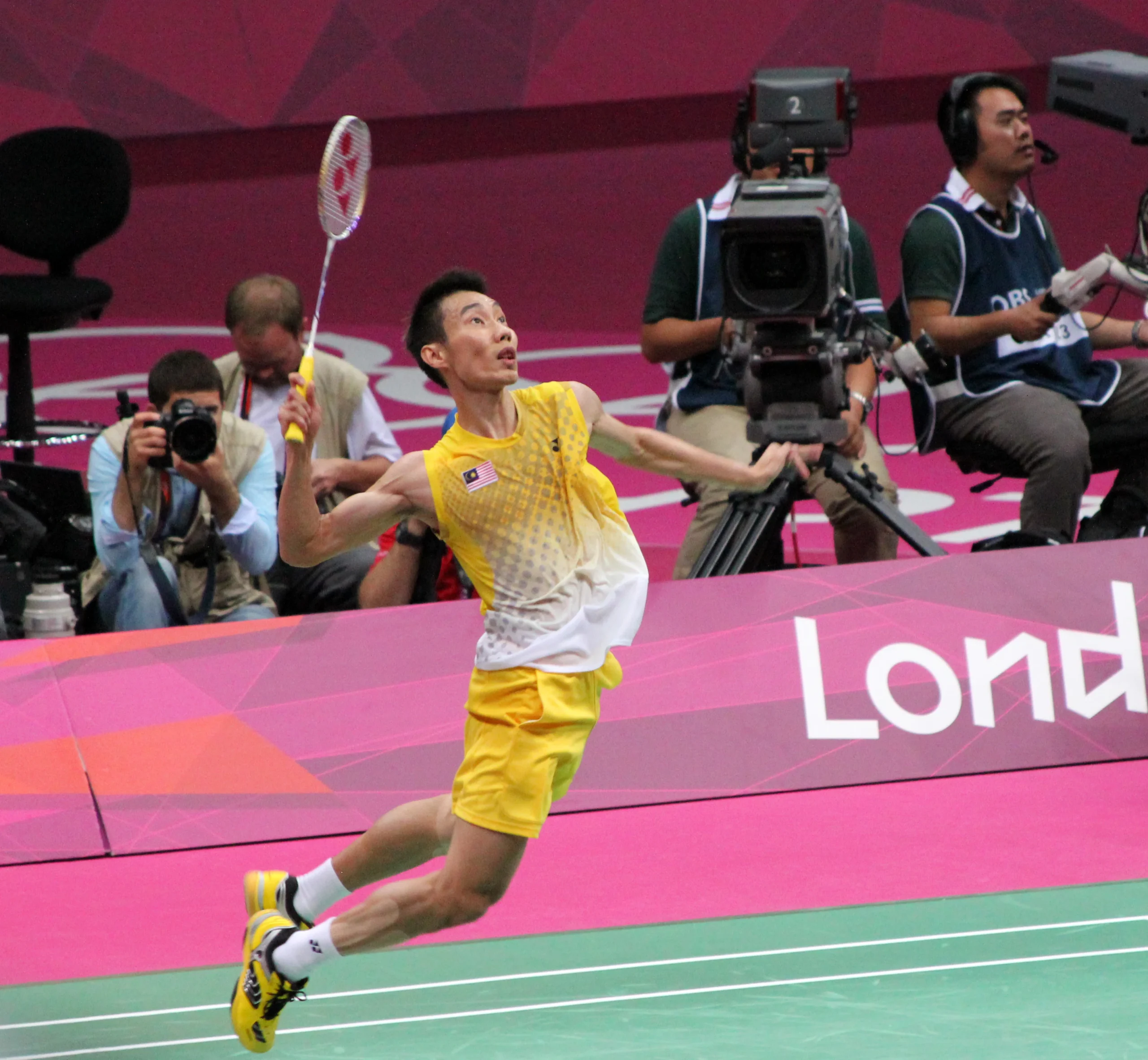
What a Badminton Rally Sounds Like in English
Imagine this point.
The server plays a low serve.
The receiver returns the shuttle quickly.
One player hits a lift toward the back of the court.
The opponent attacks with a smash.
The defending player plays a block.
The shuttle falls close to the net.
The next player attempts a net shot, but the shuttle lands outside the sideline.
“Out.”
Point over.
That short rally already contains several important badminton terms.
This is why watching badminton while learning the vocabulary is much more effective than memorizing definitions without context.
Understanding the Badminton Court
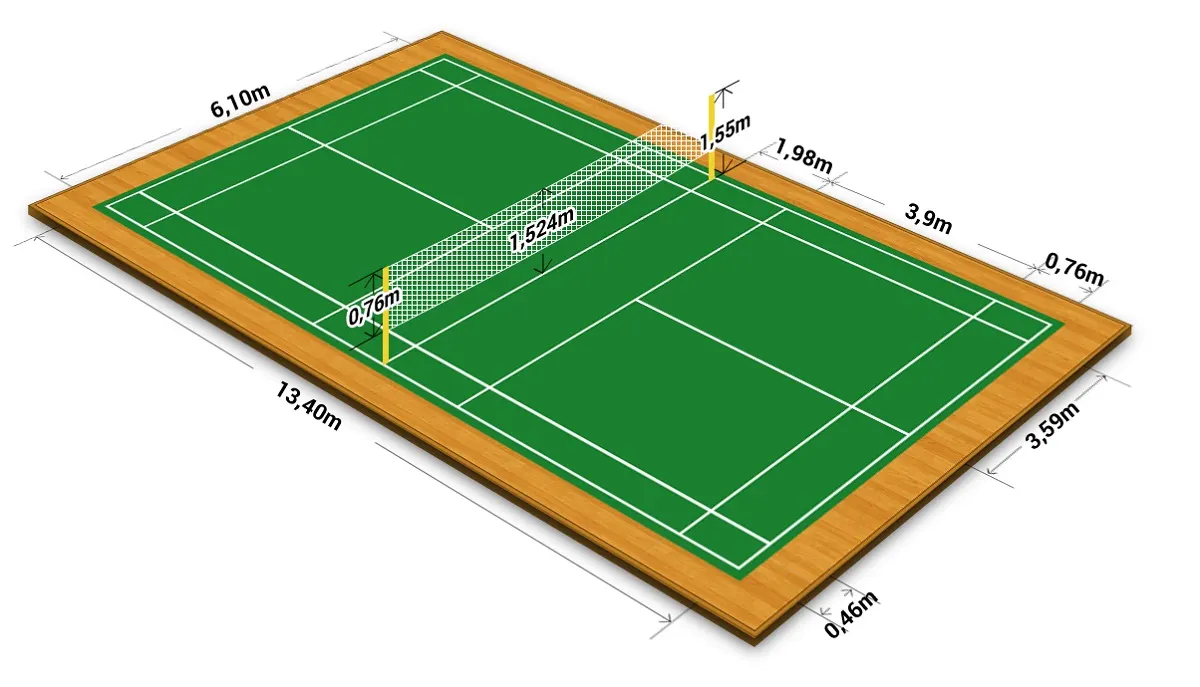
Badminton looks like one simple rectangular court, but different lines become important depending on whether you are playing singles, doubles or serving.
Understanding these court-related badminton terms will make both commentary and coaching instructions much easier to follow.
13. Court
The complete marked playing area.
14. Net
The barrier dividing the two sides of the court.
Players must send the shuttle over the net during normal play.
15. Baseline / Back Boundary Line
The line at the very back of the court.
A coach may say:
“Push your opponent toward the baseline.”
16. Sideline
The boundary running along the side of the court.
Singles and doubles use different sidelines, meaning the doubles court is wider than the singles court.
17. Centre Line
The line separating the left and right service courts.
18. Short Service Line
The front line that a legal serve must travel beyond.
19. Long Service Line for Doubles
A line inside the rear boundary that limits how far back a doubles serve can land.
This means the legal doubles service area is wide but shorter than the full doubles court.
20. Service Court
The area into which a legal serve must travel.
The server and receiver stand in diagonally opposite service courts.
21. Forecourt
The front part of the court near the net.
22. Midcourt
The central section of the playing area.
23. Backcourt
The rear part of the court.
Clears, smashes and many overhead shots are played from this area.
24. Alley / Tramline
The narrow strip between the singles and doubles sidelines.
The word tramline is common in British-influenced badminton English.
25. Rear Court
Another common way to describe the back area of the playing court.
Once you understand these badminton terms, instructions such as “move into the forecourt” or “play the shuttle deep into the backcourt” become much easier to understand.
Five Badminton Shots to Recognize Immediately
Before learning every possible technique, focus on five shots:
clear
drop
drive
lift
smash
If you can recognize these five badminton terms, you will understand a large amount of what coaches and commentators discuss during a match.
Badminton Shot Terms
26. Clear
A shot sent deep toward the opponent’s backcourt.
A clear can give you time to recover or force your opponent away from the net.
Example:
“She hit a clear to the back of the court.”
27. Defensive Clear
A high, deep clear that gives the player more time to recover their position.
28. Attacking Clear
A flatter and faster clear intended to put pressure on the opponent.
The difference is not only where the shuttle lands. The height, speed and tactical purpose are also different.
29. Drop Shot
An overhead shot played softly so the shuttle falls close to the opponent’s net.
A clear and a drop shot can begin with a similar racket preparation, helping a player disguise which shot is coming.
30. Smash
A hard attacking shot played steeply downward.
Example:
“He finished the rally with a powerful smash.”
The smash is one of the best-known badminton terms because it is one of the sport’s main attacking shots.
31. Jump Smash
A smash played while the player jumps into the air.
Jumping can allow the player to contact the shuttle higher and create a steeper angle.
32. Drive
A fast, relatively flat shot that travels across the net.
Drives are especially common during quick doubles exchanges.
33. Lift
A shot played upward from near the net or forecourt toward the opponent’s backcourt.
A lift can help a player escape defensive pressure.
However, a weak lift may give the opponent an opportunity to smash.
34. Net Shot
A controlled shot played close to the net so that the shuttle falls tightly on the opponent’s side.
35. Net Kill
A quick attacking shot used to finish a weak return near the net.
If the shuttle is too high near the net, an attacking player may be able to kill the rally immediately.
36. Push
A controlled shot directed into an open part of the court, often through the midcourt.
It normally uses less power than a drive.
37. Block
A defensive shot that redirects the shuttle, often when defending against a smash.
38. Forehand
A stroke played from the racket-hand side using a normal forehand action.
39. Backhand
A stroke played using the opposite side and action of the racket.
Backhand technique becomes particularly important when players are under pressure.
40. Overhead
A shot played with the racket above the player’s head.
Clears, drops and smashes can all be overhead shots.
41. Underarm
A stroke played from below the hand or body, often when the shuttle has dropped low.
42. Cross-Court
A shot travelling diagonally across the court.
Example:
“She played a cross-court drop.”
43. Straight
A shot travelling more directly along one side of the court rather than diagonally.
44. Slice
A technique where the racket cuts across the shuttle instead of contacting it completely square.
Slice can affect the speed and direction of the shuttle and is often used to create deceptive shots.
45. Deception
Making one shot appear to be another until very late in the movement.
For example, a player may appear to prepare for a clear and then suddenly play a drop shot.
This is one of the more interesting badminton terms for English learners because deception is also used in normal English.
It means causing someone to believe something different from what is actually happening.
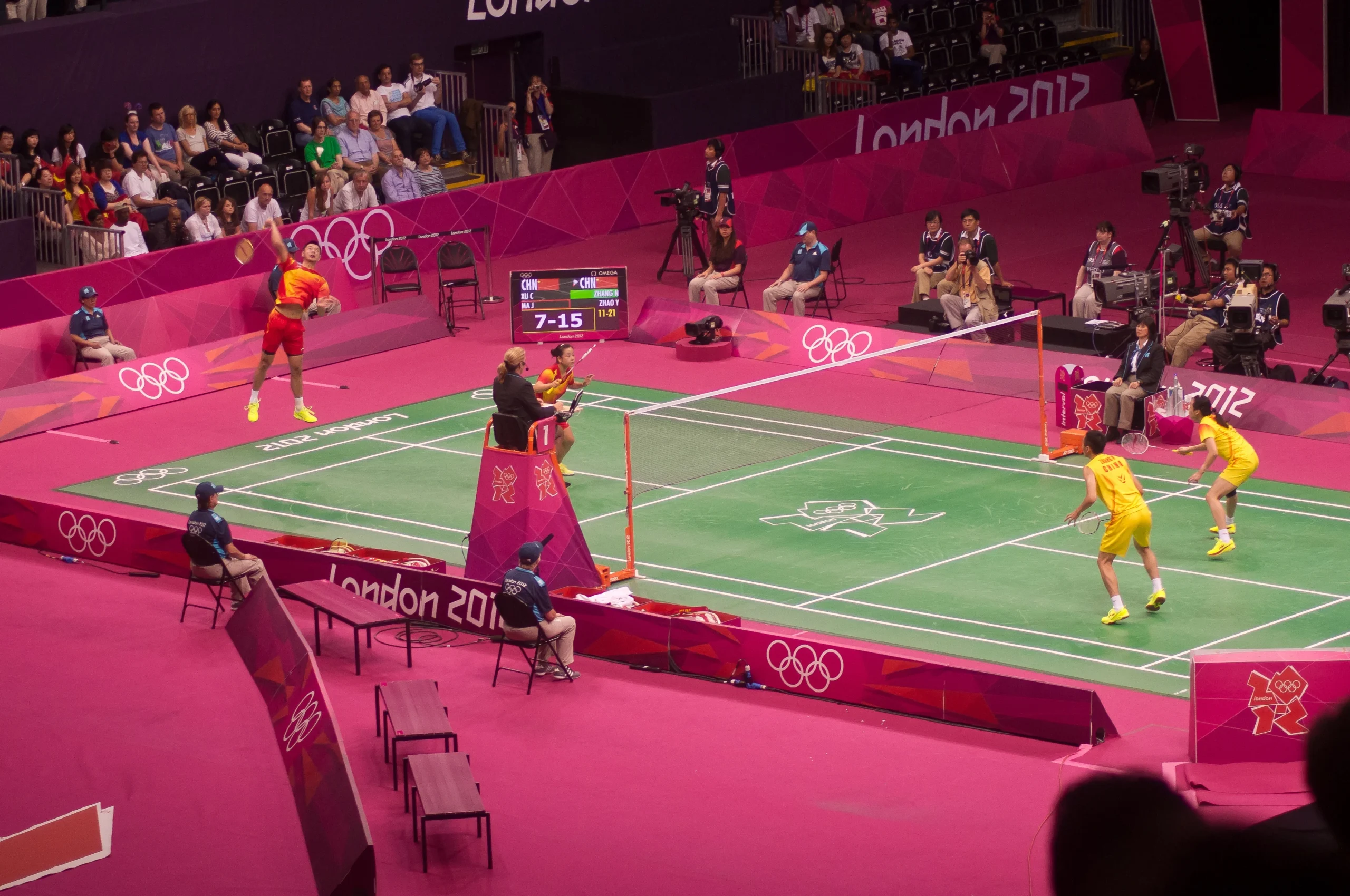
Why Badminton Vocabulary Is Useful for English Learners
Many badminton terms use ordinary English words in a specialized sporting way.
Consider these examples.
Clear
In everyday English: easy to understand or without obstruction.
In badminton: a shot played toward the rear court.
Drive
In everyday English: operate a vehicle.
In badminton: a fast, flat shot.
Lift
In everyday English: move something upward.
In badminton: hit the shuttle upward toward the backcourt.
Drop
In everyday English: fall downward.
In badminton: a soft attacking shot intended to fall close to the net.
This makes badminton useful for English learners because it demonstrates how familiar words change meaning according to context.
Badminton Scoring Terms
Badminton scoring is particularly important to explain clearly because the international scoring system is scheduled to change.
As of October 2026, standard international badminton under the current BWF rules is normally played as the best of three games to 21 points.
Under the current format:
- every rally produces a point
- at 20–20, a side must gain a two-point lead
- if the score reaches 29–29, the next point wins the game 30–29
The Badminton World Federation has approved a change to games of 15 points beginning January 4, 2027.
Readers checking this article after that date should consult the current BWF Laws of Badminton for the latest scoring rules.
Here are the scoring and officiating badminton terms you will hear most often.
46. Love
Love means zero.
At the beginning of a game, an umpire may say:
“Love all, play.”
This means the score is 0–0.
47. Game Point
A situation where a player or pair can win the current game by winning the next rally.
48. Match Point
A situation where winning the next rally would win the entire match.
Example:
“It’s match point.”
49. Deuce
Players and commentators sometimes use deuce informally when the scores are level near the end of a game.
However, official BWF language normally announces the actual score, such as 20-all, rather than relying on deuce as the formal scoring term.
50. Fault
A rule violation that causes the offending side to lose the rally.
Possible faults include hitting the shuttle outside the court, certain illegal service actions or illegally touching the net.
51. Let
A situation where play stops and the rally is replayed without changing the score.
This is different from a fault.
Fault: one side loses the rally.
Let: the rally is played again.
52. In
The shuttle has landed legally inside the relevant court boundary.
The lines form part of the areas they define.
53. Out
The shuttle has landed outside the legal court boundary.
54. Service Fault
A fault committed while serving.
Official service rules include requirements concerning the position of the server and receiver, the service courts and the way the shuttle is struck.
For exact competition rules, check the current BWF Laws and Regulations.
55. Service Court Error
A mistake involving serving or receiving from the wrong service court or in the wrong order.
56. Interval
An authorized break during a game.
Under the current 21-point BWF format, players may have an interval when the leading score reaches 11 points.
57. Change of Ends
Players move to the opposite side of the court at specific points during a match.
58. Toss
The procedure before the match where the winning side chooses either whether to serve or receive first, or which end of the court to begin from.
These rule-related badminton terms are worth learning carefully because older websites and videos may contain scoring or service information that is no longer current.
Singles and Doubles Badminton Use the Same Words Differently
The basic vocabulary is similar in singles and doubles, but the strategy is very different.
Singles places greater emphasis on court coverage, movement and recovery.
Doubles involves more language related to positioning, rotation and attacking formations.
59. Base Position
The position a player moves back toward after playing a shot so they can respond efficiently to the opponent’s next shot.
The ideal base position changes according to the situation.
60. Ready Position
A balanced position that allows the player to react quickly.
61. Footwork
The movement patterns used to reach the shuttle efficiently and recover afterward.
Example:
“Her footwork is excellent.”
Footwork is also commonly used in sports such as boxing and tennis.
62. Recovery
Moving back into an effective position after playing a shot.
Strong players do not simply hit the shuttle and watch what happens.
They hit, recover and prepare for the next shot.
63. Rotation
Movement between doubles partners as their attacking and defensive responsibilities change.
64. Front-and-Back Formation
A common attacking formation in doubles.
One player covers the front of the court while the other attacks from the back.
65. Side-by-Side Formation
A common defensive formation where the two partners cover different halves of the court.
66. Attack
Trying to put the opponent under pressure and create a winning opportunity.
Smashes, steep drop shots and net kills are typical attacking shots.
67. Defense
Responding to an opponent’s attack and trying to regain control of the rally.
68. Serve Return
The receiver’s first shot after the opponent serves.
In doubles, the quality of the return can immediately affect which side gains the attacking advantage.
69. Flick Serve
A serve played with a sudden faster action so that the shuttle travels over or behind a receiver who may be expecting a short serve.
70. Low Serve
A serve designed to travel close over the net and land near the front of the legal service area.
The low serve is extremely common in doubles because a high serve may give the opponent an immediate attacking opportunity.
One Rally Using Badminton Terms
Now put the vocabulary together.
The server plays a low serve from the right service court.
The receiver makes a quick serve return.
The shuttle is pushed through the midcourt.
The opponent plays a lift toward the backcourt.
The attacking player hits a smash.
The defender uses a block.
The shuttle falls into the forecourt.
A tight net shot follows.
The opponent lifts again.
This time the attacking player uses a drop shot rather than another smash.
The shuttle lands in.
Point.
That short description contains numerous badminton terms, but because the words form part of one sequence, they are much easier to understand and remember.
Common Badminton Phrases You Hear From Players
Real players do not communicate using complete textbook sentences during a fast rally.
Instead, you may hear short expressions such as:
“Yours!”
Your partner should play the shuttle.
“Mine!”
You intend to play it.
“Leave it!”
Do not hit the shuttle, usually because your partner thinks it will land out.
“Short!”
The shuttle is falling short or an opponent has played a weak return.
“Back!”
Move farther toward the rear court.
“Switch!”
Change positioning with your doubles partner.
“Nice shot.”
A simple compliment after a good stroke.
“Good rally.”
Praise after a long or entertaining exchange.
“Unlucky.”
A common polite reaction when someone narrowly loses a point.
These expressions matter because badminton is not only something you watch.
It is also a social sport where players communicate throughout games and practice sessions.
Badminton Terms Learners Commonly Confuse
Game vs Match
A game is one section of the complete contest.
A match contains the games.
Under the current BWF format, the first player or pair to win two games wins the match.
Shuttle vs Ball
Badminton uses a shuttle or shuttlecock, not technically a ball.
Someone unfamiliar with the sport may casually call it a ball, but shuttle is the correct badminton term.
Racket vs Racquet
Both spellings exist in English.
BWF uses racket in its official badminton documents.
Let vs Fault
A let normally means the rally is replayed.
A fault means the offending side loses the rally.
Clear vs Lift
Both shots may send the shuttle high and deep.
A clear is normally played from a higher or overhead position.
A lift is generally played upward from a lower position, often from the forecourt.
Understanding differences like these is more useful than simply memorizing a large list of disconnected badminton terms.
Learn Badminton English by Watching One Player
Here is a simple exercise for English learners.
Instead of trying to follow the entire match, choose one player and watch only that player for five rallies.
Ask yourself:
Did they serve or receive?
Did they play a clear, drop, drive, lift or smash?
Were they attacking from the backcourt or playing near the net?
After the shot, did they recover?
Was the shuttle in, out, a fault or a let?
Then describe one rally aloud.
For example:
“She served low. Her opponent lifted the shuttle. She moved backward and played a smash. The defender blocked it, but the shuttle went out.”
This type of practice turns badminton terms into vocabulary you can actually use.
Badminton Commentary Practice
Sports commentary is another useful way to improve your English.
When watching badminton highlights, listen for action verbs such as:
“She attacks the backhand.”
“He pushes it deep.”
“She gets underneath the shuttle.”
“He controls the net.”
“She forces the lift.”
“He finishes with the smash.”
“That was excellent defense.”
“Brilliant recovery.”
“He couldn’t get back into position.”
Notice that commentary does not only use specialist badminton terms.
It combines sports vocabulary with normal English verbs:
attack
push
control
force
recover
finish
Learning these combinations is what helps English learners move from recognizing individual vocabulary to understanding complete commentary.
You can practise more sports listening with our guide to English Phrases for Watching Sports Online.
Badminton Vocabulary Compared With Other Sports
Learning several sports together can make English vocabulary easier because many words appear in more than one game.
Badminton and tennis both use:
racket
serve
receiver
forehand
backhand
rally
net
baseline
You can compare these words with our Tennis Vocabulary guide.
Badminton and volleyball both use:
serve
rally
attack
defense
block
However, the actual movements are completely different.
Our Volleyball Terms guide explains those differences in more detail.
Pickleball also uses words such as:
serve
rally
drive
drop
forehand
backhand
You can compare them in our Pickleball Terms guide.
This comparison is useful because it shows how the same English word can have slightly different meanings depending on the sport.
How to Practice Badminton Terms
Do not try to memorize all 70 badminton terms in one session.
Start with:
serve
shuttle
rally
point
game
match
Then learn the most common shots:
clear
drop
drive
lift
smash
Next, watch a short badminton highlight and listen for those words.
Pause after a rally and describe what happened.
For example:
“The player served low.”
“The receiver played a lift.”
“The opponent attacked with a smash.”
“The defender blocked it.”
“The shuttle went out.”
Then watch the rally again without stopping.
This combination of watching, listening and speaking helps you remember vocabulary much more effectively than simply reading a definition.
FAQs About Badminton Terms
What are the most important badminton terms for beginners?
The most important badminton terms for beginners include shuttle, racket, serve, rally, clear, drop shot, smash, drive, lift, net shot, fault and let.
Learn those first before moving into more advanced tactics.
What is the ball called in badminton?
The object used in badminton is called a shuttlecock, usually shortened to shuttle.
You may also hear bird or birdie informally.
What does clear mean in badminton?
A clear is a shot played toward the opponent’s rear court.
It may be high and defensive or flatter and more attacking.
What is a smash in badminton?
A smash is a fast attacking shot played steeply downward.
It is one of the most important attacking badminton terms because players frequently use smashes to try to finish rallies.
What is a drop shot?
A drop shot is an overhead stroke played softly so the shuttle falls near the opponent’s net rather than travelling deep into the court.
What does love mean in badminton?
Love means zero.
At 0–0, an umpire may announce:
“Love all.”
How many points are in a badminton game?
As of October 2026, standard BWF international badminton normally uses games to 21 points, with matches played as the best of three games.
At 20–20, a player or pair must gain a two-point advantage.
At 29–29, the next point wins the game.
BWF has approved a change to games of 15 beginning January 4, 2027, so check the latest BWF regulations after that date.
What is the difference between singles and doubles badminton?
Singles has one player on each side of the court.
Doubles has two players on each side.
The boundaries and service areas are also different, and doubles usually involves more rotation and coordinated positioning.
What is a fault in badminton?
A fault is a violation of the Laws that causes the offending side to lose the rally.
Examples include certain illegal serves, hitting the shuttle outside the court and some forms of illegal net contact.
What does let mean in badminton?
A let stops play and normally means the rally is replayed without changing the score.
Is deuce an official badminton term?
Players and commentators sometimes use deuce informally when the scores are level late in a game.
Official badminton language normally uses the actual score, such as 20-all under the current scoring system.
What is the difference between a clear and a lift?
Both shots can send the shuttle toward the rear court.
A clear is normally played from an overhead or higher position.
A lift usually travels upward from a lower position, commonly from the forecourt.
Final Thoughts on Badminton Terms
The easiest way to remember badminton terms is to connect every word with something you can see.
Do not begin by trying to memorize all 70.
Start with the basic match vocabulary:
serve, shuttle, rally, point, game and match.
Then learn the five main shots:
clear, drop, drive, lift and smash.
After that, add court vocabulary and scoring language.
Finally, start noticing tactical words such as:
rotation, recovery, attack and defense.
When you hear clear, watch where the shuttle travels.
When you hear smash, notice the speed and downward angle.
When someone calls out, look at the boundary line.
When a doubles pair rotates, watch which player moves toward the front of the court.
That connection between language and action is what makes sports vocabulary memorable.
The goal is not simply to know the definitions of badminton terms.
The goal is to watch a badminton match in English and understand what is happening without needing to translate every word.