
 English
 Arabic
 Chinese (Simplified)
 Dutch
Dutch French
 German
 Italian
 Portuguese
 Russian
 Spanish
Different ways adults learn can explain why two people can take the same lesson and have completely different results.
One adult finishes the lesson and feels ready to try.
Another understands it, but needs more time.
Another wants to know why the lesson matters before they can focus.
Another needs feedback because they keep making the same mistake without realizing it.
Same lesson.
Different learner.
Different need.
That is the part many learning systems still miss.
Adult education cannot be built around one perfect method because adults do not arrive with one perfect background. They bring experience, pressure, confidence, old mistakes, goals, responsibilities, and different reasons for learning.
So the question should not be:
“What is the best way to teach adults?”
A better question is:
“What does this adult need next?”
That is where learning becomes more personal, more useful, and much more effective.
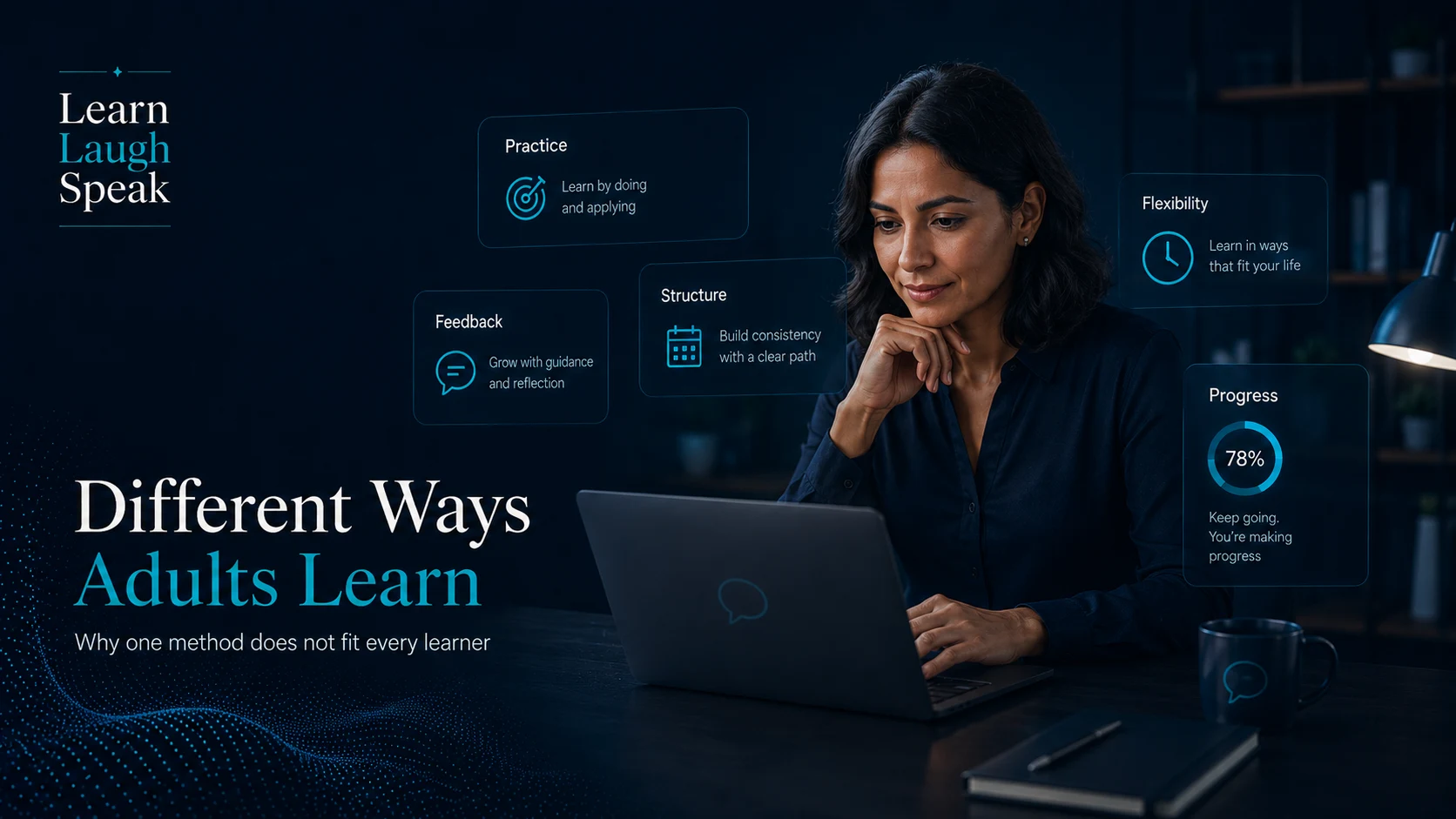
Two Adults Two Different Ways Adults Learn
Imagine two adults learning the same topic.
The first one understands quickly but forgets later.
The second one struggles at first but remembers better after practice.
Which one learned better?
It depends.
The first adult may need more recall and review.
The second may need more time to process before using the skill.
Neither learner is wrong.
They are just learning differently.
This is why adult learning needs flexibility, but not in a loose or random way. It needs flexibility with direction.
A strong learning path should notice when someone needs practice, when someone needs feedback, when someone needs structure, and when someone is ready to move faster.
That is very different from giving every adult the same lesson in the same order.
Learner 1: The Adult Who Needs to Try First
Some adults do not learn well by listening for too long.
They need to do something.
Try the task.
Write the sentence.
Answer the question.
Use the tool.
Make the mistake.
Then the lesson starts to make sense.
These learners often say:
“I understand better when I do it.”
That is not impatience.
It is how their learning becomes active.
For this type of adult, too much explanation can slow progress. They may not need a longer lecture. They may need a short explanation, a clear example, and then a chance to practise.
This is especially true when learning a skill.
You can explain how to write a professional email, but the learner understands it more deeply when they write one, get feedback, and improve it.
For this learner, action creates clarity.

Learner 2: The Adult Who Needs the Reason First
Some adults cannot focus properly until the purpose is clear.
They want to know:
Why am I learning this?
Where will I use it?
How does this help me?
Is this worth my time?
That is not resistance. It is adult logic.
Adults usually have limited time, so relevance matters. A lesson that feels random loses attention quickly. A lesson that connects to a real goal becomes easier to care about.
This type of learner needs context before content.
For example, instead of saying:
“Today we are learning formal phrases.”
It helps to say:
“Today we are learning phrases that help you sound professional when you need to disagree politely at work.”
Now the lesson has a reason.
And when the reason is clear, attention improves.
Learner 3: The Adult Who Learns Through Correction
Some adults study hard but keep repeating the same mistake.
They may understand the lesson.
They may know the rule.
They may even recognize the correct answer when they see it.
But when they use the skill alone, the mistake comes back.
This learner does not need shame.
They need feedback.
Good feedback does not simply say:
“This is wrong.”
It shows:
what happened
why it happened
whether it keeps happening
what to practise next
That kind of correction turns a mistake into a learning path.
Without feedback, adults may repeat the same error for months. With feedback, they can finally see the pattern.
For this learner, the mistake is not the problem.
The hidden pattern is.
Once the pattern is visible, progress becomes easier.
Corrections when adults are learning how progress moves forward.
Learner 4: The Adult Who Needs a Clear Path
Not every adult wants complete freedom.
Some learners feel lost when there are too many options.
A large video library may look useful, but it can also create confusion.
Where do I start?
What should I study next?
Am I at the right level?
Am I improving?
This type of adult needs structure.
Not rigid structure.
Clear structure.
They need a path that shows the starting point, the next step, and what progress should look like.
For them, learning becomes easier when the system removes guessing.
A clear path helps them stay consistent because they do not waste energy deciding what to do every time they study.
They can focus on learning instead of navigating.
Learner 5: The Adult Who Needs Flexibility
Some adults are motivated, but life keeps interrupting.
Work changes.
Family responsibilities appear.
Energy drops.
Schedules shift.
One week they can study often.
The next week they can barely study at all.
This learner does not need to be told to “try harder.”
They need learning that can survive real life.
Flexibility might mean shorter sessions, the ability to return after a break, or a path that continues from where the student actually is.
Flexible learning should not mean easy learning.
It means realistic learning.
This is important because adults are not learning in perfect conditions. The best learning system understands that and still helps them move forward.

Learner 6: The Adult Who Needs Private Practice First
Some adults need space before they participate publicly.
They may not be shy.
They may not lack ability.
They may simply need confidence before performance.
This happens often with language learning, speaking practice, digital tools, and professional communication.
The learner may understand the skill but feel uncomfortable using it in front of others too soon.
Private practice gives them room to make mistakes without feeling judged.
Then, as confidence grows, they can use the skill more openly.
This matters because pressure can block learning.
Some adults do not need to be pushed into public practice immediately.
They need a safe place to build control first.
A Quick Way to Spot What an Adult Learner Needs
| If the learner says… | They may need… |
|---|---|
| “I understand better when I try it.” | Learning by doing |
| “Why are we learning this?” | Clear relevance |
| “I keep making the same mistake.” | Feedback and correction |
| “I do not know what to study next.” | Structure |
| “I cannot study at the same time every week.” | Flexibility |
| “I need to practise before I speak.” | Private practice |
| “I learned this before, but forgot it.” | Review and reactivation |
| “I know it, but cannot use it.” | Real-life application |
This is why different ways adults learn should not be treated as a problem.
They are clues.
They help show what kind of support will make learning work better.
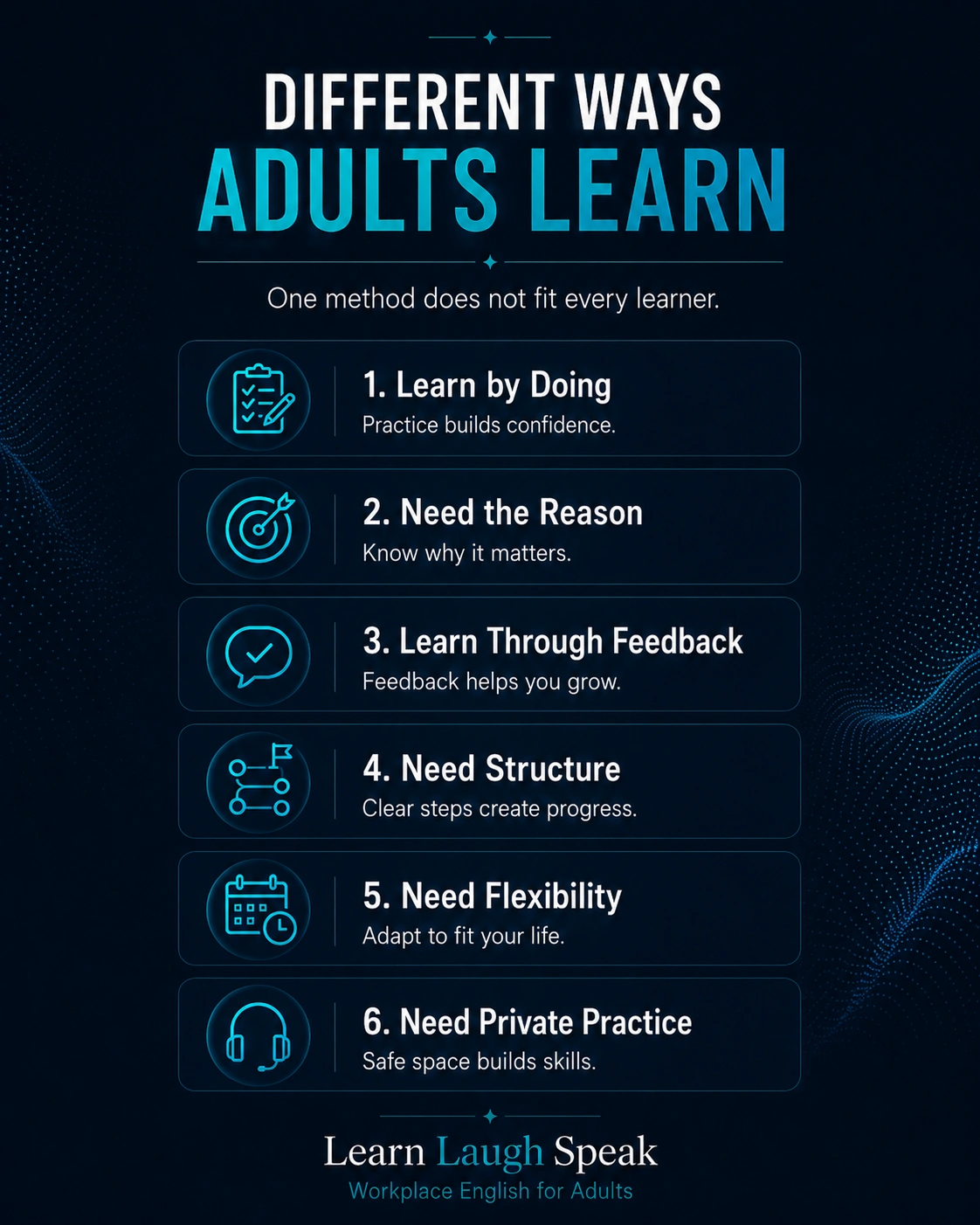
The Same Adult Can Learn Differently in Different Situations
This is important.
Adults are not fixed learning types.
Someone may need structure when learning a new topic but flexibility when life gets busy.
They may need feedback for writing but private practice for speaking.
They may learn by doing at work but need the reason first when studying something unfamiliar.
That is why adult education should not put people into simple boxes.
The same learner can need different support depending on the skill, the pressure, the goal, and the moment.
A good learning system should be able to adjust.
Not randomly.
Responsively.
It should notice what is working, what is not working, and what the learner needs next.
Different Ways Adults Learn Not The Same For Everyone
One method feels simple.
It is easy to organize.
Easy to sell.
Easy to repeat.
But adult learning is not always simple.
Adults arrive with different backgrounds.
Some have prior knowledge.
Some have old mistakes.
Some have confidence issues.
Some have limited time.
Some need practical use immediately.
Some need a clear explanation before they act.
When every adult is given the same method, some learners will do well, but others will quietly fall behind.
That does not mean they cannot learn.
It may mean the method does not fit the problem.
Better adult education should not ask every learner to adapt to the system.
It should build a system that can adapt to the learner.
How Learn Laugh Speak Supports Different Ways Adults Learn
At Learn Laugh Speak, adult students do not begin from a random lesson.
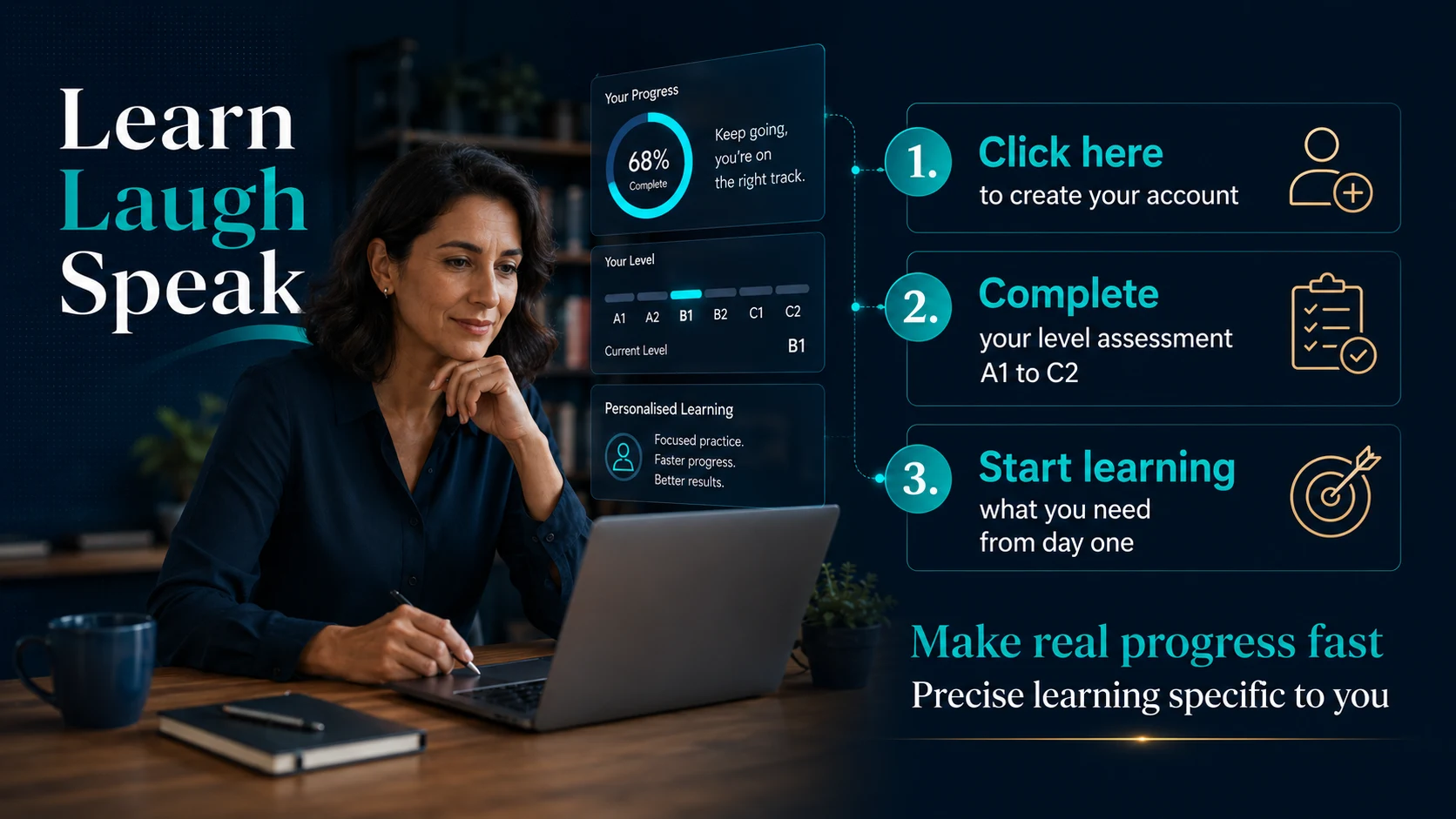
They begin with a level assessment so the platform can understand where they are now.
That matters because adults arrive with different learning histories.
Some have prior knowledge.
Some have hidden gaps.
Some need feedback because repeated mistakes are slowing them down.
Some need flexibility because they are learning around work and real life.
Some can move faster because they already understand parts of the level.
From there, each student follows a personalized learning journey based on their level, mistakes, progress, and needs.
This connects directly to different ways adults learn.
The goal is not to force every adult through the same path.
The goal is to help each learner focus on what they need, when they need it.
That makes learning more accurate.
And for adults, accuracy saves time.
What Adult Learners Should Remember
There is no single perfect method.
Some adults need action.
Some need feedback.
Some need structure.
Some need flexibility.
Some need private practice.
Some need to connect new learning to old experience.
The best method is not the one that sounds the most impressive.
It is the one that helps the learner make real progress.
That progress will look different for each adult.
And that is the point.
Adult learning should not ignore difference.
It should be built around it.
Final Thought On Different Ways Adults Learn
Different ways adults learn should not be treated as a weakness in education.
They are the reason adult education needs to be more personal.
Adults learn through goals, practice, feedback, structure, flexibility, experience, confidence, and real-life use.
One method will not work for everyone.
And one fixed course will not serve every adult equally.
The future of adult education should not be about giving every learner the same path.
It should be about helping each adult find the right path forward.
That is how different ways adults learn becomes more than a keyword.
It becomes the foundation for better learning.
3 thoughts on “Different Ways Adults Learn: Why One Method Does Not Work”
Pingback: 7 Learning Strategies for Adults That Actually Help Progress - Learn Laugh Speak
Pingback: Why Being "Good Enough" in English Just Doesn't Cut it Anymore? - Learn Laugh Speak
Pingback: Gemini 3 Pro API vs Gemini 3 Flash API: Choosing the Right Engine for EdTech Innovation - Learn Laugh Speak