
 English
 Arabic
 Chinese (Simplified)
 Dutch
Dutch French
 German
 Italian
 Portuguese
 Russian
 Spanish
Adult learning motivation usually starts with a good reason.
And an underlining motivation of learning that is normally kept private.
A better job.
More confidence.
A personal goal.
A problem at work.
A feeling that it is time to improve.
Most adults do not return to learning because they have nothing else to do.
They return because something matters.
That is why it can feel so frustrating when motivation drops.
At the beginning, everything feels possible.
The student signs up.
Starts strong.
Makes a plan.
Imagines the result.
Then real life arrives.
Work gets busy.
Progress feels slower than expected.
A few mistakes repeat.
One missed lesson becomes three.
The student starts to feel behind.
And suddenly, the problem looks like motivation.
But often, it is not motivation at all.
It is the lifelong learning design.
Adult students do not only need to feel inspired. They need a learning path that keeps progress visible, relevant, and realistic after the first burst of energy fades.
The First Week Feels Easy Because the Goal Is Fresh
The beginning is usually the easiest part.
Not because the learning is easy.
Because the reason is clear.
An adult student can feel a strong push when they first decide to learn.
They might think:
I need English for work.
I want to stop avoiding meetings.
I want to write better emails.
I want to finally finish what I started years ago.
That early motivation is powerful.
But it is also emotional.
And emotional motivation does not always last on its own.
It needs structure underneath it.
Without that structure, the student depends too much on feeling motivated every day.
That is risky because adults rarely have the same energy every day.
This is why the first week is important and the starting point for every adult student is different and must be addressed correctly.
The Drop Usually Comes Later
Motivation often drops after the first few weeks.
That is when the exciting part is over and the real habit has to begin.
The student may still care.
They may still want the result.
But the learning now competes with normal life.
Emails.
Work pressure.
Children.
Travel.
Tiredness.
Stress.
A full schedule.
This is where adult learning becomes different from school learning.
Adults are not studying inside a system built around study.
They are fitting study into a life that is already full.
OECD research on adult learning shows that adults face different participation barriers, including time, practical barriers, and differences in access depending on learner background and situation.
That matters because when adults stop learning, it is not always because they lost interest.
Sometimes the learning simply did not fit their real life well enough.

Motivation Fades When Progress Feels Invisible
One of the biggest reasons adults stop is not failure.
It is invisible progress.
They are improving, but they cannot feel it clearly.
They learn new words, but still hesitate.
They understand lessons, but still make mistakes.
They complete exercises, but still feel nervous in real situations.
So the brain starts asking:
Is this working?
That question is dangerous.
Once an adult student starts doubting the value of the learning, motivation weakens quickly.
This is why progress needs to be visible.
Not only at the end of a course.
During the journey.
Adults need to see small signs that their effort is creating movement.
A better sentence.
A clearer email.
Fewer repeated mistakes.
A faster response.
A stronger score.
A skill that was hard last month but feels easier now.
Those small signs keep motivation alive.
It is important to keep progress moving specifically and why flexible learning options for adults is key for motivation.
The Real Motivation Problem Is Often Relevance
Adults do not need learning to be entertaining.
They need it to feel useful.
That is a major difference.
A lesson can be beautifully designed and still fail if the adult student cannot see why it matters.
Adults often ask practical questions, even if they do not say them out loud:
Will this help me at work?
Will I use this soon?
Is this fixing my actual problem?
Am I learning something I need, or just completing content?
OECD’s work on adult learner profiles highlights that adults participate in learning for different reasons and need guidance that matches their motivations, barriers, and goals.
That is important for adult learning motivation because relevance is not a bonus.
It is fuel.
When the lesson connects to a real need, adults continue.
When it feels generic, they slowly disconnect.

The Motivation Timeline Most Adults Experience
| Stage | What the Adult Feels | What They Need |
|---|---|---|
| Starting | “I’m ready to improve.” | A clear goal and correct starting point |
| Early progress | “This feels good.” | Small wins and visible feedback |
| First difficulty | “Why am I still making mistakes?” | Correction, not pressure |
| Busy period | “I don’t have time this week.” | Flexibility to continue later |
| Doubt | “Is this working?” | Proof of progress |
| Restart | “I need to get back into it.” | A path that does not punish breaks |
This is why motivation should not be treated like a personality trait.
It changes.
The system should expect that.
Adults Lose Motivation When the Starting Point Is Wrong
Starting in the wrong place damages motivation quickly.
If the course is too easy, the student feels their time is being wasted.
If the course is too hard, the student feels behind before they even begin.
Both situations create frustration.
For adults, this is especially common because their skills are often uneven.
A student may understand English well when reading, but struggle when speaking.
Another may have strong grammar knowledge from years ago, but weak listening confidence.
Another may use English at work but keep repeating small mistakes.
So placing adults into one broad level is not always enough.
The starting point has to be more precise.
Adult learning motivation improves when students feel:
This is the right level for me.
This lesson has a reason.
This path understands what I need.
That feeling matters.
It tells the student the effort is worth it.
Adult Learning Motivation Can Drop Easily
Repeated mistakes can feel heavy for adult students.
A child may make a mistake and move on quickly.
Adults often carry more emotion into it.
They think:
I should know this already.
I studied this before.
Why do I keep getting it wrong?
Maybe I am too old to learn this properly.
That thinking can damage motivation.
But repeated mistakes are not proof that the student cannot learn.
They are usually signs of a gap that needs better practice.
The problem is not the mistake.
The problem is when the mistake is not explained clearly enough to become useful.
Feedback matters here.
The Education Endowment Foundation describes feedback as information given to learners about their performance in relation to learning goals, with the aim of improving outcomes.
For adults, feedback does more than correct.
It reduces doubt.
It helps the student see the mistake as something specific, not as a personal failure.
Adult Learning Motivation A Small Example
Imagine an adult English learner who keeps making mistakes with past tense.
They understand the lesson.
They know the rule.
They can complete the exercise.
But when they write quickly, the mistake returns.
At first, they laugh it off.
Then they get annoyed.
Then they start losing confidence.
Eventually, they think:
I am not improving.
But the real problem may not be motivation.
The real problem may be that the skill has not become automatic yet.
That student does not need shame.
They need targeted repetition.
They need feedback.
They need to use the skill in realistic ways until it becomes stronger.
That is how motivation comes back.
Not through a motivational quote.
Through progress that feels real.
Adults Stay Motivated When Learning Feels Personal
Personal does not mean emotional or soft.
It means accurate.
A personal learning path understands:
where the student starts
what they already know
what they keep getting wrong
what they need for real life
when they are ready to move forward
That is what keeps adults engaged.
Because adults are quick to notice when learning does not match them.
They do not want random lessons.
They want useful progress.
This is why personalized learning is so important for adult students.
It helps motivation because the student can see the connection between the lesson and their real goal.
Why “More Discipline” Is Not Always the Answer
Discipline helps.
But it is not the full answer.
A badly designed learning path will drain even a disciplined adult.
If the lessons are irrelevant, motivation drops.
If progress is invisible, motivation drops.
If feedback is unclear, motivation drops.
If the student keeps starting in the wrong place, motivation drops.
So telling adults to “just be more consistent” is not always helpful.
Consistency becomes easier when the system supports it.
That means shorter steps.
Clearer progress.
Better feedback.
Useful repetition.
Learning that can restart after interruption.
Adults do not need learning that assumes perfect conditions.
They need learning that works under real conditions.

How Learn Laugh Speak Supports Adult Learning Motivation
At Learn Laugh Speak, adult students do not begin from a random place.
They start with a level assessment so the platform can understand where they are now.
That matters because motivation is easier to keep when the starting point is correct.
From there, each student follows a personalized learning path based on their level, progress, mistakes, and needs.
This helps adults stay motivated because they are not wasting time repeating everything they already know.
They are also not pushed forward while important gaps are still holding them back.
Some students move faster because they already have prior learning experience.
Others need more support in specific areas.
Both paths are normal.
The goal is not to make every adult student follow the same journey.
The goal is to help each student learn what they need, when they need it.
For workplace English, that matters because adults do not want to study forever.
They want useful progress.
Emails.
Meetings.
Clearer speaking.
Better writing.
More confidence at work.
When learning connects to those real outcomes, motivation becomes easier to maintain.
A Better Way to Think About Adult Learning Motivation
Adult students should not ask only:
How do I stay motivated?
They should also ask:
Is my learning path helping me stay motivated?
That is a better question.
Because motivation is not only internal.
It is shaped by the learning experience.
A good learning path makes progress visible.
A good learning path gives feedback before mistakes become habits.
A good learning path respects prior learning.
A good learning path adjusts when the student needs support.
A good learning path helps the student return after life interrupts.
That is what adult learners need.
Not constant inspiration.
A system that makes continuing realistic.
What Adult Students Need to Keep Going
Adult learning motivation usually lasts longer when students have:
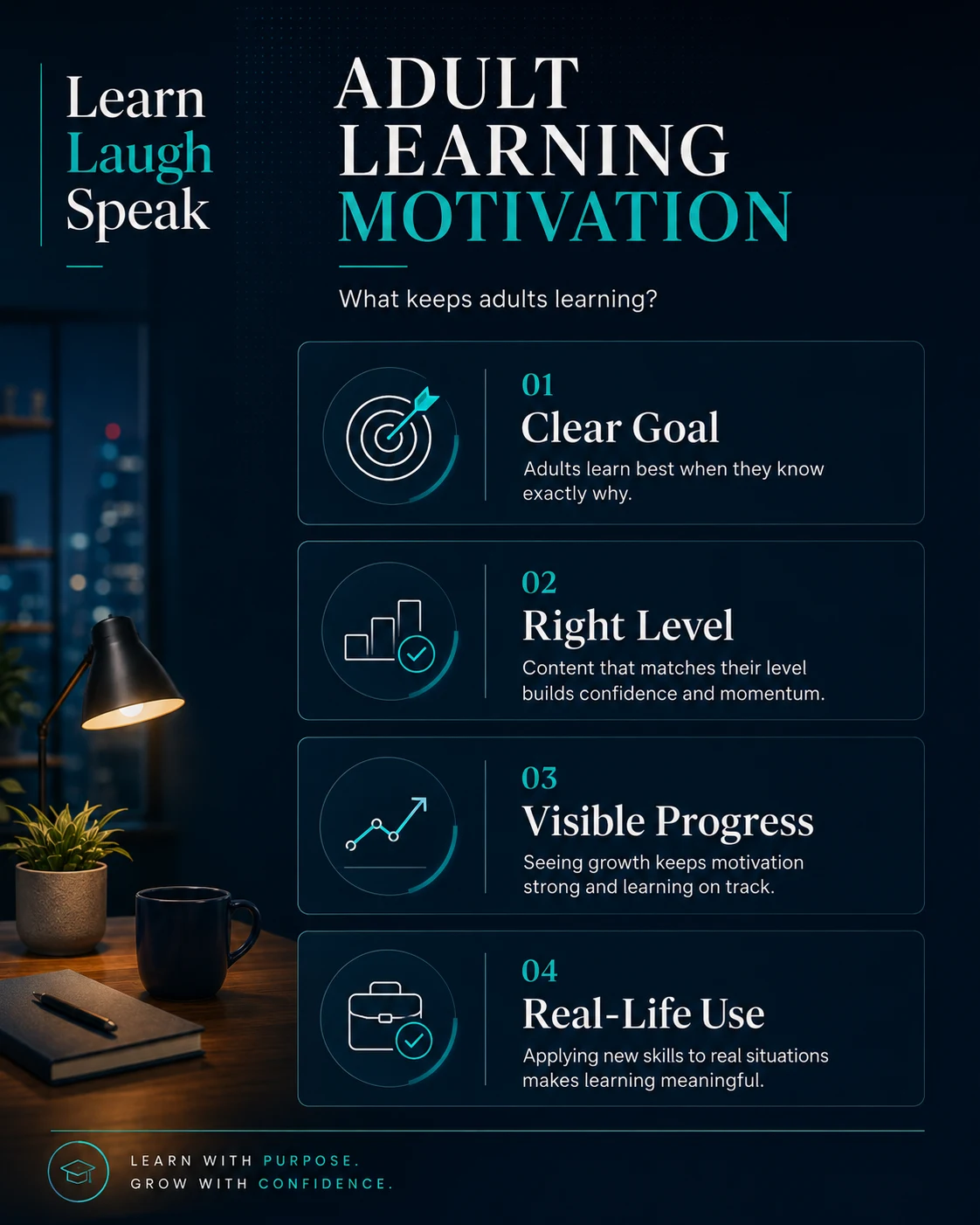
a clear reason to learn
the correct starting level
visible progress
practical lessons
specific feedback
flexible learning options
small wins that build confidence
a path connected to real-life goals
None of this removes effort.
Learning still takes work.
But it makes the work feel meaningful.
And meaningful effort is much easier to repeat.
Final Thought on Adult Learning Motivation
Adult learning motivation does not disappear because adults stop caring.
Most adults care deeply.
They stop when learning feels too slow, too generic, too disconnected, or too hard to fit into real life.
That is why better adult education needs to do more than inspire students at the beginning.
It needs to support them after the first burst of energy fades.
Because adults do not need motivation alone.
They need progress they can see, lessons they can use, feedback they can trust, and a path that respects their real life.
That is how adult learning motivation becomes something stronger than a good start.
It becomes something students can keep.

2 thoughts on “Adult Learning Motivation: Why Adults Start Strong Then Stop”
Pingback: Adult Learning Support: Why Adults Need Guidance, Not Just Lessons
Pingback: How Where You Live Impacts Your English Learning Progress - Learn Laugh Speak