
 English
 Arabic
 Chinese (Simplified)
 Dutch
Dutch French
 German
 Italian
 Portuguese
 Russian
 Spanish
Football is more than just a sport—it’s a shared global language. From the crowded streets of Rio to the quiet parks of London, millions of people use the same words to describe joy, frustration, teamwork, and passion. But to truly participate in those conversations, learners need to understand Football Vocabulary—the words that bring this game to life.
What Is Football Vocabulary?
Football vocabulary means the words and phrases people use to talk about football, including positions, rules, tactics, commentary, and common expressions.
Include 4–5 examples:
goal, offside, corner kick, striker, clean sheet
Why Do Some People Call Football “Soccer”?
Why Learning Football Vocabulary Matters
Football (or soccer, depending on where you live) is one of the easiest games to play—but one of the hardest to fully understand. Every pass, tackle, and whistle carries layers of meaning shaped by decades of history.
By learning Football Vocabulary, you can:
- Understand commentary during live matches or news recaps.
- Discuss tactics confidently with colleagues or friends.
- Recognize idioms and phrases that appear in daily English.
Whether you’re watching the Premier League, La Liga, or the World Cup, Football Vocabulary connects fans and learners across cultures.
The Beginner’s Guide To American Football
Football Vocabulary Quick Guide
Here is a quick guide to some of the most useful football words ESL students should know.
| Term | Meaning | Example |
|---|---|---|
| Goal | When the ball enters the net | “He scored a goal.” |
| Pitch | The football field | “The players walked onto the pitch.” |
| Striker | Main attacking player | “The striker scored twice.” |
| Offside | When an attacker is too far forward when the ball is played | “The goal was ruled offside.” |
| Clean sheet | When a team does not concede a goal | “The goalkeeper kept a clean sheet.” |
| Assist | A pass that helps another player score | “She got two assists in the match.” |
| Hat-trick | Three goals by one player in one match | “He scored a hat-trick.” |
| Fixture | A scheduled match | “The next fixture is on Sunday.” |
| Draw | A match with no winner | “The game ended in a 1–1 draw.” |
| Equalizer | A goal that makes the score level | “The team scored a late equalizer.” |
This quick guide gives you the foundation you need before learning more advanced football vocabulary.
Essential Terms in Football Vocabulary
Every game has its foundation—these are the most common and essential words you’ll hear in football commentary, coaching, and conversation.
- Pitch – The football field or playing surface.
- Goal – The objective of the game: scoring by sending the ball into the opponent’s net.
- Offside – When an attacker is closer to the goal than the last defender when the ball is played.
- Corner Kick – Awarded when the defending team touches the ball last before it crosses their goal line.
- Free Kick – Given after a foul, allowing a stationary restart.
- Penalty Kick – A direct shot at goal from the penalty spot following a serious foul.
- VAR (Video Assistant Referee) – Technology used to review controversial decisions.
Understanding these terms forms the foundation of your Football Vocabulary.
La historia de “soccer” vs. “football”
Football Vocabulary for Watching a Match
Include words learners hear during commentary:
kick-off
half-time
full-time
possession
shot on target
save
cross
header
equalizer

Player Positions and Roles in Football Vocabulary
Football is a team sport defined by clear roles. Each player’s position has its own purpose and terminology that enrich your Football Vocabulary.
- Goalkeeper (Keeper) – The only player allowed to handle the ball within the penalty area.
- Defenders – Protect the goal and block attacks.
- Full-Backs and Wing-Backs – Defenders who also join in attack down the sides.
- Midfielders – Link defense and attack, controlling possession and rhythm.
- Strikers and Forwards – The team’s primary goal scorers.
- Winger – A player positioned wide, providing crosses and speed.
- Holding Midfielder (Pivot) – Defends and organizes play in front of the back line.
Learning these terms helps you follow discussions about formations like 4-3-3 or 4-2-3-1—part of tactical Football Vocabulary used by analysts and coaches worldwide.
What to Know to Finish A2 Level in English: Pro Tips
Tactics and Strategies in Football Vocabulary
The strategy of football lies in how players and managers interpret movement and control. Some key phrases include:
- High Press – Forcing the opponent to make mistakes near their goal.
- Counterattack – Fast offensive move after regaining possession.
- Man Marking – Tracking specific opponents rather than covering space.
- Set Piece – Restart from a free kick or corner.
- Overlap / Underlap – Movement of full-backs or wingers to create passing options.
These tactical terms are vital parts of advanced Football Vocabulary, used in both coaching and commentary.
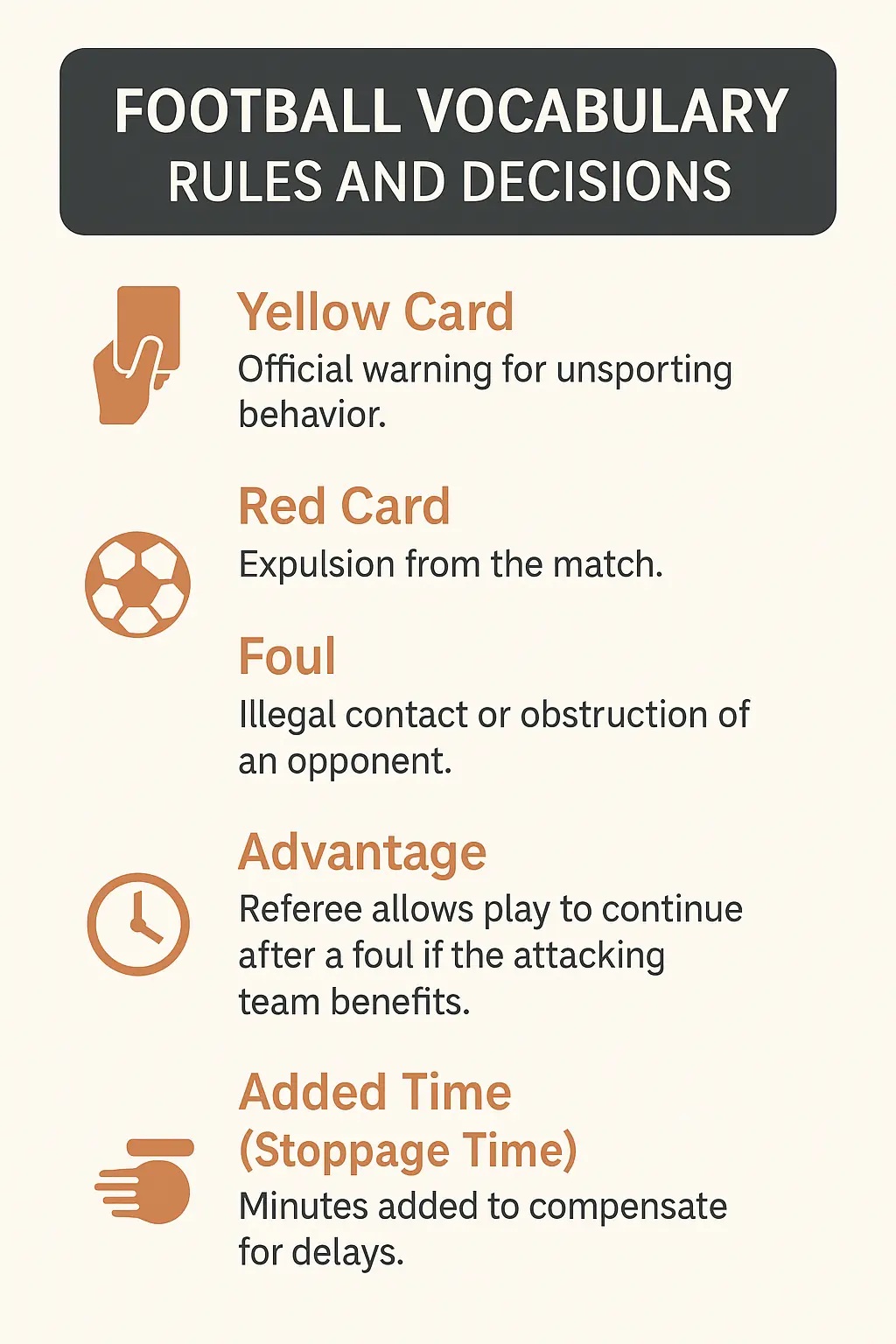
Rules and Decisions in Football Vocabulary
Football’s flow is guided by rules and referee commands, each expressed with its own vocabulary.
- Yellow Card – Official warning for unsporting behavior.
- Red Card – Expulsion from the match.
- Foul – Illegal contact or obstruction of an opponent.
- Advantage – Referee allows play to continue after a foul if the attacking team benefits.
- Added Time (Stoppage Time) – Minutes added to compensate for delays.
Knowing these expressions means you’ll never be confused when the referee blows the whistle again.
Football Vocabulary for Watching a Match
When you watch a football match in English, you will hear many words from commentators, fans, and players.
Here are some useful match-day terms.
Kick-off means the start of the match.
Example:
“Kick-off is at 8 PM.”
Half-time means the break in the middle of the match.
Example:
“The score is 1–0 at half-time.”
Full-time means the end of the match.
Example:
“At full-time, the score was 2–1.”
Possession means how much time a team controls the ball.
Example:
“Spain dominated possession.”
Shot on target means a shot that would go into the goal if the goalkeeper did not save it.
Example:
“They had five shots on target.”
Save means when the goalkeeper stops the ball from going into the goal.
Example:
“The keeper made a great save.”
Cross means a pass from the side of the pitch into the penalty area.
Example:
“He sent a perfect cross into the box.”
Header means hitting the ball with your head.
Example:
“She scored with a powerful header.”
Winner means the goal that decides the match.
Example:
“He scored the winner in the final minute.”
These words help ESL students follow live matches, understand commentary, and talk about football more naturally.
Football Vocabulary in Everyday English
Few sports have shaped modern English as much as football. Phrases inspired by the game often appear in business, education, and casual conversation.
- “Kick off” – To start something.
- “Move the goalposts” – To change rules unfairly.
- “On the ball” – Alert and aware.
- “Own goal” – A mistake that helps your opponent.
These idioms prove that Football Vocabulary reaches far beyond the stadium. It’s part of the English cultural fabric.
Understanding the Past Tense in English: A Complete Guide
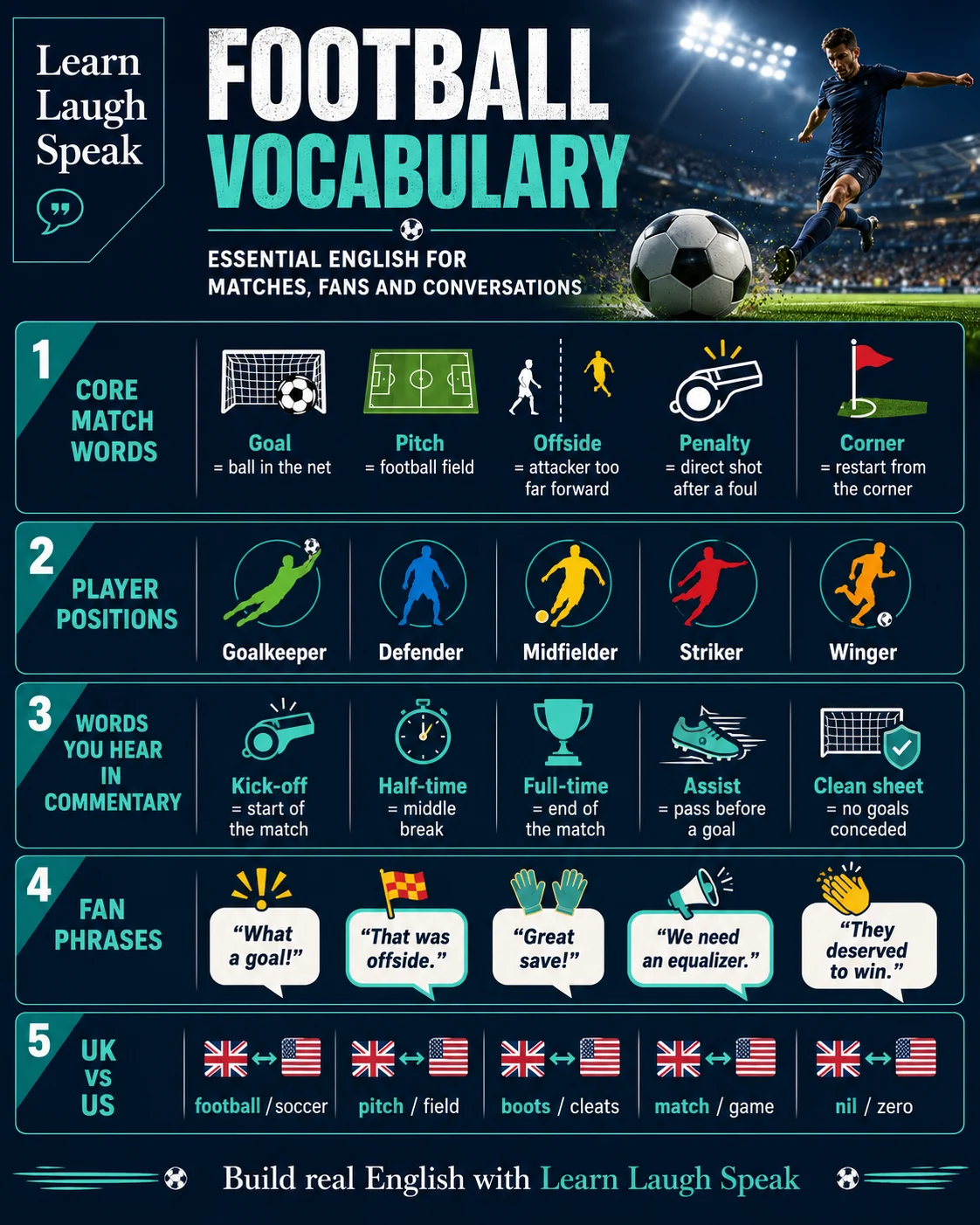
Football Vocabulary: UK vs US English
Football vocabulary can change depending on where you are.
In most countries, the sport is called football. In the United States, people usually call it soccer because football often refers to American football.
Here are some common differences.
| UK / Global English | US English | Meaning |
|---|---|---|
| football | soccer | the sport played with a round ball |
| pitch | field | the playing area |
| boots | cleats | football shoes |
| nil | zero | score term |
| match | game | football event |
| fixture | scheduled game | upcoming match |
| table | standings | league rankings |
| manager | coach | person leading the team |
Understanding these differences helps ESL students follow football conversations with people from different countries.
Cultural Differences in Football Vocabulary
Interestingly, Football Vocabulary changes slightly across regions:
- In the U.S., the game is called soccer; in most other countries, it’s football.
- British commentators might say nil instead of zero, or boot instead of cleat.
- In Latin America, golazo means an incredible goal.
Understanding these variations makes conversations smoother and more inclusive when talking with fans from around the world.
How to Practice Football Vocabulary
Improving your understanding of Football Vocabulary doesn’t have to feel like study—it can be fun.
- Watch commentary with subtitles – Listen to how experts describe transitions and tactics.
- Play or watch local games – Hear how native speakers use football expressions informally.
- Write short match summaries – Try describing a 1–0 win using correct Football Vocabulary.
- Join English-speaking fan groups – Interacting in discussions helps reinforce the terms naturally.
- Learn idioms contextually – When someone says “that was a real own goal,” connect it to the football meaning.
Using real contexts helps your brain retain both meaning and tone.
Pronunciation and Grammar Tips
Some terms in Football Vocabulary can sound tricky. Practice these for clear communication:
- Derby (pronounced “DAR-bee” in British English).
- Fixture (refers to a scheduled match).
- Form (team performance streak).
- Squad (entire team of players).
Grammar tip: Use play for when referring to clubs (He plays for Arsenal) and play against for opponents (They played against France).
Vocabulary in Professional Communication
In workplaces, football expressions often symbolize teamwork and leadership. Saying “We need to defend this idea” or “Let’s go on the attack in this meeting” shows how football-inspired language can energize collaboration.
Understanding Football Vocabulary helps English learners adapt to these metaphors naturally in professional life.
FAQ: Football Vocabulary
What is football vocabulary?
Football vocabulary means the English words and phrases used to talk about football, including rules, positions, tactics, match events, and fan expressions.
What are the most important football words in English?
Some of the most important football words are goal, pitch, striker, goalkeeper, offside, corner kick, penalty, assist, clean sheet, and hat-trick.
Why do Americans say soccer?
In the United States, people usually say soccer because football often means American football. In most other countries, the same sport is called football.
What does offside mean in football?
Offside is a rule that stops attacking players from standing too close to the opponent’s goal before the ball is passed to them.
Can football vocabulary help with business English?
Yes. Many football expressions are used in professional English, such as kick off, on the ball, move the goalposts, own goal, and defend an idea.
Final Thoughts
Football speaks a universal language, and mastering Football Vocabulary lets you participate in that global conversation.
Every term—whether it’s offside, hat-trick, or clean sheet—carries the energy of teamwork and competition.
As you grow more fluent, the commentary won’t just be words—it’ll be insight.
And when someone says “He really kicked off that meeting with energy,” you’ll smile, knowing how deep the connection between language and sport truly runs.
Mastering Football Vocabulary means more than understanding the game—it means understanding people.
4 thoughts on “A Professional Guide to Football Vocabulary for ESL Students”
Pingback: Baseball Vocabulary: Understanding America’s Pastime - Learn Laugh Speak
Pingback: How to Negotiate in Email in English Professionally
Pingback: Guide to Basketball Vocabulary: The Language of the Court
Pingback: Your Pro Guide to Tennis Vocabulary: Serving Success