
 English
 Arabic
 Chinese (Simplified)
 Dutch
Dutch French
 German
 Italian
 Portuguese
 Russian
 Spanish
Talking to large groups becomes easier when you prepare your message, practise out loud, understand your audience, slow down, use clear structure, and focus on communication instead of perfection. Feeling nervous is normal, but with the right steps, you can speak more clearly and confidently in English.
Many people feel nervous when they have to speak in front of a group. This can happen in meetings, presentations, workshops, classrooms, interviews, events, or workplace training. If English is not your first language, talking to large groups can feel even more stressful because you are thinking about your ideas, grammar, pronunciation, and audience reaction at the same time.
The good news is that public speaking is a skill. You can improve it step by step. You do not need perfect English to speak well. You need preparation, practice, structure, and confidence in your message.

Why Talking to Large Groups Feels Difficult
Talking to large groups feels difficult because your brain treats the situation as high pressure. You may worry about being judged, making mistakes, forgetting your words, or not being understood.
Common worries include:
- “What if I forget what to say?”
- “What if my English is not good enough?”
- “What if people notice my accent?”
- “What if I make a grammar mistake?”
- “What if someone asks a question I cannot answer?”
- “What if I speak too fast or too quietly?”
These fears are normal. Even experienced speakers can feel nervous before speaking publicly. The difference is that experienced speakers know how to manage their nerves and continue anyway.
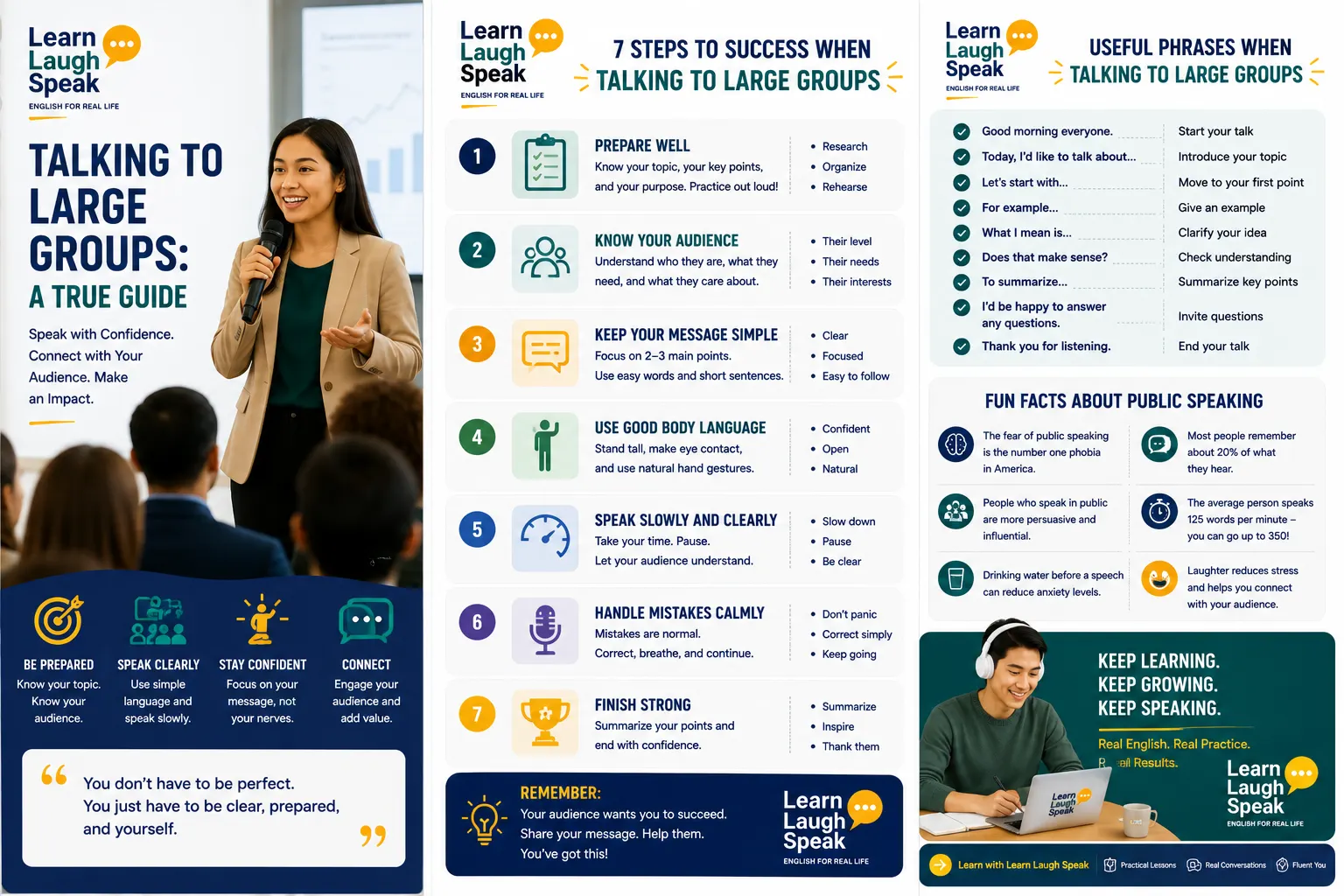
Talking to Large Groups Starts with Preparation
Preparation is one of the best ways to reduce nervousness. If you know your topic well, you are less likely to panic when speaking.
Before talking to large groups, ask yourself:
- What is my main message?
- Who is my audience?
- What do they need to understand?
- What examples can I use?
- What questions might they ask?
- What action do I want them to take after listening?
A simple structure can help:
Opening: Tell people what you will talk about.
Main points: Explain two or three important ideas.
Examples: Use real situations to make your points clear.
Conclusion: Summarise and finish with confidence.
Example opening:
“Good morning everyone. Today, I’d like to talk about three ways we can improve communication with our customers.”
This sounds clear, calm, and organised.
Talking to Large Groups Requires a Clear Message
When speaking to a group, your message needs to be easy to follow. Do not try to say everything you know. Choose the most useful points.
A good speech or presentation should answer:
- What is the topic?
- Why does it matter?
- What are the key points?
- What should people remember?
- What should happen next?
For example, instead of saying:
“Today I will talk about communication and many different things related to communication.”
Say:
“Today I will share three simple communication habits that can help our team avoid mistakes and work faster.”
The second version is more direct and useful.
Talking to Large Groups in English: Use Simple Language
Many English learners think they need advanced vocabulary to sound professional. This is not true. Clear English is better than complicated English.
When talking to large groups, use:
- short sentences
- clear examples
- familiar words
- simple transitions
- natural pauses
- practical phrases
For example:
Too complicated:
“The objective of this presentation is to facilitate an understanding of operational communication deficiencies.”
Better:
“The goal of this presentation is to explain how we can improve communication at work.”
The second version is easier to say and easier for the audience to understand.
How to Overcome Nerves When Talking to Large Groups
Nervousness often comes from focusing too much on yourself. You may think everyone is judging your grammar, pronunciation, clothes, voice, or confidence.
In reality, most people are focused on your message. They want to understand what you are saying. They are usually not judging every small mistake.
Try these steps:
- breathe slowly before you start
- practise your opening several times
- use notes, not a full script
- speak slightly slower than normal
- pause when you need time
- look at friendly faces in the audience
- remember your main message
- keep going even if you make a mistake
Useful phrase if you lose your place:
“Let me return to the main point.”
Useful phrase if you need a moment:
“Let me think about that for a second.”
These phrases help you stay calm and professional.
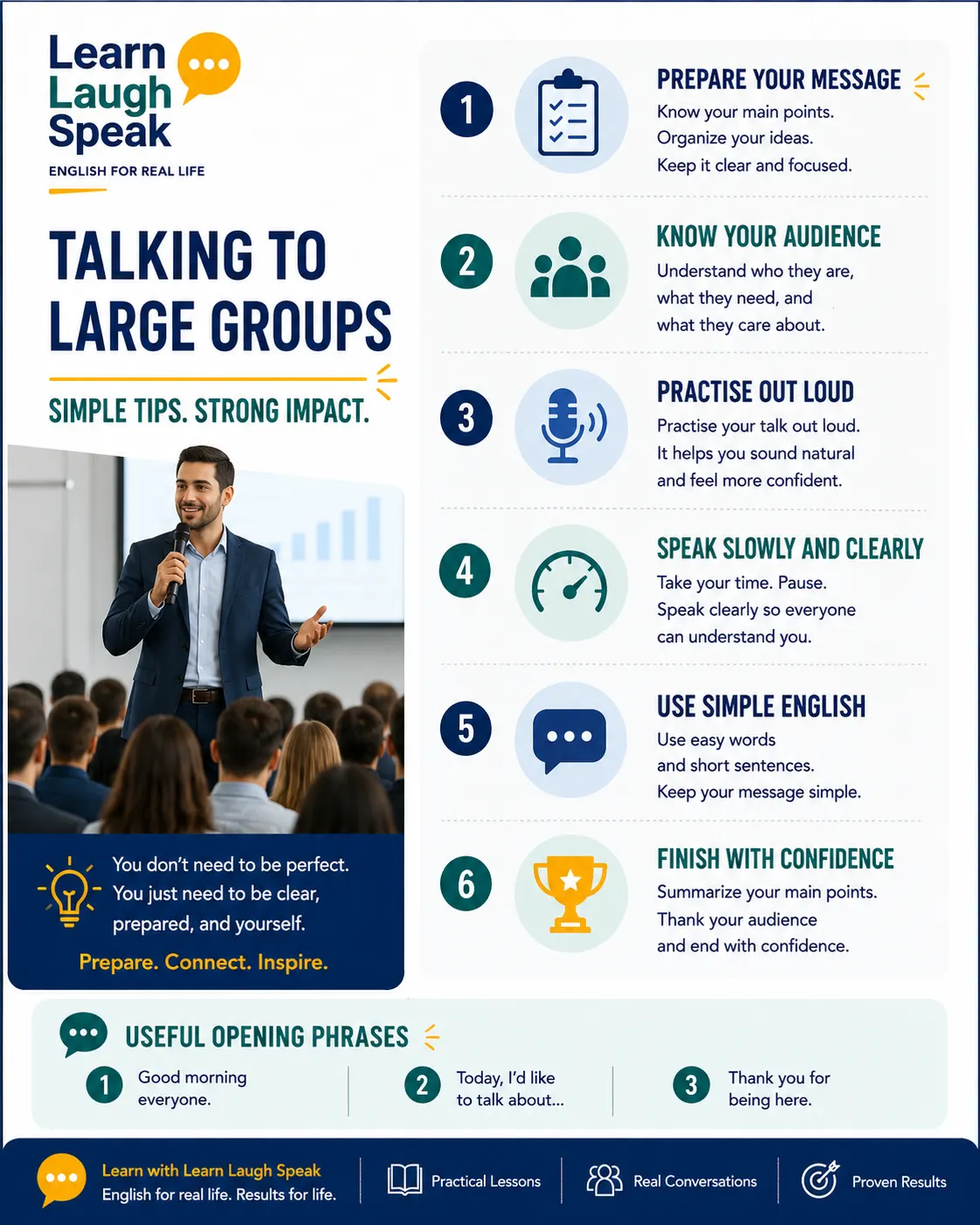
Talking to Large Groups: Know Your Audience
Before speaking, learn as much as you can about your audience. This helps you choose the right tone, examples, and level of detail.
Ask:
- Are they colleagues, customers, students, managers, or guests?
- Do they know the topic already?
- Are they beginners or experts?
- Do they need practical advice or general information?
- Is the setting formal or informal?
- What problem are they trying to solve?
For example, if you are speaking to managers, you may use examples about deadlines, teamwork, and results.
If you are speaking to English learners, you may use slower speech, simple explanations, and practical examples.
Knowing your audience makes your speech more useful and more confident.
Talking to Large Groups: Practise Out Loud
Reading your speech silently is not enough. You need to practise speaking out loud because public speaking is a spoken skill.
Practise like this:
- Say your opening out loud.
- Practise each main point.
- Record yourself.
- Listen for speed and clarity.
- Practise again with better pauses.
- Present to one person if possible.
- Ask for feedback.
Do not only practise the beginning. Many people practise the first minute and then become less confident later. Practise the middle and the ending too.
A strong ending can sound like this:
“To summarise, clear communication helps us save time, avoid confusion, and support our customers better. Thank you for listening.”
Talking to Large Groups: Use Body Language Well
Your body language helps your audience feel confident in you. Even if you feel nervous, calm body language can help you look more prepared.
Good body language includes:
- standing or sitting straight
- keeping your shoulders relaxed
- making natural eye contact
- using small hand gestures
- smiling when appropriate
- facing the audience
- avoiding fast movements
- not hiding behind your notes
You do not need to stare at people. Look at different parts of the room naturally.
If eye contact feels difficult, look near people’s eyes or at different friendly faces for a few seconds at a time.
Talking to Large Groups: Speak Slowly and Clearly
When people feel nervous, they often speak too fast. This makes it harder for the audience to follow, especially if the presentation is in English.
To speak clearly:
- slow down slightly
- pause after important points
- pronounce key words carefully
- avoid rushing your introduction
- breathe between sections
- repeat important ideas in simple words
Example:
“There are three important points. First, we need clearer updates. Second, we need faster replies. Third, we need to confirm next steps after every meeting.”
This is easy to follow because the speaker uses structure and pauses.
Talking to Large Groups: Use Visual Aids Carefully
Visual aids can help when talking to large groups. Slides, charts, images, or diagrams can make information easier to understand.
Good visual aids should be:
- clear
- simple
- easy to read
- connected to your message
- not full of text
- useful for the audience
Avoid reading directly from your slides. Your audience can read. Your job is to explain.
Useful phrases:
“As you can see on this slide…”
“This example shows why the topic matters.”
“Let’s look at the main result here.”
“The key point is…”
Visual aids should support your speech, not replace it.
Talking to Large Groups: What to Do If You Make a Mistake
Mistakes are normal. A small mistake does not ruin your speech. Most people will not remember it unless you stop and panic.
If you make a mistake, try one of these:
“Let me say that again.”
“What I mean is…”
“Let me correct that.”
“Sorry, I’ll rephrase that.”
“The main point is…”
Example:
“The report was sent on Monday — sorry, I mean Tuesday.”
This is clear and professional.
Do not apologise too much. One quick correction is enough.
Talking to Large Groups: How to Answer Questions
Questions can feel stressful, but they are also a sign that people are listening.
Useful phrases for answering questions:
- “That’s a great question.”
- “Let me think about that for a moment.”
- “Could you clarify what you mean?”
- “Can I check that I understood your question correctly?”
- “The short answer is…”
- “From my experience…”
- “I don’t have the exact answer right now, but I can follow up.”
- “Let me answer that in two parts.”
If you do not know the answer, do not invent one.
Say:
“I don’t have the exact answer right now, but I’ll check and follow up with you.”
This sounds more professional than guessing.
Useful Phrases for Talking to Large Groups
Here are practical English phrases you can use in presentations and speeches.
| Situation | Useful phrase |
|---|---|
| Starting | “Good morning everyone. Thank you for being here.” |
| Introducing the topic | “Today, I’d like to talk about…” |
| Explaining the purpose | “The goal of this presentation is…” |
| Moving to the first point | “Let’s start with…” |
| Adding another point | “Another important point is…” |
| Giving an example | “For example…” |
| Clarifying | “What I mean by this is…” |
| Checking understanding | “Does that make sense so far?” |
| Summarising | “To summarise…” |
| Ending | “Thank you for your time.” |
| Inviting questions | “I’d be happy to answer any questions.” |
These phrases help you sound organised and confident.
What Not to Say and What to Say Instead
Some phrases can make you sound nervous or unprepared. Here are better options.
| What not to say | What to say instead |
| “My English is bad.” | “Thank you for your patience while I explain this.” |
| “I don’t know how to say this.” | “Let me explain it another way.” |
| “I forgot everything.” | “Let me return to my main point.” |
| “You understand?” | “Does that make sense?” |
| “Sorry, I’m nervous.” | “I’m happy to be here and share this with you.” |
| “This is all.” | “That brings me to the end of my presentation.” |
| “Ask me anything.” | “I’d be happy to answer any questions.” |
| “I made many mistakes.” | “Thank you for listening.” |
These small changes make a big difference in professional English.
Common Mistakes When Talking to Large Groups
Many speakers make the same mistakes when presenting.
1. Speaking too fast
Nervous speakers often rush. Slow down and pause.
2. Trying to memorise every word
If you forget one sentence, you may panic. Use key notes instead.
3. Using too much text on slides
Slides should support your message, not become your full script.
4. Apologising too much
Do not keep saying sorry for your English. Focus on your message.
5. Not practising the ending
A clear ending helps people remember your message.
6. Ignoring the audience
Look at people, ask questions, and connect your message to their needs.
Practice Activity for Talking to Large Groups
Try this simple speaking practice activity.
Step 1: Choose a topic
Pick a simple topic:
“How to improve communication at work”
“Why teamwork matters”
“How to give better customer service”
“My experience learning English”
Step 2: Choose three points
Example:
Topic: How to improve communication at work
- send clear updates
- ask for clarification
- confirm next steps
Step 3: Write a short opening
“Today, I’d like to talk about three habits that can help us communicate better at work.”
Step 4: Speak for two minutes
Do not read everything. Use your notes and speak naturally.
Step 5: Record and improve
Listen to your recording. Check:
- Was I too fast?
- Was my message clear?
- Did I pause?
- Did I explain examples?
- Did I finish clearly?
Practise again and improve one thing.
Fun Facts About Public Speaking
Public speaking can feel intimidating, but it is also one of the most useful skills you can build.
Here are a few helpful facts:
- Many people feel nervous before speaking publicly.
- Preparation usually reduces anxiety.
- Audiences remember clear messages more than perfect grammar.
- A slower speaking pace helps people understand you better.
- Pauses can make you sound more confident.
- Practising out loud is more useful than only reading notes.
- Laughter and natural personality can help people connect with you.
The goal is not to remove all nervousness. The goal is to speak clearly even when you feel nervous.
Learn Public Speaking English with Learn Laugh Speak
Learn Laugh Speak helps adult English learners improve speaking, listening, pronunciation, vocabulary, grammar, and professional communication.
If you want to improve talking to large groups, you need more than grammar exercises. You need real speaking practice, useful phrases, pronunciation support, and confidence-building activities.
Learn Laugh Speak helps learners practise English for:
- presentations
- meetings
- workplace communication
- customer service
- leadership conversations
- interviews
- daily speaking
- pronunciation and fluency
Students learn at the right level, from beginner to advanced, with structured lessons and instant corrections. The goal is to help learners speak English clearly and confidently in real situations.

FAQs About Talking to Large Groups
How can I get better at talking to large groups?
Prepare your message, practise out loud, speak slowly, use simple structure, make eye contact, and focus on helping the audience understand your message.
Why do I get nervous when speaking to a group?
You may feel nervous because you are afraid of being judged, making mistakes, forgetting your words, or not being understood. This is normal and improves with practice.
How can I speak confidently in English in front of people?
Use simple English, prepare key points, practise your opening, slow down, and use phrases like “Let me explain that another way” or “The main point is…”
What should I say at the start of a presentation?
You can say: “Good morning everyone. Thank you for being here. Today, I’d like to talk about…”
What should I do if I forget what to say?
Pause, breathe, and say: “Let me return to the main point.” Then continue. You do not need to apologise too much.
Do I need perfect English to speak to large groups?
No. You need clear communication, preparation, and confidence. Perfect grammar is less important than helping your audience understand your message.
Final Thoughts on Talking to Large Groups
Talking to large groups can feel scary, especially when English is not your first language. But public speaking is a skill you can develop with practice.
Start by preparing your message, understanding your audience, using simple English, speaking slowly, and practising out loud. If you make a mistake, correct it calmly and continue.
You do not need to be perfect. You need to be clear, prepared, and focused on your message. With time, talking to large groups in English can become less stressful and much more natural.
One thought on “Talking to Large Groups: A True Guide for English Learners”
Pingback: Talking to Large Groups: Professional English Guide