
 English
 Arabic
 Chinese (Simplified)
 Dutch
Dutch French
 German
 Italian
 Portuguese
 Russian
 Spanish
This guide answers the question what is CEFR in simple English, so you can understand your level, choose the right lessons, and measure your progress more clearly.
Many English learners see letters like A1, A2, B1, B2, C1, and C2 when they take a test, join a course, or compare English learning programs.
But what do these letters actually mean?
Are they exam scores?
Are they grammar levels?
Do they measure fluency?
And how do you know which level is right for you?
CEFR is important because it gives learners, teachers, schools, and employers a shared way to describe language ability.
Instead of saying:
“My English is basic.”
or
“My English is advanced.”
CEFR gives clearer levels:
A1, A2, B1, B2, C1, and C2.
Each level describes what a learner can usually do in real communication.
Quick Answer: What Is CEFR?
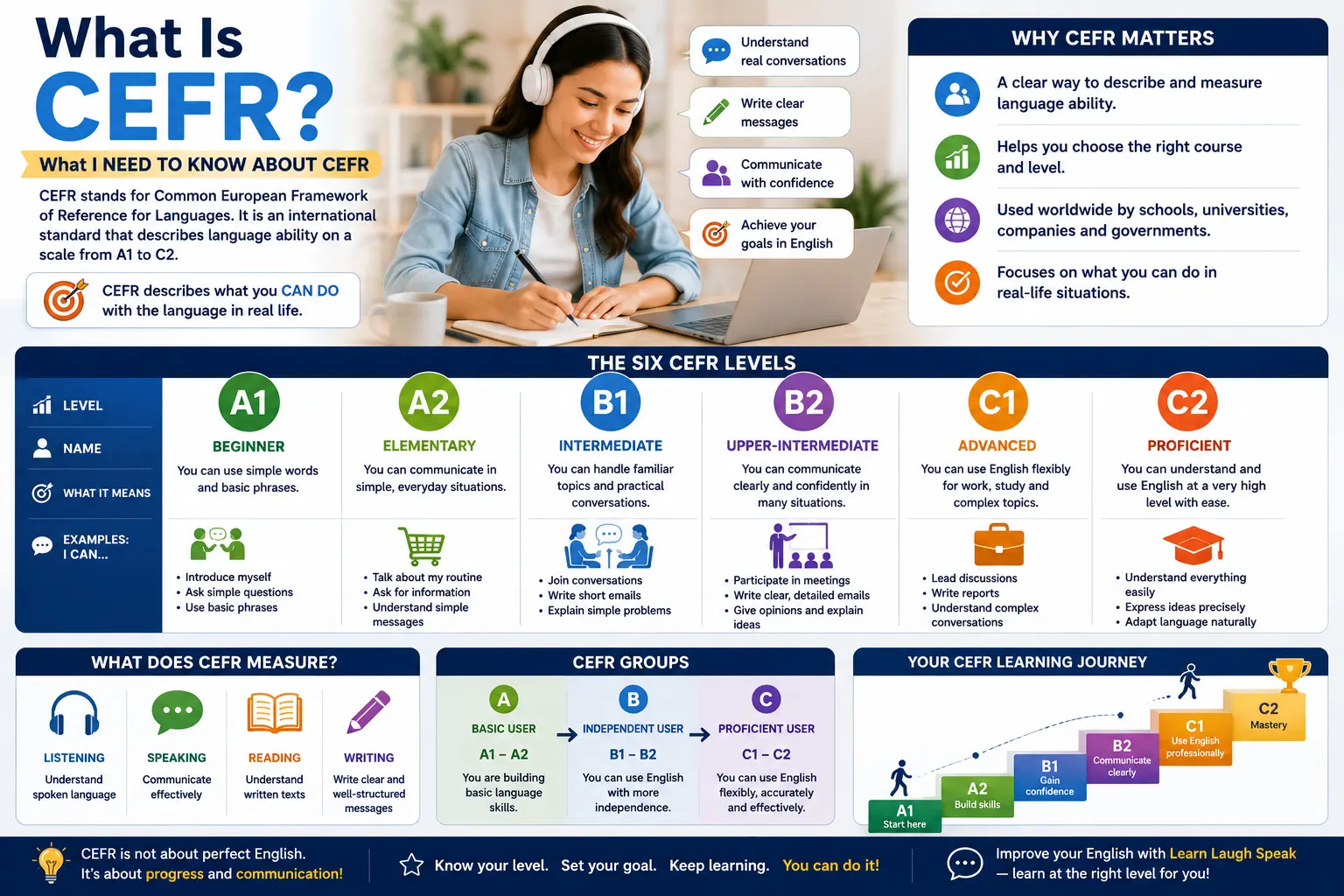
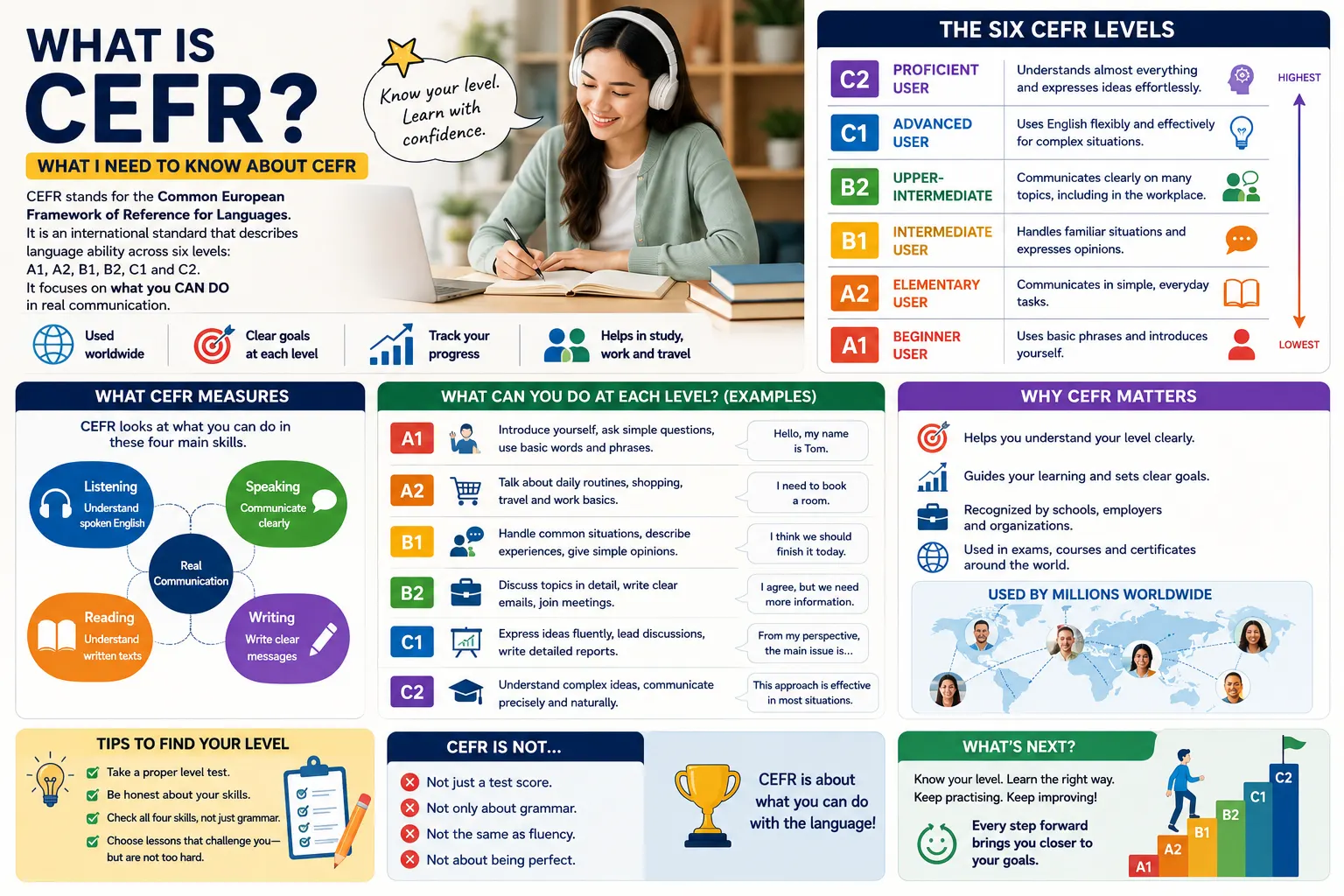
CEFR stands for the Common European Framework of Reference for Languages.
It is an international framework used to describe language ability.
The CEFR has six main levels:
A1
A2
B1
B2
C1
C2
These levels move from beginner to proficient.
C2 is the highest main level.
The important point is this:
CEFR does not only ask what grammar you know. It describes what you can do with the language.
Can you introduce yourself?
Can you understand simple instructions?
Can you join a conversation?
Can you write a clear email?
Can you explain your opinion?
Can you understand complex professional English?
This is why CEFR is useful. It connects English learning to real-life communication.
Why CEFR Matters for English Learners
English learners often feel confused about their level.
One student may say:
“I am intermediate.”
Another may say:
“I speak a little English.”
Another may say:
“I understand English, but I cannot speak well.”
These descriptions are common, but they are not very clear.
CEFR helps make level descriptions more precise.
For example:
A learner at A1 can usually use very basic phrases.
A learner at B1 can usually handle familiar situations.
A learner at C1 can usually use English flexibly in work, study, and professional situations.
This helps learners know where they are and what they need to practise next.
What I Need to Know About CEFR Before Starting
The first thing to know is that CEFR is not only about passing a test.
It is a way to understand your language skills.
A good CEFR-based program should help you improve:
speaking
listening
reading
writing
grammar
vocabulary
pronunciation
communication confidence
CEFR is also not only about knowing words.
A student may know many words but still struggle to speak clearly in a meeting.
Another student may speak confidently but make grammar mistakes in writing.
This is why proper level placement matters.
You need to know your real level across different skills, not just guess.
The Six CEFR Levels Explained Simply
CEFR has six main levels.
They are grouped into three larger categories:
A levels: Basic User
B levels: Independent User
C levels: Proficient User
Here is the simple version.
| CEFR Level | Simple Name | What it Means |
|---|---|---|
| A1 | Beginner | You can use simple words and basic phrases. |
| A2 | Elementary | You can communicate in simple everyday situations. |
| B1 | Intermediate | You can handle familiar topics and practical conversations. |
| B2 | Upper-intermediate | You can communicate more clearly and confidently in many situations. |
| C1 | Advanced | You can use English flexibly for work, study, and complex topics. |
| C2 | Proficient | You can understand and use English at a very high level. |
These levels help learners see progress step by step.
A1 Level: Beginner English
At A1, you are starting to use English.
You can understand and use very basic phrases.
You may be able to:
introduce yourself
say where you are from
ask simple questions
understand short phrases
use basic vocabulary
talk about simple personal information
Example A1 sentences:
My name is Ana.
I am from Mexico.
I work in a hotel.
Where are you from?
I like coffee.
At A1, you need slow, clear English and simple situations.
This level is not bad. It is the beginning of your English journey.
A2 Level: Elementary English
At A2, you can communicate in simple routine situations.
You may still need help, but you can understand more everyday English.
You may be able to:
talk about your job
describe your daily routine
ask for basic information
understand simple messages
talk about family, shopping, travel, and work basics
I usually start work at 9 a.m.
Can you help me with this form?
I need to book a room for tomorrow.
The meeting is at 3 p.m.
I worked yesterday, but I am free today.
At A2, you are building confidence and learning to use English more often.
B1 Level: Intermediate English
At B1, you can manage many familiar situations.
You may not speak perfectly, but you can usually communicate your main idea.
You may be able to:
join simple workplace conversations
write short emails
explain basic problems
describe experiences
give opinions on familiar topics
understand the main points of clear speech
Example B1 sentences:
I understand the main idea, but could you explain the last part again?
I have experience working with customers.
I think we should finish the report before Friday.
I am interested in improving my English for meetings.
The client asked for more information about the price.
B1 is an important level because learners often start to feel more independent.
B2 Level: Upper-Intermediate English
At B2, you can communicate with more confidence.
You can usually explain ideas, give opinions, and understand more detailed English.
You may be able to:
participate in meetings
write clearer professional emails
understand longer conversations
explain advantages and disadvantages
communicate with native speakers more comfortably
discuss work topics with more detail
Example B2 sentences:
From my perspective, the main issue is the timing of the project.
I agree with the idea, but I think we should consider the cost first.
Could we clarify the next steps before the end of the meeting?
The proposal is useful, but it may need more detail before we send it to the client.
B2 is often a strong goal for workplace English because it allows more independent communication.
C1 Level: Advanced English
At C1, you can use English flexibly and effectively.
You can understand complex ideas and express yourself with more precision.
You may be able to:
lead meetings
write detailed reports
handle professional discussions
understand implied meaning
adjust tone depending on the situation
explain complex ideas clearly
use English in academic or professional contexts
Example C1 sentences:
Although the proposal is strong, we may need to adjust the timeline to meet the client’s expectations.
The main challenge is not the strategy itself, but the way it is communicated across departments.
I would suggest reviewing the data before making a final decision.
At C1, English becomes a strong professional tool.
C2 Level: Proficient English
At C2, a learner can understand and use English at a very high level.
This does not mean the person never makes mistakes. It means they can use the language very effectively in almost all situations.
You may be able to:
understand complex texts
communicate with precision
adapt style and tone naturally
understand subtle meaning
write and speak fluently on complex topics
use English in demanding professional or academic settings
Example C2 sentence:
The success of the project depends not only on the quality of the strategy, but also on how effectively it is implemented across different teams.
C2 is the highest CEFR level.
CEFR Is About What You Can Do
One of the most useful parts of CEFR is that it describes ability through practical outcomes.
This means it focuses on what a learner can do with the language.
For example, at different levels, a learner may be able to:
understand basic greetings
ask for directions
write a short message
explain a work problem
join a meeting
give a presentation
negotiate with a client
write a professional report
This is very helpful because English learning should not only be about memorizing rules.
It should help you communicate.
CEFR and the Four Main Skills
CEFR looks at language ability across different skills.
These usually include:
listening
speaking
reading
writing
A learner may not have the same level in every skill.
For example:
You may read at B2 but speak at B1.
You may listen at B1 but write at A2.
You may understand meetings but struggle to speak confidently.
This is normal.
That is why a good level test should look at more than one skill.
If you only test grammar, you do not get the full picture.
CEFR and English for Work
CEFR is especially useful for workplace English.
At work, you need more than vocabulary.
You need to understand tasks, answer questions, write clearly, join conversations, and use the right tone.
For example:
At A2, you may be able to answer simple customer questions.
At B1, you may be able to explain a common problem.
At B2, you may be able to participate in meetings and emails with more confidence.
At C1, you may be able to lead discussions, write detailed reports, and manage professional communication.
This is why CEFR levels are useful for companies, teams, and adult learners.
They help connect English learning to real workplace needs.
CEFR Is Not the Same as Fluency
Many learners ask:
Does CEFR measure fluency?
The answer is: partly, but not only.
Fluency is one part of communication.
CEFR also includes understanding, accuracy, range of vocabulary, interaction, writing ability, and task completion.
A learner may speak quickly but still make many mistakes.
Another learner may speak more slowly but communicate clearly and accurately.
CEFR helps look at the full communication picture.
So instead of asking only:
“Am I fluent?”
It is better to ask:
“What can I do in English now, and what do I need to do next?”

Why Guessing Your Level Can Be a Problem
Many learners guess their level incorrectly.
Some learners think they are lower than they really are because they lack confidence.
Others think they are higher because they know many words, but they cannot use them well in real situations.
This can create problems.
If lessons are too easy, you get bored.
If lessons are too hard, you feel lost.
If the level is correct, learning feels challenging but possible.
This is why proper placement matters.
A good CEFR assessment helps you start in the right place.
How Learn Laugh Speak Uses CEFR
Learn Laugh Speak is designed to help adult learners improve English step by step through a structured level system.
The platform uses level placement so students can begin from the correct point and progress through lessons matched to their ability.
This matters because adults do not need random lessons.
They need the right lesson at the right level.
Learn Laugh Speak helps students practise:
speaking
listening
reading
writing
grammar
vocabulary
pronunciation
real communication
The goal is not only to “study English.”
The goal is to make measurable progress.
What Level Do You Need?
The level you need depends on your goal.
For travel, simple daily life, or basic communication, A2 may be enough for some situations.
For many workplace roles, B1 or B2 is often more useful.
For professional meetings, leadership, detailed writing, and complex communication, B2 to C1 is often a stronger target.
For academic study, advanced work, or high-level professional English, C1 or C2 may be needed.
The best question is not only:
What level am I?
The better question is:
What do I need to do in English?
Your goal should match your real situation.
Common Mistakes About CEFR
Here are some common misunderstandings.
Mistake 1: Thinking CEFR Is Only for Europe
CEFR started in Europe, but it is now used internationally by schools, teachers, exams, companies, and learning platforms.
Mistake 2: Thinking C2 Means Native Speaker
C2 is a very high level, but it does not mean the same as being a native speaker.
It means the learner can use the language with a very high level of control, flexibility, and accuracy.
Mistake 3: Thinking One Test Shows Everything
One test can help, but language ability is complex.
Speaking, listening, reading, and writing can develop at different speeds.
Mistake 4: Thinking A1 Is Bad
A1 is not bad.
A1 means you are starting.
Every learner begins somewhere.
Mistake 5: Thinking Grammar Alone Is Enough
Grammar matters, but communication is more than grammar.
You also need vocabulary, pronunciation, listening, confidence, and practice in real situations.
Simple CEFR Self-Check
Here is a simple way to think about your level.
Ask yourself:
Can I introduce myself in English?
Can I answer simple questions?
Can I talk about my work?
Can I explain a problem?
Can I write a clear email?
Can I understand a meeting?
Can I give an opinion?
Can I explain complex ideas?
Can I adjust my tone depending on the situation?
The more you can do, the higher your practical level may be.
But for an accurate level, a proper assessment is better.
Final Thoughts: What Is CEFR?
So, what is CEFR?
CEFR is a clear framework for describing language ability from A1 to C2.
It helps learners understand their level, choose the right lessons, measure progress, and connect English learning to real communication.
The most important thing to remember is this:
CEFR is not only about what you know.
It is about what you can do.
If you understand your level, you can study with more direction and confidence.
You can stop guessing and start improving from the right point.

Learn English at the Right CEFR Level With Learn Laugh Speak
Learn Laugh Speak helps adult English learners improve speaking, listening, reading, writing, grammar, pronunciation, and vocabulary at the correct level.
Students complete a full level assessment and begin learning from the point that matches their ability.
With structured lessons from beginner to advanced levels, learners can practise real English, receive corrections, and build confidence step by step.
If you want to understand your level and improve with a clear path, Learn Laugh Speak can help you start learning at the right CEFR level today.
4 thoughts on “What Is CEFR? What I Need to Know About CEFR”
Pingback: How to Professionally Ask for a Pay Rise in English
Pingback: What is CEFR and Why It Matters for English Learners
Pingback: Why Some English Accents Are Hard While Others Easier – Learn Laugh Speak
Pingback: Understanding Accents: A Practical Guide for English Learners - Learn Laugh Speak