
 English
 Arabic
 Chinese (Simplified)
 Dutch
Dutch French
 German
 Italian
 Portuguese
 Russian
 Spanish
Every day, people around the world type the same question into Google: “What is the best way to learn English?” It remains one of the most searched questions in language learning because learners at every level are looking for faster, more effective ways to improve. The reason it keeps getting searched is simple: most answers are too vague. “Watch movies.” “Practise every day.” “Find a native speaker.” Helpful in theory, but not specific enough to act on.
This post does something different. Instead of giving you another generic list, it answers the specific questions that English learners ask most, the ones that flood forums like Reddit, come up in every language learning community, and keep learners stuck for months or years. Let’s work through them one by one.
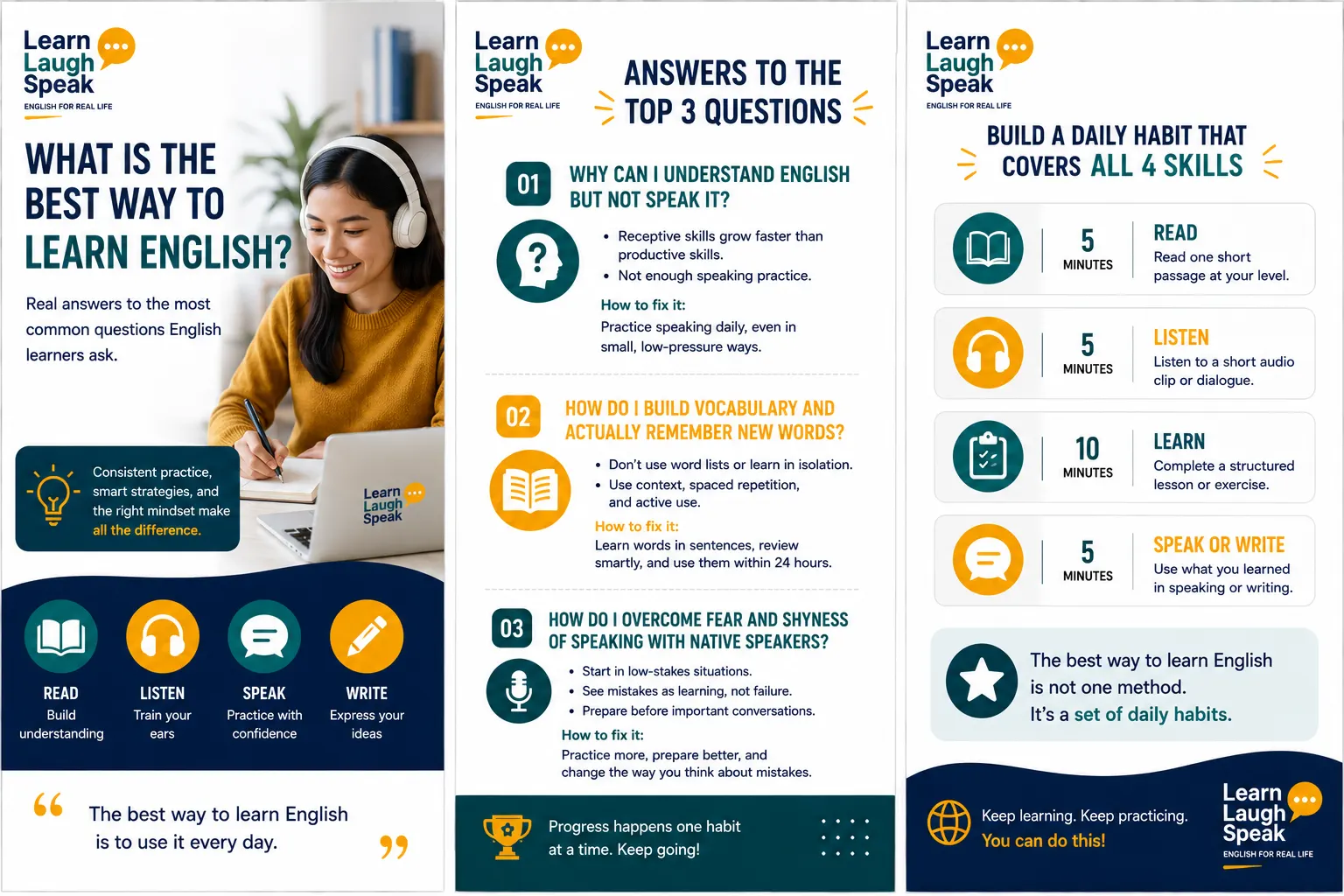
Why Can I Understand English But Not Speak It?
This is probably the most discussed frustration in English learning. You watch a show and follow every word. You read an article with no problem. But the moment someone asks you a question in English, your mind goes blank. What is happening?
There are two things going on:
- Receptive skills (listening and reading) develop faster than productive skills (speaking and writing). Understanding is passive, your brain recognises patterns. Speaking is active, your brain has to retrieve and assemble language in real time under pressure.
- Most learners do not practise output enough. If 90% of your study time is consuming English and 10% is producing it, your speaking will always lag behind your comprehension.
The fix is deliberate speaking practice; not waiting until you feel “ready,” because that moment rarely comes. Start with low-stakes output: describe your day out loud in English, summarise a video you just watched, or read a paragraph aloud and then close the page and say it back from memory.
In classroom and workshop settings, interactive activities can help learners practise retrieval before speaking aloud. For example, Slidea’s interactive presentation tools enable learners to engage through polls, quizzes, and word clouds, creating a lower-pressure environment that supports language production.

How Do I Build Vocabulary and Actually Remember New Words?
The second most common question, and the most common mistake. Most learners open a vocabulary app, swipe through 30 words, and forget 28 of them by the next morning. This is not a memory problem. It is a method problem.
What does not work:
- Studying long word lists with translations
- Reviewing words only once
- Learning words in isolation, with no sentence or context
What actually works:
- Context-first learning: Learn words inside a sentence that shows how they are used. “The meeting was postponed” teaches “postponed” far more effectively than a flashcard that says “postponed = delayed.”
- Spaced repetition: Review a word one day after learning it, then three days later, then a week, then a month. This technique, well documented in cognitive science research, matches your brain’s natural forgetting curve and builds long-term retention with far less total study time.
- Active use within 24 hours: Use the word in a sentence you write or say on the same day you learn it. Production forces deeper processing than recognition alone.
A practical target: focus on the 2,000 – 3,000 most common English words before worrying about anything else. Knowing the most frequent words in a language gives you access to the vast majority of everyday spoken and written communication, making high-frequency vocabulary the highest-return investment for any learner.
How Do I Overcome the Fear and Shyness of Speaking With Native Speakers?
Fear of speaking is not a personality flaw. It is a predictable response to a real cognitive challenge. When you speak in a second language, you are simultaneously retrieving grammar, choosing vocabulary, monitoring your pronunciation, tracking what the other person said, and planning your next sentence. That is an enormous cognitive load, no wonder it feels overwhelming.
Three things that genuinely help:
- Lower the stakes first. Start speaking English in situations where a mistake has zero consequences: talking to yourself, recording voice notes, or using a language exchange app with a stranger you will never meet in person. The goal is to accumulate speaking hours until your brain stops treating English output as a threat.
- Reframe mistakes as data. Every error tells you exactly what to work on next. Native speakers are not judging your grammar, they are trying to understand your message. Communication is the goal, not perfection.
- Prepare before high-stakes conversations. If you have a work meeting, job interview, or important call in English, rehearse out loud beforehand. Run through likely questions and your answers. Preparation does not eliminate nervousness, but it dramatically reduces the cognitive load in the moment.
Some teachers also use interactive presentation tools that allow learners to overcome the fear of speaking by participating anonymously through polls and word clouds before speaking aloud. This helps reduce anxiety while encouraging active language use. Activities such as classroom icebreaker activities, live polls, and word cloud exercises help learners engage with English in a low-pressure way before they are ready to speak in front of a group.
The One Habit That Ties Everything Together
If there is a single answer to the question “what is the best way to learn English,” it is this: consistent, level-appropriate practice across all four skills: reading, writing, speaking, and listening, with regular feedback and deliberate review.
Not a two-hour session on Sunday. Not a grammar textbook you open when you feel motivated. A daily habit. Research in second language acquisition consistently shows that distributed practice, shorter, more frequent sessions, produces stronger long-term retention than the same total hours crammed into fewer, longer blocks.
A simple daily structure that covers all four skills:
- 5 minutes — Read one short passage at your level
- 5 minutes — Listen to a short audio clip or dialogue
- 10 minutes — Complete a structured lesson or exercise
- 5 minutes — Write or speak something using what you just learned
A structured programme like Learn Laugh Speak removes the guesswork from this process, you know every session is building on what came before, at the right level, with nothing important being skipped.
So, What Is the Best Way to Learn English?
It is not one method. It is a set of aligned habits: practise speaking even when it feels uncomfortable, learn vocabulary in context rather than in lists, address the gap between understanding and producing, and show up every day for a short focused session.
The learners who reach fluency are not the ones who found a magic shortcut. They are the ones who kept going when it felt slow, who treated every mistake as useful information, and who built a routine they could actually sustain.
You already asked the right question. Now you have a real answer, and a place to start.
