
 English
 Arabic
 Chinese (Simplified)
 Dutch
Dutch French
 German
 Italian
 Portuguese
 Russian
 Spanish
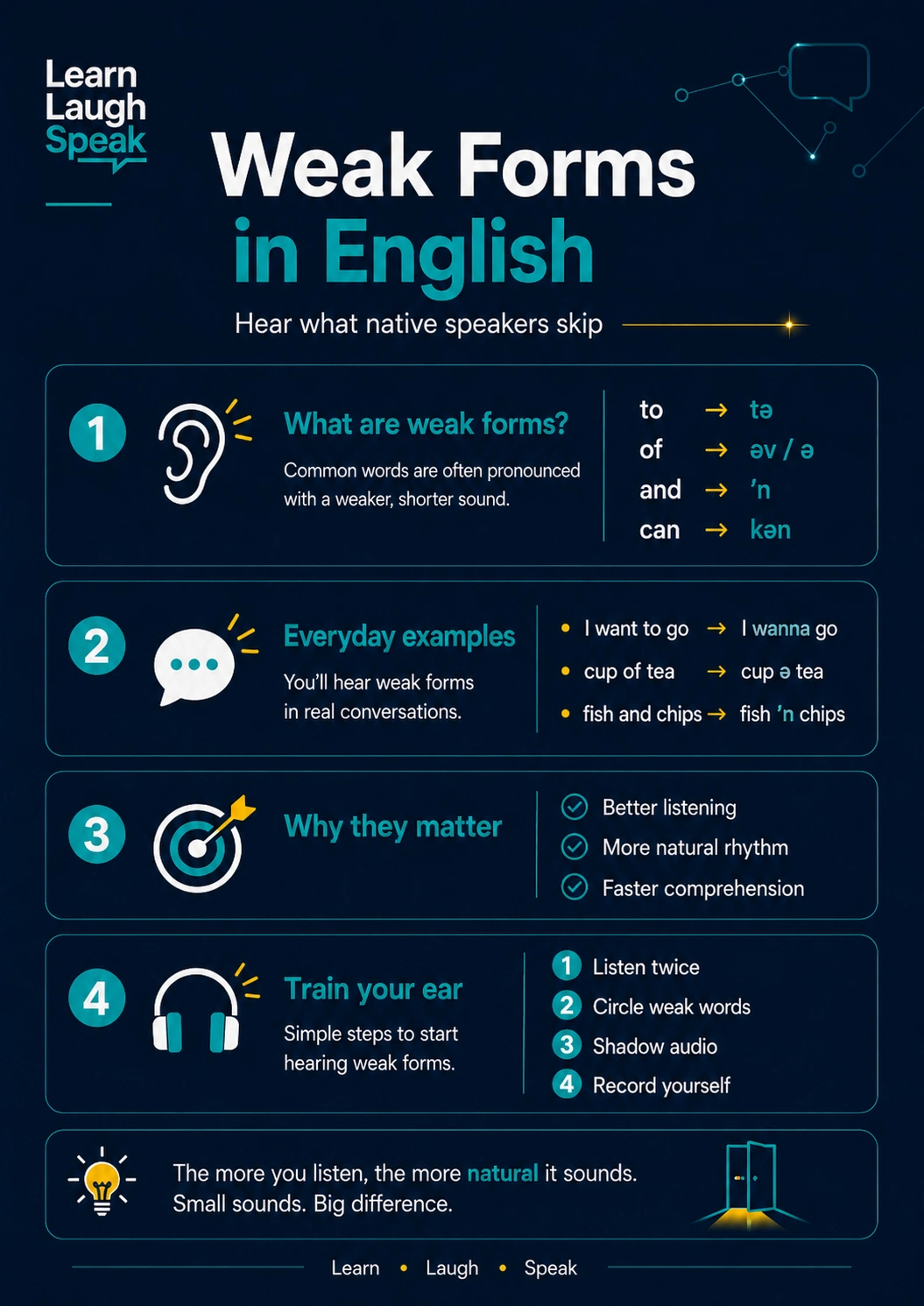
Weak forms in English are unstressed sounds that native speakers use in fast, natural speech. Words like to, of, and, can, have, for, and you often become shorter and softer, which is why English can sound faster than it looks on the page.
If you have ever listened to native speakers and thought, “Why do they sound so fast?”, weak forms in English are one of the main reasons. Native speakers do not always pronounce every word clearly and fully. Instead, they reduce small grammar words so the sentence sounds smoother.
For English learners, this can make listening difficult. You may know the words when you read them, but not recognize them when you hear them. This guide will help you understand weak forms, hear them more easily, and start using them naturally in real conversations.

What Are Weak Forms in English?
Weak forms in English are reduced pronunciations of common words when they are not stressed in a sentence. These words are usually grammar words, not the most important meaning words.
For example:
“I want to go.”
In slow English, you may hear every word clearly. But in natural speech, it may sound more like:
“I wanna go.”
Another example:
“a cup of tea”
In natural English, of often becomes very soft:
“a cup ə tea”
The word is still there, but it is reduced. This is why learners sometimes feel like native speakers are “skipping” words.
They are not always skipping them completely. They are using weak forms.
Why Weak Forms in English Matter for Listening
Learning weak forms in English is important because real spoken English is very different from textbook English. In textbooks, words appear clearly and separately. In real speech, words connect, reduce, and blend together.
If you only learn full pronunciations, you may expect to hear:
“I am going to speak to him.”
But in real conversation, you may hear something closer to:
“I’m gonna speak tə him.”
This can feel confusing if you are not ready for it.
Understanding weak forms helps you:
- follow native speakers more easily
- understand fast conversations
- improve listening confidence
- recognize common reduced words
- understand movies, podcasts, and meetings better
- sound more natural when speaking
- improve your rhythm in English
Weak forms are especially useful for workplace English because meetings, phone calls, and customer conversations often happen quickly.
Weak Forms in English and the Schwa Sound
Many weak forms in English use the schwa sound: /ə/.
The schwa is the relaxed vowel sound in words like:
about → /əˈbaʊt/
support → /səˈpɔːrt/
problem → sometimes /ˈprɒbləm/
In weak forms, small words often reduce to this soft sound.
Examples:
| Full word | Weak sound | Example |
|---|---|---|
| to | /tə/ | “I need to go.” |
| of | /əv/ or /ə/ | “a cup of coffee” |
| for | /fə/ | “This is for you.” |
| can | /kən/ | “I can help.” |
| and | /ən/ or /n/ | “fish and chips” |
| have | /həv/ or /əv/ | “I have done it.” |
The schwa sound is one of the biggest secrets to understanding natural English. Once you start hearing it, fast English becomes easier to follow.
Common Weak Forms in English
Here are some of the most common weak forms in English that learners should know.
| Word | Strong form | Weak form | Example |
| to | /tuː/ | /tə/ | “I need to leave.” |
| of | /ɒv/ or /ʌv/ | /əv/ or /ə/ | “a lot of work” |
| and | /ænd/ | /ən/ or /n/ | “bread and butter” |
| can | /kæn/ | /kən/ | “I can do it.” |
| for | /fɔːr/ | /fə/ | “This is for you.” |
| have | /hæv/ | /həv/ or /əv/ | “I have finished.” |
| you | /juː/ | /jə/ | “Do you want it?” |
| your | /jɔːr/ | /jə/ | “What’s your name?” |
| them | /ðem/ | /ðəm/ or /əm/ | “Tell them later.” |
| are | /ɑːr/ | /ə/ | “What are you doing?” |
Do not worry if you cannot hear all of these immediately. Weak forms take time to notice because they are soft and fast.
Weak Forms in English Examples You Hear Every Day
Here are everyday examples of weak forms in English in natural speech.
| Written English | Natural spoken English |
| I want to go. | I wanna go. |
| I am going to call you. | I’m gonna call you. |
| a cup of tea | a cup ə tea |
| fish and chips | fish ’n chips |
| I can help you. | I kən help you. |
| What do you want? | Whaddaya want? |
| I have got to leave. | I’ve gotta leave. |
| This is for you. | This is fə you. |
For learners, the goal is not to copy every casual form immediately. The first goal is to recognize these sounds when you hear them.
If you can hear weak forms, native English will stop sounding so unclear.
Weak Forms in English at Work
Weak forms are not only used in casual English. They also appear in professional conversations, meetings, customer service, hospitality, and office communication.
For example, in a meeting, someone may say:
“We need to send the report by Friday.”
In natural speech, this may sound like:
“We need tə send the report by Friday.”
A manager may say:
“Can you check the file for me?”
In natural speech, this may sound like:
“Kən you check the file fə me?”
A customer may say:
“I’d like to speak to someone about my booking.”
In natural speech, this may sound like:
“I’d like tə speak tə someone about my booking.”
If you work in customer service, hotels, restaurants, tourism, sales, or business, recognizing weak forms can help you understand people faster and respond more confidently.
Weak Forms in English for Customer Service
Customer service English often includes fast questions, requests, and short phrases. Weak forms appear often because customers usually speak naturally, not like a textbook.
Examples:
| Customer says | What it may sound like |
| “Can I speak to a manager?” | “Kən I speak tə a manager?” |
| “I’m looking for the reception desk.” | “I’m looking fə the reception desk.” |
| “Do you have a table for two?” | “D’ya have a table fə two?” |
| “I need to change my reservation.” | “I need tə change my reservation.” |
| “Could you send it to my email?” | “Couldja send it tə my email?” |
If you miss a weak form, listen for the main words:
speak / manager
looking / reception desk
table / two
change / reservation
send / email
You do not need to hear every sound perfectly. You need to understand the message.
Why Weak Forms in English Improve Fluency
Using weak forms in English can make your speech sound smoother and less robotic. Many learners pronounce every word with equal stress, which can make English sound slow or unnatural.
For example:
Robotic: “I want to go to the meeting.”
Natural: “I want tə go tə the meeting.”
In natural English, important words are usually stressed:
want / go / meeting
Small grammar words become weaker:
to / the
This rhythm helps your English sound more natural. It also helps people understand you more easily because your sentence has the expected English flow.
However, you do not need to force weak forms. Start by noticing them in listening. Then slowly practise using them in common phrases.
What Not to Listen For and What to Listen For Instead
When learners listen to fast English, they often expect every word to sound clear. This makes weak forms harder to recognize.
| What not to expect | What to listen for instead |
| Every word pronounced clearly | Key words and sentence rhythm |
| “to” always sounding like /tuː/ | “to” often sounding like /tə/ |
| “of” always sounding like /ɒv/ | “of” often sounding like /əv/ or /ə/ |
| “and” always sounding like /ænd/ | “and” often sounding like /ən/ or /n/ |
| “can” always sounding like /kæn/ | “can” often sounding like /kən/ |
| Perfect separation between words | Connected speech and reduced sounds |
This change in listening strategy is important. Instead of asking, “Why can’t I hear every word?”, ask, “What are the key words?”
Common Mistakes with Weak Forms in English
Many learners struggle with weak forms because they try to match spoken English exactly to written English.
1. Expecting every word to sound full
In real speech, small words are often reduced.
Written: “I need to talk to you.”
Spoken: “I need tə talk tə you.”
2. Thinking native speakers are skipping everything
Sometimes words are skipped, but often they are just reduced. The sound is there, but very soft.
3. Stressing every word equally
If you stress every word, your English may sound unnatural.
Too equal: “I CAN GO TO THE MEETING.”
Better rhythm: “I can GO tə the MEETING.”
4. Trying to use weak forms before hearing them
Listening comes first. Train your ear before trying to copy every reduction.
5. Using weak forms in the wrong place
Some words are weak only when they are not important in the sentence.
For example:
“I can help.”
Here, can is weak: /kən/
But if you want to emphasize ability:
“Yes, I can.”
Here, can is strong: /kæn/
How to Train Your Ear for Weak Forms in English
To improve your listening, practise weak forms step by step.
1. Listen twice
First, listen for meaning. Do not stop every time you miss a word.
Second, listen again and focus on the small words.
Ask yourself:
- Did I hear to as /tə/?
- Did and become /n/?
- Did of become /ə/?
- Did can sound like /kən/?
2. Read and listen together
Use subtitles or a transcript. Read the sentence and listen at the same time. Notice which words sound weaker than they look.
3. Circle weak words
When reading a transcript, circle words like:
to, of, and, can, have, for, you, them, are
Then listen again and focus on how they sound.
4. Shadow native audio
Shadowing means listening and repeating immediately after the speaker. Try to copy the rhythm, not only the words.
Example:
Audio: “I need to go.”
You repeat: “I need tə go.”
5. Record yourself
Record yourself saying a short sentence. Then compare it with native audio. Ask:
- Am I stressing every word?
- Are my small words too strong?
- Does my sentence sound smooth?
This practice helps your speaking become more natural over time.
Weak Forms in English Practice Sentences
Practise these sentences slowly first, then more naturally.
| Full sentence | Natural rhythm |
| I need to speak to you. | I need tə speak tə you. |
| Can you send it to me? | Kən you send it tə me? |
| This is for the customer. | This is fə the customer. |
| I have a lot of work. | I have a lot ə work. |
| We are going to meet at five. | We’re gonna meet ət five. |
| Bread and butter is on the table. | Bread ’n butter is on the table. |
| I want to ask you a question. | I wanna ask yə a question. |
Remember, your goal is not to sound exactly like a native speaker. Your goal is to understand natural English and speak with clearer rhythm.

Learn Weak Forms in English with Learn Laugh Speak
Learn Laugh Speak helps adult English learners improve real listening and speaking skills for work, daily life, and professional communication.
If you want to understand weak forms in English, you need structured listening and speaking practice. Random videos can help, but level-based learning makes your progress clearer and easier to follow.
Learn Laugh Speak supports learners from beginner to advanced levels with lessons that practise:
- listening
- speaking
- pronunciation
- vocabulary
- grammar
- workplace English
- customer service communication
- real-life English conversations
With the right level and consistent practice, you can train your ear to hear natural English and build the confidence to speak more smoothly.
FAQs About Weak Forms in English
What are weak forms in English?
Weak forms in English are reduced pronunciations of common words in natural speech. Words like to, of, and, can, for, have, and you often become shorter and softer when they are not stressed.
Why do native speakers use weak forms?
Native speakers use weak forms because English has rhythm. Important words are stressed, while smaller grammar words are often reduced. This makes speech smoother and faster.
Are weak forms slang?
No, weak forms are not slang. They are a normal part of natural spoken English. Some casual reductions like wanna and gonna are informal, but weak forms themselves happen in everyday speech, including professional conversations.
Do I need to use weak forms when speaking English?
You do not need to force them immediately. First, learn to hear weak forms. Then you can practise using them in common sentences so your speech sounds smoother and more natural.
What is the most common weak sound in English?
The most common weak sound is the schwa sound /ə/. It appears in many reduced words, such as to /tə/, for /fə/, and of /əv/ or /ə/.
How can I practise weak forms in English?
Listen to short native audio, read the transcript, circle small words, listen again, and repeat the sentence aloud. Focus on rhythm and key words instead of trying to pronounce every word strongly.
Final Thoughts on Weak Forms in English
Weak forms in English are one of the biggest reasons native speakers sound fast. They reduce small words, connect sounds, and create the natural rhythm of spoken English.
Once you start hearing weak forms, English listening becomes easier. You begin to understand that native speakers are not always speaking too fast. They are often reducing words you already know.
Start with common words like to, of, and, can, for, have, and you. Listen for them in podcasts, videos, meetings, and daily conversations. Then practise using them in short sentences.
With time, weak forms will help you understand real English better and speak with a smoother, more natural rhythm.