English
 Arabic
 Chinese (Simplified)
 Dutch
Dutch French
 German
 Italian
 Portuguese
 Russian
 Spanish
In a professional environment, it’s common to have scheduling conflicts or prior commitments.
Saying no while staying respectful is key.
This guide will show you polite and effective ways to say I have other plans without sounding rude, disinterested, or uncooperative.
Whether you are declining a meeting, a work event, a client call, cancelling a job interview, or a social invitation from a colleague, the right phrase can help you sound clear, professional, and polite.

Why Ways to Say I Have Other Plans Matter at Work
You can’t attend every meeting, event, or social invitation.
But how you communicate your unavailability makes a big difference in how people perceive you.
Using clear and courteous phrases helps you:
Maintain professionalism.
Protect your time and priorities.
Keep relationships positive.
Avoid sounding dismissive or unhelpful.
Show respect for the person inviting you.
In English, especially at work, you do not always need to give a long explanation.
Sometimes a simple and polite phrase is enough.
This is why learning different ways to say I have other plans can help you sound more confident in real workplace conversations.
Quick Guide: Ways to Say I Have Other Plans Politely
Here are some simple options depending on the situation.
| Situation | Professional Phrase |
|---|---|
| Formal meeting | “I have a prior commitment at that time.” |
| Work event | “Thank you for the invitation, but I won’t be able to attend.” |
| Friendly colleague invite | “Thanks for inviting me, but I already have plans.” |
| Client call | “I’m unavailable at that time, but I’d be happy to find another option.” |
| Repeated request | “I appreciate you asking again, but I still won’t be able to make it.” |
This helps you choose the right phrase based on the relationship and the situation.
Some phrases sound formal.
Some sound friendly.
Some are better when you want to reschedule instead of saying no completely.
Do’s and Don’ts When Declining Politely
When you need to say you have other plans, it is better to be clear, polite, and direct.
Do:
Acknowledge the invitation.
Be polite and to the point.
Offer a follow-up or alternative, if appropriate.
Thank the person for thinking of you.
Keep your answer simple.
Don’t:
Sound dismissive.
Give unnecessary or overly personal excuses.
Leave the person wondering if you’re just avoiding them.
Apologize too much when it is not needed.
Say yes when you already know you cannot attend.
You can be polite without over-explaining.
That is often the most professional option.
If you also find it difficult to sound confident when you decline, you can read our guide on how to speak professionally with confidence.
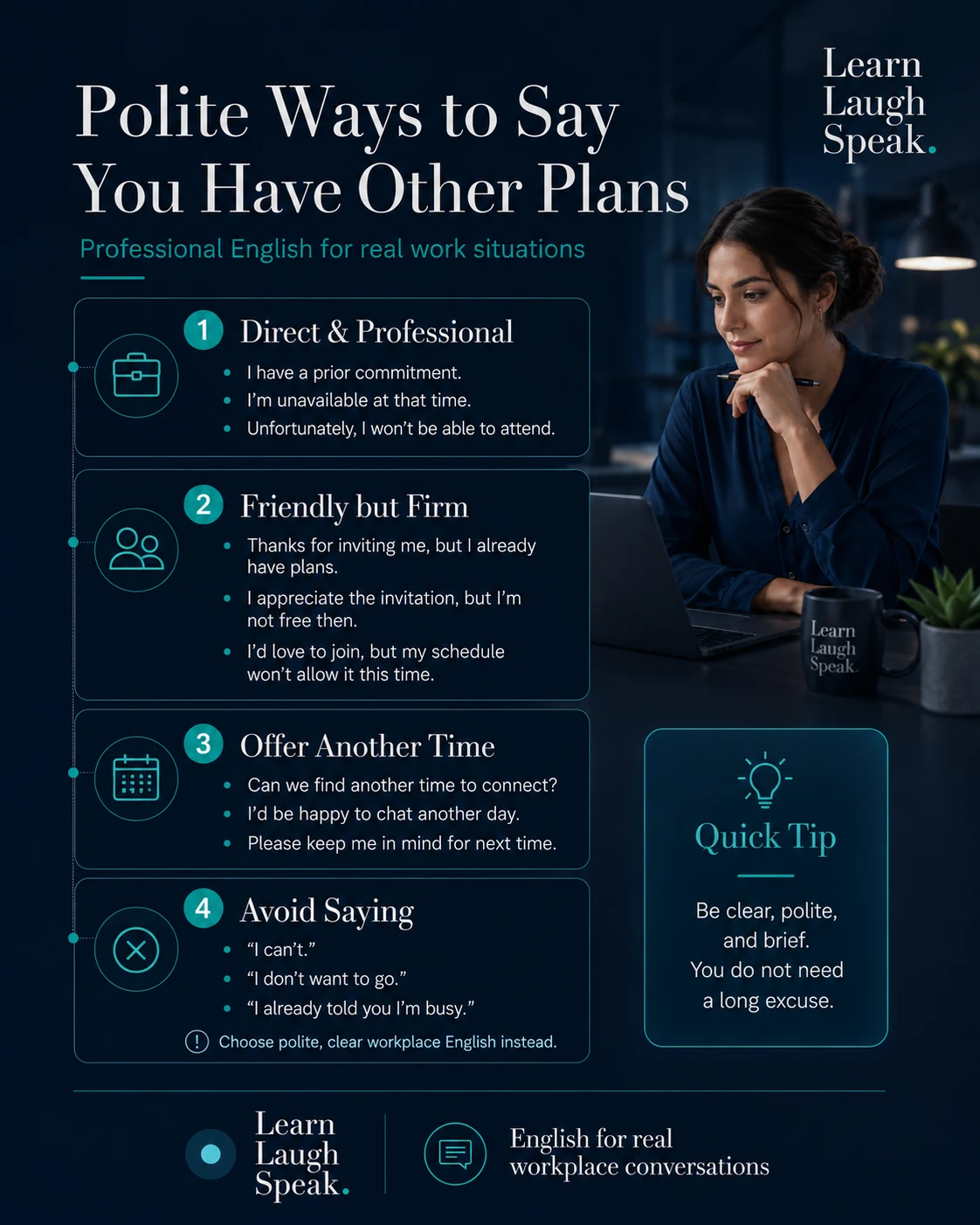
1. Straightforward Ways to Say I Have Other Plans
These are clean and simple phrases for professional communication.
They work well in emails, messages, and conversations.
“I won’t be able to attend. I have other plans at that time.”
“Thank you for the invite. Unfortunately, I’m already committed elsewhere.”
“I have a prior engagement during that time.”
“I’m not available then due to another appointment.”
“I already have something scheduled for that time.”
“Unfortunately, I won’t be able to make it.”
Example:
“Thanks for including me. I have other plans that day, but I hope the event goes well.”
This type of response is polite because it gives a clear answer without sounding negative.
It also shows appreciation for the invitation.
These ways to say I have other plans are useful when you want to be honest, but still respectful.
2. Flexible but Firm Ways to Say I Have Other Plans
Sometimes you want to decline without closing the door completely.
These phrases help you sound warm and professional while still making your answer clear.
“I’m already booked at that time, but thank you for the opportunity.”
“I appreciate the invitation. I’m just not free on that date.”
“That sounds great, but I have other commitments.”
“I’d love to join, but my schedule won’t allow it this time.”
“I really appreciate you asking, but I’m unavailable then.”
“That sounds like a fantastic event, but I have other plans I can’t change.”
Example:
“This sounds like a fantastic event, but I have other plans I can’t change. Thank you for thinking of me.”
This phrase works well because it shows interest, even though you are not available.
You are saying no to the timing, not to the person.
These professional phrases are useful when you want to protect your time while keeping the relationship positive.
3. How to Decline and Offer Another Time
If it’s appropriate, suggest an alternative.
This is especially useful when the meeting, call, or connection is still important to you.
“Can we find another time to connect?”
“I’d be happy to chat another day. Does next week work for you?”
“Please keep me in mind for next time. I’d love to join when I’m free.”
“I have a conflict that day, but I’d really enjoy meeting at another time.”
“I’m unavailable then, but I’d be happy to arrange another option.”
“Could we look at another time that works for both of us?”
Example:
“I have a conflict that day, but I’d really enjoy meeting at another time. Would next week work?”
This is a helpful way to keep the relationship positive.
It shows that you are still interested, even if you cannot attend at the original time.
When learning ways to say I have other plans, it is important to know when to offer another time and when to simply decline.
4. What to Say When Someone Keeps Asking
Sometimes someone keeps asking, even after you have already explained that you are not available.
In this situation, you can stay polite but be a little firmer.
“I really appreciate your persistence, but I’ve got other ongoing commitments.”
“My calendar has been consistently full lately, and I need to stick with what’s already booked.”
“I respect your offer, but I’ll need to pass this time.”
“Thank you again for asking, but I’m still not available.”
“I appreciate the invitation, but I won’t be able to make it.”
Example:
“I respect your offer, but I’ll need to pass again. I’m already booked.”
This keeps your answer polite but clear.
You do not need to give a new explanation every time.
You may also find these polite ways to say I’m busy when declining an invite useful when someone keeps asking or when you need another respectful phrase.
Professional Alternatives to “I Have Other Plans”
Sometimes “I have other plans” is perfectly fine.
But in more formal workplace situations, you may want to use a phrase that sounds a little more professional.
| Instead of Saying | Try Saying |
|---|---|
| “I’m busy.” | “I have a prior commitment.” |
| “I can’t come.” | “Unfortunately, I won’t be able to attend.” |
| “I already have plans.” | “I’m already committed elsewhere.” |
| “Not this time.” | “Thank you for the invitation, but I’ll need to pass this time.” |
| “I have stuff to do.” | “I already have something scheduled.” |
These small changes can make your English sound more professional and natural.
They also help you avoid sounding too direct or careless.
This is one reason workplace learners should practise different ways to say I have other plans, not just memorize one phrase.
Example Messages You Can Use at Work
Here are some complete examples you can copy and adjust depending on the situation.
| Situation | Professional Example |
|---|---|
| Declining a meeting | “Thank you for including me. Unfortunately, I have a prior commitment at that time, so I won’t be able to attend.” |
| Declining a work event | “I appreciate the invitation. I already have plans that evening, but I hope the event goes well.” |
| Asking to reschedule | “I’m unavailable at that time, but I’d be happy to find another day that works for both of us.” |
| Declining a team lunch | “Thanks for thinking of me. I can’t make it this time, but please keep me in mind for the next one.” |
| Declining a repeated request | “I appreciate you checking again, but I’m still not available at that time.” |
These examples are useful because they are short, polite, and clear.
They do not give too much personal information, but they still sound respectful.
For English learners, full examples are helpful because you can see how the phrase works inside a real message.
Ways to Say I Have Other Plans: What not to say
When declining an invitation, avoid phrases that sound too cold, too casual, or too direct.
Instead of saying:
“I can’t.”
Try:
“I’m sorry, I’m not available at that time.”
Instead of saying:
“I don’t want to go.”
Try:
“Thank you for inviting me, but I won’t be able to attend.”
Instead of saying:
“I already told you I’m busy.”
Try:
“I appreciate you checking again, but I’m still unavailable.”
Instead of saying:
“That doesn’t work for me.”
Try:
“Unfortunately, I have another commitment at that time.”
Professional English is not about using complicated words.
It is about choosing words that fit the situation.
Learning polite ways to say I have other plans helps you avoid sounding rude when you simply need to protect your time.
Why These Phrases Help You Communicate Better
Using professional ways to say you have other plans allows you to:
Be respectful and honest.
Maintain control of your schedule.
Protect your boundaries without sounding negative.
Decline invitations without damaging relationships.
Sound more confident in workplace English.
Whether you’re turning down a meeting, a social lunch, or a work event, how you say it matters just as much as what you say.
A polite phrase can help you protect your time while keeping the relationship positive.
If you are working on improving your professional English level, this guide on how to increase from B1 to B2 English can also help you understand what to practise next.
Learn More Professional English With Learn Laugh Speak
Learn Laugh Speak helps adult English learners improve their English for real workplace situations.
You can learn professional phrases, practise communication for meetings and emails, and improve step by step at the correct level for you.
If you want to speak more clearly, politely, and confidently at work, Learn Laugh Speak can help you build the English skills you need for real conversations.