
 English
 Arabic
 Chinese (Simplified)
 Dutch
Dutch French
 German
 Italian
 Portuguese
 Russian
 Spanish
Explaining something well is often harder than building it. Teams may understand their product, lesson, or workflow perfectly inside the company, yet the message becomes harder to follow once it has to reach students, users, clients, or external stakeholders. Text can carry the core idea, but text alone often puts too much pressure on the audience to imagine the rest.
That is where Wan 2.7 Video API starts to matter for developers and workflow teams. Its value is not only in generating video output. Its stronger value is helping teams turn explanations into something easier to follow, easier to review, and easier to communicate through a structured API-driven workflow.
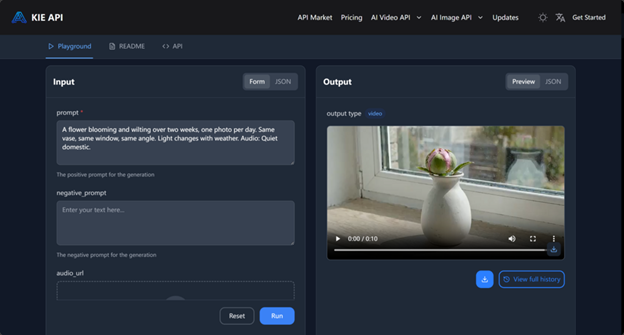
Wan 2.7 Video API Fits Teams That Need Clearer Visual Communication Workflows
A lot of communication problems begin after the core idea is already sound. The issue is not always that a product or lesson is confusing. The issue is that the format makes understanding slower than it needs to be. Long text blocks, static slides, and disconnected visuals often make the audience work harder than necessary.
That is why visual communication workflows matter. Teams that need to teach, guide, or explain increasingly need a way to add motion and structure without rebuilding everything from scratch each time.
Explanation Work Gets Harder When Text Stays the Only Output Layer
Text is strong for precision, but it is not always strong for flow. Once the explanation depends on sequence, pacing, or visual emphasis, a text-only output layer starts to create friction.
Visual Communication Workflows Need More Than Static Content Assets
Static diagrams, screenshots, and slide images still matter, but they often need a more dynamic layer before the explanation becomes easier to absorb.
Wan 2.7 Text-to-Video API Adds a Faster Visual Layer to Teaching and Explainer Work
Some teams begin with scripts, lesson notes, product walkthroughs, or written explainers. In those situations, Wan 2.7 Text-to-Video API gives them a practical route from structured language to visual output without requiring a full manual production cycle.
That workflow matters because early video drafts make communication easier to assess. A team can see whether an explanation feels too slow, too crowded, or too abstract much earlier than it could in a traditional edit-first process.
Script-Led Workflows Benefit From Wan 2.7 Text-to-Video API
When the core message already exists in writing, teams do not need to start from zero. They need a way to turn that structure into something visual enough to test and improve.
Early Visual Drafts Make Explanations Easier to Review and Improve
A rough but visible version gives reviewers more to react to than a written outline ever can. That helps teams move from concept to revision more efficiently.
Wan 2.7 Image to Video API Helps Existing Teaching Assets Go Further
Not every communication workflow starts with text. A lot of teams already have diagrams, interface screenshots, presentation slides, product images, or educational visuals. In those cases, Wan 2.7 Image to Video API becomes especially useful because it extends existing assets instead of forcing a new asset pipeline from the beginning.
That makes the API more practical for real teams. Existing material stays useful rather than becoming a dead end once motion enters the workflow.
Screens, Diagrams, and Slide Assets Become More Usable in Video Workflows
Materials created for static explanation can gain a second life once they become part of a dynamic communication sequence.
Wan 2.7 Image to Video API Fits Teams With Existing Visual Material
Teams that already have visual assets often gain more from extension than reinvention. That makes this route easier to justify in day-to-day production.
Wan 2.7 Reference To Video API Supports More Consistent Explanatory Output
Consistency matters in teaching and communication more than many teams realize. A visual explainer that changes tone, structure, or style too sharply from one section to another can make understanding harder, not easier. That is why Wan 2.7 Reference To Video API is useful in workflows where consistency is part of clarity.
Reference-led API work helps teams maintain a steadier visual logic across multiple assets, especially when the explanation is broken into segments or supporting pieces.
Why You Sound Less Confident in English When Speaking at Work
Reference-Led API Workflows Help Teams Keep Style and Structure Aligned
A communication system becomes easier to follow when the visual language stays coherent from one section to the next.
Consistency Matters More When Explanations Span Multiple Assets
The longer or more modular the explanation becomes, the more valuable alignment and continuity feel.
Wan 2.7 Edit Video API Matters When Teams Refine the Message in Stages
Explanatory work rarely succeeds in one pass. Teams test, revise, tighten, and simplify. That is why Wan 2.7 Edit Video API deserves attention in communication workflows. It supports the reality that stronger explanations usually emerge through revision rather than through a single generation request.
This is one of the more practical reasons to treat video generation as part of a workflow rather than a one-step output function. The message improves because the process allows it to improve.
Stronger Explanations Usually Come From Iteration, Not One Request
A first version can reveal what is unclear. The next version has a chance to fix it. That rhythm matters in real instructional and communication work.
Wan 2.7 Edit Video API Supports Revision-Centered Communication Work
For teams that improve explanations through staged editing, revision support is not secondary. It is central to the workflow.
Wan AI API Works Best When the Communication Goal Is Already Clear
No API can replace clarity of intent. Teams still need to know what they want to explain, what the audience needs to understand, and where visual support actually helps. That is why Wan AI API works best when the communication goal is already defined.
Better inputs generally lead to better explanatory outputs. Strong briefs, clearer structure, and better source material all improve the odds that the resulting video supports understanding rather than adding noise.
How to Stop Overthinking in English at Work and Speak Freely
Better Inputs Usually Produce More Usable Explanatory Output
A stronger brief gives the API a better chance to support clarity instead of just producing motion.
Wan Video API Adds More Value When Teams Already Know What They Need to Explain
The workflow gets much stronger once the team has a clear communication objective instead of a vague desire to “make something visual.”
Wan 2.7 Video API Becomes Most Useful in Clarity-Driven Content Workflows
The strongest reason to pay attention to Wan 2.7 AI Video API is not novelty. It is clarity. For developers, educators, creators, and workflow teams, Wan 2.7 Video API becomes valuable when explanation quality matters more than visual spectacle alone. It helps teams move from text-heavy communication toward something audiences can follow more easily, revise more effectively, and absorb with less friction. That is what makes the API useful in real teaching and visual communication work.