
 English
 Arabic
 Chinese (Simplified)
 Dutch
Dutch French
 German
 Italian
 Portuguese
 Russian
 Spanish
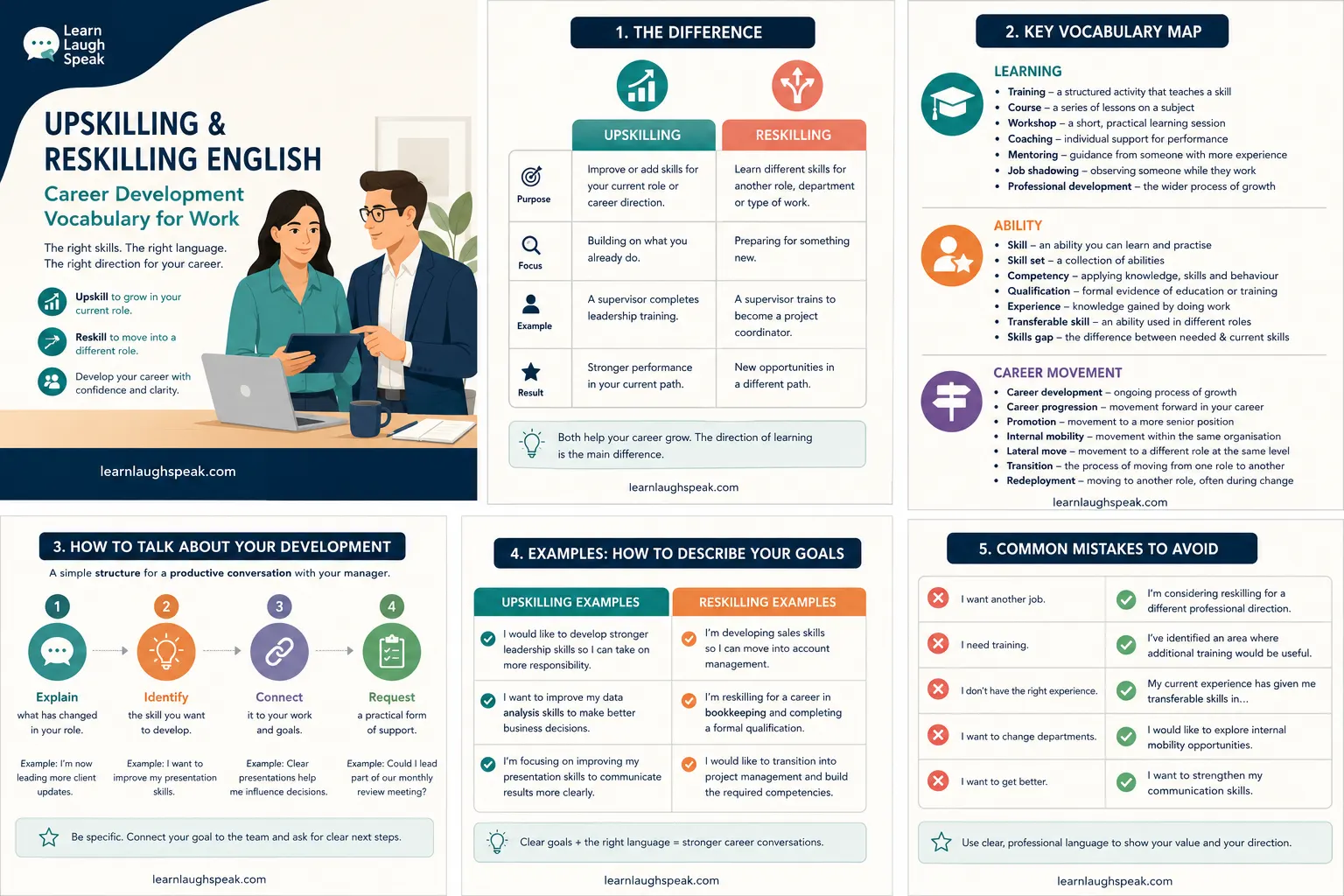
Upskilling and reskilling English is the language professionals use to discuss improving existing skills, preparing for a different role, requesting training, and planning career growth. Upskilling means developing abilities that support your current role or career direction. Reskilling means learning different abilities so you can move into another role, department, or type of work.
A sales manager who completes advanced negotiation training is upskilling.
A hotel manager who trains to become a project coordinator is reskilling.
The ideas are not difficult, but the workplace vocabulary can be. Terms such as skills gap, competency, professional development, internal mobility, and career progression often appear in HR emails, appraisals, interviews, and meetings with managers.
This guide explains upskilling and reskilling English through realistic career situations, practical vocabulary, and language professionals can use at work.
For a wider introduction to professional communication, read what Business English is and why it matters.
What Upskilling and Reskilling English Means at Work
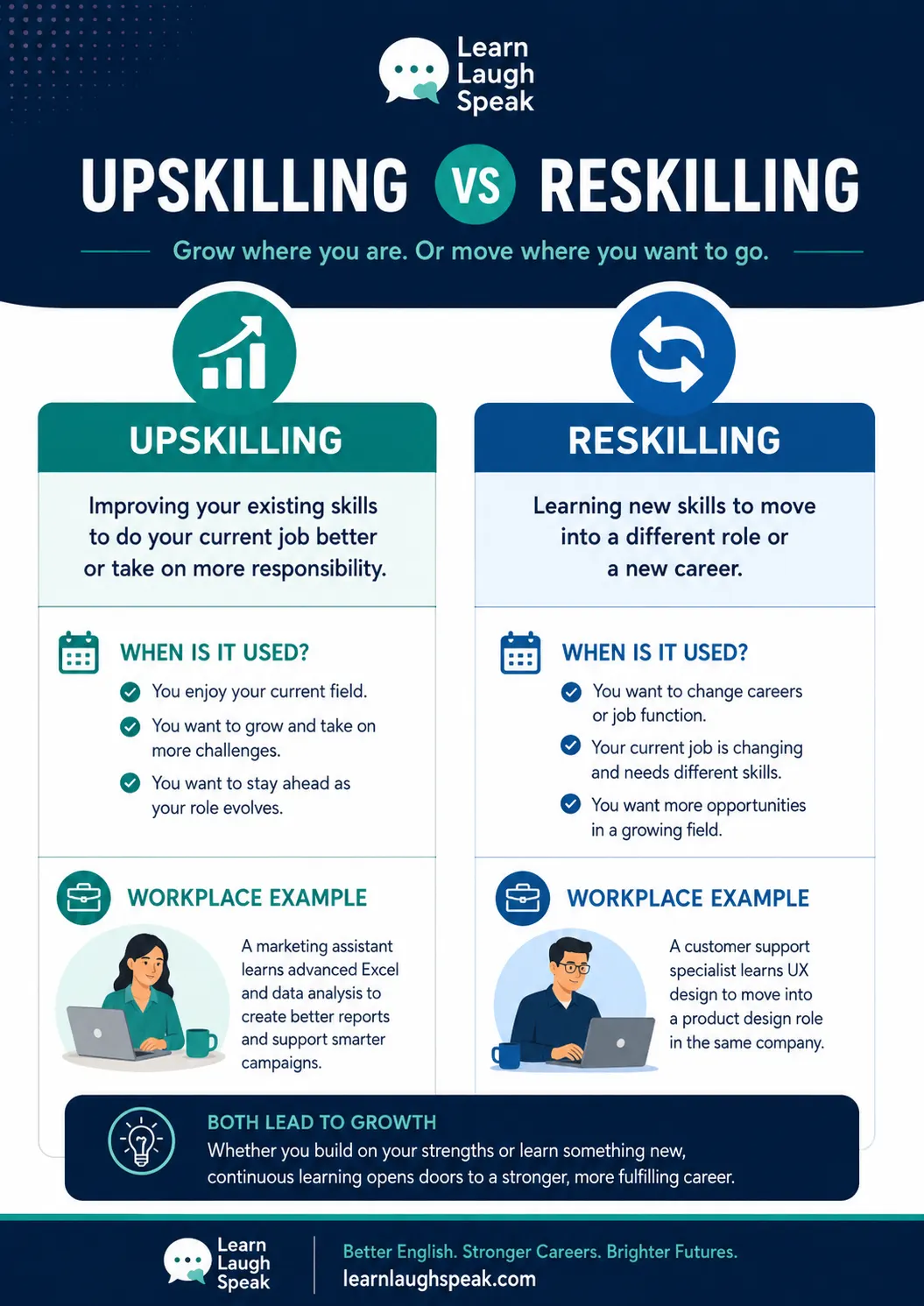
The simplest difference is the direction of the learning.
| Term | Main purpose | Example |
|---|---|---|
| Upskilling | Improving or adding skills for your current role or career direction | A supervisor completes leadership training |
| Reskilling | Learning skills for a different role or professional direction | A supervisor trains to move into recruitment |
| Retraining | Learning again because work has changed or you are preparing for different work | A warehouse employee retrains as a technician |
| Professional development | The wider process of improving throughout your career | Courses, mentoring, coaching, and practical experience |
The Cedefop definition of upskilling describes it as targeted training that supplements, improves, or updates existing knowledge, skills, and competencies.
Its definition of retraining and reskilling focuses on acquiring new skills that provide access to another occupation or professional activity.
The distinction depends on the goal, not only the course.
Learning English can be upskilling when it helps someone communicate more effectively in their current job.
It can be reskilling when it prepares that person for a different profession, an international position, or work in another industry.
That is why the language must always be understood in context.
Where This Career Vocabulary Appears at Work
Career-development language often appears before an employee has decided to take a course.
You may see it in:
- a job description
- a performance review
- an employee-development plan
- an HR email
- a training announcement
- an internal vacancy
- a restructuring update
- a conversation about promotion
- a meeting about changing departments
A manager might say:
We need to identify the skills gaps within the team.
In simpler English, this means:
We need to decide which important abilities the team is missing.
HR might write:
Employees affected by the restructure will be offered reskilling and redeployment opportunities.
In simpler English:
Employees whose jobs are changing may receive training and move into other positions in the organisation.
This vocabulary is becoming more common because employers expect significant changes in the abilities people need.
According to the World Economic Forum’s Future of Jobs Report 2025, 59 out of every 100 workers may need training by 2030. The report also found that 85% of surveyed employers planned to prioritise workforce upskilling.
The purpose of learning these terms is not to make your English more complicated. It is to understand formal workplace language and respond clearly.
Three Career Situations That Show the Difference
The difference becomes easier to understand when you see it inside a real career decision.
Situation 1: Growing in Your Current Role
Elena works in customer service. She already handles customer questions, but she wants to become a team leader.
Her development goals include:
- giving clearer feedback
- managing difficult conversations
- leading short team meetings
- coaching new employees
Elena is upskilling because she is strengthening abilities connected to her current career direction.
She could explain her goal like this:
I would like to develop stronger leadership and coaching skills so I can prepare for more responsibility within the team.
This is more useful than saying:
I want to improve at work.
The first sentence identifies the skills, the reason, and the intended result.
Situation 2: Moving to Another Department
Marco works in hotel operations but wants to move into sales.
He already has transferable skills in:
- customer service
- relationship building
- problem-solving
- handling pressure
- understanding guest needs
However, he still needs to develop:
- prospecting
- account management
- negotiation
- sales reporting
- commercial vocabulary
Marco is reskilling because he is preparing for a different professional function.
He could say:
My hospitality experience has given me strong transferable skills, but I would need additional training in negotiation and account management before moving into sales.
Situation 3: Changing Career Direction
Priya is an administrator who wants to become a bookkeeper.
She plans to complete a formal course, practise with accounting software, and gain an entry-level qualification.
This is also reskilling, but it involves a larger career change.
She could explain:
I’m currently reskilling for a career in bookkeeping. My administrative experience has given me strong organisational skills, and I’m now developing the technical knowledge required for the new role.
These examples show why upskilling and reskilling English is about more than two definitions. It helps professionals connect previous experience, current training, and future goals.

The Vocabulary Map: Learning, Ability and Career Movement
Career-development vocabulary becomes easier when it is grouped by purpose.
Words for Learning
| Word | Meaning | Example |
|---|---|---|
| Training | A structured activity that teaches a skill or task | I completed customer-service training. |
| Course | A series of lessons on a subject | I enrolled in a leadership course. |
| Workshop | A short, practical learning session | We attended a negotiation workshop. |
| Coaching | Individual support focused on performance | My manager provides presentation coaching. |
| Mentoring | Guidance from someone with more experience | I joined the company’s mentoring programme. |
| Job shadowing | Observing someone while they work | I spent two days job shadowing the sales manager. |
| Professional development | The wider process of career learning and growth | The qualification is part of my professional development. |
Words for Ability
| Word | Meaning | Example |
|---|---|---|
| Skill | An ability you can learn and practise | Negotiation is an important skill. |
| Skill set | A collection of abilities | Her skill set includes sales and account management. |
| Competency | The ability to apply knowledge, behaviour, and skills effectively | Leadership is a core competency for the role. |
| Qualification | Formal evidence of education or training | He holds a project-management qualification. |
| Experience | Knowledge gained by doing work | I have five years of customer-service experience. |
| Transferable skill | An ability that can be used in different roles or industries | Problem-solving is a transferable skill. |
| Skills gap | A difference between the abilities required and those currently available | The training will help address our skills gap. |
Words for Career Movement
| Word | Meaning | Example |
|---|---|---|
| Career development | The ongoing process of building your professional abilities and direction | I want to discuss my career development. |
| Career progression | Movement forward in your career | The company offers clear career progression. |
| Promotion | Movement to a more senior position | She received a promotion to department manager. |
| Internal mobility | Movement into another opportunity within the same organisation | Internal mobility allowed him to join the finance team. |
| Lateral move | Movement to a different role at a similar level | She made a lateral move into training. |
| Transition | The process of moving from one role or field to another | He is preparing for a transition into sales. |
| Redeployment | Moving an employee to another role, often during restructuring | The organisation offered redeployment to affected employees. |
How to Describe Your Current Skills Clearly
Professionals often know what they can do but use language that is too broad.
For example:
I am good with people.
This is understandable, but it does not tell a manager or recruiter enough.
A clearer version would be:
I build strong client relationships and remain calm during difficult conversations.
Instead of:
I have many skills.
Try:
My current skill set includes customer service, team coordination, and complaint resolution.
Instead of:
I need to get better at presentations.
Try:
Presentation skills are an important development area for me, particularly when I need to explain results to senior managers.
The goal is not to replace every simple word with formal vocabulary. The goal is to make the meaning more precise.
Professionals who need help adjusting their tone can also review how to sound more professional in English at work.
Discussing Professional Development With Your Manager
A development conversation is more productive when the request connects a skill to a real workplace need.
A useful structure is:
- Explain what has changed.
- Identify the skill you want to develop.
- Connect it to your work.
- Request a practical form of support.
Example
I’m now leading more client updates, and I would like to improve my presentation skills. A short course would help, but I would also like opportunities to practise by leading part of our monthly review meeting. Could we include this in my development plan?
This request works because it is specific.
It explains:
- the new responsibility
- the development need
- the learning method
- the opportunity to practise
- the desired next step
Other natural phrases include:
I’ve identified negotiation as an area I would like to strengthen.
Which competencies should I focus on during the next six months?
Are there any projects that would help me gain experience in this area?
Could I shadow someone who already performs this role?
I would appreciate your feedback on the skills I should prioritise.
Is there a relevant course or mentoring opportunity available?
The LinkedIn Workplace Learning Report found that only 15% of surveyed employees said their manager had helped them build a career plan during the previous six months. This makes it useful for employees to enter development conversations with a clear goal and specific questions.
For more support with this type of conversation, see how to improve your professional language in English.
Discussing Reskilling and a Possible Career Change
Reskilling conversations require a slightly different structure.
You need to explain:
- the professional direction that interests you
- which current abilities are relevant
- which new skills you still need
- how you plan to gain experience
Avoid focusing only on what you dislike.
Instead of:
I’m bored in my department and want another job.
Try:
I’ve learned a great deal in my current role, and I’m interested in developing the skills required for a move into account management.
Instead of:
I do not have the right experience.
Try:
My customer-service background has given me transferable skills in communication and relationship management, although I would need more commercial and negotiation experience.
Instead of:
I want to change careers completely.
Try:
I’m exploring a longer-term transition into project management and would like to understand which qualifications and practical experience would be most relevant.
This language acknowledges both your existing value and the work still required.
A related Learn Laugh Speak guide explains how professionals can use professional English to advance their careers.
A Full Career-Development Meeting in English
The following conversation shows the vocabulary in context.
Employee:
Could we use part of today’s meeting to discuss my professional development?
Manager:
Of course. Which area would you like to focus on?
Employee:
I’m taking on more responsibility for client updates, so I would like to strengthen my presentation and meeting-management skills.
Manager:
That sounds relevant to your current role. What type of support would help?
Employee:
I found a short presentation course, but I would also like practical experience. Could I lead the first section of our monthly client review?
Manager:
Yes. We can use the next review as a development opportunity and discuss your progress afterwards.
Employee:
Thank you. I’m also interested in the longer-term path into account management.
Manager:
That would require a broader skill set. You already have strong customer-service experience, but you would need more exposure to negotiation, renewals, and commercial reporting.
Employee:
Would it be possible to shadow an account manager or support a cross-department project?
Manager:
That would be a good first step. Let’s add it to your development plan and review it again in three months.
The conversation has two clear parts:
- The employee is upskilling for stronger performance in the current role.
- The employee is beginning to reskill for a possible future move.
The manager does not promise a promotion or transfer. Both people agree on practical actions and a review point.
Common English Mistakes in Career Conversations
A few small language points frequently appear in career-development conversations.
“Discuss” or “Discuss About”?
Use discuss without about.
Correct:
I would like to discuss my development plan.
Incorrect:
I would like to discuss about my development plan.
You can use about after talk:
I would like to talk about my development plan.
This distinction also appears in our guide to common Business English mistakes.
“Training” or “Trainings”?
In standard international Business English, training is usually uncountable.
Natural:
I received additional training.
I completed three training courses.
The company organised two training sessions.
Less natural internationally:
I completed three trainings.
“Experience” or “Experiences”?
Use experience as an uncountable noun when referring to knowledge gained through work.
I have experience in sales.
Use experiences for separate events or situations.
Working in three countries gave me several valuable professional experiences.
“Skill” or “Skills”?
Use skill for one ability:
Negotiation is a useful skill.
Use skills for more than one:
The role requires strong communication and leadership skills.
Use skill set for a connected collection:
My skill set includes sales, negotiation, and client retention.
“Career Path” or “Career Progression”?
A career path is the possible route through different roles.
The usual career path moves from coordinator to manager.
Career progression is the act or possibility of moving forward.
I would like clearer opportunities for career progression.
Simple English and Clearer Workplace English
Formal language is useful only when it improves precision.
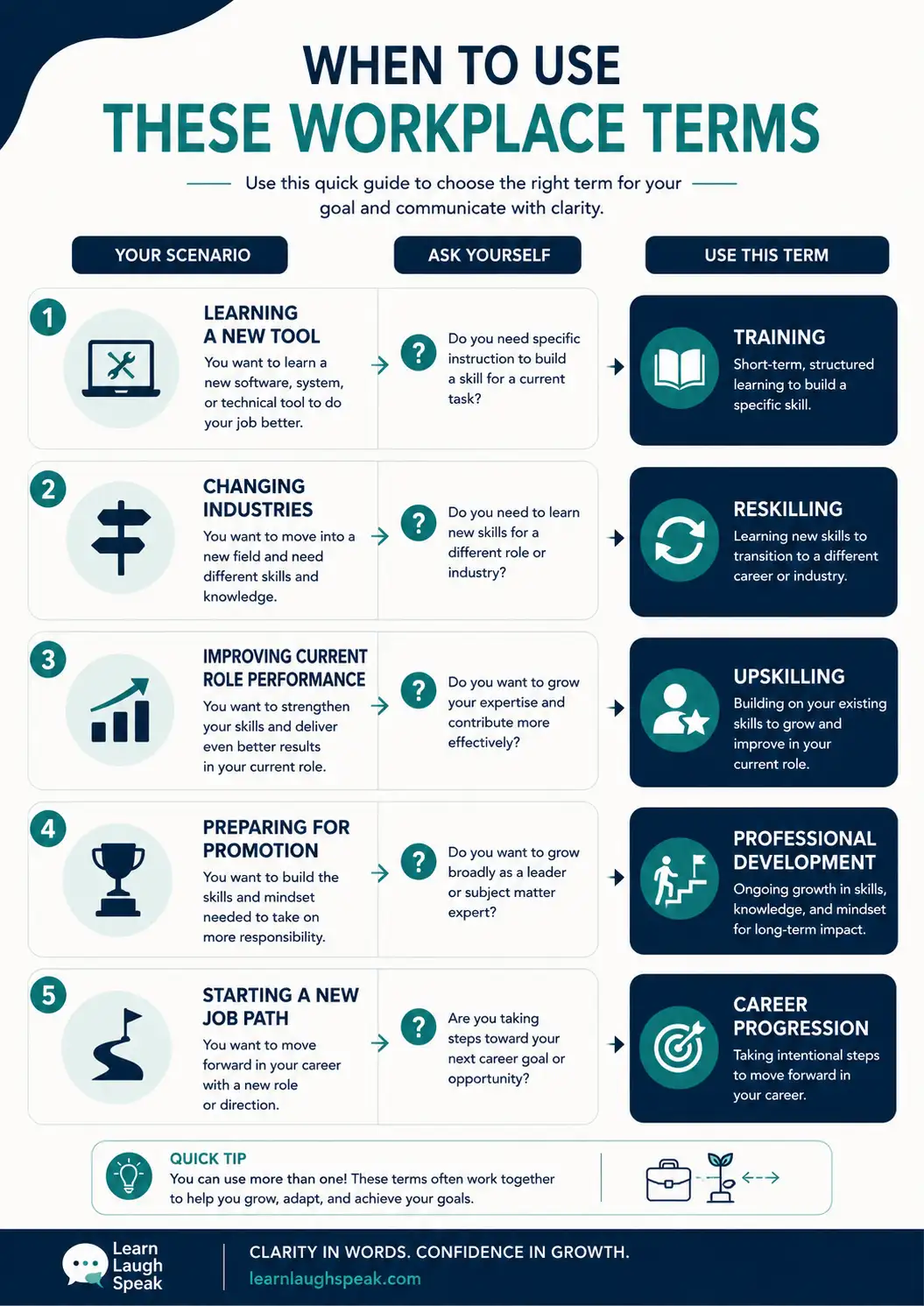
| Simple English | Clear workplace English |
|---|---|
| I want to learn more. | I would like to develop my current skill set. |
| I need training. | I’ve identified an area where additional training would be useful. |
| I want another job. | I’m considering reskilling for a different professional direction. |
| I want to change departments. | I would like to explore internal mobility opportunities. |
| I want a promotion. | I would like to understand what I need to demonstrate to progress. |
| I can use these skills elsewhere. | These are transferable skills that I can apply in another role. |
| I need experience. | I would like to gain practical experience in this area. |
| I am not qualified. | I meet several requirements, although I would need additional training in… |
| What course should I do? | Which training would be most relevant to my development goals? |
The professional versions are not better because they are longer. They are better because they give the listener more useful information.
Common Collocations for Career Development
A collocation is a natural combination of words.
| Verb | Natural combination |
|---|---|
| develop | develop a skill |
| strengthen | strengthen a competency |
| gain | gain experience |
| build | build confidence |
| complete | complete a course |
| earn | earn a qualification |
| receive | receive training |
| identify | identify a skills gap |
| address | address a development need |
| create | create a development plan |
| set | set a learning goal |
| take on | take on more responsibility |
| pursue | pursue a new career |
| make | make a career change |
| apply | apply transferable skills |
| progress | progress into a senior role |
| transition | transition into another position |
Examples:
I would like to gain experience in project management.
The course will help me develop my leadership skills.
The programme was created to address a skills gap.
I’m ready to take on more responsibility.
She is preparing to transition into another role.
Learning complete word combinations can make professional speech more automatic. This is especially useful for learners who are trying to stop translating in their heads.
Barriers to Career Training
Not every employee can access training easily.
Common barriers include:
- limited time
- course costs
- family responsibilities
- unsuitable schedules
- lack of employer support
- uncertainty about which course to choose
- low confidence
- language difficulties
- limited opportunities to practise
The OECD explains that barriers can appear before adults consider training, while they compare options, during the decision-making process, or after enrolment.
Its policy brief on helping adults overcome barriers to training highlights support such as career guidance, financial assistance, training leave, flexible learning formats, and inclusive learning environments.
This context matters because “complete more training” is not always a realistic solution.
A useful development plan should consider:
- the employee’s goal
- the time available
- the learner’s current level
- workplace support
- opportunities to practise
- how progress will be measured
Career Vocabulary Practice
Choose the correct answer.
1. Upskilling or reskilling?
A customer-service supervisor completes an advanced complaint-management course.
Answer: Upskilling
2. Upskilling or reskilling?
The same supervisor trains to become a graphic designer.
Answer: Reskilling
3. Skill or qualification?
A recognised project-management certificate is a formal ________.
Answer: Qualification
4. Skill or skill set?
Communication, negotiation, sales, and account management form her professional ________.
Answer: Skill set
5. Promotion or internal mobility?
An employee moves from operations into marketing at the same level within the same organisation.
Answer: Internal mobility
6. Training or professional development?
A one-day workshop on workplace safety is ________.
Answer: Training
7. Transferable or technical skill?
The ability to build strong client relationships can be useful in many industries.
Answer: Transferable skill
8. Career development or career progression?
Moving into a senior management position is an example of career ________.
Answer: Progression

How Professional English Supports Career Growth
Professional English can support both learning paths.
It may be part of upskilling when someone needs English to:
- participate more confidently in meetings
- write clearer emails
- manage international clients
- give presentations
- handle complaints
- lead a multilingual team
It may be part of reskilling when English helps someone:
- enter an international industry
- move into a customer-facing position
- apply for work in another country
- transition from operations into sales
- prepare for a profession where English is required
This is the practical purpose of upskilling and reskilling English: connecting language development to a clear professional situation rather than memorising isolated HR terms.
Building confidence when speaking English can also help learners use this vocabulary during real conversations instead of only recognising it on a page.
FAQs About Upskilling and Reskilling English
What does upskilling mean?
Upskilling means improving, updating, or adding skills that support your current role or career direction.
What does reskilling mean?
Reskilling means learning different skills so you can prepare for another role, occupation, department, or professional activity.
What is the main difference between upskilling and reskilling?
The main difference is the intended direction. Upskilling supports your existing professional path. Reskilling prepares you for different work.
Is learning English upskilling or reskilling?
It can be either.
It is usually upskilling when English improves performance in a current job. It may be reskilling when English is part of preparing for a different profession or industry.
Is reskilling the same as changing careers?
Not always. Reskilling may support a complete career change, but it can also prepare someone to move into another role or department within the same organisation.
What is a transferable skill?
A transferable skill is an ability that can be used in different roles or industries. Communication, organisation, leadership, customer service, and problem-solving are common examples.
What is the difference between training and professional development?
Training usually focuses on a particular skill, task, or requirement.
Professional development is broader and may include training, coaching, mentoring, experience, qualifications, and long-term career planning.
What does internal mobility mean?
Internal mobility means moving into another opportunity within the same organisation. It may involve a promotion, a lateral move, a department change, or a temporary assignment.
How should I mention upskilling on my résumé?
Name the specific course, skill, qualification, or result rather than writing only “upskilling.”
For example:
Completed advanced negotiation training and applied the techniques during client-renewal discussions.
Is “discuss about” correct?
No. Say discuss something or talk about something.
We need to discuss my development plan.
We need to talk about my development plan.
Final Thoughts on Upskilling and Reskilling English
Understanding upskilling and reskilling English makes formal career-development conversations easier to follow.
Upskilling means improving abilities that support your current professional direction. Reskilling means developing different abilities for another role or type of work.
Related terms such as professional development, skills gap, career progression, transferable skills, and internal mobility describe different parts of that process.
The language may sound formal, but the purpose is simple: to explain what a person can do now, what they need to learn, and where they want their career to go.