
 English
 Arabic
 Chinese (Simplified)
 Dutch
Dutch French
 German
 Italian
 Portuguese
 Russian
 Spanish
These tips to fluency will help you build better English habits, speak with more confidence, and use the language more naturally in real situations.
There are many ways to improve your fluency in English.
Some learners focus on grammar rules.
Others focus on speaking, listening, vocabulary, or pronunciation.
The truth is that real fluency comes from combining all of these skills and practising them regularly.
Whether you are learning English for work, study, travel, or daily communication, the goal is not to be perfect.
The goal is to communicate clearly, keep improving, and feel more confident every time you use English.

Why These Tips to Fluency Help English Learners
Fluency does not happen in one day.
It improves when you practise often, use the language in real situations, and build habits that help your brain respond faster in English.
Many learners know grammar and vocabulary, but still feel slow when they speak.
This usually happens because they do not practise using English actively enough.
The best tips to fluency are simple, practical, and consistent.
You need to speak, listen, read, write, review, and practise regularly.
You also need patience because progress takes time.
28 Presentation Phrases in English for Work and Meetings
Quick Guide: 18 Tips to Improve Fluency
Here is a simple overview of the main areas you should practise.
| Fluency Area | What to Practise | Why It Helps |
|---|---|---|
| Speaking | Short daily conversations | Builds speed and confidence |
| Listening | Music, podcasts, videos, or lessons | Helps you understand natural English |
| Vocabulary | Flashcards, reading, and real examples | Gives you more words to use |
| Grammar | Short focused practice | Helps you speak more accurately |
| Confidence | Repeating useful phrases out loud | Makes speaking feel easier |
| Routine | Daily practice habits | Creates steady progress |
Now let’s look at the 18 tips in more detail.
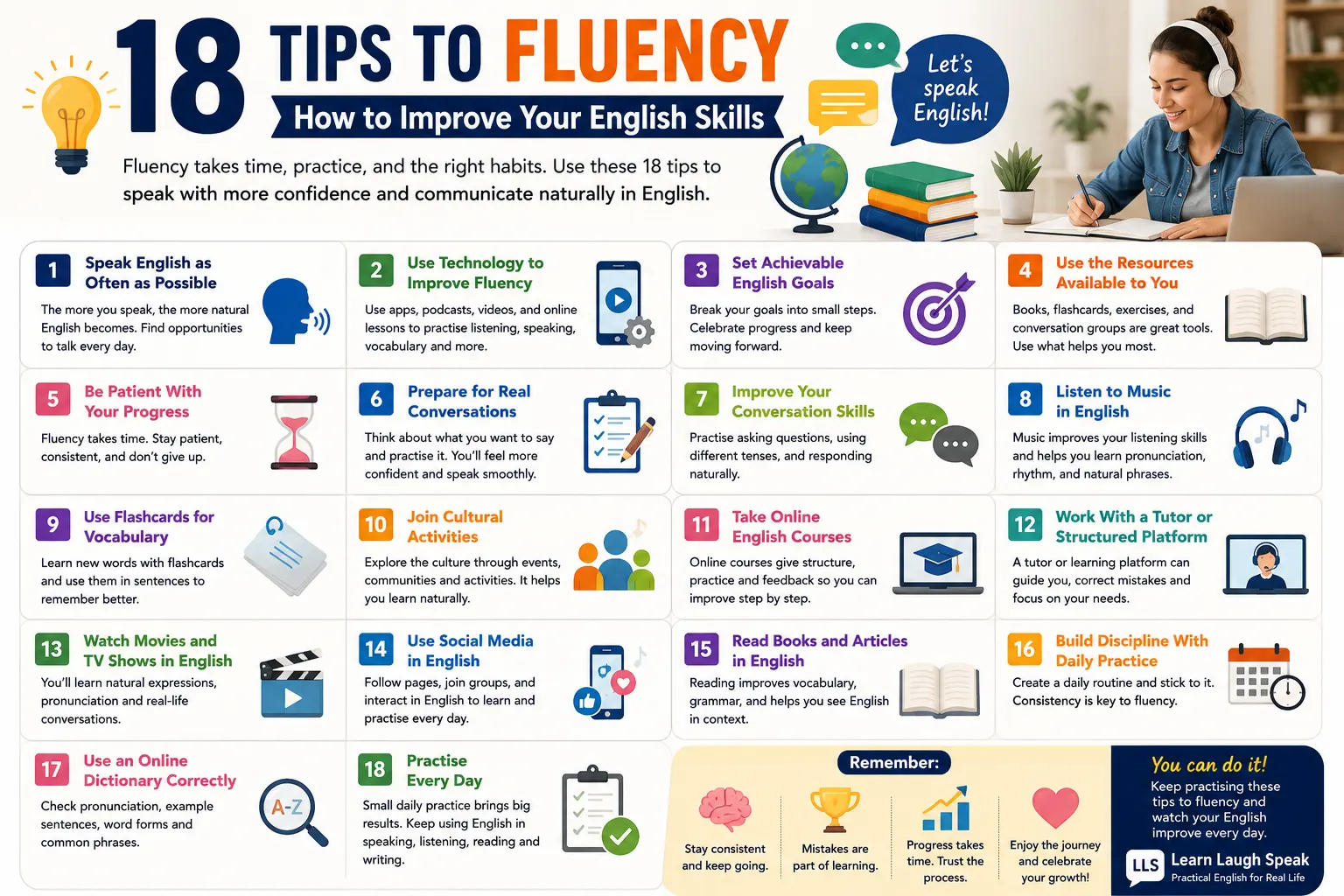
1. Speak English as Often as Possible
The more you speak, the more natural English becomes.
This may sound obvious, but it is one of the most important tips to fluency.
Speaking helps you practise sentence structure, pronunciation, vocabulary, and confidence at the same time.
Try to find opportunities to speak English every day.
You can talk to native speakers, classmates, teachers, coworkers, or other learners.
You can also speak to yourself when practising.
For example, describe what you are doing:
“I’m making coffee.”
“I’m preparing for a meeting.”
“I need to send this email before 3 PM.”
Small daily speaking habits help your brain become faster in English.
2. Use Technology to Improve Fluency
Technology can help you practise English anywhere.
There are many tools that support pronunciation, listening, vocabulary, grammar, and speaking practice.
You can use:
English learning apps.
Online dictionaries with audio.
Speech recognition tools.
Video lessons.
Podcasts.
Subtitles.
Online courses.
Pronunciation recordings.
Technology is useful because it gives you more ways to hear and repeat English.
For example, if you are learning a new word, listen to the pronunciation, repeat it out loud, and then use it in a sentence.
This helps you move from passive learning to active use.
3. Set Achievable English Goals
It is important to set realistic goals when improving fluency.
Do not try to learn everything at once.
That can feel overwhelming and make you lose motivation.
Instead, break your goals into smaller steps.
For example:
Learn 10 useful work phrases this week.
Practise speaking for five minutes every day.
Watch one short English video each morning.
Write three sentences about your day.
Learn how to explain one work task in English.
Small goals are easier to complete.
When you complete them, you build confidence and momentum.
This is one of the most practical tips to fluency because it helps you stay consistent.
4. Use the Resources Available to You
There are many resources that can help you improve your English fluency.
These include books, flashcards, online exercises, podcasts, videos, grammar guides, and conversation groups.
The key is not to use every resource.
The key is to choose resources that match your level and your goals.
If you want to improve speaking, use resources that make you speak.
If you want to improve listening, use audio and video.
If you want to improve writing, practise short emails, messages, and paragraphs.
Good resources should help you practise the English you actually need.
5. Be Patient With Your Progress
Learning a language takes time.
Do not get discouraged if you do not see progress immediately.
Some days you may feel confident.
Other days you may forget words or make mistakes.
This is normal.
Fluency improves slowly through repetition, practice, and real use.
Be patient with yourself.
Instead of asking, “Why am I not fluent yet?” ask:
“What can I practise today?”
“What mistake can I improve?”
“What phrase can I use better next time?”
Progress becomes easier when you focus on small improvements.
6. Prepare for Real Conversations
One great way to improve fluency is to prepare for conversations before they happen.
This is especially useful for work, meetings, interviews, phone calls, or customer conversations.
Before a conversation, think about:
What you need to say.
What questions the other person may ask.
What vocabulary you might need.
What phrases will help you sound polite and clear.
You can rehearse in your head or say the sentences out loud.
For example:
“I wanted to ask about the deadline.”
“Could you explain that again?”
“I’m not sure I understood the last point.”
Preparation helps you feel more confident when the real conversation starts.
7. Improve Your Conversation Skills
To improve your fluency, focus on real conversation skills.
This means practising more than just vocabulary.
You also need to practise:
Asking questions.
Giving opinions.
Agreeing and disagreeing politely.
Using different tenses.
Explaining ideas clearly.
Responding naturally.
Asking for clarification.
Good conversation is not about speaking perfectly.
It is about keeping communication moving.
For example, if you do not understand something, you can say:
“Sorry, could you repeat that?”
“Can you explain what you mean?”
“Let me make sure I understand.”
These simple phrases help you stay involved in the conversation.
8. Listen to Music in English
Listening to music in English can help improve your fluency because it exposes you to rhythm, pronunciation, and natural phrases.
Music can help you remember words more easily because melody and repetition support memory.
Choose songs you enjoy.
Read the lyrics while listening.
Repeat useful phrases out loud.
Try to notice connected speech, pronunciation, and common expressions.
You do not need to understand every word.
The goal is to listen regularly and become more comfortable with the sound of English.
9. Use Flashcards for Vocabulary
Flashcards are a simple and effective way to remember new words and phrases.
They help you focus on one word or expression at a time.
But do not only write the translation.
Write the word in a sentence.
For example:
Word: “deadline”
Sentence: “The deadline for the report is Friday.”
Word: “reschedule”
Sentence: “Can we reschedule the meeting for tomorrow?”
This helps you learn how the word works in real communication.
Flashcards are more useful when they include context.
10. Join Cultural Activities
Language and culture are connected.
When you join cultural activities, you see how English is used in real life.
This can include:
Conversation groups.
International events.
Online communities.
Book clubs.
Workshops.
Meetups.
English-speaking activities.
Cultural activities help you practise English in a more natural way.
They also help you learn expressions, tone, humor, and social language.
This is useful because fluency is not only about grammar.
It is also about understanding how people communicate.
11. Take Online English Courses
Online courses can help you improve your fluency because they give you structure.
A good course helps you practise step by step instead of guessing what to learn next.
Online courses may include:
Speaking practice.
Listening exercises.
Grammar review.
Vocabulary lessons.
Pronunciation support.
Quizzes and feedback.
Real-life examples.
The best course for you depends on your level and your goals.
If you need English for work, choose lessons that include meetings, emails, presentations, and professional conversations.
12. Work With a Tutor or Structured Platform
A tutor can help you improve faster because they can correct mistakes and focus on your specific needs.
A tutor may help with pronunciation, conversation, grammar, or confidence.
However, a structured platform can also be useful because it gives you a clear learning path.
Many learners improve more when they know exactly what to practise next.
This is why assessment, structure, and feedback are important.
If you want to improve fluency, you need more than random practice.
You need practice that matches your level.
13. Watch Movies and TV Shows in English
Watching movies and TV shows in English can help you hear natural speech, expressions, pronunciation, and different accents.
This is a fun way to improve listening skills.
Start with subtitles if needed.
You can use English subtitles to connect the sound with the words.
Choose short scenes and repeat them.
Pause and copy useful phrases.
For example, if a character says:
“Let me think about it.”
You can repeat it and practise using it in your own sentence.
Movies and shows are helpful because they show English in context.
14. Use Social Media in English
Social media can be a useful tool for fluency if you use it actively.
Follow English pages, teachers, creators, or professional accounts related to your interests.
Read comments.
Watch short videos.
Write small replies.
Save useful phrases.
You can also join groups for English learners or professional topics.
The key is to interact, not only scroll.
Try writing one comment in English each day.
Even short comments help you practise forming thoughts in English.
15. Read Books and Articles in English
Reading helps improve vocabulary, grammar, sentence structure, and confidence.
You do not need to read difficult books at first.
Start with articles, short stories, blog posts, or books that match your level.
Choose topics you enjoy.
Reading becomes easier when the topic is interesting.
As you read, write down useful phrases.
Do not only collect single words.
Collect chunks of language, such as:
“I would like to…”
“The main reason is…”
“According to the article…”
“This means that…”
These phrases help you speak and write more naturally.
16. Build Discipline With Daily Practice
Discipline is one of the most important tips to fluency.
You do not need to study for hours every day.
But you do need consistency.
Even 10 to 20 minutes a day can help if you practise with focus.
For example:
Monday: speaking practice.
Tuesday: listening practice.
Wednesday: vocabulary review.
Thursday: writing practice.
Friday: grammar review.
Saturday: movie or podcast.
Sunday: review the week.
A simple routine helps you keep moving forward.
Fluency improves when English becomes part of your daily life.
17. Use an Online Dictionary Correctly
An online dictionary is a great tool for improving fluency, but only if you use it properly.
Do not only check the translation.
Look at:
Pronunciation.
Example sentences.
Word form.
Common phrases.
Synonyms.
How the word is used in context.
For example, if you search the word “manage,” look at sentences like:
“She manages a small team.”
“We need to manage the deadline carefully.”
“He managed to finish the project on time.”
This helps you understand how the word works in real English.
18. Practise Every Day
The best way to improve your fluency skills is to practise every day.
The more you use English, the more natural it becomes.
You can practise by:
Speaking with a friend.
Reading a short article.
Watching a video.
Writing a message.
Repeating useful phrases.
Listening to a podcast.
Reviewing vocabulary.
Talking about your day.
Daily practice does not need to be perfect.
It just needs to be consistent.
This is one of the most important tips to fluency because small daily actions create long-term progress.
Final Thoughts on Tips to Fluency
Improving your English fluency takes time, but it is possible with the right habits.
Speak as much as you can.
Listen often.
Read regularly.
Practise useful vocabulary.
Prepare for real conversations.
Use technology and resources wisely.
Stay patient and consistent.
These tips to fluency are not about studying harder every day.
They are about practising smarter and using English in ways that connect to your real life.
The more you use English, the easier it becomes to speak naturally and confidently.

Tips to Fluency With Learn Laugh Speak
Learn Laugh Speak helps adult English learners improve speaking, listening, reading, writing, pronunciation, and grammar at the correct level.
Instead of guessing what to study next, students complete a full level assessment and begin learning from the exact point that matches their ability.
This makes practice more focused and helps learners improve step by step.
If you want to improve your fluency for work, study, or daily communication, Learn Laugh Speak gives you structured lessons, real examples, and clear progress.
With the right support and consistent practice, you can build stronger English fluency and communicate with more confidence.
Still need more tips to fluency to help you speak easily? Send us a email today!