
 English
 Arabic
 Chinese (Simplified)
 Dutch
Dutch French
 German
 Italian
 Portuguese
 Russian
 Spanish
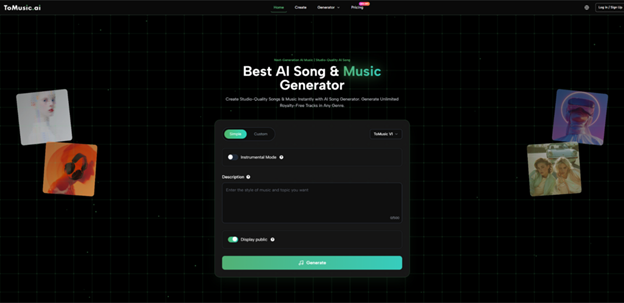
A lot of people assume AI music tools are for “people who can’t write music.” My experience was almost the opposite: the most useful moments were when the tool behaved like a practice room—an always-available way to test ideas, explore arrangements, and hear what your words might sound like when they become music.
That’s why I think an AI Music Generator can be meaningful even if you already write, sing, or produce—because it accelerates experimentation.
The Real Problem: You Can Write Words, But You Can’t Hear the Song Yet
- Problem: Lyrics on a page don’t tell you whether the chorus lifts, whether the cadence sings, or whether the mood lands
- Agitation: You can waste days polishing words that don’t fit a melody—or abandon good lyrics because you never found the right musical shape
- Solution: Generate musical drafts quickly so you can listen to your writing, not just read it
When I tried this approach, I stopped treating “first drafts” like something I needed to be proud of. I treated them like prototypes—something to test and learn from.
A Helpful Metaphor: It’s Like Trying on Outfits for Your Lyrics
Lyrics are the same words, but:
- in a pop arrangement, they feel bright and direct
- in a cinematic arrangement, they feel dramatic and spacious
- In lo-fi, they feel intimate and reflective.
AI generation makes that “outfit change” fast. Instead of guessing which style fits, you can try three.
How This Changes Your Writing Process
Traditional songwriting often moves like this:
- write lyrics → 2) search for chords/melody → 3) arrange → 4) revise lyrics to fit
AI drafting lets you flip it:
- write concept/lyrics → 2) generate draft → 3) revise lyrics based on what you hear → 4) regenerate or refine
That is an important shift: you’re no longer writing in a vacuum. You’re writing with immediate feedback.
Comparison Table: Practice vs. Production
Here’s a clear way to separate expectations:
| Goal | Traditional Path | AI Drafting Path |
| Find a hook that sings | Jam, record, revise repeatedly | Generate multiple drafts, keep the best chorus moments |
| Test lyrical cadence | Sing it yourself (or wait for a demo) | Hear how lines land across different musical contexts |
| Explore genre crossover | Learn new style conventions manually | Prompt style changes and compare outcomes quickly |
| Get a “demo” feeling | Requires arrangement and recording time | Fast prototypes (then refine the one worth keeping) |
| Final release quality | Full production workflow | Usually needs human finishing work |
If you treat AI drafts as “final,” you’ll be disappointed. If you treat them as “practice,” you’ll get value fast.
A Practical Way to Write
Lyrics for Better Results
In my tests, lyrics worked best when they had:
- clear sections (verse / chorus / bridge),
- consistent line length (cadence matters),
- simple imagery that supports mood.
Example structure you can reuse
- Verse: scene + emotion
- Pre-chorus: rising tension
- Chorus: the message in one sentence
- Bridge: contrast or confession
Even if you’re not trained in songwriting, that structure gives the generator something stable to interpret.
What I Noticed When Iterating
A pattern I didn’t expect: the tool helped me identify weak writing.
If the chorus felt flat across multiple generations, it usually wasn’t the music’s fault—it was the chorus concept. That’s valuable feedback. It pushes you to rewrite the hook instead of endlessly polishing the verse.
Another thing: when I tightened my prompts (tempo, instrument palette, vocal attitude), the outputs became less random and more “directed.” That made the practice feel intentional rather than lottery-based.
Where It’s Especially Useful
1. Chorus discovery
Generate several variations, then listen only for the chorus lift. You can “borrow” the emotional contour as inspiration for your own rewrite.
2. Genre translation
Try the same lyrics in two different styles. If one style suddenly feels natural, you’ve learned something about your own writing voice.
3. Emotional calibration
Sometimes the question isn’t “Is this good?” It’s “Is this the emotion I meant?” Drafts help you answer that quickly.
Limitations (The Honest Parts)
To keep expectations grounded:
- Prompt precision matters: vague prompts can lead to generic results.
- Multiple generations are normal: the first draft is often a direction, not a destination.
- Vocal nuance can vary: certain lyrical densities or genres may be less stable.
- You might still want to finish elsewhere: if you care about final mix, mastering, and full control.
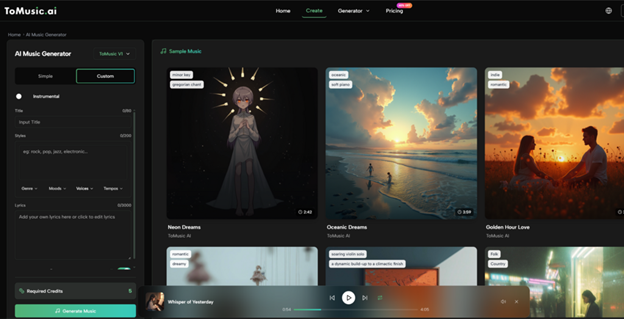
For me, the key was to treat limitations as part of the creative loop: generate → listen → adjust → regenerate.
A “Practice Routine” You Can Use in 15 Minutes
If you want a repeatable method:
- Write a one-sentence concept (the emotional core).
- Draft a simple chorus (4–8 lines
- Generate a version with clear style + tempo + instrument anchors
- Listen only for: hook strength, emotional tone, and cadence
- Rewrite the chorus based on what you heard
- Generate
That’s a compact loop that can produce real songwriting growth, not just output.
Closing Thought: The Value Isn’t Replacement—It’s Reflection
The best creative tools don’t replace you. They reflect you—fast enough that you can learn from the reflection.
When you can hear your lyrics as a song before you’ve invested hours into production, you gain something rare: the freedom to experiment without fear of wasting time. And that freedom is often where the best hooks come from.