
 English
 Arabic
 Chinese (Simplified)
 Dutch
Dutch French
 German
 Italian
 Portuguese
 Russian
 Spanish
Moving to the United States can be exciting, but everyday money language can feel confusing at first.
You may understand normal English conversations, but financial English is different. Banks, landlords, employers, phone companies, car dealers, credit card companies, and loan providers often use words that affect important decisions.
For many newcomers, the challenge is not only money itself. The challenge is understanding the words people use when they talk about money.
What is a credit score?
What does interest mean?
What is a loan term?
Why does a lender ask for income?
What does monthly payment really include?
These words matter because they appear in real situations. You may see them when opening a bank account, renting an apartment, buying a car, applying for a credit card, comparing loan options, or paying monthly bills.
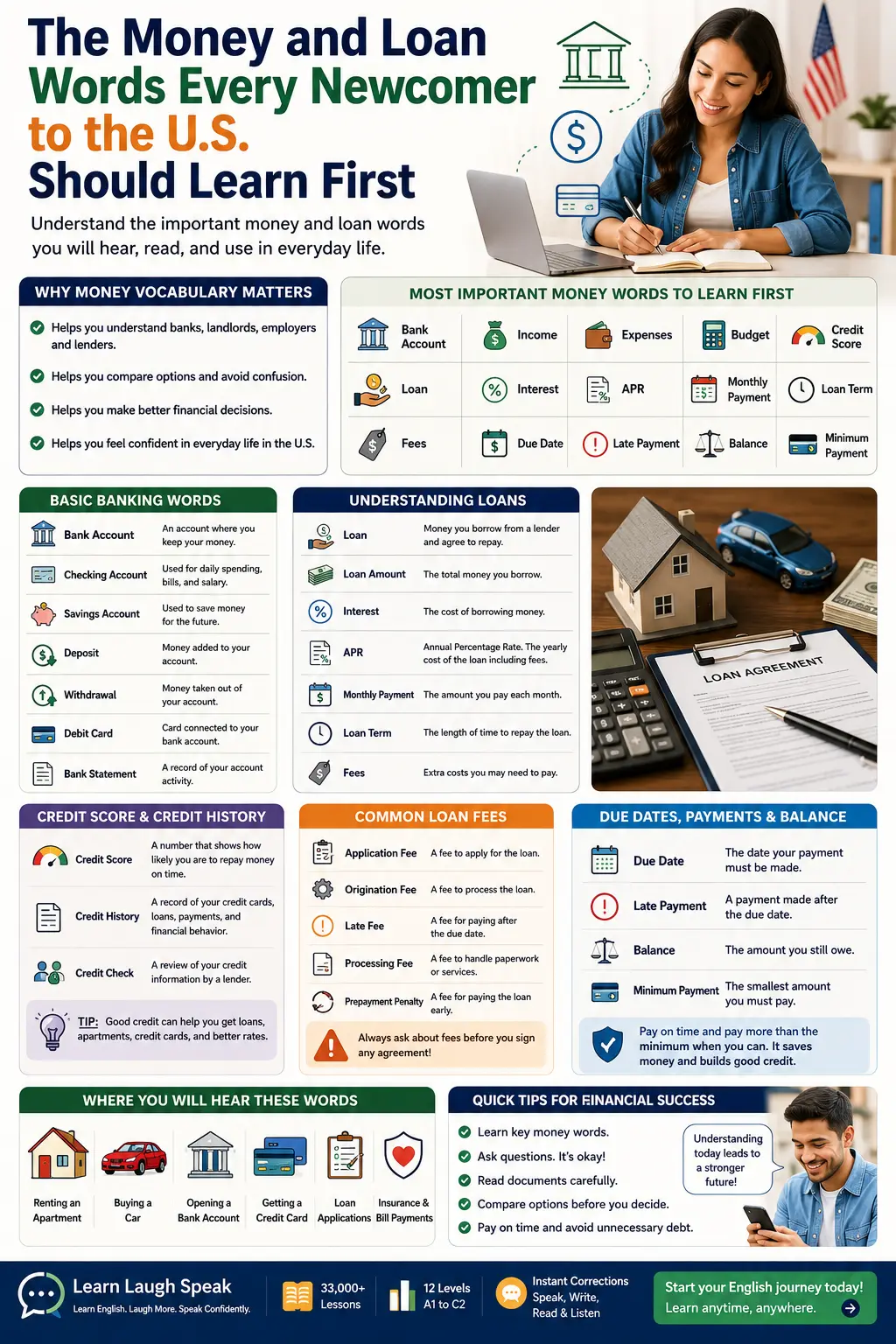
This guide explains the money and loan words every newcomer to the U.S. should learn first, using clear English and practical examples.
Why Money Vocabulary Matters in the U.S.
In the U.S., many parts of daily life are connected to financial records.
You may need proof of income to rent an apartment. You may need a bank account to receive salary payments. You may need credit history to apply for a credit card, car loan, phone plan, or apartment lease.
If you do not understand the vocabulary, it is easier to feel pressure or agree to something without knowing the full meaning.
Learning financial English helps you ask better questions, compare options, and avoid confusion.
It also helps you feel more confident when speaking with banks, employers, landlords, customer service teams, and lenders.
The First Money Words to Learn
Some financial words are more important than others when you first arrive in the U.S.
Start with these:
bank account
checking account
savings account
income
expenses
budget
credit score
credit history
loan
interest
APR
monthly payment
loan term
fees
due date
late payment
balance
minimum payment
You do not need to learn every financial word at once. Start with the words that appear in everyday life first.
Basic Banking Words
A bank account is an account where you keep your money.
A checking account is usually used for daily spending, salary deposits, rent, bills, and debit card payments.
Example:
My salary is deposited into my checking account.
A savings account is usually used to save money for later.
Example:
I keep emergency money in my savings account.
A debit card is connected to your bank account. When you use it, the money comes directly from your account.
Example:
I paid with my debit card.
A deposit means money added to an account.
Example:
My employer made a direct deposit.
A withdrawal means money taken out of an account.
Example:
I made a withdrawal from the ATM.
A bank statement is a record of your account activity.
Example:
The landlord asked for three months of bank statements.
These words are useful when opening an account, paying rent, receiving income, or proving your financial situation.
Income, Expenses and Budget
Income means money you receive.
This may come from a job, freelance work, a business, or another source.
Example:
My monthly income is $3,000.
Expenses are the things you pay for.
Common expenses include rent, food, transportation, insurance, phone bills, internet, utilities, and loan payments.
Example:
Rent is my biggest monthly expense.
A budget is a plan for how you use your money.
Example:
I made a budget to track my income and expenses.
A simple budget helps you see what comes in, what goes out, and how much is left.
For newcomers, this is important because many U.S. payments happen monthly. Rent, car payments, phone plans, insurance, and credit cards often follow a monthly schedule.
Credit Score and Credit History
A credit score is a number that helps lenders understand how likely you are to repay borrowed money on time.
A credit history is the record behind that score.
It may include credit cards, loans, payments, late payments, balances, and account history.
Example:
The bank checked my credit history before approving the loan.
When you are new to the U.S., you may not have a U.S. credit history yet. This can make some applications harder at first.
You may hear phrases like:
You have no credit history.
You need to build credit.
Your credit score is too low.
We need to run a credit check.
A credit check means a company reviews your credit information before making a decision.
Credit can affect apartment applications, credit cards, car loans, personal loans, and sometimes service plans.
Loan Words Newcomers Should Know
A loan is money you borrow and agree to repay.
The person or company giving the money is the lender.
The person receiving the money is the borrower.
Example:
The borrower must repay the loan every month.
The loan amount is the total money borrowed.
Example:
The loan amount is $5,000.
The loan term is the length of time you have to repay the loan.
Example:
The loan term is 24 months.
A monthly payment is the amount you pay each month.
Example:
My monthly payment is $220.
Interest is the cost of borrowing money.
Example:
The loan has a high interest rate.
APR means annual percentage rate. It helps show the yearly cost of borrowing, including interest and some costs or fees.
Example:
The APR is higher than the interest rate because it includes more costs.
When you compare loans, do not only look at the monthly payment. Also look at the APR, fees, loan term, and total cost.
This is why understanding loans as a newcomer to the U.S. is important before signing any agreement.
Common Loan Fees and Costs
A fee is an extra cost.
Some loans may include fees such as:
application fee
origination fee
late fee
processing fee
prepayment penalty
An application fee is a cost to apply.
An origination fee is a fee some lenders charge to create or process the loan.
A late fee is charged when you pay after the due date.
A prepayment penalty is a fee some lenders charge if you pay the loan early.
Not every loan has all of these fees, but you should always ask.
Useful questions:
Are there any fees?
Is there a late payment fee?
Is there a prepayment penalty?
What is the total cost of the loan?
What will I pay each month?
These questions help you understand the agreement before you accept it.
Due Date, Late Payment and Balance
The due date is the date your payment must be made.
Example:
My payment is due on the 15th of every month.
A late payment happens when you pay after the due date.
Example:
A late payment may hurt your credit history.
A balance is the amount still owed.
Example:
My remaining balance is $1,200.
A minimum payment is the smallest amount you must pay by the due date, often used with credit cards.
Example:
The minimum payment is $35.
Paying only the minimum may keep the account active, but it can cost more over time if interest continues to grow.
Credit Card Words
A credit card lets you borrow money up to a limit and repay it later.
A credit limit is the maximum amount you can borrow on the card.
Example:
My credit limit is $1,000.
A statement shows your purchases, payments, interest, fees, and balance.
Example:
I checked my credit card statement online.
A billing cycle is the time period covered by one statement.
Example:
My billing cycle ends on the 20th.
A minimum payment is the smallest amount you must pay.
A full payment means you pay the full balance.
Example:
I paid the full balance to avoid interest.
Credit cards can help build credit, but they can also become expensive if you do not understand interest, fees, due dates, and balances.
Words You May Hear When Renting an Apartment
Money vocabulary is also important when renting a home.
A lease is a rental agreement.
Example:
I signed a one-year lease.
A security deposit is money paid before moving in. It may be returned if there is no damage and all lease rules are followed.
Example:
The security deposit is one month’s rent.
Proof of income is evidence that you earn money.
Example:
The landlord asked for proof of income.
A background check is a review of your history.
A credit check is a review of your credit information.
Example:
The apartment application includes a credit check.
These words are important because renting in the U.S. often includes paperwork, financial questions, and payment deadlines.
How to Ask Questions Before Borrowing Money
If you are not sure about a loan, it is okay to ask questions.
You can say:
Can you explain this in simple terms?
What is the total amount I will pay?
What is the APR?
Are there any extra fees?
What happens if I miss a payment?
Can I pay early without a penalty?
Is this monthly payment fixed or can it change?
Can I have this information in writing?
These questions are polite, clear, and useful.
Never feel embarrassed about asking for clarification. Financial words can be difficult even for native English speakers.
Fixed Rate and Variable Rate
A fixed rate means the interest rate stays the same during the loan.
Example:
This loan has a fixed interest rate.
A variable rate means the interest rate can change.
Example:
The monthly payment may change because the rate is variable.
For newcomers, this difference is important.
If a payment can change later, ask:
How much can it increase?
When can the rate change?
What is the highest possible payment?
Understanding this can help you avoid surprises.
Secured and Unsecured Loans
A secured loan is connected to something valuable, called collateral.
Collateral may be a car, property, or another asset.
Example:
The car is collateral for the loan.
An unsecured loan does not use collateral in the same way.
Example:
This personal loan is unsecured.
Secured loans may have different requirements because the lender has an asset connected to the agreement.
Before signing anything, make sure you understand what happens if you cannot pay.
Good Questions to Ask Yourself
Before borrowing money, ask yourself:
Do I understand the monthly payment?
Do I know the total cost?
Can I afford this payment every month?
What happens if I lose income?
Are there extra fees?
Do I understand the contract?
Have I compared more than one option?
Do I need this loan now, or can I wait?
These questions can help you make a calmer decision.
A Simple Money Vocabulary Example
Imagine you want to buy a car.
The dealer says:
The loan amount is $12,000. The APR is 9%. The loan term is 60 months. Your monthly payment is $249, and your first payment is due next month.
To understand this, you need to know:
loan amount = how much you borrow
APR = yearly borrowing cost
loan term = how long you repay
monthly payment = what you pay each month
due = when payment must be made
Without these words, the sentence feels difficult.
With these words, you can ask better questions.
For example:
What is the total cost after 60 months?
Are there any extra fees?
Can I pay early?
What happens if I pay late?
Financial English Is Practical English
Money vocabulary is not only for banks.
It appears in normal adult life.
You may need these words when:
renting an apartment
starting a job
buying a car
opening a bank account
getting insurance
paying bills
building credit
applying for a credit card
speaking with customer service
signing a contract
This is why financial English is practical English.
It helps you protect yourself, ask better questions, and understand your choices.
Common Mistakes Newcomers Make
One common mistake is only looking at the monthly payment.
A low monthly payment may look easy, but the loan may last longer and cost more overall.
Another mistake is ignoring fees.
Small fees can add up.
Another mistake is signing before reading.
If the language is difficult, ask for time. You can say:
I need time to review this before I sign.
Another mistake is not asking about late payments.
You should understand what happens if a payment is missed or delayed.
Another mistake is feeling embarrassed.
It is normal to ask questions about financial documents. Clear understanding is more important than pretending everything is okay.
Useful Sentences for Financial Conversations
Here are practical sentences you can use.
Can you explain this fee?
When is the payment due?
What is the interest rate?
What is the APR?
How long is the loan term?
Is the payment fixed?
Can the payment change?
What is the total amount I will repay?
Can I get a copy of the agreement?
I would like to compare options before deciding.
I need time to read this carefully.
These sentences are simple, professional, and useful in real life.
Final Thoughts
Learning money and loan vocabulary helps newcomers feel more confident in the U.S.
You do not need to understand every financial term immediately.
Start with the words that appear most often:
income
expenses
budget
bank account
credit score
loan
interest
APR
monthly payment
loan term
fees
due date
balance
Once these words become familiar, financial conversations become easier.
You can ask better questions, compare choices, and make decisions with more confidence.
For anyone learning financial English, understanding loans as a newcomer to the U.S. is a helpful step toward feeling more prepared in everyday life.
Learn Financial English With Learn Laugh Speak
Learn Laugh Speak helps adult English learners improve reading, writing, speaking, listening, pronunciation, grammar, and vocabulary at the correct level.
Financial English can feel stressful because the words are connected to real decisions. But with structured practice, learners can build confidence step by step.
With Learn Laugh Speak, students complete a full level assessment and begin learning from the exact point that matches their ability.
You can practise real English for work, daily life, customer service, banking, professional conversations, and practical situations.
If you want to improve your English and feel more confident using important vocabulary in real life, Learn Laugh Speak can help you make progress every day.