
 English
 Arabic
 Chinese (Simplified)
 Dutch
Dutch French
 German
 Italian
 Portuguese
 Russian
 Spanish
Knowing how to speak with difficult clients professionally isn’t about winning an argument.
Every professional eventually faces this situation.
- A client is frustrated.
- A conversation becomes tense.
- Expectations don’t match reality.
It’s about staying calm, protecting the relationship, and guiding the conversation toward solutions.
This is a skill used daily in customer service, management, sales, finance, hospitality, and corporate environments.
5 Poor Customer Service Examples and How to Deal With Them

Why Professionals Must Speak With Difficult Clients Carefully
Difficult conversations are often emotional — but your language must stay professional.
When you know how to speak with difficult clients, you:
Reduce conflict
Maintain trust
Protect your company’s reputation
Keep conversations productive
Clients usually remember how they were treated during problems more than when things went smoothly.
How to Speak With Difficult Clients When They Are Upset
When a client is emotional, your first goal is not to solve the problem.
Your first goal is to show you understand their concern.
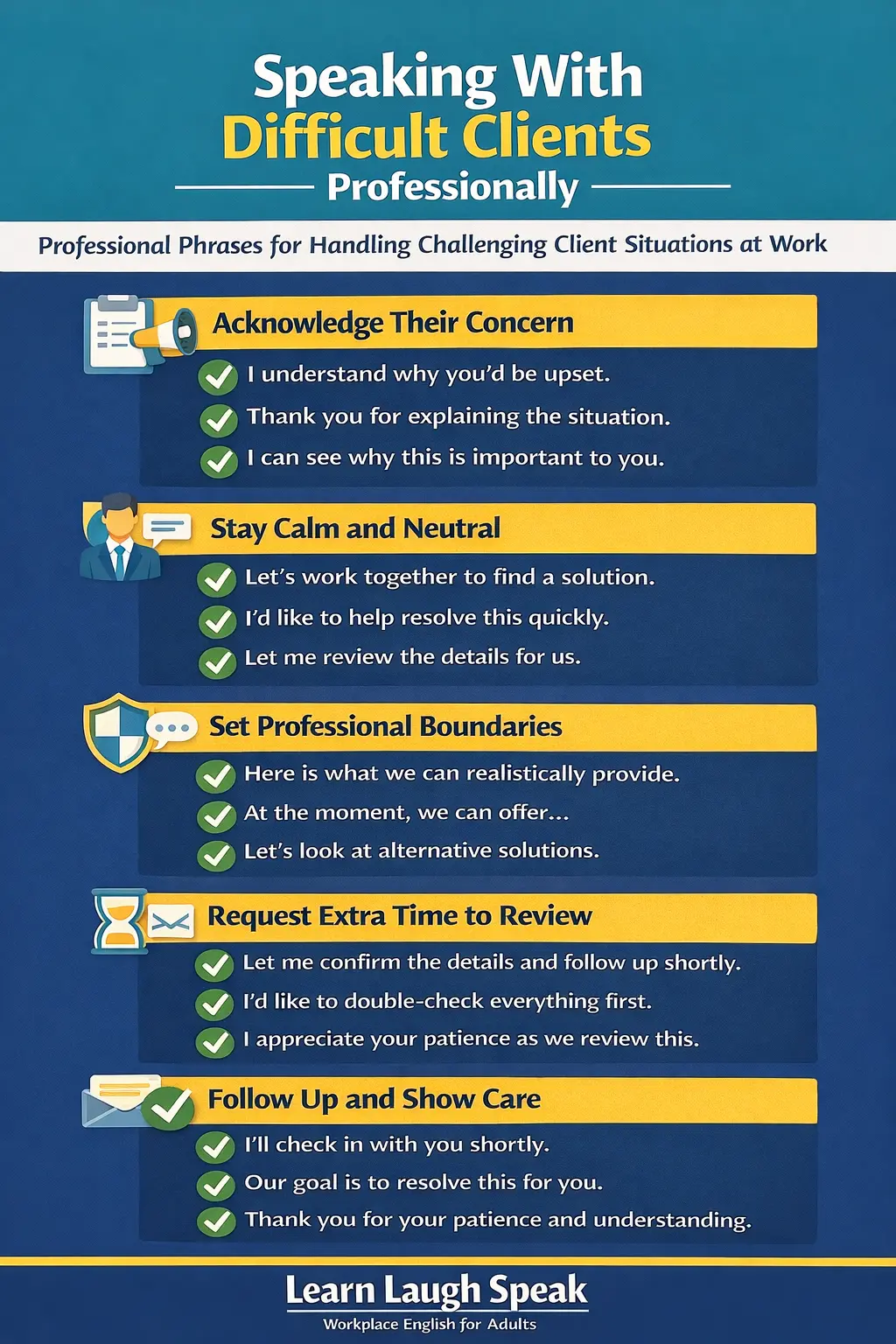
Professional Acknowledgment Phrases
“I understand why this situation would be frustrating.”
“Thank you for explaining this to me.”
“I can see why this is important to you.”
Acknowledgment lowers tension and makes clients more willing to listen.
How to Use Professional Hotel English Easily
Speak With Difficult Clients Without Taking Things Personally
Some clients speak strongly when they feel pressure.
Professional communication means staying calm and neutral.
Safe, Professional Responses
“Let’s work together to find a solution.”
“I’d like to help resolve this as quickly as possible.”
“Let me review the details so I can assist you properly.”
This keeps control of the conversation without creating conflict.
How to Speak With Difficult Clients When You Need More Time
Clients often want immediate answers. Professionals know when to slow the conversation down respectfully.
Professional Holding Language
“Let me review this and follow up shortly.”
“I’d like to confirm the details before giving you an update.”
“I’m going to check with our team to ensure we provide the best solution.”
This protects accuracy and builds credibility.
Speak With Difficult Clients When Expectations Are Unrealistic
Sometimes clients request something that isn’t possible. The goal is to say no without damaging the relationship.
Professional Boundary Phrases
“I understand what you’re requesting, and I want to be transparent about what we can realistically provide.”
“At the moment, this option isn’t available, but here is what we can offer.”
“Let’s look at alternative solutions that may still achieve your goal.”
This keeps conversations constructive instead of confrontational.
How to Speak With Difficult Clients During Complaints
Complaints are opportunities to show professionalism.
A Simple Complaint Structure
Acknowledge → Apologize → Explain → Solve
Example
“I’m sorry this experience didn’t meet expectations. I understand your concern, and we’re reviewing the situation now. Here’s what we can do to resolve it…”
This structure helps you speak with difficult clients while showing accountability.
How to Offer Help to Hotel Guests Professionally in English
Speak With Difficult Clients in Professional Emails
Written communication must sound calm, clear, and solution-focused.
Professional Email Template
Subject: Following up on your concern
Hi [Name],
Thank you for bringing this to our attention. I understand your concerns regarding [issue].
We are currently reviewing the situation and will update you as soon as possible. Our goal is to resolve this in a way that supports your needs.
Please let me know if you’d like to discuss this further.
Kind regards,
[Your name]
This shows professionalism without sounding defensive.
Tips on How To Deal with An Angry Customer
Speak With Difficult Clients Across Cultures
Different cultures express frustration differently. Professional language helps avoid misunderstandings.
Global-Friendly Phrases
“From our perspective…”
“Let’s review the situation together.”
“We appreciate your patience while we work on this.”
This type of language travels well across international teams and clients.
Swap This for That: Professional Client Communication
| Avoid This | Use This Instead |
|---|---|
| “That’s not our fault.” | “Let’s review what happened.” |
| “You misunderstood.” | “Let me clarify the details.” |
| “You’re wrong.” | “There may have been some confusion.” |
| “Calm down.” | “I understand this is frustrating.” |
These swaps help you speak with difficult clients without escalating tension.
When You Don’t Know the Solution Yet
It’s normal not to have immediate answers. Professionals focus on transparency and follow-up.
Professional Confidence Phrases
“I want to make sure I give you accurate information.”
“I’m reviewing this with our team and will update you shortly.”
“Thank you for your patience while we work through this.”
These responses maintain trust even in uncertain situations.
Real Workplace Scenario
A client says:
“This service hasn’t met our expectations.”
Weak response:
That shouldn’t have happened.
Professional response:
I appreciate you sharing that feedback. Let’s review what happened and identify how we can improve the situation.
Same issue. Stronger professionalism.
Final Takeaway
To speak with difficult clients professionally, you don’t need perfect English.
You need:
Calm tone
Respectful acknowledgment
Clear solutions
Confidence under pressure
When clients feel heard, conversations become easier — even during difficult situations.
Learn Laugh Speak — 33,000+ CEFR-aligned lessons for adults using English at work
