
 English
 Arabic
 Chinese (Simplified)
 Dutch
Dutch French
 German
 Italian
 Portuguese
 Russian
 Spanish
Whether a colleague is managing a tough project, going through a challenge, or celebrating a win, knowing what to say — and how to say it — matters. Using the right phrases to show support professionally builds trust, strengthens teams, and shows that you care without crossing personal boundaries.
In this guide, you’ll learn how to express encouragement, empathy, and appreciation in the workplace, all while keeping your tone respectful and professional.
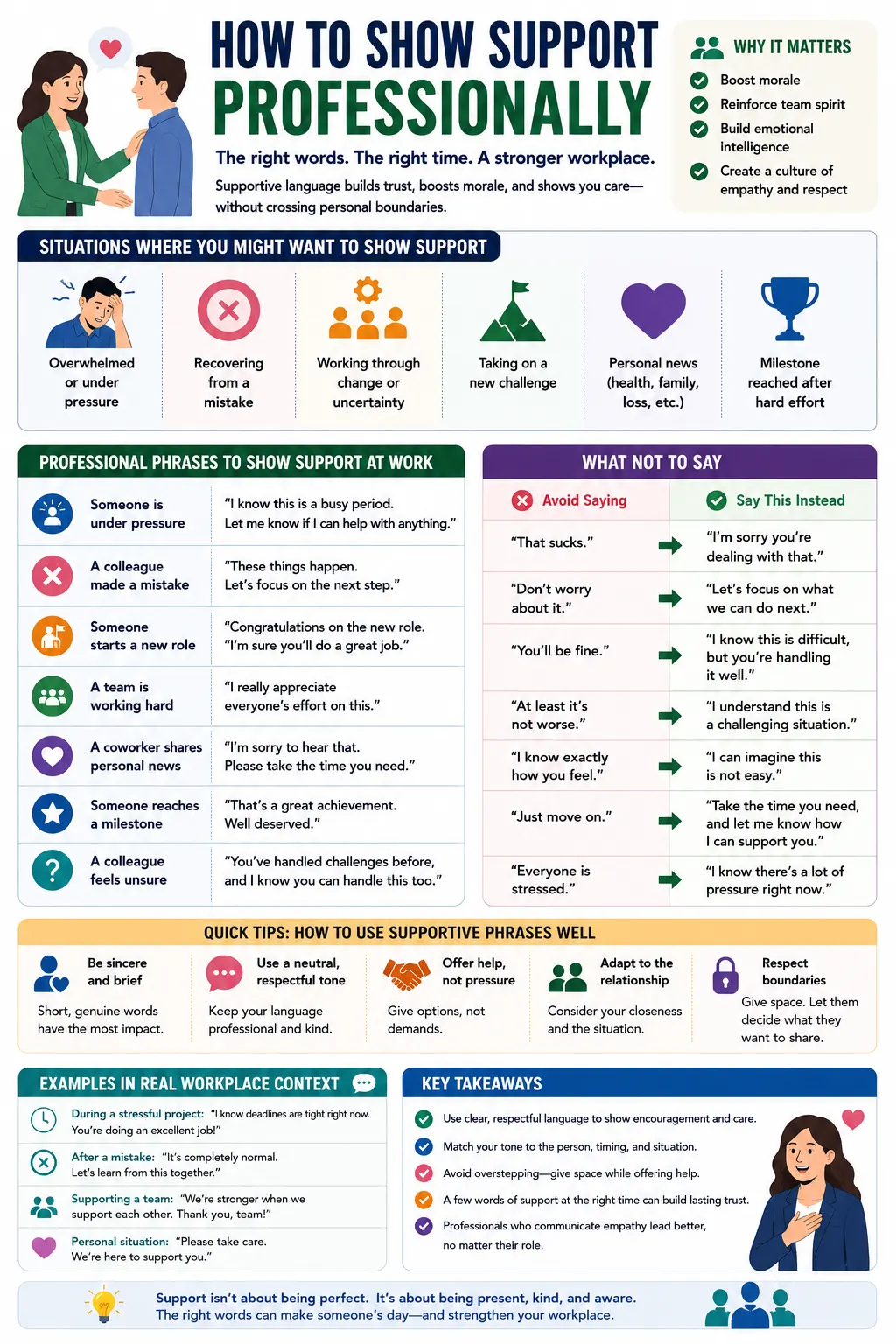
Quick Answer: How to Show Support Professionally
To show support professionally, use short, respectful phrases that offer encouragement, help, or empathy without being too personal or emotional. The best phrases are calm, sincere, and appropriate for the relationship.
For example, instead of saying something too casual like “That sucks,” you can say, “I’m sorry you’re dealing with that. Let me know if there’s anything I can do to support you.”
Professional support is about showing care while respecting boundaries. You do not need to say too much. A simple phrase, said at the right time, can help someone feel respected, valued, and less alone at work.
10 Examples of Great Customer Service for Your Business

What Not to Say When Showing Support Professionally
Sometimes people try to be supportive, but the words come out too casual, dismissive, or personal. In professional English, it is better to keep support respectful, calm, and appropriate for the situation.
| Avoid Saying | Say This Instead |
|---|---|
| “That sucks.” | “I’m sorry you’re dealing with that.” |
| “Don’t worry about it.” | “Let’s focus on what we can do next.” |
| “You’ll be fine.” | “I know this is difficult, but you’re handling it well.” |
| “At least it’s not worse.” | “I understand this is a challenging situation.” |
| “I know exactly how you feel.” | “I can imagine this is not easy.” |
| “Just move on.” | “Take the time you need, and let me know how I can support you.” |
| “Everyone is stressed.” | “I know there’s a lot of pressure right now.” |
The goal is to avoid minimizing the person’s situation. Supportive language should make people feel heard, not dismissed.
Why Show Support Professionally?
In fast-paced or high-pressure environments, a little encouragement goes a long way. When you use the right phrases to show support professionally, you help:
Boost morale
Reinforce team spirit
Build emotional intelligence
Create a workplace culture of empathy and respect
And often, just a few words — said the right way — are enough to make someone feel seen and valued.
29 Helpful Customer Service Phrases To Use
Situations Where You Might Want to Show Support
Here are typical moments where supportive language makes a difference:
A colleague is overwhelmed or under pressure
Someone is recovering from a mistake
A team is working through change or uncertainty
An employee or peer takes on a new challenge
A coworker shares personal news (health, family, loss, etc.)
A milestone is reached after hard effort
Let’s explore what to say in each of these workplace situations.
Professional Phrases to Show Support at Work
| Situation | Professional phrase |
|---|---|
| Someone is under pressure | “I know this is a busy period. Let me know if I can help with anything.” |
| A colleague made a mistake | “These things happen. Let’s focus on the next step.” |
| Someone starts a new role | “Congratulations on the new role. I’m sure you’ll do a great job.” |
| A team is working hard | “I really appreciate everyone’s effort on this.” |
| A coworker shares personal news | “I’m sorry to hear that. Please take the time you need.” |
| Someone reaches a milestone | “That’s a great achievement. Well deserved.” |
| A colleague feels unsure | “You’ve handled challenges before, and I know you can handle this too.” |
Cross-Cultural Communication in English at Work
Phrases to Show Support Professionally During Stressful Times
“Let me know if there’s anything I can do to help.”
“I know this week’s been intense — you’re doing great.”
“If you need backup or a second set of eyes, I’m here.”
“Don’t hesitate to reach out if you need support.”
✅ These phrases offer help without pressure — they leave space for the person to respond.
Phrases to Support Someone After a Mistake or Setback
“We all make mistakes — what matters is how we move forward.”
“Don’t be too hard on yourself. You’ve handled this with professionalism.”
“I’ve got your back on this — let me know what you need.”
“Let’s focus on what we can control from here.”
✅ These phrases to show support professionally shift the focus from blame to recovery.
Phrases for Colleagues Taking on New Challenges
“You’ve got this — and I’m here if you need anything.”
“This is a big step, but I know you’re ready for it.”
“It’s great to see you take this on. I’m cheering for you.”
“You bring a lot to the table — don’t forget that.”
✅ Ideal during promotions, new roles, or leadership transitions.
Phrases for Team Encouragement or Motivation
“I really appreciate the effort everyone’s putting in.”
“This team works best under pressure — and we’ve got what it takes.”
“Thanks for staying focused — I know it’s not easy right now.”
“Let’s keep supporting one another through this.”
✅ Use these in emails, meetings, or quick check-ins when the team needs a lift.
Phrases to Support Someone Personally (With Boundaries)
“I heard what you’re going through — if there’s anything you need, I’m here.”
“Take the time you need — your health and well-being matter.”
“If you ever need to talk or step away, it’s completely okay.”
“Sending positive thoughts — and here if you need anything work-related handled.”
✅ These show empathy while maintaining professional space. Respect privacy, especially in sensitive moments.
How to Easily Show Empathy and Understanding in English

How to Use Supportive Phrases Professionally (and Naturally)
| Do | Don’t |
|---|---|
| Be sincere and brief | Over-explain or ask for details |
| Use neutral, respectful tone | Be too casual (e.g. “That sucks!” in formal settings) |
| Offer help or flexibility | Take over or speak for someone without asking |
| Adapt to the relationship | Use emotional phrases with people you barely know |
Tip: Always match the tone to the relationship and situation. Some support is better given in private, not in a group chat or public setting.
Improve Professional English with Learn Laugh Speak
Learn Laugh Speak helps adults use English confidently in real workplace situations.
That includes:
- showing support professionally
- expressing empathy
- joining meetings
- writing professional emails
- handling difficult conversations
- communicating clearly with international teams
Every student starts with a level assessment from A1 to C2. From there, learners follow a personalized path based on their level, goals, progress, and mistakes.
If you want to sound more natural and professional at work, Learn Laugh Speak helps you learn the phrases you need for real communication.
Final Thoughts: Show Support Professionally
Support isn’t just about grand gestures — it’s about presence, words, and awareness. When you learn the right phrases to show support professionally, you become the kind of colleague others trust and respect — someone who listens, understands, and helps others feel stronger, even on difficult days.
And the best part? You don’t need perfect English — just the right tone and real intent.
Key Takeaways: Show Support Professionally
✅ Use clear, respectful language to show encouragement and care
✅ Match your tone to the person, timing, and situation
✅ Avoid overstepping — give space while offering help
✅ A few words of support at the right time can build lasting trust
✅ Professionals who communicate empathy lead better, no matter their role
2 thoughts on “Phrases to Show Support Professionally in English at Work”
Pingback: How AI in English Education is Transforming Learning Experiences
Pingback: How to Respond Faster in English at Work Without Freezing - Learn Laugh Speak