
 English
 Arabic
 Chinese (Simplified)
 Dutch
Dutch French
 German
 Italian
 Portuguese
 Russian
 Spanish
Learning how to say you are concerned professionally helps you speak clearly at work without sounding negative, emotional, or too direct.
In professional English, concern needs careful wording.
You may need to raise a concern about a deadline.
You may need to question a decision.
You may need to flag a risk.
You may need to ask for clarification before a problem becomes bigger.
The goal is not to sound worried or critical.
The goal is to sound calm, respectful, and solution-focused.
When To Use the Salutation “To Whom It May Concern”
Why Is It Important to Express Concern Professionally?
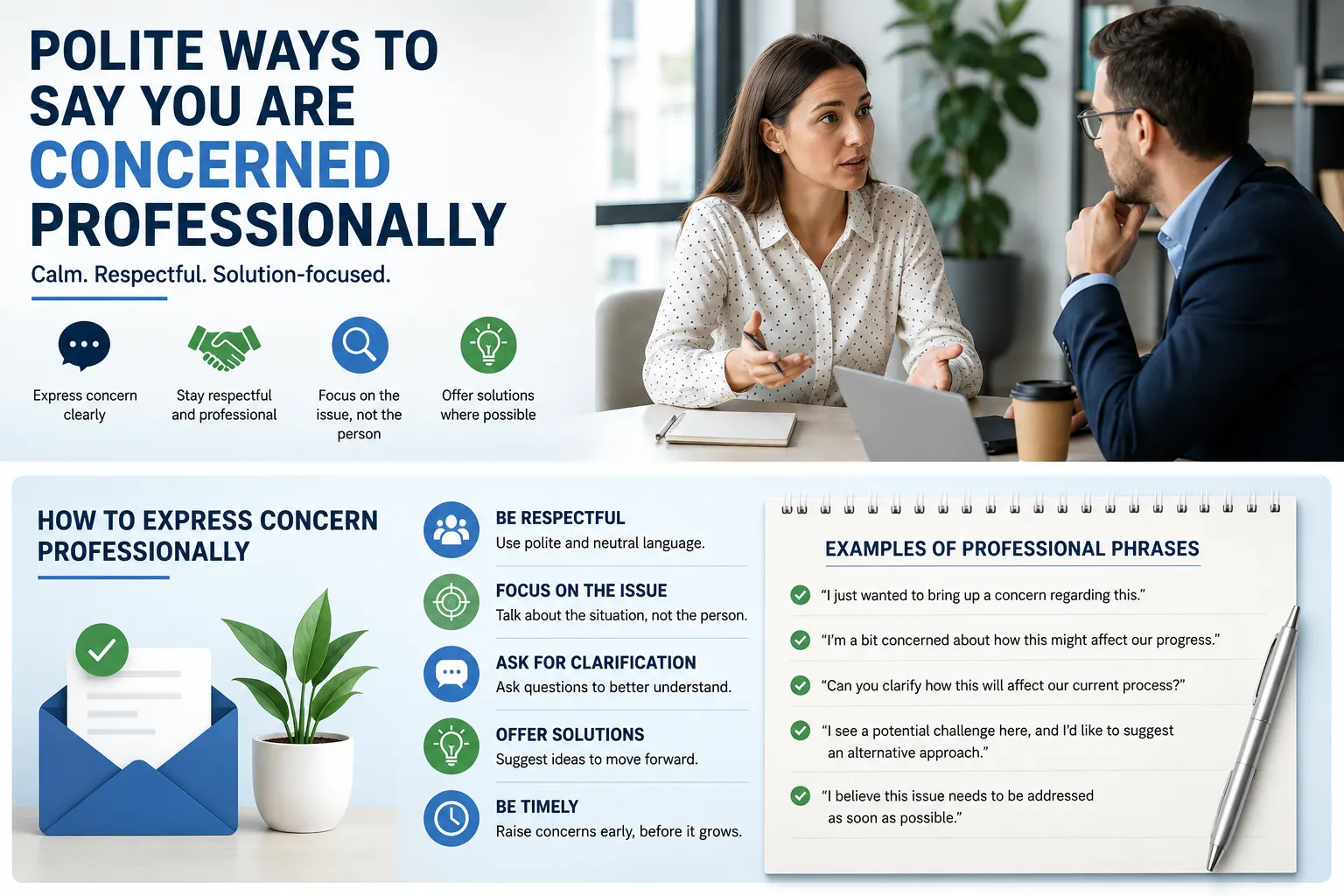
When you need to express concern at work:
- keep your tone neutral
- focus on the issue, not the person
- avoid dramatic language
- ask questions before assuming
- offer a solution when possible
- keep the message clear and short
Professional concern should sound constructive, not alarming.

1. Say You Are Concerned Professionally in a General Way
Use these phrases when you want to raise a concern without sounding too forceful.
Professional phrases
- “I just wanted to bring up a concern regarding this issue.”
- “I have some concerns about how this situation is unfolding.”
- “I’d like to discuss something that has been on my mind.”
- “I’m not sure this is the best approach, and I’d like to talk about it further.”
- “I think this may need a closer look.”
✅ Example:
“I just wanted to bring up a concern regarding the project timeline. Are we still on track to meet the deadline?”
Pro tip – never forget you please and thank you!
2. Say You Are Concerned Professionally About a Specific Issue
Use these phrases when there is a clear problem or risk that needs attention.
Professional phrases
- “I’m a bit concerned about how this might affect our progress.”
- “I’d like to understand more about this decision and its potential impact.”
- “I’m not entirely comfortable with this approach.”
- “I believe this issue requires further discussion.”
- “This may create some challenges for the team.”
✅ Example:
“I’m a bit concerned about how this change might affect our workflow. Can we discuss the possible challenges before moving forward?”
3. Say You Are Concerned Professionally While Offering a Solution
Concern sounds better when it comes with a helpful suggestion.
Professional phrases
- “I see a potential challenge here, and I’d like to suggest an alternative approach.”
- “I’m concerned about this, but I think we can find a solution together.”
- “This situation raises some concerns for me, and I’d like to propose a way forward.”
- “I understand the reasoning, but I wonder if we should consider another option.”
- “Maybe we could test this on a smaller scale first.”
✅ Example:
“I see a potential challenge with this strategy. Perhaps we could test a small-scale version before a full rollout?”
4. Say You Are Concerned Professionally by Asking for Clarification
Sometimes it is better to express concern as a question.
This keeps the tone calm and avoids sounding critical too early.
Professional phrases
- “Can you clarify how this will affect our current process?”
- “I’d appreciate some insight into how this decision was made.”
- “I just want to make sure we’re aligned on the best course of action.”
- “Is there a plan in place to manage the potential risks?”
- “Could you help me understand the thinking behind this?”
✅ Example:
“Can you clarify how this will affect our budget? I want to make sure we stay within our financial goals.”
5. Say You Are Concerned Professionally When the Issue Is Urgent
If something needs quick attention, be direct but calm.
Professional phrases
- “I believe this issue needs to be addressed as soon as possible.”
- “I’m concerned about the impact this could have if it is not handled promptly.”
- “I want to flag this as something that may need urgent attention.”
- “This is something we should prioritize before it becomes a bigger issue.”
- “I think we should review this before moving forward.”
✅ Example:
“I believe this issue needs to be addressed as soon as possible. What steps can we take right now?”
6. Say You Are Concerned Professionally in an Email
Emails should be polite, clear, and not too emotional.
Professional email phrases
- “I wanted to raise a concern regarding…”
- “I would like to flag a potential issue with…”
- “I have some concerns about the current timeline.”
- “Could we review this before moving forward?”
- “I’d appreciate your thoughts on this.”
✅ Example email:
Hi Sarah,
I wanted to raise a concern regarding the current project timeline.
Based on the latest updates, I’m not sure we have enough time to complete the final review properly.
Could we review the deadline and confirm the next steps?
Best regards,
James
7. Say You Are Concerned Professionally to Your Manager
When speaking to a manager, focus on the business impact.
Professional phrases
- “I wanted to flag a possible issue before it becomes a bigger problem.”
- “I have a concern about the timeline and wanted to get your advice.”
- “I think we may need to review the current approach.”
- “Could we discuss the potential impact before moving forward?”
- “I want to make sure we are managing this risk properly.”
✅ Example:
“I wanted to flag a possible issue with the timeline before it becomes a bigger problem. Could we review the priorities together?”
8. Say You Are Concerned Professionally to a Client
Client communication should stay respectful and solution-focused.
Professional phrases
- “I understand your request, but I do have some concerns about the timeline.”
- “I want to make sure we can deliver this properly.”
- “There may be some challenges with the current approach.”
- “To avoid any issues, I think it would be best to review this first.”
- “We want to make sure the final result meets expectations.”
✅ Example:
“I understand your request, but I do have some concerns about the timeline. To make sure we deliver this properly, could we review the deadline together?”
Phrases to Avoid When Expressing Concern
Some phrases can sound too strong or emotional in professional English.
| Avoid Saying | Say This Instead |
|---|---|
| This is a big problem. | I have some concerns about this. |
| You are making a mistake. | I think we may need to review this approach. |
| This will fail. | I’m concerned about the possible outcome. |
| I don’t like this idea. | I’m not entirely comfortable with this approach. |
| This is wrong. | I think there may be another way to look at this. |
Small changes make your concern sound more professional.
Benefits of Saying You Are Concerned Professionally
When you learn how to say you are concerned professionally, you can:
- raise issues without sounding rude
- communicate risks clearly
- protect workplace relationships
- support better teamwork
- show confidence in English
- offer solutions instead of only pointing out problems
Professional concern is not complaining.
It is responsible communication.
Improve Workplace English with Learn Laugh Speak
At Learn Laugh Speak, adults learn practical English for real workplace situations.
That includes:
- meetings
- emails
- client communication
- professional phrases
- polite disagreement
- workplace problem-solving
Every student starts with a level assessment from A1 to C2.
From there, learners follow a personalized path based on their level, goals, mistakes, and progress.
Learn Laugh Speak helps adults use English clearly, calmly, and professionally at work.

Final Thought
To say you are concerned professionally, you do not need complicated English.
You need calm, clear, and respectful phrases.
Use phrases like:
- “I wanted to raise a concern regarding this.”
- “I’m a bit concerned about the timeline.”
- “Can you clarify how this will affect the process?”
- “I see a potential challenge here.”
- “I think this may need urgent attention.”
These phrases help you express concern without sounding rude, negative, or emotional.
That is why professional English is so powerful.
It helps you speak up while keeping the conversation respectful.
5 thoughts on “Polite Ways to Say You Are Concerned Professionally in English”
Pingback: How to Say You Are Excited Professionally in English
Pingback: Tactful Ways to Express Stress or Overwhelm in the Workplace
Pingback: Your Guide to Positive English Language for Negative Situations
Pingback: How to Think in English at Work Instead of Translating
Pingback: Why Traditional Learning No Longer Works the Way It Used To