
 English
 Arabic
 Chinese (Simplified)
 Dutch
Dutch French
 German
 Italian
 Portuguese
 Russian
 Spanish
Saying “no” at work can feel uncomfortable — especially in English, and especially if you’re not sure how to sound polite. But knowing how to respond with a no professionally is an essential communication skill. Whether you’re declining a request, turning down extra work, or setting boundaries, it’s possible to say no clearly without being rude or difficult.
This guide offers real examples, useful phrases, and key tips for turning someone down respectfully in different professional situations.
How To Nicely Say “No” (With 50 Examples)
Your Answer Now: How Do You Respond with a No Professionally?
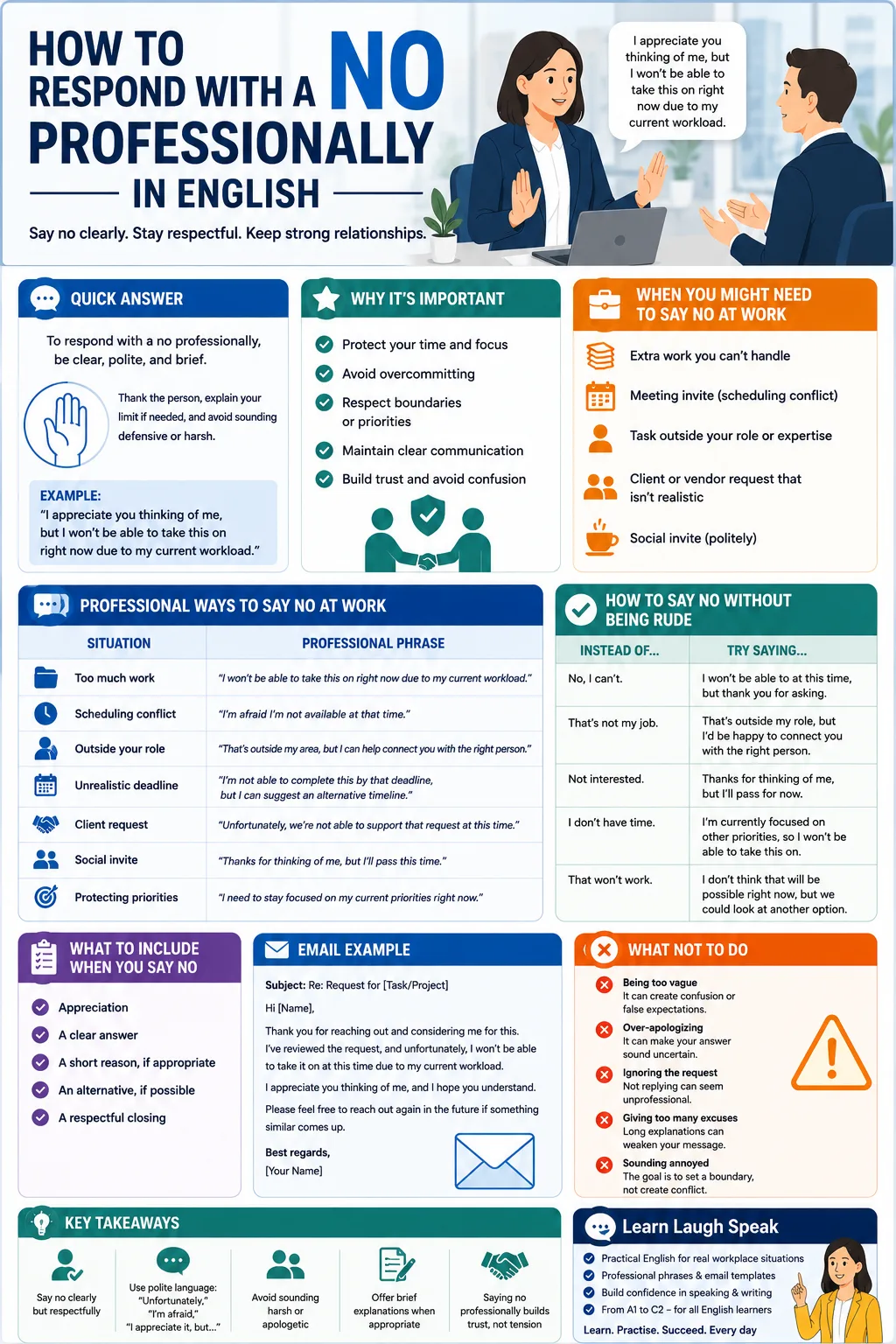
To respond with a no professionally, be clear, polite, and brief. Thank the person, explain your limit if needed, and avoid sounding defensive or harsh.
For example:
“I appreciate you thinking of me, but I won’t be able to take this on right now due to my current workload.”
This works because it says no clearly while still showing respect.
You can also say:
“Unfortunately, I’m not able to commit to this at the moment.”
The key is to be respectful, not overly apologetic.
Why It’s Important to Respond with a No Professionally
Being agreeable all the time isn’t always realistic — or healthy. Sometimes, saying no is necessary to:
Protect your time and focus
Avoid overcommitting
Respect boundaries or priorities
Maintain clear communication
The key is how you do it. A respectful “no” maintains relationships, builds trust, and avoids confusion.
The Correct Way to Say Sorry I Can’t Make It
When You Might Need to Say No at Work
Here are common situations where you might need to respond with a no professionally:
Being asked to take on extra work you can’t handle
Declining a meeting invite due to a scheduling conflict
Turning down a task that’s outside your role or expertise
Saying no to a client or vendor request that isn’t realistic
Refusing a social invite (politely)
16 Business English Idioms for Customer Service
Polite and Professional Ways to Say No in English
You don’t need to use the word “no” directly every time. Here are clear and respectful alternatives:
✅ “I’m afraid I won’t be able to…”
“I’m afraid I won’t be able to take this on right now due to current deadlines.”
✅ “I appreciate you thinking of me, but…”
“I appreciate you thinking of me for this, but I have to pass due to prior commitments.”
✅ “Unfortunately, that’s not something I can commit to…”
“Unfortunately, that’s not something I can commit to this week.”
✅ “That doesn’t align with our current priorities.”
“Thanks for your suggestion, but that doesn’t align with our current goals at the moment.”
Professional Ways to Say No at Work
| Situation | Professional Phrase |
|---|---|
| Too much work | “I won’t be able to take this on right now due to my current workload.” |
| Scheduling conflict | “I’m afraid I’m not available at that time.” |
| Outside your role | “That’s outside my area, but I can help connect you with the right person.” |
| Unrealistic deadline | “I’m not able to complete this by that deadline, but I can suggest an alternative timeline.” |
| Client request | “Unfortunately, we’re not able to support that request at this time.” |
| Social invite | “Thanks for thinking of me, but I’ll pass this time.” |
| Need to protect priorities | “I need to stay focused on my current priorities right now.” |
Email Example: How to Respond with a No Professionally
Subject: Re: Request for [Task/Project]
Hi [Name],
Thank you for reaching out and considering me for this.
I’ve reviewed the request, and unfortunately, I won’t be able to take it on at this time due to my current workload.
I appreciate you thinking of me, and I hope you understand.
Please feel free to reach out again in the future if something similar comes up.
Best regards,
[Your Name]
11 Tips for Practicing Good Office Etiquette (With Examples)
How to Say No Without Sounding Negative
Here are a few ways to respond with a no professionally while keeping the tone positive:
Keep your table underneath, but add 2–3 more examples:
| Instead of… | Try Saying… |
|---|---|
| “No, I can’t.” | “I won’t be able to at this time, but thank you for asking.” |
| “That’s not my job.” | “That’s outside my role, but I’d be happy to connect you with the right person.” |
| “Not interested.” | “Thanks for thinking of me, but I’ll pass for now.” |
| “I don’t have time.” | “I’m currently focused on other priorities, so I won’t be able to take this on.” |
| “That won’t work.” | “I don’t think that will be possible right now, but we could look at another option.” |
Tone is everything — a calm, respectful tone softens the message.
Respond with a No Professionally: What Not To Do
❌ Being vague:
“I’m not sure… maybe… I’ll think about it.”
This can cause delays or confusion.
❌ Over-apologizing:
“I’m so sorry, I feel terrible saying no!”
Be respectful but confident.
❌ Ignoring the request:
Not replying at all is worse than a polite refusal.
Learn Professional English Phrases with Learn Laugh Speak
Learn Laugh Speak helps adults communicate clearly in real workplace situations.
That includes:
- responding with a no professionally
- declining requests politely
- setting boundaries at work
- writing professional emails
- speaking with confidence
- using natural workplace English
Every student starts with a level assessment from A1 to C2. From there, learners follow a structured path based on their level, goals, mistakes, and progress.
If you want to sound more natural and professional in English, Learn Laugh Speak helps you practise real phrases for real situations.

Key Takeaways
✅ Say no clearly but respectfully
✅ Use polite language: “Unfortunately,” “I’m afraid,” “I appreciate it, but…”
✅ Avoid sounding harsh or apologetic
✅ Offer brief explanations when appropriate
✅ Saying no professionally builds trust, not tension
One thought on “How to Respond with a No Professionally in English”
Pingback: How to Confirm Understanding in English Professionally